

AI promised creative teams more free time. Most ended up with more work. This guide explains what AI-native creative operations actually are, how they differ from the AI-enabled setups most teams are stuck in and how to build the model across briefing, production, quality control and optimization.
Most enterprise creative teams have added AI to their workflows. In many cases, though, the underlying workflows have barely changed.
In AI-enabled teams, artificial intelligence helps generate concepts, draft copy and create versions of an asset, while briefing, approvals and performance analysis still happen across disconnected systems and departments.
Teams running AI-native creative operations work differently. They connect every stage of the creative lifecycle, so people, AI, brand context and performance data move together through briefing, production, quality assurance and optimization as a single process. AI handles repetitive production and high-volume generation. Human professionals stay firmly in control of creative direction, strategic judgment, taste and final approval.
Building that model takes three things working together: AI-fluent talent, a connected platform that preserves brand knowledge and workflows designed around human and AI collaboration.
Here's what the model looks like, and how Superside, the world's leading AI-first creative partner, helps enterprise teams put it in place!
Throughout, Celeste Booth, Head of Creative Operations at Superside, shares what the shift looks like from inside a creative operation.
The creative process didn't get easier when AI arrived
Marketing and creative leaders were promised AI would ease the pressure. Instead, many teams feel more stretched than ever. Content demand has accelerated, expectations have risen and most teams now juggle more platforms and tools than before.
Superside's Breakpoint research put numbers behind that reality. 86% of teams now operate at or over capacity, and seven in ten leaders report burnout.
The problem is that many organizations added AI tools to their stack without changing how work flows from brief to delivery. AI sped up individual tasks while the stubborn bottlenecks stayed exactly where they were. A designer might generate a concept in seconds, then spend days waiting on feedback, approvals, versioning and localization. The slowest parts of the process are still painfully slow.
Celeste Booth, who designs creative operating models for a living, has a quick way to spot a team in exactly that position.
The first tell is that the work is being created faster, but it's still waiting in all the same places.

This is what AI-native creative operations change. Rather than layering AI onto legacy workflows, teams rebuild the operating model itself.
What are AI-native creative operations?

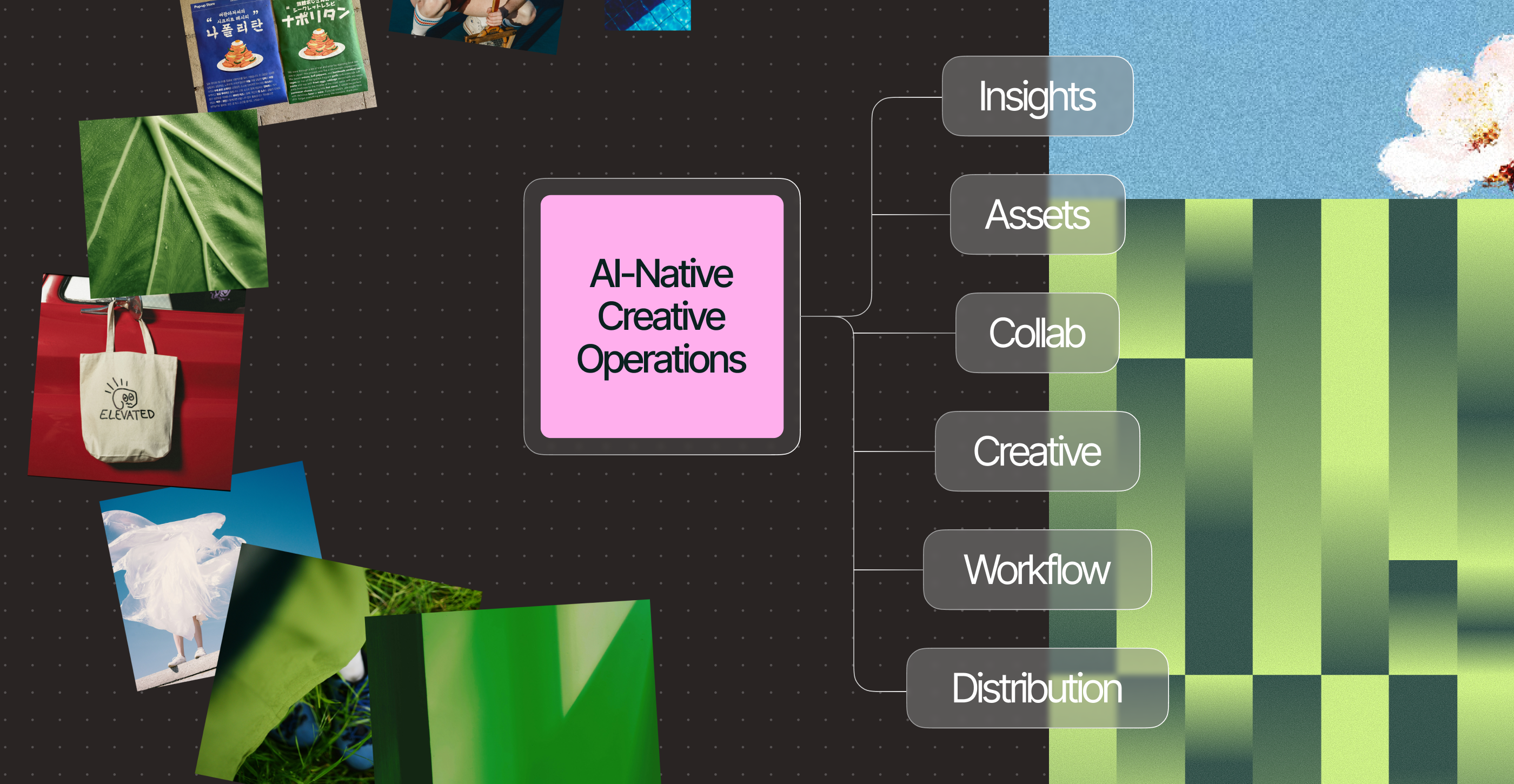
AI-native creative operations are an operating model in which AI holds the creative workflow together, from briefing and ideation through production, quality assurance, feedback and optimization.
Brand knowledge, workflows and performance data all move through that layer, and every project is human-led.
To understand the definition, it helps to unpack both halves of the term.
What creative operations means
Creative operations are the connective tissue of a creative team. They cover how work is requested, briefed, prioritized, produced, reviewed, delivered and measured. Done well, creative operations turn creative work into a repeatable, scalable business capability: clear briefs, defined ownership, standardized workflows and the visibility leaders need to manage capacity and protect quality.
At the enterprise level, a strong creative operations framework reduces friction, dissolves bottlenecks and helps teams coordinate across regions, platforms and approval groups. The discipline overlaps with project management, marketing operations and DesignOps, but focuses specifically on how creative work moves from request to delivery.
What AI-native means
The term is borrowed from software. IBM defines AI-native as something designed from the ground up with AI as a core component, not bolted on later as a mere feature. Applied to creative and marketing operations, it describes a model where:
- Brand context informs the brief before anyone starts producing.
- The brief guides AI-assisted ideation and production.
- AI and human reviewers work together to check quality, brand alignment and compliance.
- Performance insights feed back into future briefs, so the system gets smarter over time.
A working definition
Put the two ideas together and you get a creative operating model designed around human and AI collaboration from the start. AI is woven into briefing, ideation, production, quality control and optimization, while experienced people own direction, taste, strategic decisions and final judgment.
The word that matters is operating model, not tool.
In an AI-native creative operating model, AI supports every stage and continuously learns from brand assets, creative decisions and performance data to give each new project richer context. AI is the operating layer, not a shortcut a few team members use when they remember to.
An AI-native creative partner is one expression of this model. Enterprise teams can also build the capability internally. The destination is the same either way: a creative operation where AI and people work as one continuously improving system.
That's the destination, though, not an instruction to start rebuilding tomorrow. Asked where bolting AI onto an existing workflow is genuinely the right call, Booth makes the distinction carefully.
A bolt-on approach can be a perfectly sensible starting point. It just shouldn't be confused with having built an AI-native operation. There are plenty of situations where you don't need to redesign the whole workflow straight away. If a team is still figuring out where AI is actually useful, or the workflow itself is still changing, start small.
AI-native vs AI-enabled creative operations
An AI-enabled team has adopted AI without changing how work flows through the system. Designers generate visuals with DALL-E, copywriters refine drafts with ChatGPT and team leads add automation where they can.
But approvals follow the same cumbersome path, reviews happen over email and brand guidelines sit in folders nobody opens.
Here's how the two models compare across the dimensions that decide whether AI actually pays off.
| Dimension | AI-enabled creative operations | AI-native creative operations |
|---|---|---|
| Where AI sits | Bolted onto a traditional workflow | The operating layer the whole process runs on |
| Brand context | Lives in guidelines, folders and people's heads | Captured once and activated through connected systems |
| Briefing | Manual, often incomplete | Structured and enriched with brand context automatically |
| Human role | Individuals choose when to use AI | Senior creatives design, supervise and improve the workflows |
| Scale | Isolated tasks get faster | Volume grows without a matching rise in headcount |
| Learning | Nothing compounds between projects | Every project makes the next one smarter |
Booth reduces that whole comparison to a single diagnostic question a leader can ask about their own team.
The simplest question is: what actually changed about how the work moves? If AI made production faster but didn't reduce the waiting, searching or rework around it, then the operating model hasn't really changed.
Bolt-on AI adoption stalls for three structural reasons more tools can't fix.
- No shared brand memory. Generic tools start every project with little brand context, so teams re-explain tone, messaging and design standards over and over, which makes consistently on-brand work much harder.
- No shared learning. Knowledge stays trapped in individual prompts, chats and people's heads. The next campaign doesn't benefit from the last one, a problem worth understanding as creative memory loss.
- More surface area, not less friction. Every new tool adds another login, export and handoff. With more than 15,000 martech tools on the market, 47% of martech decision-makers say stack complexity and data integration challenges block them from getting value out of what they've bought.
Underneath all three, Booth sees a simpler reason more tools keep failing to help.
For me, the biggest issue is that teams often add tools because they feel like they should, not because there's a clear problem in the workflow that needs solving. A tool gets hot, everyone thinks they need it, and three months later you have low adoption, another contract to manage and a new bottleneck.
More tools without an operating layer to connect them create more creative friction, not less.
Why AI-native creative operations matter now

Three business problems make the shift urgent rather than theoretical.
1. Creative demand outpaces capacity
According to Adobe's June 2025 research, 71% of marketers expect content demand to grow more than fivefold between now and 2027. A single campaign now needs dozens of assets across formats, channels and audience segments, and personalization and localization multiply that again.
Hiring isn't always the answer. Demand fluctuates, recruitment takes months and inefficient workflows recreate the same creative bottlenecks that triggered the hiring in the first place.
Booth has watched teams reach the point where buying another tool stops feeling like the answer.
The shift usually happens when the team realizes they've added more tools, but the same problems keep showing up. Work is faster in places, but briefs are still weak, review still takes too long, adoption is inconsistent and the team is somehow still at capacity.
2. AI expectations can increase burnout
The productivity math looks appealing on a slide. McKinsey estimates generative AI could lift marketing-function productivity by the equivalent of 5% to 15% of total marketing spend. But when leaders assume those gains are automatic and teams lack the workflows or training to deliver them, the pressure lands on people. That's how you get widespread burnout even as AI adoption climbs.
3. Quality gets harder to protect at scale
Automation helps teams produce more, faster. It also scales mistakes. Every vague brief, inconsistent brand rule or weak creative decision gets replicated across more assets, which means longer review cycles, more rework and greater risk of off-brand work reaching market. Many enterprises find creative quality suffers when teams scale too quickly. Speed only creates value when the system also protects craft, accuracy, compliance and brand consistency.
On what finally pushes a team from shopping for tools to redesigning the process, Booth says it's rarely a strategy document.
Usually something has to become painful enough to force the conversation. Maybe a launch slips, revision rounds keep growing or a tool that looked promising is barely being used three months later. That's when teams stop asking, 'What should we add next?' and start asking, 'Why does the work still move like this?'
How AI-native creative operations work
The model spans the full creative lifecycle. Each stage uses AI where it adds practical value and keeps humans in control of the decisions that matter.
Step 1: Brief smarter
A request like "we need ads for the Q3 launch" often omits the audience, objective, specs and prior feedback, which forces teams to uncover missing context through revision rounds.
AI can turn rough requests into structured briefs that fill the gaps and apply brand context from the start. The strongest systems draw on past projects and decisions rather than treating every request as new. Better input reduces ambiguity and helps teams cut revision rounds.
Booth explains what a brief actually gains once the AI can see the brand context behind it.
When AI has access to the right brand context, the brief arrives with much more than the initial ask. It can pull in the relevant brand guidelines, previous work, audience and channel requirements, stakeholder preferences, technical specifications and known guardrails, and flag what's missing before production starts.
Step 2: Broaden the field of options
AI lets teams explore more visual territories, messaging angles and early concepts before committing production resources.
Human taste stays essential, because AI gravitates toward recognizable patterns. Without strong creative direction, output drifts toward familiar conventions. Used well, AI widens the field and senior creatives decide which ideas are genuinely useful. Teams should introduce the technology deliberately, with training, clear expectations and guardrails.
Step 3: Produce, version and localize at scale
AI can resize creative, swap in localized assets, generate variations and prepare files for new channels. Design systems, templates and component libraries provide the guardrails.
This is where automated creative production frees up human capacity for strategy, concepting and craft. Creative professionals should stay involved wherever cultural nuance, messaging sensitivity or business risk is in play. Localization in particular needs more than machine translation, since regional reviewers have to assess meaning and market fit.
Step 4: Set clear guardrails
Volume is worthless if the output is off-brand. An AI-native system needs defined standards for brand alignment, factual accuracy, copyright, data handling and approval, plus clear escalation points when output falls outside them.
Custom image models and structured, AI-ready brand guidelines improve consistency, while automated checks flag obvious deviations before work reaches senior reviewers. Superside's guides to AI creative quality control and giving AI your brand guidelines go deeper on these controls.
Step 5: Close the loop with performance data
When AI is layered onto legacy workflows, work ends when the asset ships. In an AI-native operation, delivery starts a new learning cycle.
Performance data from live campaigns feeds back into the system, so the next brief starts with evidence about what worked. Instead of gathering dust in post-campaign reports, insights become an input to every new project, and the operation gets measurably better at producing work that performs.
The three pillars of an AI-native creative operating model
Enterprises that adopt AI successfully develop people, platform and process together. When all three move at once, creative operations scale. If one lags, progress stalls.
- People. Teams need practical AI fluency: understanding the strengths, limits and risks of the tools, knowing when AI speeds work up, when human judgment carries more value and how to review output critically.
- Platform. A connected creative management platform gives people and AI access to the same briefs, brand context, assets, feedback and workflows. That shared source of truth cuts the manual work of moving information between tools, and because AI sees the same context as the team, it can support multiple stages rather than operating as a standalone tool.
- Process. Map existing processes before automating them. Find where work gets stuck, identify what's genuinely repeatable and define where human review is mandatory. Our Creative Operations 201 framework is a practical starting point.
Booth puts the weight on that third pillar, and on who owns it.
That's where Creative Ops becomes really important. You need to understand the tool, where it adds value, where it doesn't, what the limits are and what guardrails, enablement and governance need to sit around it. Otherwise the stack just keeps growing and the operation gets more complicated, not better. More tools aren't the goal. A better workflow is.
How Superside runs AI-native creative operations
Building an AI-native operation takes more than new tools and a training workshop. It takes connected brand intelligence, redesigned workflows, AI-fluent talent, clear governance and the technical capability to bring those together.
That's where a creative partner helps. As we become your creative team's AI-native creative team, we combine global creative talent, AI expertise, technology and repeatable workflows into one operation. Being AI-first means AI isn't just powering individual tools. It's embedded across the entire creative model, from how teams are trained to how brand knowledge compounds over time.
Work runs through Superspace, our AI-powered creative management platform, where you brief, review and manage projects. Inside it, Brand Brain provides the brand intelligence layer, so both teams and AI agents work from consistent brand context as projects move from intake through production and review.
Behind the platform sits a global creative bench rather than a single hire. More than 800 Supersiders across 67 countries give you specialist depth and surge capacity on one engagement, with almost 100% of the creative team AI-certified and over 40 AI-powered workflows in active use. We also build custom AI image models and workflows around each brand, and our forward-deployed engineers can wire that operating layer into the tools you already use. A dedicated setup goes live in about three weeks, then compounds every quarter as Brand Brain sharpens and the workflow library grows.
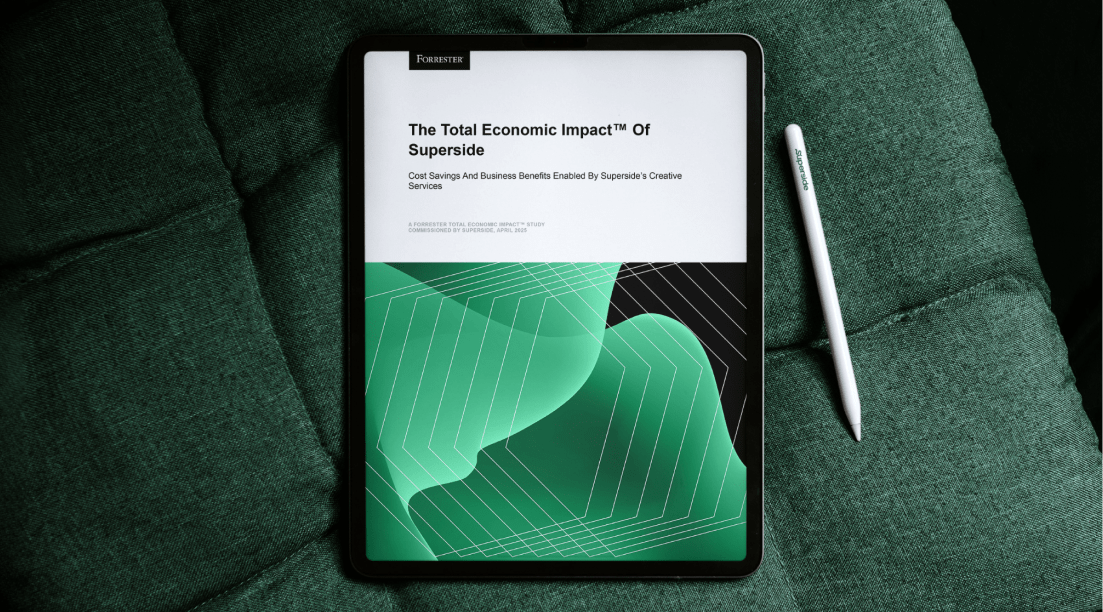
The model is measured, not asserted. A commissioned Forrester Total Economic Impact study (April 2025) found that a composite enterprise customer achieved:
- 94% ROI over three years
- $4.16 million in total business benefits
- Payback in under six months
- 60% fewer review rounds
In practice, that shows up in our customer stories.
AI-native creative operations are the new enterprise standard
AI success is no longer determined by the tools companies buy. It's determined by how they redesign the way work gets done.
Connecting AI to brand context, creative workflows, performance data and human oversight gives enterprise teams a way to produce more without lowering creative standards. Our own results show it at scale: across more than 12,000 AI-powered projects, we've delivered roughly 35% more efficiently than standard workflows and saved customers over 31,000 hours in 2025 alone.
Booth's closing caution is about what happens after the first pilot.
Starting small isn't the problem. The problem is staying there and expecting that to somehow turn into a better operating model.
You can build this operating model internally or plug into one already running. Superside offers the second path, through world-class creative talent, AI excellence and scalable execution in one AI-first partnership.
Book a call to explore what AI-native creative operations could look like for your team.
FAQs

Creative teams are at a breaking point
The pressure is real, the opportunity is too.
Get insights from 300+ leaders on
beating burnout, using AI wisely
and navigating 2026’s inflection point.



What 200+ creative leaders had to say
There’s a reason we called it the Overcommitted Report.
But, is there light at the end of the carpal tunnel?


Meet Customers Who’ve Experienced Exceptional ROI
Discover how Shopify got 4,375 assets in 12-24 hours or how Amazon saved 345 hours in three months.


See how top brands do it
Looking for extra inspiration?
Check out more of Superside's brand projects.

The data speaks for itself
According to a Forrester Total Economic Impact™ study, Superside delivers a 94% ROI and pays for itself in six months.


Your creative team's creative team
Choose the world's leading AI-powered creative service
and get high-performing ads, videos, experiences and
more at scale, on your schedule and to your standards.