

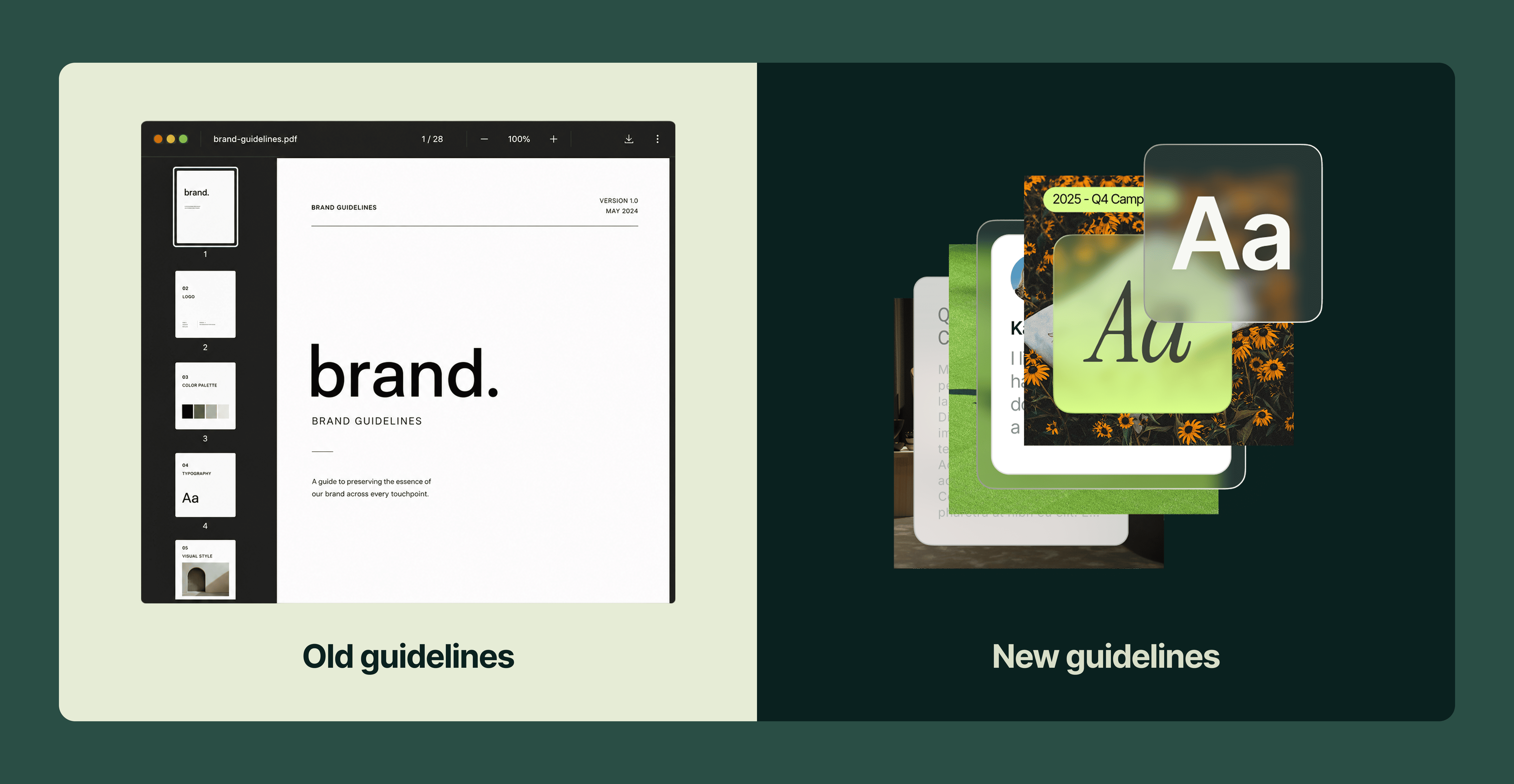
For decades, brand guidelines were a PDF written for humans. But the AI tools now producing your content never open it, so guidelines are becoming living, machine-readable systems that humans and AI can both act on. Inside, see the five shifts reshaping them, how Superside rewrote its own brand for the AI era and how Brand Brain turns a guideline into operational memory.
Think about who, or what, now develops your brand's creative assets. Your in-house creatives, a trusted agency or perhaps a few freelancers might still be involved. But if you're like most enterprise teams, a growing share of your content now comes from an AI model.
The problem? People are no longer the only ones who need to understand and apply these style guides, and machines interpret things very differently from humans. A line of text that reads "our blue is warm and optimistic" means something to a designer, but very little to an AI model that thinks in hex values.
As more creative work runs through AI, the gap between what PDF brand books describe and what machines can reliably use becomes the point where brand inconsistencies typically creep in.
Finding it hard to deliver brand-consistent work at scale? Then this article, which looks at what brand guidelines used to be, why static PDFs no longer work in an AI world and how brand guidelines have evolved into living systems both humans and machines can interpret, is for you. Along the way, you'll find practical tips and discover how Superside, after rebuilding our own brand with AI brand guidelines, can help your team do the same.
What brand guidelines used to be

A traditional brand guidelines document describes both a brand's visual and verbal identity. It typically covers basics such as logo usage, color palettes and color codes, typography and type hierarchy, imagery style and tone of voice.
However, as our "Ultimate Branding Brilliance" guide explains, effective brand guidelines go beyond these foundational elements. How the brand shows up across all customer touchpoints is also laid out. You can see the range in Superside's brand guideline examples, from lean one-pagers to dense corporate systems.
The brand guidelines document saved in a shared folder has worked for a long time, and the fundamentals still matter.
Whether the goal is brand recognition or trust, the brand book's job is consistency: to ensure the brand looks and sounds the same everywhere it appears.
Today, however, the format is a limitation. Traditional brand guidelines are static, human-written documents designed for people to read, interpret and apply manually. That worked when every asset passed through a designer, art director or copywriter who could make informed judgment calls.
But this approach becomes ineffective when content is created at machine speed and scale. AI doesn't interpret PDFs or infer intent. It needs explicit, structured, machine-readable instructions in the form of AI brand guidelines.
Why static guidelines fall short in the AI era
While 85% of organizations have brand guidelines, only around 30% enforce them consistently. This was already a problem when humans developed most creative assets. With AI now co-creating content at scale, brand inconsistencies spread much faster.
The reality is that, while AI can certainly read the text and images in brand documents, static PDF guidelines were never designed for machines. AI struggles to interpret phrases like "leave plenty of breathing room around the logo" without exact spacing rules, or tone-of-voice instructions such as "sound confident, but not arrogant" without clear examples and rules.
There's now also a governance dimension that traditional brand books don't cover. "Strategic self-governance," an approach in which companies introduce clear rules for how AI should be used to protect their brand, reduce legal risk and ensure consistent outputs, is becoming more important. Without those rules, every AI prompt becomes a potential brand risk.
How brand guidelines are changing in the AI era
The point is that old-school brand books are no longer enough. To support today's AI-powered workflows, your company's brand guidelines must shift from static documents written for humans into systems that AI tools can follow.
Here are five ways traditional brand guides are changing into AI brand guidelines.
1. From document to system
The biggest change is conceptual. Brand guidelines are moving from documents teams create and share to systems they operate.
Instead of a Google Doc that defines your brand personality but quickly goes out of date, today's living brand systems are up-to-date sources of brand intelligence that draw from and contribute to every creative project. The system becomes a shared source of brand intelligence, embedded in the creative workflow and serving as operational memory that grows smarter over time.
A static brand book describes what the brand is. A living brand system helps ensure the brand shows up consistently across every asset, campaign and interaction. The tools are evolving too. Platforms like Corebook AI have transformed the traditional brand book into a refined, AI-assisted brand management system.
2. Machine-readable as well as human-readable
AI-era brand guidelines have to be readable by both humans and machines. While the subjective, human-facing language is still important, it needs to be paired with precise, machine-actionable rules, structured metadata and clearly labeled brand attributes. This structured approach is becoming essential for achieving the brand consistency AI systems can reliably maintain across channels and campaigns.
When Superside rebranded, for example, we updated our brand guidelines for AI and trained a custom GPT to follow them. This shift was also in line with our vision to be the world's leading AI-first creative partner.
3. Visual identity as a trained model (not a spec sheet)
A spec sheet tells people how your brand should look. But it can't create new campaign images. That's why many top brands now use custom AI image models trained on their assets to generate images that automatically match their brands.
Here, the images and references you use to train your model are everything. Research shows training quality is determined mostly (80%) by your dataset and only 20% by your settings. The new brand guideline system is therefore as much a curated library of approved work as it is a written rulebook. It's also why the visual half of a modern guideline increasingly looks like an on-brand image model rather than a page of rules.
4. Learning from every project
The traditional brand style guide is fixed, while AI-powered systems continuously improve. They combine your brand rules with real-world feedback, creative decisions and performance data, so the system improves with every use. What performed, what got rejected, which messaging angle won for which segment. All of this data becomes part of the system's operational memory that informs the next brief.
5. Humans remain part of every step
None of this means handing your brand over to AI. Human judgment, taste and oversight remain as important as ever. However, instead of starting from scratch every time, creative teams can simply review strong first drafts and refine ideas.
That's the model we've built at Superside, the world's leading AI-first creative partner. AI handles repetitive production work, while Brand Brain, an AI layer inside our Superspace creative management platform, brings rich context into every project. Experienced creatives lead strategy, apply brand judgment and set the final quality bar.
How Superside rewrote our own brand for the AI era

Superside's new visual identity
Our own recent rebrand gave us the opportunity to rethink Superside's brand guidelines for an AI-first way of working. It also provides the perfect example of what's possible.
In line with industry trends, our creative talent developed a living brand system that now supports both our human creatives and the AI-powered workflows that enable the speed and scale we're known for.
First, we rewrote our brand voice to make it machine-readable. Then, we used those guidelines to train a custom GPT that applies them in practice. Instead of a document that only a few people referenced, our machine-readable brand guidelines became a tool every writer or editor could use to sound on-brand instantly.
The whole brand voice was written in a very AI-friendly way. We created a GPT that wasn't just for our copywriters but actually for all Supersiders, so that everyone can talk in an on-brand way.

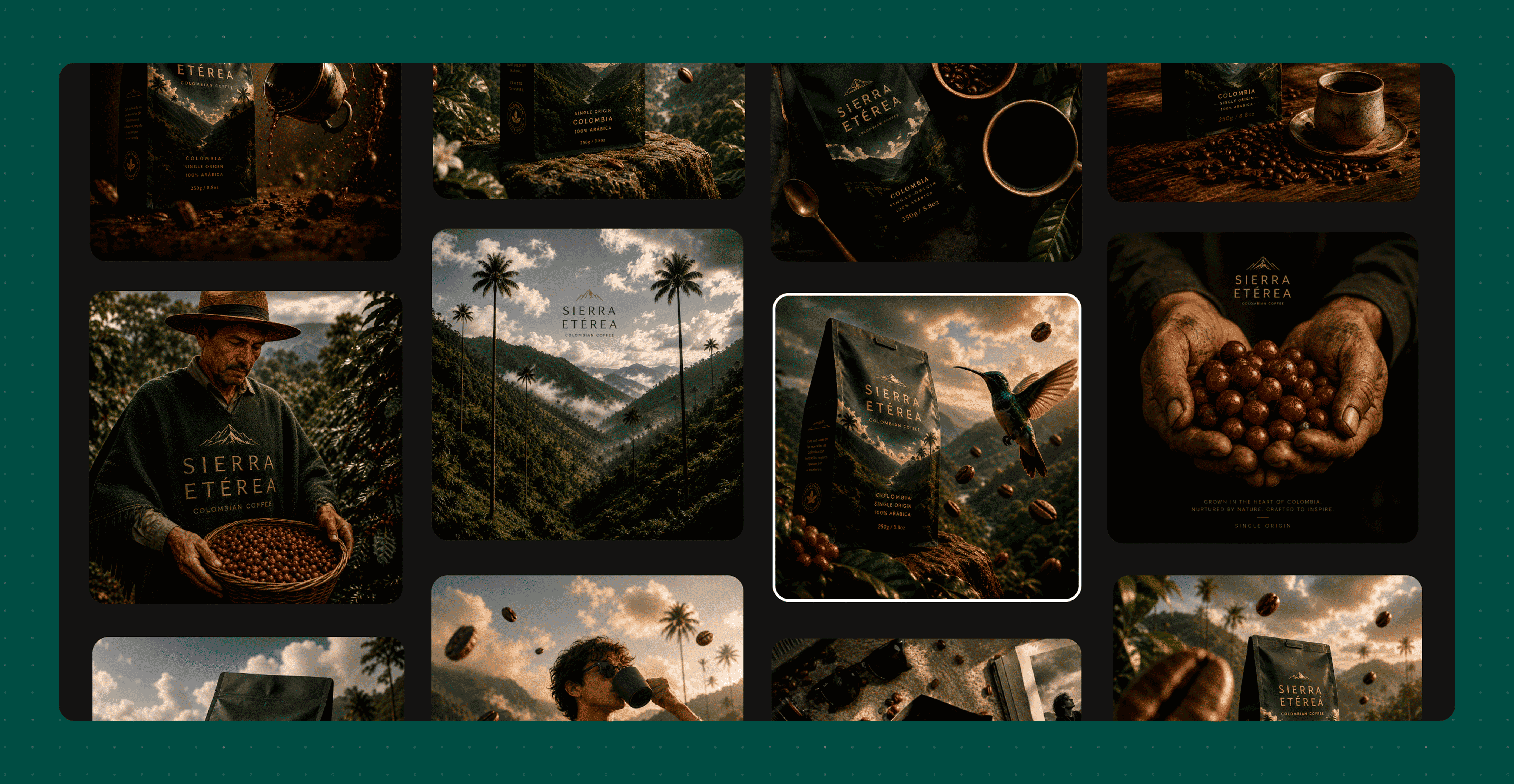
Our visual identity followed the same logic. Instead of handing external photographers a static brief, a visual direction and a brand style guide, we did a foundational brand photoshoot in Cape Town, South Africa. We then used that imagery to train a custom AI image model on everything from tone and lighting to composition.
We had to create proprietary first-party datasets around it. You want to have some intellectual property around it.

The payoff was dramatic. A single shoot powered a full year of on-brand imagery, and the model delivered 10x faster content creation, 75% less time per image and 85% lower cost per image.
Crucially, humans led every step of the process and refined the results. AI sped up exploration and visualization, but the creative judgment stayed with people.
Creatives have this reflex. We squint at the work to blur out the noise and see the big picture. Does the idea hold up? Does it feel right?

What changed was the speed of that judgment.
That gut check used to take days of mockups, revisions and proofs of concept just to validate a hunch. With AI, we could move at the speed of instinct. What once took a week now takes minutes.
The rebrand shipped in just six months and drove Superside's best-ever sales quarter. Thanks to our collaborative AI-human approach, 90% of our Q3 revenue pipeline now comes from the enterprise businesses we targeted.
How Brand Brain turns brand guidelines into living brand intelligence
At Superside, the system that makes all of this possible, and repeatable for every customer, is Brand Brain. Think of this AI intelligence layer inside our Superspace platform as the evolution of the brand guide. Instead of storing brand knowledge in a static document, Brand Brain captures it, continuously learns from it and makes it available wherever creative work happens, from briefs and reviews to the assets themselves.
Being AI-first means AI isn't just powering individual tools. It's embedded across the entire creative model, from how teams are trained to how brand knowledge compounds over time.
Brand Brain continuously builds its understanding from everything that defines your brand, as our guide to training AI on brand assets explains. That includes:
- Machine-readable brand guidelines
- Messaging frameworks
- Visual identity systems
- Past creative work, including the decisions and feedback behind it
- Performance data, such as engagement and conversions
- Team preferences and workflows
- Iteration and revision patterns
The result is a system that gets smarter over time. Every new project starts with more context than the last, which makes creative work faster, more consistent and better aligned with your brand.
That intelligence powers every stage of the creative workflow:
- An AI Briefing Agent transforms rough ideas into structured, on-brand creative briefs using your brand's messaging, specifications and creative history.
- An AI Insights Agent lets teams "pick your brand's brain" to uncover what's worked before, identify gaps and surface relevant knowledge.
- Custom AI image models generate on-brand visuals in seconds, rather than relying on stock photography or commissioning a new shoot.
- Automated workflows handle repetitive production tasks such as resizing, versioning and routine edits, so creatives can focus on higher-value work.
With Brand Brain, Superside replaces scattered brand guidelines and disconnected knowledge with a living brand intelligence system that evolves with your business.
AI-powered. Human-crafted.

Superside has always believed the best creative work comes from combining technology with human expertise. That's why Brand Brain is "AI-first" and not "AI-only."
When Superside becomes your creative team's creative team, we'll build and manage your Brand Brain for you. Our team handles onboarding, model training, optimization, governance and ongoing maintenance. This means the creatives who work on your brand can focus on the strategic and creative decisions that move your brand forward.
The high quality of the work comes from combining AI and human creative expertise. AI provides speed, scale and consistency, while experienced creatives bring judgment, taste and brand understanding. Together, they produce work that's indistinguishable from traditionally created assets. Ultimately, your brand becomes stronger over time rather than drifting off course. And because Brand Brain is built into every Superside engagement, all our customers benefit from it.
Ready to turn your brand guidelines into living intelligence that humans and AI can both act on? Book a demo and see Brand Brain in action.
The brand guidelines of the future are alive
A clear brand identity, a distinct voice and consistent execution across the customer journey, from social posts to billboards, matter more than ever in a world flooded with generic AI output. What's changed is the form in which the brand guide needs to live to power AI-driven creative work.
Static PDFs written only for human eyes are being replaced by living brand systems that humans and machines can both read, query and improve. The brands that successfully adapt treat their guidelines as operational memory: machine-readable, model-trained, performance-aware and human-governed.
The rest find it increasingly difficult to deliver a consistent brand experience as AI scales creative execution.
Superside proved the better path with our own rebrand and living brand guidelines. We created a set of AI-ready brand guidelines and trained custom AI image models on the photos we took during our Cape Town shoot. Now, AI effortlessly speeds up our work, while human creatives remain responsible for every important creative and strategic decision. That's what Brand Brain inside Superspace gives every Superside customer.
The future belongs to brands that treat their brand identities as intelligent systems that learn, adapt and scale with them. If you see yourself in this future, an AI-first, human-led creative partner like Superside can get you there. Book a demo to bring your guidelines to life.
FAQs
Stuck in AI testing mode?
Get a quick, practical checklist
for implementing AI across your team.


Ready to see it in action?
The best way to understand it is to experience it.
Because once your creative system has memory,
you won’t want to go back to starting from scratch.


Increase your creative capacity
Let your in-house team reach for the stars,
while Superside keeps your day-to-day creative needs
at an industry-leading level. Ready to scale?