


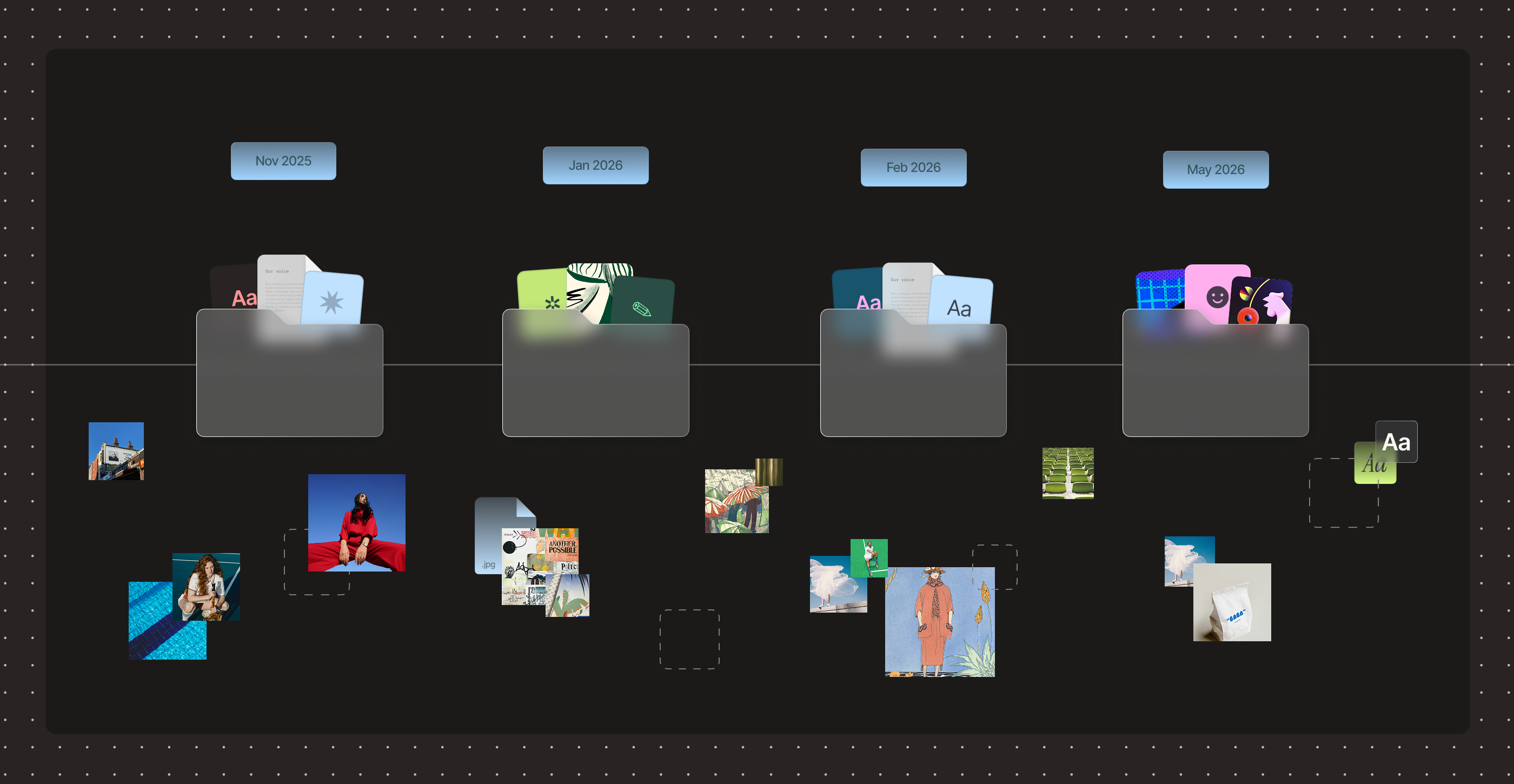
Creative memory loss happens when brand context, feedback and past decisions don't carry over between projects. Teams end up repeating work, revisiting old debates and rebuilding context from scratch. Generic AI tools can't solve this because they don't remember your brand. Brand Brain captures and applies that knowledge so every project starts with the context of the last one.
The rationale behind an important creative decision was established months ago. Now that context is lost, and your team has to dig through email threads and Slack messages to piece it back together.
Multiply that across dozens of projects and a pattern emerges. Feedback gets repeated, past decisions get revisited and performance insights never make it into future briefs.
This gradual disappearance of brand knowledge between projects is what teams call creative memory loss. As creative volumes rise, the cost of losing project context rises with them. Many enterprise leaders look to generative AI for the answer, but generic AI has no persistent memory of your brand, no direct line to the team executing the work and no way to learn from what was created and launched before.
The most effective long-term solution is a structured AI memory layer inside the creative workflow that captures, organizes and applies what your team learns over time. This guide explains what creative memory loss is, the five recognizable signs and why generic AI tools are not a solution. You will also learn how Brand Brain, the intelligence layer inside our Superspace platform, helps teams preserve brand context, reduce rework and make every project smarter than the last.
What is creative memory loss?

Creative memory loss is the persistent loss of brand context, decisions, feedback, performance learnings and team preferences between projects.
It’s the reason every campaign feels like it is starting from zero, and the structural cause of repeated mistakes, re-litigated decisions and brand drift at scale.
It describes a problem many creative leaders have lived with for years. The biggest bottlenecks in enterprise creative work often are not the creative itself. They are the lost context, the misalignment and the knowledge that fails to carry forward from one project to the next.
Siloed information, forgotten decisions, duplicated effort and repeated mistakes trap teams in a cycle of rebuilding context instead of building on what they have already learned. The term gives that pattern a name.
Monica Romaniuc, Senior Product Marketing Manager at Superside and a Brand Brain expert, defines it simply.
Creative memory loss is what happens when important brand knowledge, feedback, and learnings only live in people's heads instead of a shared system. Knowledge becomes fragmented, teams work from different versions of the truth, and the same decisions end up getting revisited over and over again.

How creative memory loss shows up in enterprise creative work
Creative memory loss leaves clues. The teams that experience it tend to see the same five signatures, and most hit at least three of them on every campaign cycle.
1. Repeated questions and re-litigated decisions
The same brand questions keep coming up. What is our position on AI-generated photography? Are we still avoiding emoji in subject lines? Do we use title or sentence case in ad copy? These were answered three campaigns ago, but the answer never made it back into the workflow, so the team relives the same debate every six weeks.
Monica says one signature usually shows up first.
For most teams, it shows up as forgotten feedback that resurfaces in review. It's usually not a creative problem. It's a memory problem.
2. Briefs that restart from zero
Prior work that should inform the new campaign is not referenced in the creative brief because nobody remembers exactly which campaign solved a similar problem.
Most enterprise workflows were not built to share context across teams, tools and projects, so valuable knowledge stays spread across documents, emails and collaboration platforms and the brief lands with less context than it needs.
3. Forgotten feedback that resurfaces in review
The brand director flagged the same issue months ago. The legal team raised the same concern on the previous campaign. None of it carried forward, so the work goes through the same review cycle for the same reasons. Senior reviewers feel like they are correcting the same mistakes, and junior creatives feel like the goalposts keep moving.
4. Brand decisions that quietly drift
When brand knowledge does not carry forward, inconsistencies emerge. Early on they are easy to miss. A slightly different visual style, a shift in color combinations. Across hundreds of assets, those small deviations compound and the brand starts to move in multiple directions, which makes brand consistency hard to hold across channels, teams and markets.
5. Performance learnings that evaporate
The highest-performing campaign from last quarter generated valuable insight. What angle worked, what format outperformed, what audience responded. By the time the next project briefs out, that knowledge is gone, and the team relearns the same lessons instead of building on them. When all five show up across the same team in the same quarter, creative memory loss is the diagnosis.
Why creative memory loss is worse in 2026

Creative memory loss is not new. What has changed is the volume of information teams are expected to manage.
In 2026, enterprise teams produce more assets, support more channels and work across more markets than ever, and AI has accelerated production faster than internal teams can adapt. Three forces drive the problem today.
1. Creative demand is growing faster than teams can absorb it
As organizations scale, every campaign generates new briefs, decisions, stakeholder feedback, performance insights and brand learnings, most of which gets scattered across documents, project tools, Slack and email. Superside's Breakpoint report found 80% of leaders say creative demand is higher than last year, and 4 in 5 teams operate at or beyond capacity. Under those conditions, institutional memory is the first thing that falls through the cracks.
2. AI has raised the stakes for brand memory
AI tools have dramatically increased how fast assets can be produced, and 96% of creative leaders believe AI can help teams move faster. But without access to brand knowledge, past feedback, campaign history and creative preferences, AI produces content in isolation. Teams create more assets, while senior people still have to provide direction, correct inconsistencies and re-explain decisions.
As McKinsey notes, most enterprise martech (CMS, DAM, CRM and analytics) was never built for shared data models or real-time workflows, which is exactly why brand memory keeps falling through the cracks.
3. The business cost of memory loss has risen
When teams lose context, the cost is not a few extra review rounds. Memory loss creates rework, slows approvals, drives bottlenecks and pulls senior creatives into coordination instead of strategy and craft.
Those costs grow with scale. Used well, the inverse is just as real. Forrester's Total Economic Impact study of Superside found a composite customer saved $1.9 million in avoided agency costs and $1.2 million in internal labor through AI-powered creative processes.
Why generic AI tools cannot solve creative memory loss alone
Generic AI tools generate concepts quickly, cut time on routine tasks and help spot gaps in briefs. But without persistent brand memory, they struggle to support the direction and final decisions that produce standout work. Four limitations explain why.
1. Context windows are finite
Every model has a finite context window. Even when teams paste in past briefs, draft assets, feedback and campaign history, the relevant context quickly becomes overwhelming. Important details get missed, context has to be reintroduced again and again, and the model holds no memory of the brand beyond the current conversation.
2. Memory does not persist between sessions
Some platforms retain information between sessions, but most are not designed to systematically capture and apply the context, feedback and creative decisions that accumulate across enterprise creative workflows. A new session starts close to zero.
3. Generic AI does not turn context into institutional knowledge
Even in shared AI workspaces, brand knowledge stays scattered across conversations, documents and projects. The challenge is making sure feedback, decisions and lessons from one project automatically carry into the next and get applied in future workflows. Generic tools do not close that loop.
4. There is no structured memory layer for AI to reason over
Generic AI is trained on broad data, not on your brand. Without a structured memory layer, it relies on whatever context is provided in the moment rather than the accumulated decisions and preferences that define your brand over time. The output often looks polished but lacks the qualities that make the brand recognizable.
Add the four together and the picture is consistent. Classic AI amplifies volume, not memory, so the fix has to be a system designed for memory in the first place.
How to fix creative memory loss
Fixing creative memory loss is a five-step process, and the order matters. Each step depends on the one before it.
- Make the diagnosis. Audit where memory is being lost, which questions recur, which feedback repeats, which decisions keep getting revisited. The audit also reveals which parts of the process are highest-leverage to fix first.
- Capture context as memory, not as documents. Brand decisions, feedback, stakeholder preferences and performance signals need to live in a structured layer the team and the AI can both query. Translating things people know into memories the system can apply is the most underestimated step.
- Connect the memory layer to the work. Memory that lives in a side system gets ignored. It has to be wired into the brief, production, QA and approval flow. If people have to leave the workflow to retrieve context, they stop retrieving it within a quarter.
- Maintain memory continuously. Brand context evolves every campaign, so memory has to be updated continuously, not in annual brand-book refreshes. Add new memory after every project and review existing memory regularly to keep it accurate.
- Close the feedback loop. Memory cannot be a black box. The team needs visibility into what is captured and the ability to flag updates. When customers can see and refine memory in real time, the system gets more accurate and the team trusts it more.
Most teams can do step one alone. Steps two through five require structured memory infrastructure that is hard to build internally, which is the gap that pulls teams toward a managed system rather than a build-it-yourself approach.
Brand Brain: A memory system built for this
Brand Brain is the intelligence layer inside Superspace, Superside's AI-first creative management platform. It is built around the diagnosis above. Memory loss is structural, so the fix has to be structural too.
Brand Brain captures and applies your brand's voice, visual rules, specs and feedback to every brief and project, keeping work on-brand from day one while reducing rework and review rounds.
Unlike a static asset library, your Brand Brain keeps evolving. With every project, it learns what works, captures nuance and feeds those learnings back into future briefs and creative decisions, strengthening output while continuously improving the context behind it.
What Brand Brain memories are
Memories are the structured units of brand learning that live inside Brand Brain. Each one captures something specific about how your brand operates in practice. A feedback pattern. A stakeholder preference.
A performance signal. A visual standard. A messaging rule. An approval workflow.
Memories are different from documents because they are queryable, applied automatically across briefs, reviews and outputs, and reviewed and refined continuously, so each new project starts with a sharper version of your brand context than the one before it.
Monica makes the concept concrete.
A memory is a piece of brand knowledge that's worth preserving and reusing. For example, a brand team might love concepts that push the messaging but consistently reject concepts that push the visual identity.
How memories are added after each project
Four loops keep Brand Brain accurate and continuously deepening.
- Inputs become structured memories. Guidelines, briefs, feedback and other inputs are turned into memories Brand Brain can apply across projects.
- Memories are applied to every project. Each new brief, review and asset reflects the brand preferences captured so far, so output is on-brand from the first draft.
- New memories are added after each project. Learnings, feedback and performance signals from each delivery feed back in, so the next project starts smarter than the last.
- Continuous review by Superside. Our team maintains the memories to keep them accurate, and the customer team can flag updates that get reviewed and incorporated.
How memories are organised
As the volume of memories grows, organization matters. Brand Brain supports memory groups, which cluster related memories under one heading. One group can hold the feedback patterns from a specific brand director, another the visual standards for a product line, a third the messaging rules for a market. You can create, edit and delete memory groups directly inside Superspace. The full walkthrough lives in the Manage your Brand Brain memories help center article.
Monica Romaniuc explains when a group is worth creating.
A memory group helps teams organize related knowledge in one place. You'd create a memory group when those memories become more valuable together than they are on their own.
How memories stay current
Memories work best when they reflect your current brand guidance. When one becomes outdated, unclear or inaccurate, the customer team can flag it inside Superspace and submit feedback, and the Superside team reviews and updates it.
This is the key difference from a static brand book, which is published once and goes stale. The memory layer is reviewed continuously and refined in real time, across both Superside-led updates and customer-flagged improvements. The full controls are in the Manage your Brand Brain memories guide.
Monica frames why that matters.
Brand Brain is designed to evolve alongside those changes, so memories can be updated, refined, or replaced as the brand grows. This way, memories stay useful instead of becoming another outdated document nobody trusts.
How memories are applied
Memories show up where they matter most across the process, applied directly inside the workflow teams already use rather than living in a separate knowledge base. They power AI Briefing, which turns a rough request into a structured, on-brand brief by pulling in relevant memories automatically.
They inform AI Insights, which surfaces patterns across projects and team activity. And they shape Brand Models, the custom-trained image generators that produce on-brand visuals from the first render.
That might be while building a brief, reviewing creative, or making decisions throughout a project. The goal is to bring the right context into the workflow, not ask teams to go searching for it.
Managing your memories as a customer

If you already use Superspace with Brand Brain, the path is direct.
Select Brand Brain from the sidebar, select any memory to view its details, then group memories, edit groups, flag anything outdated and submit feedback for the Superside team to review.
The full walkthrough lives in Manage your Brand Brain memories. If you are not yet using Superspace with Brand Brain, the Intro to Brand Brain article is the right starting point. Access is rolling out gradually, with the Superside team preparing each customer's Brand Brain before activation. Your brand knowledge stays private and protected, and AI is optional at the account and project level.
From memory loss to memory layer
Creative memory loss is the slow, structural drag that sits underneath almost every other complaint about enterprise creative work.
The repeated questions. The repeated feedback. The brand drift at the edges.
The senior creatives stuck on production work. The performance signals that never make it back into the next brief. They are all symptoms of the same root cause. The system that produces creative work has no working memory.
The solution is a structured brand memory layer, connected to the team executing the work, maintained continuously and refined in real time. Brand Brain is what that layer looks like when it is built right.
Each new project starts smarter than the last, the team stops re-litigating the same questions, the brand stops drifting at the edges and the work that ships gets sharper, not just faster. When you make Superside your creative team's creative team, that memory layer does the heavy lifting underneath every project.
If your team keeps repeating the same conversations, feedback and decisions, the highest-leverage move you can make this quarter is a 30-minute conversation about what a working creative memory looks like inside your stack.
FAQs



Creative teams are at a breaking point
The pressure is real, the opportunity is too.
Get insights from 300+ leaders on
beating burnout, using AI wisely
and navigating 2026’s inflection point.

The data speaks for itself
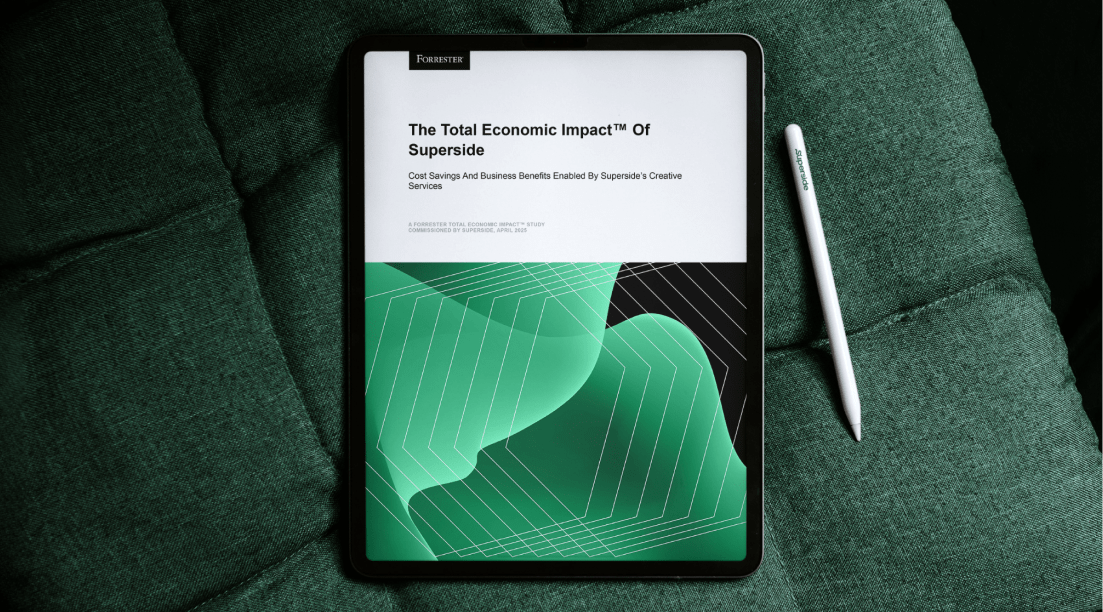
According to a Forrester Total Economic Impact™ study, Superside delivers a 94% ROI and pays for itself in six months.


The real story behind GenAI’s impact on creative
You've heard the hype. But what does the data say?


Increase your creative capacity
Let your in-house team reach for the stars,
while Superside keeps your day-to-day creative needs
at an industry-leading level. Ready to scale?