

Category
AI-Powered Creative

AI ad creative production: What works and what doesn't
AI ad creative production has moved the bottleneck in paid advertising. Generation now runs faster than people can review, so the hard part has shifted to deciding what is good enough to ship. Most enterprise teams already run AI creative workflows for concepting and resizing. The open question is which parts of an ad hold up under brand scrutiny and which still need art direction, retouching and a human sign-off.
How to set AI content quality standards before you scale creative
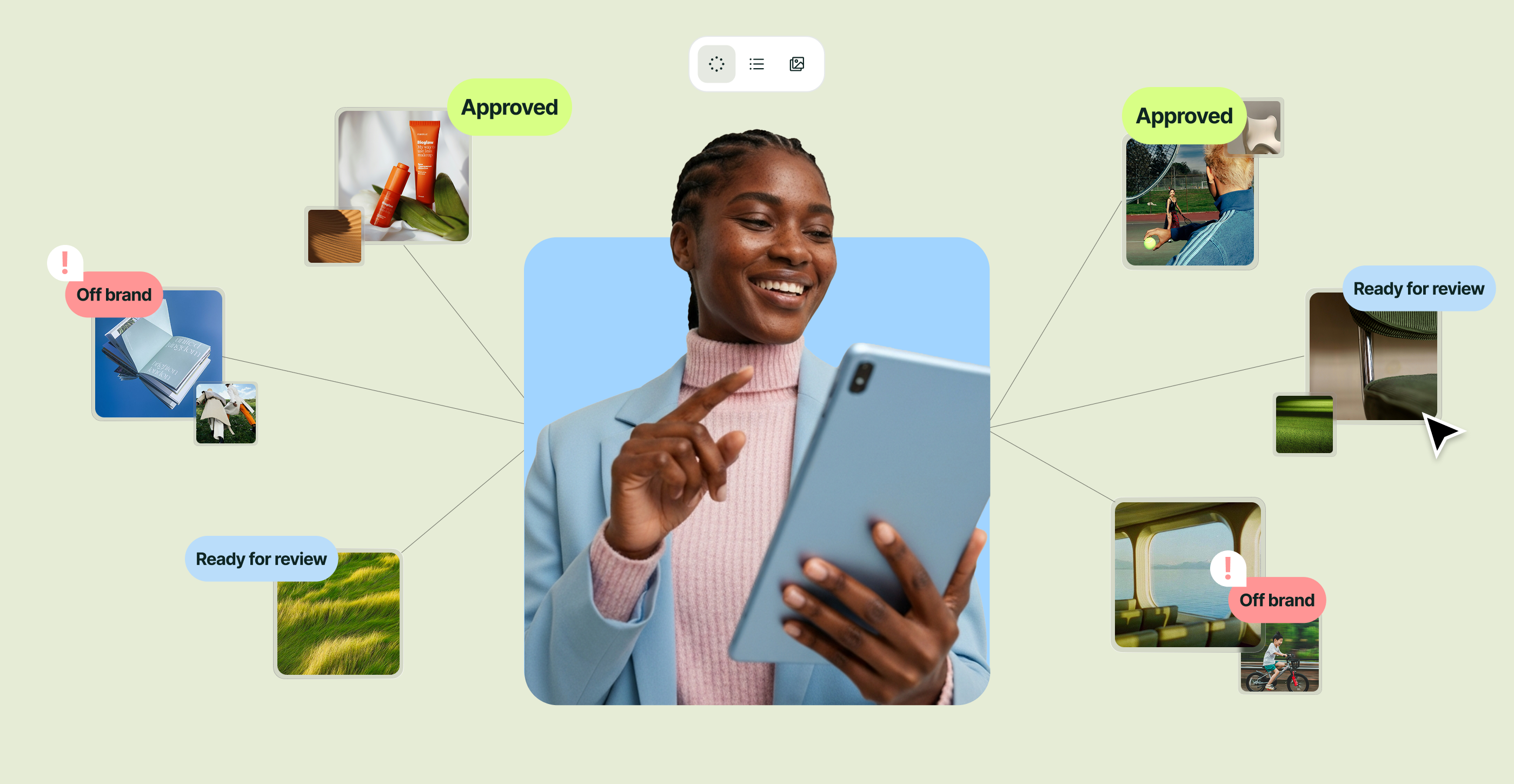
It's just before 5 pm when someone asks whether the campaign assets are ready to go live tomorrow. Your stomach drops when you realize there are now 35 messages in the Slack thread. One person says the headline is "not quite us." Another has spotted that the product name is wrong. The brand manager asks who approved the image. And the creative director reacts with a thumbs-up, which nobody can interpret with confidence. Meanwhile, your AI tool has produced another 17 variations.
How creative workflow management lets AI scale your output
Many creative teams think better AI tools and sharper prompts will help them produce creative work faster. But faster generation doesn't automatically mean faster delivery. If approvals stall because the work isn't right, your team can generate assets in seconds and still spend days getting them out the door. The reality is that AI alone won't fix your creative bottlenecks. Added to a chaotic creative production workflow, it may even slow things down. True speed comes from a strong underlying system.
18 Powerhouse AI Marketing Agencies for Creative and Performance
AI has become every agency's favorite calling card. But adding "AI-powered" to a capabilities deck doesn't make an agency the right partner for your enterprise. The first step is to understand what kind of help you need. Some AI marketing agencies use AI to produce more creative, faster. Others use the technology to buy media and optimize creative performance. Confuse the two, and you could end up with an impressive partner that does very little to move your brand forward.
Custom AI models for creative that stay on-brand at scale
If your company is like most enterprises, your marketing team needs to produce more creative, faster, than ever before. Generic AI image generators can help boost creative capacity, but getting a tool like Midjourney or DALL·E to produce visuals that look unmistakably like your brand is tough. And when every asset needs another round of prompts and edits, AI's speed gains quickly disappear.
AI for creative production, the operating model for on-brand creative at scale
Right now, many enterprise creative teams have an uncomfortable problem: the demand for creative output keeps rising, while team capacity doesn't keep pace. Our Breakpoint report, based on a survey of more than 300 creative and marketing leaders, found that 86% of teams are already at or over capacity and 70% of leaders report burnout. Because 51% of creative teams' projects are considered high priority, many feel it's nearly impossible to keep up.
AI tools vs graphic designers, and when to stop prompting
For early-stage, low-volume or low-stakes design work, AI tools and one capable graphic designer are a smart, cost-effective setup. If you need a few social posts a month, simple product image edits or early logo concepts, there's no reason to overcomplicate it. The math changes as your company grows. Scale up to hundreds of assets a month and it gets much harder to hold brand consistency or handle complex, multi-format work without a proper operating model behind it.