

AI cannot follow your brand from a PDF. A static brand book is missing the operational context AI needs, like feedback patterns, stakeholder preferences and what has actually worked. Brand Brain captures that context as a living, brand-trained layer and applies it to every brief and output, so the work is on-brand from the first render.
Almost every enterprise marketing team is wrestling with the same problem.
They have a 60-page brand guidelines PDF nobody actually reads, and a generative AI tool the team uses every week. The output looks fine in isolation. Across hundreds of assets, it does not look like the brand. The colors are roughly right. The tone is in the neighborhood. The visual style is close. None of it is theirs.
Sharing the PDF with the AI does not fix it. Pasting the guidelines into a system prompt does not fix it. Adding a prompt template that says 'on brand' does not fix it. Each new project resets to roughly the same baseline of generic-feeling output, with the same five rounds of brand feedback that have to happen every time before the asset ships.
This article is for marketing and creative leaders who have hit the wall between brand guidelines and AI output. We cover why AI struggles to follow brand guidelines, what AI actually needs to produce on-brand work, why a PDF brand book is not enough, how to operationalize brand guidelines for AI step by step and how Brand Brain is built around exactly this problem.
Why AI does not follow your brand guidelines (even when you share them)

Generic AI tools are surprisingly bad at following brand guidelines, not because the AI is incompetent, but because brand guidelines in the form most teams keep them are not the kind of input AI can act on reliably. Four constraints stack up.
Static documents versus living systems
Most guidelines are PDFs, decks or static design system pages, written for humans who can read, interpret and apply judgment. AI does not read in that sense. It needs structured signals it can apply, and a 60-page document is human-readable reference material, not structured signal.
Generic AI versus brand-trained AI
An off-the-shelf model is trained on the world's content, not on your brand. Even with your guidelines pasted into a prompt, the model is still pulling on its general training, so the output trends toward the average of what looks like a brand asset on the open internet, not toward what looks like yours.
The context window problem
Context windows are finite. A 60-page brand book does not fit cleanly, and even when it does, the model weights early instructions less than recent ones. By the time it is generating, the brand context has been compressed or deprioritized against the specific request at the end of the prompt. The longer the conversation, the worse it gets.
The training problem
Truly fine-tuning a foundation model on your brand takes data, infrastructure, AI expertise and ongoing maintenance most teams do not have. The teams that try usually end up with a half-trained model that is closer to brand than the default but still needs heavy cleanup, where the work to maintain the model exceeds the work it saves.
Monica Romaniuc, Senior Product Marketing Manager at Superside and a Brand Brain expert, names what breaks.
Most brand guidelines were never designed to power AI systems. They're static references, usually a PDF or a Figma file, and they're missing a huge amount of operational context.

Add the four constraints together and the picture is consistent. Generic AI tools, no matter how powerful, are working with the wrong inputs. The answer is a different kind of input.
What AI actually needs to follow your brand at scale

Producing on-brand work at scale takes more than a guidelines document. It takes a structured layer that captures everything that makes the brand recognizable in a form AI can use. Eight categories of brand signal need to live in that layer.
- Voice and tone. Not just adjectives like warm or confident. Examples of approved copy, patterns the brand uses and avoids, plus tone shifts across formats and channels.
- Visual standards. Locked colors, typography, spacing, photography, illustration, iconography, layout and motion, specific enough to evaluate a generation against, not just align with.
- Specs and formats. Channel specs, aspect ratios, file requirements, legal disclaimer formats, localization rules and accessibility requirements. The layer that gets assets rejected when it is wrong.
- Past assets and campaigns. What the brand has actually shipped. AI works by pattern matching, and the patterns of approved past work are some of the strongest signal available.
- Past feedback patterns. The recurring corrections the brand team applies and the notes the Creative Director gives every time. The cheapest way to bake brand judgment into future work.
- Stakeholder preferences. Who reviews what and what each function cares about. Brand consistency at scale is partly a coordination problem, and that context belongs in the layer AI reasons over.
- Performance signals. What converted, what did not and which themes resonated. Performance data is brand context too.
- Workflow patterns. How briefs get written, how approvals flow and which channels run on which cadence, so output fits how the brand actually operates.
Monica Romaniuc says one of these categories is almost always the gap on day one.
The biggest gap is usually stakeholder preferences, especially that creative taste layer. That kind of context almost never exists in a formal brand document, but it has a huge impact on whether creative actually feels on-brand.
Why a PDF brand book is not enough
PDF brand books are still useful for humans. They are the wrong artifact for AI at enterprise scale, for five reasons.
- PDFs are static. They reflect the brand at a single moment, often the last rebrand. The brand has moved since.
- PDFs are not queryable. AI cannot retrieve specific brand decisions from a PDF without a layer that translates the document into structured signal.
- PDFs do not capture decisions made after publication. Every campaign, Creative Director note, legal flag and stakeholder preference that landed after the PDF was written is invisible to AI.
- PDFs do not connect to execution. Even when the document is good, nothing automatically applies its standards to the work AI generates.
- PDFs do not improve over time. AI gets sharper with feedback. PDFs get stale. The thing that should be learning is the one that cannot.
PDF brand books should still exist for new hires, agency partners and the moment a stakeholder asks what the font is. They are not the input AI needs to follow the brand at scale. Treating the PDF as the system is the most common mistake enterprise teams make, and it is where brand consistency quietly starts to slip.
What about Notion pages, Figma libraries and design systems?
These are better than PDFs and still not enough on their own. Notion pages are queryable but rarely connected to the AI generating the work.
Figma libraries cover design system components but not brand voice, messaging frameworks, performance signals or feedback patterns.
A formal design system is the closest analogue most enterprises already have, but it is built for product UX, not for surfacing the marketing creative context AI needs to produce an on-brand campaign asset.
The same logic applies to DAM systems and brand portals. They store assets. They do not maintain the brand intelligence around how those assets get applied, what feedback they generated or how the brand has evolved since they were uploaded.
Monica draws the line between a reference system and an operational one.
Tools like Frontify or Figma are really important, but they're still mostly reference systems. Brand Brain is different because it's operational. It applies context during the actual creative process.
How to operationalize brand guidelines for AI
Operationalizing brand guidelines for AI is a five-step process. The order matters, and skipping a step usually means the next one fails.
- Audit what already exists. Pull together the brand book, recent campaigns, approved hero assets, past briefs, archived feedback, performance data and team preferences. The audit reveals what the brand actually is in practice, which is often different from what the PDF says it is.
- Capture context that lives in heads. Brand context lives in documents, working files and people's heads. The third bucket is the largest and the most often skipped, held by senior creatives, brand managers, performance leads and customer-facing teams.
- Convert it into structured brand memory. Structured brand memory means signals AI can apply: patterns the AI can match against, retrieve from and reason over. This translation layer is the one most teams underestimate, and it decides whether the output is on-brand or generic.
- Connect the layer to the work. Structured memory has to be wired into briefing, generation, QA and approval. If it sits beside the work instead of inside it, AI generation does not pull on it reliably and brand drift creeps back in.
- Maintain and refine continuously. The brand evolves, campaigns ship and decisions get rewritten. With a maintenance loop, the layer compounds, so the work that ships next quarter starts smarter than the work that shipped last quarter.
Most teams can do step one on their own. Step two takes time most teams do not have. Steps three, four and five require expertise, infrastructure and ongoing maintenance most teams cannot staff alone, which is the gap that pulls teams toward a managed system rather than a build-it-yourself approach.
Brand Brain: The system designed for this
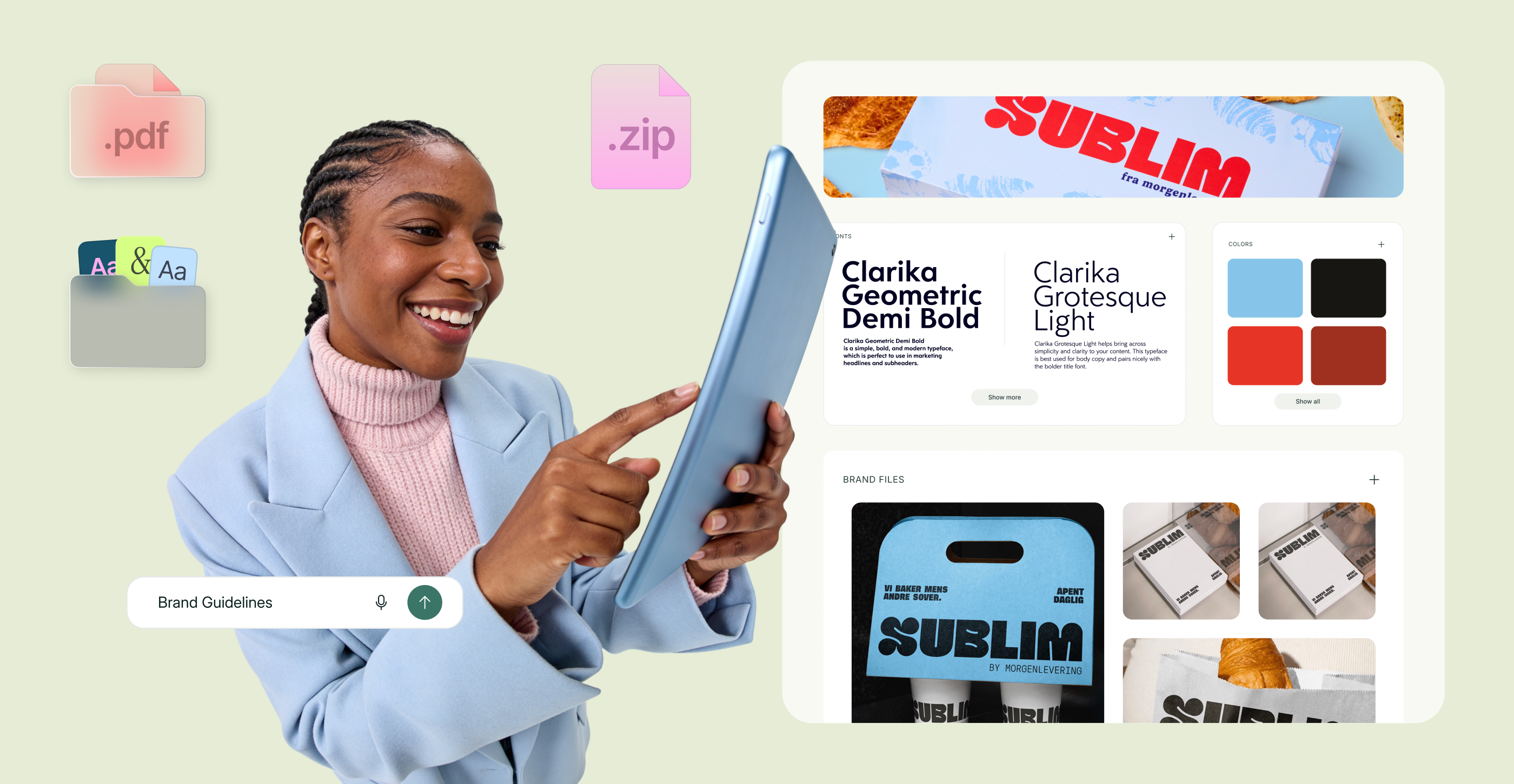
Superside built Brand Brain around exactly this problem. It is the AI-first creative memory inside Superspace, our creative management platform. Brand Brain captures and applies your brand's voice, visual rules, specs and feedback to every brief and project, keeping work on-brand from day one while reducing rework and review rounds.
Unlike a static asset library, your Brand Brain keeps evolving. With every project, it learns what works, captures nuance and feeds those learnings back into future briefs and creative decisions, strengthening output while continuously improving the context behind it.
What Brand Brain captures
Brand Brain holds everything that makes a brand recognizable. Voice and messaging, visual rules, specs, past assets and campaigns, team preferences, feedback patterns, performance signals and workflow context. The same eight categories of brand signal above, captured as structured brand memory rather than as static documents.
How Brand Brain stays current
Four loops keep Brand Brain accurate and continuously deepening.
- Inputs become structured memories. Guidelines, briefs, feedback and other inputs are turned into memories Brand Brain can apply across projects.
- Memories are applied to every project. Each new brief, review and asset reflects the brand preferences captured so far, so output is on-brand from the first draft.
- New memories are added after each project. Learnings, feedback and performance signals from each delivery feed back in, so the next project starts smarter than the last.
- Continuous review by Superside. Our team maintains the memories to keep them accurate, and the customer team can flag updates inside Superspace that get reviewed and incorporated.
Monica describes what gets added back once a project is done.
Once a project ships, Brand Brain keeps building on everything that happened during the process. So if certain revisions keep coming up or a campaign establishes a new direction for the brand, that context doesn't disappear after delivery.
How Brand Brain is set up

Brand Brain is built before the first project starts. Early context gathering happens during onboarding, capturing brand guidelines, tone, past briefs, assets and preferences. It is then enriched and validated through kickoff conversations, internal review by the Superside team and a creative alignment workshop with the customer.
By the end of onboarding, the Brand Brain is curated and ready inside Superspace, so the first project starts with brand context already embedded.
It does not require perfect documentation. When formal guidelines are limited, the system captures and structures brand knowledge over time from real interactions, feedback patterns, stakeholder preferences, asset history and performance signals.
Transparent and editable
Customers can see what is included in their Brand Brain directly within Superspace.
Captured brand inputs, memories and structured context are visible, and if something needs to be updated, corrected or refined, customers can flag it inside the platform for the Superside team to review and incorporate. Brand Brain is curated by Superside, and the customer team keeps visibility and control.
Built into the creative process
Brand Brain is connected to the rest of Superspace, where briefs are submitted, projects are tracked, feedback is captured and assets are reviewed. AI agents activate it at the moments that matter.
AI Briefing turns rough requests into structured, on-brand briefs that pull on the brand memory automatically. AI Insights surface patterns across campaigns and team activity.
Brand Models, custom-trained image models built on your brand, generate on-brand visuals from the first render with no stock fees or shoots. AI Apps, coming soon, will automate repeatable production like resizing, localization and campaign variations.
How Brand Brain differs from generic AI tools
Three differences matter. Brand Brain is curated and maintained continuously by Superside, so the brand intelligence stays sharp without your team running it.
It’s connected to the team executing the work, so output flows from the brand layer through production with context preserved. And it learns from every project, so each new asset starts smarter than the last instead of starting from zero.
There is also a security layer. The AI inside Superspace operates within strict security protocols to ensure your brand's knowledge is protected, private and never repurposed, with full details in the Superside Trust Center.
Where to start

If you already use Superspace with Brand Brain, the Intro to Brand Brain article is the right starting point. Submit a brief with Brand Brain walks through the project initiation flow, and Manage your Brand Brain memories covers the maintenance side.
Beyond the brand book
The PDF brand book was the right artifact for the world before AI. It is the wrong artifact for the world that is here. Giving AI your brand guidelines so it actually follows them is an operating-model decision.
The brand needs to live in a structured, queryable, learning layer connected to the team executing the work.
Most enterprise teams cannot build that layer alone. Capturing brand context, structuring it as brand memory, connecting it to production and maintaining it continuously is more than most internal teams can absorb. Brand Brain is the system Superside built so they do not have to, and it is the layer that makes every other AI capability inside Superspace land sharper.
AI Briefing pulls on it. AI Insights surface from it. Brand Models are built around it. The brand layer is the foundation, and everything else compounds on top. It is also why partnering with Superside means making us your creative team's creative team.
If your team has hit the wall between brand guidelines and AI output, the cheapest move you can make this quarter is a 30-minute conversation about what a brand-trained AI system looks like inside your stack. Pricing and Superside vs alternatives are good next reads if you are mapping the field, and our work shows the model in production with brands like Boomi, IPG and Vimeo.
FAQs




Ready to see it in action?
The best way to understand it is to experience it.
Because once your creative system has memory,
you won’t want to go back to starting from scratch.


Give your internal teams the power to boost your brand
Publish once. Deliver everywhere. Our Creative Ops platform
puts your brand in front of the right people, everywhere.
Unlock seamless content distribution. Access your audience.


Increase your creative capacity
Let your in-house team reach for the stars,
while Superside keeps your day-to-day creative needs
at an industry-leading level. Ready to scale?