


“AI-first” is more than a label. It’s the philosophy embedded throughout a company’s operations. The seven AI-first companies on this list have deeply integrated AI into the core of their organizations and reshaped how work gets done at every level. They all share the same operating pattern: AI-trained people, a platform that captures and compounds context and processes redesigned around where AI adds real value. Learn what sets them apart and discover a framework for making AI part of your company’s DNA.
As early as 2014, NVIDIA CEO Jensen Huang expressed in a keynote speech that the company was repositioning itself to power an AI-driven future. In 2016, Sundar Pichai wrote in his first shareholder letter as Google CEO that the company was moving “from a mobile-first to an AI-first world.”
Today, the term “AI-first” is everywhere, but true AI-first companies remain relatively rare. This article takes a closer look at the leading AI-first companies today and the patterns they share.
Six featured companies here span fintech, education, enterprise SaaS, productivity software, AI infrastructure and chip design industries. Superside earns its place on this list through an AI-first approach that combines human expertise, AI workflows and AI-driven brand intelligence across the entire creative process.
All of these companies have hardwired AI into the way their businesses operate, from how teams work and decisions are made to how products and services are delivered.
Read each company’s story below!
What it means to be an AI-first company
What separates truly AI-first companies from other businesses is their operating model.
The most successful organizations have gone well beyond AI experimentation and rebuilt core parts of their business around the technology. That shift allows them to innovate fast, adapt quickly to changing market conditions and create a flywheel of learning and improvement.
AI-powered means AI is one of the tools in the workflow. AI-first means AI shapes how the entire engagement works, from day one.

The simplest way to understand what AI-first companies do is to look at it through the “People, Process and Platform” lens:
People
AI-first organizations ensure their people know how to work effectively with AI. Their teams understand which tasks are best handled by AI and which require human judgment and expertise.
To support this, they invest in AI upskilling that builds skills in prompting, evaluating outputs, quality control and designing workflows that combine AI efficiency with human oversight.
Process
AI-first firms redesign their processes around the strengths of both humans and AI. Repetitive routine tasks are automated, information flows more easily between business units and teams spend less time on manual, repetitive tasks and coordination.
At Superside, AI is embedded throughout the entire creative process, from creative briefing and brand alignment to production and quality control.
Human creatives remain in the loop but have more time to focus on strategy, creative judgment and craft because AI does much of the heavy lifting.
Platform
AI-first organizations treat the platform layer as core infrastructure. Data, relevant context, past decisions and institutional knowledge are all interconnected, making them accessible to both people and AI systems.
At Superside, for example, that platform is Superspace, with Brand Brain at its core.
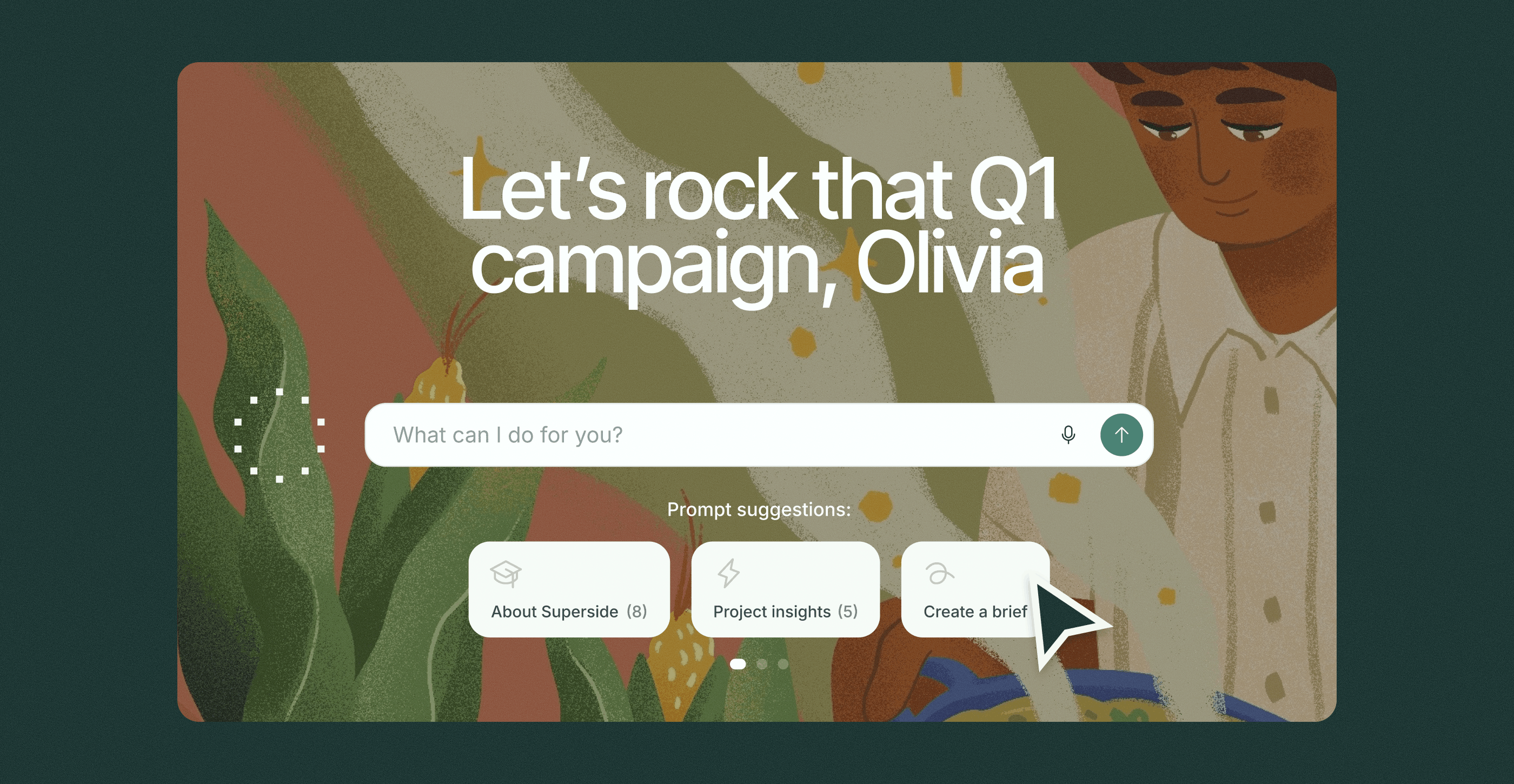
Brand Brain captures each Superside customer’s brand voice, visual rules, specs, feedback and preferences and then applies that context to every brief and creative project run through Superspace, our creative management platform.
Brand Brain evolves with every project and becomes smarter and more valuable over time.
What “AI-first” isn’t
It’s also worth defining what “AI-first” isn’t, because the term is now applied to a wide range of very different approaches.
The most common confusion is that "AI-first" sounds like customers are getting a tool or an automated system rather than a creative partner. People hear AI and immediately wonder whether there are real humans involved, whether the work will feel generic and whether their brand will get lost in the process.
An AI-first mindset doesn’t mean:
- Replacing people with AI. Several high-profile companies have already learned this lesson. Klarna brought customer service staff back into the mix after over-relying on AI, while Duolingo softened parts of its AI-first messaging in response to public backlash.
- Fast and cheap. The companies that successfully implement an AI-first business model leverage AI to expand what their teams can do. They don’t use the technology to cut corners.
- A stack of individual AI tools. Even the best AI tools are only one piece of the puzzle. Real AI-first transformation requires rethinking how people, platforms and processes work together across the organization.
AI-first vs. AI-powered
There’s also a difference between AI-first and AI-powered. An AI-powered company adds AI usage to existing products, services or workflows. An AI-first company rebuilds key parts of its operating model around AI.
They change how decisions are made, how work flows through the organization and how value is created, becoming truly AI-native.
Why companies are going AI-first today
In 2026, the shift toward AI-first operating models is being driven by three forces:
1. Demand is growing faster than most teams can scale
Across industries, organizations are being asked to deliver more with the same resources. Customers expect faster service, more personalization and better experiences. At the same time, businesses face pressure to launch more products, support more channels and respond more quickly to change.
The strain shows up across business functions, and marketing and creative teams are no exception. Superside’s Breakpoint report, which surveyed more than 300 creative and marketing leaders at enterprise companies, found that 86% of these teams are at or beyond capacity, and 70% of creative leaders report burnout.
Similar pressures exist in customer support, internal operations, finance and other knowledge-work functions.
AI-first operating models can help organizations increase capacity without adding headcount.
2. AI is now capable of meaningful production work
Modern AI agents and models can analyze information, automate workflows, assist with customer interactions and support increasingly complex business processes.
As machine learning technology improves, more organizations will redesign their operating models to take advantage of these capabilities.
3. AI readiness has become a leadership issue
Boards, investors and business leaders increasingly view AI as a strategic priority. This means organizations are expected to have a clear plan for how AI will improve productivity, speed up innovation and strengthen their competitive position.
Companies that can demonstrate measurable progress are often rewarded. In turn, those that can’t explain their AI strategy face growing pressure to justify how they’ll compete in today’s AI world.
Superside’s own evolution over the last few years reflects this shift.
We shifted to AI-first because we implemented AI-certified creative talents, custom AI workflows and the latest AI tools, leading to faster delivery, more efficiency and more money saved for our customers.
Not sure where your team currently stands? Superside’s free AI Readiness Quiz benchmarks your team’s AI readiness in just 2 minutes.
7 AI-first companies leading the shift in now
Examples often tell the story better than theory. So, let’s take a closer look at seven companies that demonstrate what “AI-first” really means:
1. Superside
Superside sits right at the top of this list as the world’s leading AI-first creative partner. We’re more than a traditional agency or a freelance marketplace. We’re a human-led, AI-native creative partner that transforms as your creative team’s creative team while keeping human expertise at the center of our work.
Superside is human-led, not human-replaced. Every project is run by world-class designers, writers, and creative directors who use AI to go further and faster, not to skip the work that actually matters.
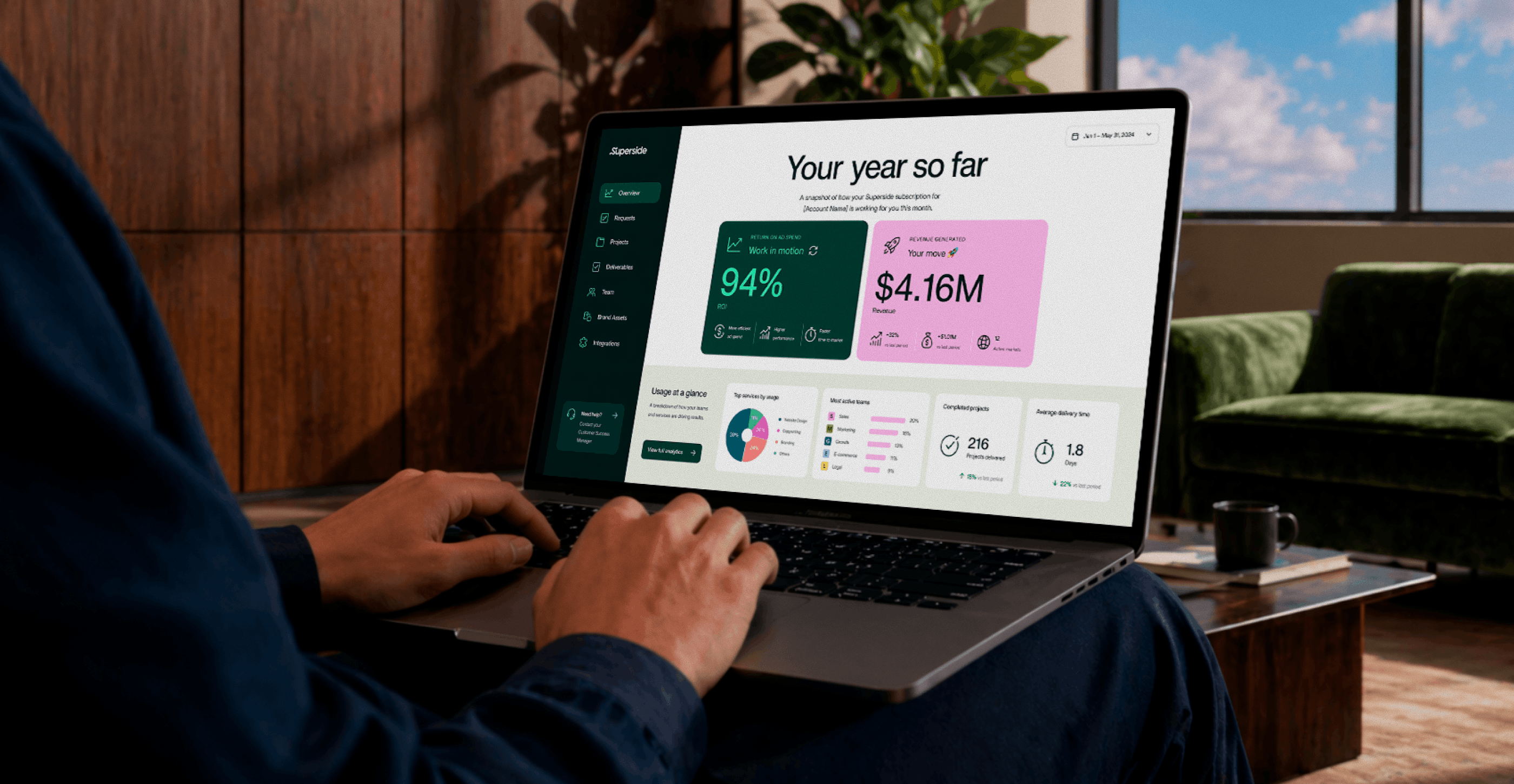
Thanks to the successful implementation of the “People, Platform and Process” framework, we now help in-house marketing and creative teams at brands like Microsoft, Amazon, DoorDash, Bolt and Reddit deliver high-quality, on-brand creative faster than ever before.
Here’s what the implementation of the framework looks like in practice at Superside:
- People. Our global team includes top-tier designers, writers, motion artists, developers, videographers, brand strategists and more. Almost 100% of our creatives are AI-certified. This means they’re trained on how to use AI as a creative amplifier while keeping strategy, craft and judgment human-led.
- Platform. Every project runs through Superspace, where briefs, reviews, feedback and delivery come together in one central hub.
- Process. AI is woven throughout our creative workflows. The technology helps our creative teams move faster, maintain brand consistency and deliver high-quality work.
At its center is Brand Brain, an AI memory layer that captures every customer’s brand voice, visual guidelines, preferences and feedback, and then applies that context across every project. Brand Brain is the connective tissue between the brand, our creative teams and the AI-powered workflows that help bring the work to life.
It is not a generic AI output. It is a living system trained on a customer's specific brand, refined by Superside's team, and guided by human creative judgment on every project.
Inside Brand Brain, which lives within Superspace, AI agents help customers and teams execute tasks:
- Onboarding builds a living system. Rather than just gathering a brief, Superside builds a Brand Brain during onboarding, a dynamic system that captures your brand's voice, visual rules, past assets, and preferences. Every project after that gets smarter because of the one before it.
- Briefs, QA, and reviews are all AI-informed. Contextual briefing pulls from past work and campaign goals automatically. Quality checks run AI-powered brand alignment before human review (beta). This means fewer revision rounds and less back-and-forth.
- Speed comes from structure, not shortcuts. Because AI is embedded in the process rather than bolted on, production timelines compress without sacrificing quality or brand consistency.
- The team is already trained for it. More than 90% of Superside creatives are AI-certified, so customers aren't waiting for the team to catch up. They get AI expertise built in from the start.
- The value compounds over time. AI-powered resets with every new project. An AI-first partner like Superside gets more efficient and more accurate the longer the relationship continues, because the Brand Brain keeps learning
As projects are completed, new feedback, preferences and creative decisions are added into the company’s Brand Brain, helping future work start with better context.
AI handles the first 80%, the exploration, ideation and early drafts. The last 20%, the polish, the judgment, the final execution, is where human expertise leads, and that part cannot be automated.
If you’re looking to structure your team’s journey toward becoming AI-first, Superside has two resources built for exactly that moment:
- The AI Reset: A Playbook for Bringing AI to Your Creative Team. This is a step-by-step framework for moving your team from AI experimentation to scalable, on-brand creative operations. Covers assessing readiness, identifying high-impact use cases, building AI workflows, equipping your team and scaling across the organization.
- AI Readiness Quiz. Try a free 2-minute assessment that benchmarks your team’s current AI maturity and surfaces curated resources based on where you are today.
Underpinning it all is Superside’s AI Excellence operating layer. This means we continuously evaluate, test and improve the application of AI capabilities across our creative workflows.
The impact of our AI-first creative service in practice
In 2025 alone, our AI-powered projects were completed with 35% more efficiency, saving our customers 31,000+ hours.
96% of Superside's own brand projects are now AI-first, and output increased by 52% with the same team size. Superside was recognized by one of our major customers as leading the way in AI photography. That level of recognition does not come from automation alone.
Independent research also shows why a partnership with Superside makes business sense. Forrester’s Total Economic Impact™ study of Superside found a 94% three-year ROI for a composite enterprise customer, with payback achieved in less than six months.
The results we achieve for our customers help bring those numbers to life:
- Boomi tripled its creative output and reported a 24% engagement rate on LinkedIn.
- IPG built an AI-powered illustration bank in just 12 hours, cutting design time by 90%.
- SecurityScorecard transformed its visual identity with more than 500 custom comic-style illustrations, reducing design time by 85%.
Taken together, these results illustrate what the Superside AI-first creative operating model can achieve.
2. NVIDIA
 (Source: NVIDIA)
NVIDIA was AI-first before “AI-first” became a business buzzword.
In 2014, CEO Jensen Huang articulated a vision that positioned deep learning and AI at the center of the company’s future. Over the following decade, NVIDIA expanded far beyond graphics hardware.
They built an integrated AI computing platform spanning GPUs, CUDA, software frameworks, networking, systems and a global developer ecosystem.
Today, most leading foundation models are trained and deployed on NVIDIA infrastructure, while CUDA serves as the dominant software platform for AI development.
By repeatedly reinventing itself around the conviction that AI would become a foundational computing paradigm, NVIDIA positioned itself at the center of the modern AI ecosystem and became one of the most valuable companies in history.
3. Klarna
 (Source: Klarna)
Klarna is probably the most cited AI-first transformation case in fintech, and one of the most instructive, for the right reasons.
CEO Sebastian Siemiatkowski moved aggressively to embed AI across the organization, and the productivity results are hard to argue with: 96% of employees now use AI tools daily, and revenue per employee has climbed by 152% since Q1 2023, approaching nearly $1 million per employee, a figure almost unheard of at Klarna's scale.
But Klarna's story is most valuable for what came next. After leaning heavily on an AI chatbot for customer support, one Siemiatkowski had publicly described as doing the work of 700 human agents, quality began to slip.
Response times improved, but the AI struggled with nuance, empathy and complex problem-solving. Customer satisfaction fell, and by mid-2025, Siemiatkowski acknowledged that the approach had "gone too far." The company reversed course and began rebuilding its human customer service capacity, moving to a hybrid model where AI handles high-volume routine queries and human agents manage escalations and complex cases.
The outcome is arguably stronger than the original model: AI agent response times improved 82%, repeat issues dropped 25% and cost per transaction fell 40 per cent. All while customers regained access to human support when they need it most.
For enterprise teams, this is the clearest data-backed argument for keeping humans in the loop. While keeping themselves AI-first, Klarna course-corrected toward the model that actually works. One where AI expands capacity and humans protect quality.
That balance is something Superside has built in over the years now, with senior creatives overseeing every AI-assisted workflow and human judgment at the center of every strategic decision.
4. Duolingo
 (Source: Duolingo)
Duolingo declared itself AI-first in April 2025, with CEO Luis von Ahn sharing an all-hands memo outlining the company's ambition to use AI to scale content creation in ways that weren't humanly possible before.
The strategy quickly delivered results: Duolingo launched 148 new AI-assisted courses and expanded features like personalized learning paths and conversational practice at a speed and scale that a human-only team couldn't have matched.
The announcement, however, sparked public backlash. Largely because the initial framing raised concerns about contractor displacement. Von Ahn later acknowledged the misstep directly. "When I released my AI memo a few weeks ago, I didn't do that well," he wrote in a follow-up note to staff. "To be clear: I do not see AI as replacing what our employees do — we are, in fact, continuing to hire at the same speed as before."
That clarification brought Duolingo's approach closer to what the most effective AI-first companies actually practice: AI as an amplifier, not a substitute.
In a September 2025 interview with CNBC, von Ahn affirmed AI makes his employees "four or five times" as productive, without a single layoff among full-time staff. To back that up, Duolingo launched internal workshops, advisory councils and dedicated experimentation time to help teams build confidence with the technology.
The broader takeaway for enterprise teams is less about the controversy and more about the correction: even a company with $1 billion in revenue and 52.7 million daily active users had to relearn that AI-first transformation only works when people feel equipped and supported, not sidelined.
That's a lesson Superside built into its model from the start. Nearly 100% of our creatives are AI-certified, with ongoing training, clear guardrails and humans in the loop at every critical decision point.
5. Glean
 (Source: Glean)
Glean is one of the strongest examples of an AI-first enterprise B2B company.
Its Work AI platform connects workplace applications such as Slack, Google Workspace, Salesforce, Notion, Jira and Confluence, using AI-powered search, assistants and agents to help employees find information and automate work.
Originally known for enterprise search, Glean has expanded its positioning into a broader platform that connects AI capabilities with enterprise data and workflows. Investor enthusiasm for that vision is reflected in the $7.2 billion valuation that followed its 2025 Series F funding round.
For knowledge workers, Glean offers a great example of what an AI-first productivity layer can look like in practice.
6. Notion
 (Source: Notion)
Notion has increasingly reoriented its product roadmap around AI, a shift that CEO Ivan Zhao has traced back to an early encounter with GPT-4 that convinced him the company needed to bet heavily on AI.
Notion AI can analyze workspace content to assist with writing, summarization, project planning, enterprise search and question answering across organizational knowledge.
More recently, Notion has launched other AI integrations and infrastructure, such as MCP and its External Agents platform, that allow AI tools like Claude and Codex to access and work with Notion data directly.
The result is a workspace that becomes increasingly useful as teams build up knowledge, automate routine work and enable AI agents to operate on shared context.
7. Anthropic
 (Source: Anthropic)
Anthropic is AI-first in the most literal sense. The company’s research and product efforts are centered on building reliable, interpretable and steerable AI systems.
Claude is used across a growing number of AI-first products and platforms, including Notion AI, Quora’s Poe, Cursor and many others.
Anthropic also serves enterprises directly through its Claude offerings and API platform, which reinforces its role as a key provider of AI infrastructure.
Many of the companies on this list, and many beyond it, rely on Anthropic models as part of their AI stack. Anthropic is now worth almost $1 trillion.
What AI-first companies have in common
Across very different industries, the seven companies above share four operating patterns:
- AI is core, not a feature. The product, service and in most instances operating model have been redesigned around AI solutions from the inside out.
- Humans stay in the loop where it matters. Klarna’s customer service walk-back, Duolingo’s recalibration and Superside’s senior creative oversight all point to the same principle: AI handles execution at volume, while humans handle critical thinking and the high-level decision-making that moves the business forward.
- Context compounds. AI-first companies invest in systems that capture context, such as brand decisions, customer history, performance signals and organizational knowledge. Glean does it for enterprise data. Notion does it for workspace data. Superside’s Brand Brain does it for brand and creative intelligence. The AI systems learn from the organization’s data and institutional knowledge to become sharper over time.
- It’s a long-term commitment, not a pilot. AI-first companies redesign roles, workflows, systems and incentives around it. NVIDIA spent a decade building for an AI future before the market caught up. Duolingo restructured how content gets created. Superside rebuilt its creative operating model around AI-certified talent, AI workflows and Brand Brain.
How Superside helps marketing and creative teams operate AI-first
The average enterprise marketing and creative team doesn’t need to become the next NVIDIA or Anthropic. They simply need to apply AI-first principles to move faster and scale creative output without sacrificing brand consistency or quality.
That’s exactly what Superside delivers.
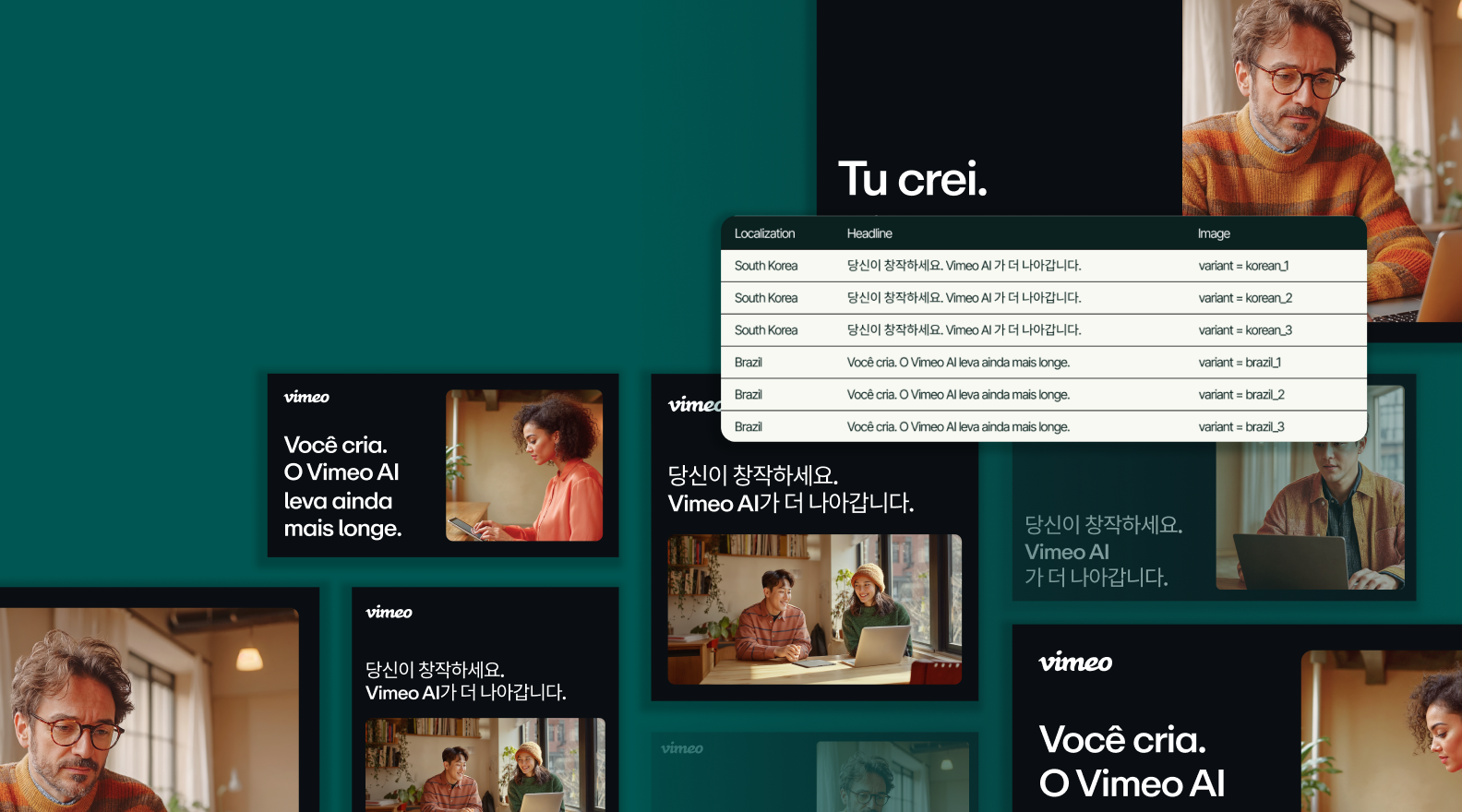
Our creative automation services bring 50+ AI-powered workflows to enterprise creative production. Think static and motion ads at scale, cross-format video versioning, brand-trained image generation, email and web template systems and AI-enhanced QA, briefing and approval.
Each track is supervised by senior creatives, governed by the brand’s Brand Brain and tied to creative performance signals so the system gets sharper with every project.
Our services cover the full creative loop:
- Ad creative for performance teams.
- Social media creative across every native format.
- Video production and motion design for cutdowns, aspect ratios and language swaps.
- Web design services, email design, branding services and campaign strategy round out the rest.
Beyond production, Superside’s expert AI consulting team helps brands build the actual AI operating model itself, including strategy, workflow design, change management, AI tools, upskilling, tailored tech stacks and governance.
Carolina recalled a great use case of AI-first creative services from us:
A marketing leader comes in already using AI internally. Their team has been experimenting with various tools to speed up content production, but the output feels inconsistent. Different people are prompting in different ways, the visuals don't quite match the brand and by the time the creative director reviews everything, the rework almost cancels out the time saved. They're getting speed but losing brand integrity, and leadership is starting to notice.
When Superside's AI-first positioning comes up in the conversation, the moment that clicks is when you explain the Brand Brain and how it runs with custom brand models trained specifically on their brand. The customer realizes they've been trying to use general AI tools to do something those tools were never designed for: remember and apply the specific nuance of their brand, consistently, across every asset, every time.
Then, if the customer raises a concern about their own internal team keeping up, or whether their creatives will actually trust and use AI consistently, that's when we bring our AI Academy Essentials workshops. 90-minute training sessions that cover topics from prompting principles to image generation to building custom copy assistants.
That combination, a Brand Brain with custom models, human oversight baked into every deliverable and internal team alignment through practical upskilling, is usually what shifts the conversation from "interesting" to "let's talk next steps." The customer stops seeing Superside as another vendor offering AI and starts seeing it as the infrastructure and the team they've been missing.
Our AI consulting teams include generative AI specialists, creative directors with global agency backgrounds and project leads who’ve managed 500+ GenAI projects for customers such as Kellogg’s, Meta, Coca-Cola and Google.
What AI-first companies share (and what it takes to become one)
What every AI-first company on this list has in common is the operating model.
They’ve trained their teams to work with AI, integrated a platform layer that captures context and becomes smarter over time, redesigned their workflows and use the best AI tools where they truly make sense.
All of these elements compound to create exponential value.
If your team wants to operate more like an AI-first company without rebuilding from scratch, partnering with one is a great place to start. Superside is the partner for ambitious enterprise marketing and creative teams.
Explore how Superside stacks up against competitors and what our pricing model looks like if you’re mapping the field. Alternatively, our customer stories are a great place to start if you want to see the Superside model in action
FAQs


Stuck in AI testing mode?
It’s time to move from experiments
to real impact.
Explore AI Reset—a 5-step framework
to embed AI into your creative workflows.


Ready to see it in action?
The best way to understand it is to experience it.
Because once your creative system has memory,
you won’t want to go back to starting from scratch.


Get top creative 5x faster
Superside’s integrated human + AI workflows unlock
faster delivery, scalable output and campaign-ready
assets, without burning out your team.

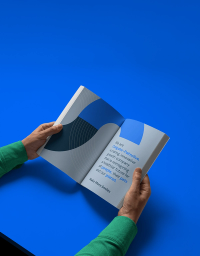
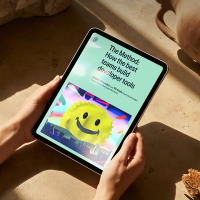

Stuck in AI testing mode?
It’s time to move from experiments
to real impact.
Explore AI Reset—a 5-step framework
to embed AI into your creative workflows.