

Creative bottlenecks are the biggest drag on enterprise creative output in 2026, and they get worse as organizations scale, with 78% of creative leaders saying demand already outstrips capacity. Hiring, more agencies and bolting AI onto a broken process rarely fix it, because the bottleneck is structural. The teams pulling ahead embed AI in a redesigned operating model with senior creatives in the loop, and Superside customers saved more than 31,000 hours in a single year doing exactly that.
It’s late Friday afternoon. A new brief lands with a Monday deadline. The team that should pick it up is busy producing last-minute assets for another campaign.
The CMO needs video cutdowns for a presentation, and sales is waiting on a pitch deck. Unless something gives, that Monday deadline is coming at the expense of someone's weekend.
If you have ever led a marketing or creative team, you have lived some version of this. In 2026, most teams are expected to create more content, for more channels, with faster turnaround and deeper personalization than ever. AI has only raised the bar, while the creative operating models many teams still run were built for a different era.
The result is that creative bottlenecks stay a weekly reality, even as teams invest in more tools, talent and outside support. Superside's Overcommitted research shows 76% of creative leaders felt burned out last year, and 78% say creative demand now outstrips their team's capacity.
This article looks at why creative bottlenecks in large organizations get worse at scale, what the data really says and how AI and human craft together can unblock the work without watering it down.
What, exactly, are creative bottlenecks?
A creative bottleneck is any point in the creative process where work piles up or gets stuck, limiting the team's ability to deliver at the speed the business requires.
Inside large organizations, creative teams sit at the center of almost every customer-facing deliverable, from product launch creative to website updates and sales enablement. Almost every department depends on creative output to move work forward, which makes the creative team the operational choke point.
Most enterprise creative bottlenecks share three signatures.
- Demand persistently exceeds capacity. Both the day-to-day requests and the high-pressure campaign moments outpace what the team can deliver, as a steady state rather than a seasonal spike.
- Senior creatives work below their skill level. The most talented people spend their hours on repetitive production instead of the strategic thinking they were hired for.
- Speed and quality are always in tension. Move too fast and quality slips. Protect quality and deadlines slip. Both cannot be held at once.
When all three are present at the same time, the team is not just busy. It is bottlenecked, and the operating model has reached its limit.
Why creative bottlenecks compound in large organizations

Bottlenecks exist in small teams too. They get harder, not easier, as the organization grows. As more departments compete for the same creative resources, urgency becomes the default.
Superside research found 55% of creative projects in large organizations are labeled high priority. When everything is urgent, teams fall into a cycle of task-switching and reactive delivery that leaves little room for strategic work. Several forces make it worse.
Grecia Barrios, Senior Project Manager at Superside, has watched this play out from inside enterprise projects, and the most surprising pattern is not a capacity problem at all.
One of the most surprising bottleneck patterns I've seen inside large enterprise creative teams is the lack of clear ownership. In large-scale projects, where many creatives and stakeholders are involved (copywriters, animators, designers, Creative Leads, and other collaborators), communication can easily become fragmented. It's the classic too many cooks in the kitchen situation.

More channels and formats create more production work
Today's teams create for far more channels and formats than a decade ago. Each new channel adds its own resizing, localization and adaptation work. What looks like a simple request, a new image or a revised headline, often triggers a cascade of behind-the-scenes production.
More stakeholders create more approvals
Growth adds complexity to creative decision-making. More teams and leaders get involved, which adds review cycles and approval layers that slow work down. In theory, teams could deprioritize requests. In practice it is hard, because 35% of delivery pressure comes directly from executives. When requests come from senior leadership, they are rarely treated as optional.
That tangle of stakeholders is exactly where accountability erodes, Grecia adds.
As more people get involved, accountability often starts to disappear. Tasks are passed between teams, causing delays, unnecessary back-and-forth, and slower decision-making. What initially seems like a resource advantage can quickly become an operational bottleneck when roles, ownership, and decision-makers aren't clearly defined from the start.
Strategic talent gets pulled into operational work
As demand rises, senior creatives spend less time on strategy and more time keeping work moving. 85% of creative leaders say they regularly push creative or strategic work aside for day-to-day admin, and 70% say their most talented designers spend significant time on work below their skill level.
Over time, the people best equipped to solve creative challenges become bottlenecks because too much depends on them.
The self-reinforcing bottleneck cycle
The most damaging part is that bottlenecks reinforce themselves. As teams stretch thinner, mistakes become more common, which triggers more revisions, rework and longer reviews. The more pressure the team faces, the less capacity it has to prevent the next bottleneck.
This has become the norm. Superside's Breakpoint research found 4 in 5 creative teams are at or over capacity. Under those conditions, even small delays ripple through the whole workflow.

Over time, creative bottlenecks drive burnout, waste the team's best talent and make it harder to deliver strong creative performance. To understand how widespread the problem has become, Superside surveyed 206 enterprise creative and marketing leaders for the Overcommitted report.
- 78% said creative demand exceeds the team's capacity to deliver.
- 76% personally felt burned out by the amount of work in the past year. 49% felt that way all the time.
- Around 80% reported burnout across their teams.
- 70% said their most talented creatives spend their time on tasks below their skill level.
- 85% said they have had to focus on day-to-day admin over creative work.
- 51% have lost faith in traditional agencies. Of the 41% still working with agencies, only 13% say the partnership is going well.
- 85% said they need to do a better job when they outsource.
Despite the pressure, creative leaders are adapting. Many have already started implementing AI to ease the load, with 96% saying AI can help teams move faster and handle more projects. The technology is no longer the question. The operating model around it is.
Why traditional fixes do not solve creative bottlenecks
Once bottlenecks start to hurt output, quality and morale, the natural response is to add capacity. But hiring, outsourcing and new technology rarely address how work moves through the system, so the bottlenecks creep back. Here is why the four common moves fall short, especially in isolation.
More creative team members
More headcount sounds straightforward until timelines and budgets come into play. Hiring and onboarding take months and carry real cost. And unless the process changes, new team members inherit the same broken workflows, complex approvals and pressure as everyone else. The workload spreads across more people, then the bottleneck returns.
David Sutherland, Senior Customer Success Manager at Superside, sees the same ceiling when enterprise teams try to hire their way out of it.
Most enterprise design teams are built predominantly on generalists. That works until it doesn't. At a certain point the business needs something more specialized; motion, 3D, AR, etc, and a generalist team can only stretch so far.

So the team hires a specialist. That is where the economics get tricky.
So a specialist gets hired. But here's where it gets complicated: that person's utilization is entirely at the mercy of how consistently their specific discipline is needed. Some specialists are immediately overwhelmed and stay that way. Others find themselves underutilized because the demand for their skill set doesn't show up reliably enough to keep them fully occupied.
Either outcome is a problem. And the one thing both have in common is that the headcount is there to stay regardless. Unlike agency spend or project budgets, a full-time hire doesn't flex. The cost is fixed whether the work justifies it or not.
More agency help
As pressure grows, many teams turn to outsourcing, but traditional agencies often struggle to deliver the speed, quality and operational support enterprise teams need.
51% of leaders have lost faith in traditional agencies, and among teams still working with them, only 13% say the partnership works well. The reasons are familiar: 37% say agencies move too slowly, 34% point to quality and 31% say briefing the agency takes longer than briefing the internal team.
AI tools
Many organizations turn to AI for capacity. AI can absolutely be part of the solution, but layering tools onto inefficient workflows usually creates more work than it removes. AI speeds up content creation, so teams produce more concepts and variations, but every extra asset still needs review, brand checks, feedback and approval. If those steps stay slow, the bottleneck just moves downstream. McKinsey calls this the gen AI paradox: AI is everywhere except on the bottom line.
Grecia has seen this firsthand, and the failure usually starts before a single prompt is written.
One situation where AI can actually make a bottleneck worse is when it's added to a process that was already not the right fit for automation in the first place. A common example is when teams try to use AI mainly to save budget or speed up production, even for highly complex creative projects that require a lot of specificity, strategic thinking, or detailed customization.
In those cases, AI-generated outputs often miss the mark, which creates even more revisions, alignment rounds, and back-and-forth between teams. Instead of accelerating the process, the team ends up spending additional hours fixing, refining, or recreating work that should have been handled differently from the beginning.
Better software
Teams also adopt new workflow and creative management platforms hoping better tools will remove bottlenecks. But every new platform brings its own workflows, permissions and training requirements.
That adds pressure and rarely fixes the operational issues that created the bottleneck in the first place. The pattern across all four moves is the same. Bottlenecks are structural, so the fix has to be structural too.
How to remove creative bottlenecks with AI and human creativity
When AI is simply slapped onto existing workflows, it adds noise. More assets to review, more feedback loops. When it is carefully built into how creative work gets planned, produced and delivered, it cuts bottlenecks across the operation.
By automating repetitive production work like asset resizing, versioning, localization and basic QA, AI gives creative teams time back for strategy, storytelling, creative direction and the high-level decisions that move a brand forward. But how the work is structured matters as much as the models behind it.
Even with AI, many teams still lose time to slow briefing, siloed context, duplicated effort, forgotten decisions and repeated mistakes. This creative memory loss is where timelines slip, quality suffers and execution stalls.
The fix is a creative memory layer that captures what works and what does not, and gets sharper with every project.
That is exactly what Superside's Brand Brain does. Inside our Superspace platform, it builds with every project. AI Briefing turns rough requests into clear, on-brand briefs, the AI Insights Agent surfaces patterns, gaps and opportunities, and Brand Models generate on-brand imagery in seconds.
For Grecia, the difference a creative memory layer makes is less about any single project and more about what carries across all of them.
Overall vision and consistency. Brand Brain is created to have a holistic view of all projects instead of looking at each one individually. When you have a record from the beginning, you start collecting learnings across projects that can later be applied to most future work.
The results of this AI-first, human-led approach are concrete. In a single year, our customers saved more than 31,000 hours through AI projects delivered about 35% more efficiently than traditional workflows, across more than 12,000 AI-powered projects. Boomi tripled its creative output, while IPG built an AI illustration bank in 12 hours and reduced design time by 90%.
Scaling creative output for enterprise teams without adding bottlenecks

As the world's leading AI-first creative partner, Superside is built for enterprise companies that need to scale high-quality creative fast across channels, markets and campaigns. The model combines top senior creative talent, AI-first workflows and operational support to remove production bottlenecks and handle high volume with ease.
The whole model is built around how humans and AI work best together, with senior creatives in the loop on the work that matters.
It is also the shift David describes as the way enterprise teams finally move past fixed capacity.
The teams that move past this tend to be the ones that stop trying to replicate every discipline in-house and instead build access to a diverse mix of creatives who can cover a wide range of needs fluidly, with genuine depth available where the demand is consistent. That shifts the model from fixed capacity to actual creative range and that's a much better fit for how enterprise creative demand really works.
Superside's creative team includes more than 800 creatives, project managers, strategists and AI specialists, with senior people recruited from top brands and agencies such as Adobe, Pinterest, McKinsey, Sony Music and Fendi.
Almost 100% of our creatives are AI-certified, so they navigate complex approvals, fast turnarounds and constant demand with AI's help rather than against it.

AI Excellence is the operating layer behind every Superside project, with more than 40 AI-powered workflows for variation, resizing, localization, motion, video, image enhancement and brand-aware production at scale.
Every project runs through Superspace and Brand Brain, which capture the context behind the work and apply it across future briefs, so teams start with more alignment and 30% fewer feedback loops. Superside also offers the full range of creative services, from ad and social media creative to video production, motion design and branding, so internal teams stop re-explaining brand guidelines to new vendors with every project.
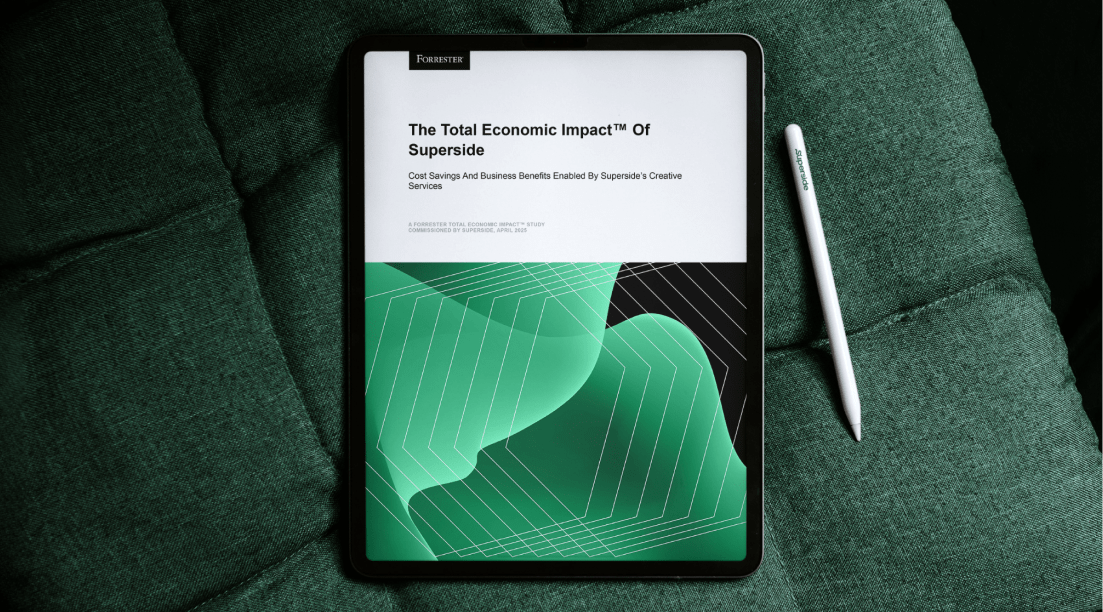
The financial case is hard to ignore. The Forrester Total Economic Impact study of Superside found a composite enterprise customer generated $4.16 million in business value over three years, achieved a 94% ROI and recovered its investment in under six months. The study also found Superside saved $1.9 million in avoided agency costs and $1.2 million in internal labor, helped by 60% fewer review rounds.
Two ways enterprise teams work with Superside
Enterprises typically work with Superside in one of two ways, depending on the support they need.
1. Superside as a creative service partner

When you work through our creative automation services, AI is already embedded in the work that lands on your desk. You get the output, strategic support and brand consistency without managing prompts, platforms, model selection or training yourself. Your senior creatives stay focused on the work AI still cannot do, and as the heavy production moves to us, internal bottlenecks start to ease.
2. Superside as an AI consulting partner

When you work through our AI consulting services to redesign your operating model, we help you identify where AI delivers outsized value, onboard your team with hands-on upskilling and build a mix of proprietary turnkey solutions and custom development. The result is 360-degree support to implement AI in a way that actually removes the bottlenecks holding your team back.
Many enterprises eventually combine both. First they use consulting to redesign the workflows, then they use the creative service to handle the high-volume work they choose to outsource. Sherweb scaled AI adoption this way. Vimeo transformed its creative workflows. Two Fortune 500 enterprises doubled their AI adoption and identified 25% efficiency gains through structured rollouts.
From overcommitted to unblocked
Creative bottlenecks in large organizations are not a sign that the team is failing. They are a sign that the operating model has not kept up with the demands placed on it. Volume is up. Channels are up. Stakeholders are up. Stakes are up. The structural pressure is not going away.
What can change is the operating model. AI handles the execution work that drains creative attention. Senior creatives keep the craft, the brand and the strategic calls that compound. A creative memory layer captures decisions and gets sharper with every project. Production flows, briefs land cleaner, approval rounds shrink and the work that ships is better, not just faster.
Grecia describes what that unblocked state actually feels like for a team that has reached it.
It looks organized and reasonable, with clear priorities, realistic timelines, and strong follow-through across the team. When expectations are clearly aligned and the process is well managed, the end result is high-performing creative work.
Superside is built around exactly this idea, and Superside customers save more than 31,000 hours a year as a result. If your team is feeling the squeeze between volume demand and brand standards, the highest-leverage move you can make this quarter is a 30-minute conversation about what an unblocked operating model looks like inside your stack.
It’s time to make Superside your creative team's creative team.
FAQs


Stuck in AI testing mode?
It’s time to move from experiments
to real impact.
Explore AI Reset—a 5-step framework
to embed AI into your creative workflows.

Creative teams are at a breaking point
The pressure is real, the opportunity is too.
Get insights from 300+ leaders on
beating burnout, using AI wisely
and navigating 2026’s inflection point.


What 200+ creative leaders had to say
There’s a reason we called it the Overcommitted Report.
But, is there light at the end of the carpal tunnel?



The data speaks for itself
According to a Forrester Total Economic Impact™ study, Superside delivers a 94% ROI and pays for itself in six months.


Increase your creative capacity
Let your in-house team reach for the stars,
while Superside keeps your day-to-day creative needs
at an industry-leading level. Ready to scale?