

Enterprise teams don't scale creative with AI alone. They scale through a hybrid model that combines automation, human oversight and managed production to prevent brand drift, tool sprawl and declining creative quality.
Ask any marketing or creative team what the hardest part of an enterprise campaign is, and the answer is almost always the same.
Shipping it.
The idea is rarely the bottleneck. Getting it out the door is. In 200 sizes. In nine languages. In three formats. Before the campaign window closes.
The ideation phase is often less resource-intensive than production, especially when teams use AI-first creative services. But once the ideas are there, hundreds of assets need to roll out in different sizes, languages and formats.
The technology to close that gap has arrived. McKinsey estimates agentic AI will come to power as much as two-thirds of current marketing activities. Yet nearly 90% of CMOs are still only experimenting, and fewer than 10% have captured value across end-to-end workflows. The tools showed up. The throughput did not.
To stay ahead, many teams now run automated creative production workflows. But without the right workflows and guardrails, AI can churn out off-brand assets that clog review cycles and blow campaign timelines.
This article explores two key approaches to automated creative production. Using creative automation tools, and engaging a creative automation service. We unpack what automated creative production means in the environment marketing teams operate in right now, and how AI-powered systems that learn with each project (cue Superside's Brand Brain) keep automated outputs consistent, on-brand and on point.
What automated creative production really is in 2026
Automated creative production uses systems like templates, workflow logic, generative models and agentic AI to take the repetitive parts of creative work off the human plate, while keeping strategy, taste and brand integrity in human hands. The goal is twofold:
- Eliminate repetitive work, speed up production and protect brand integrity.
- Give human creatives more time for higher-level work that moves the brand forward.
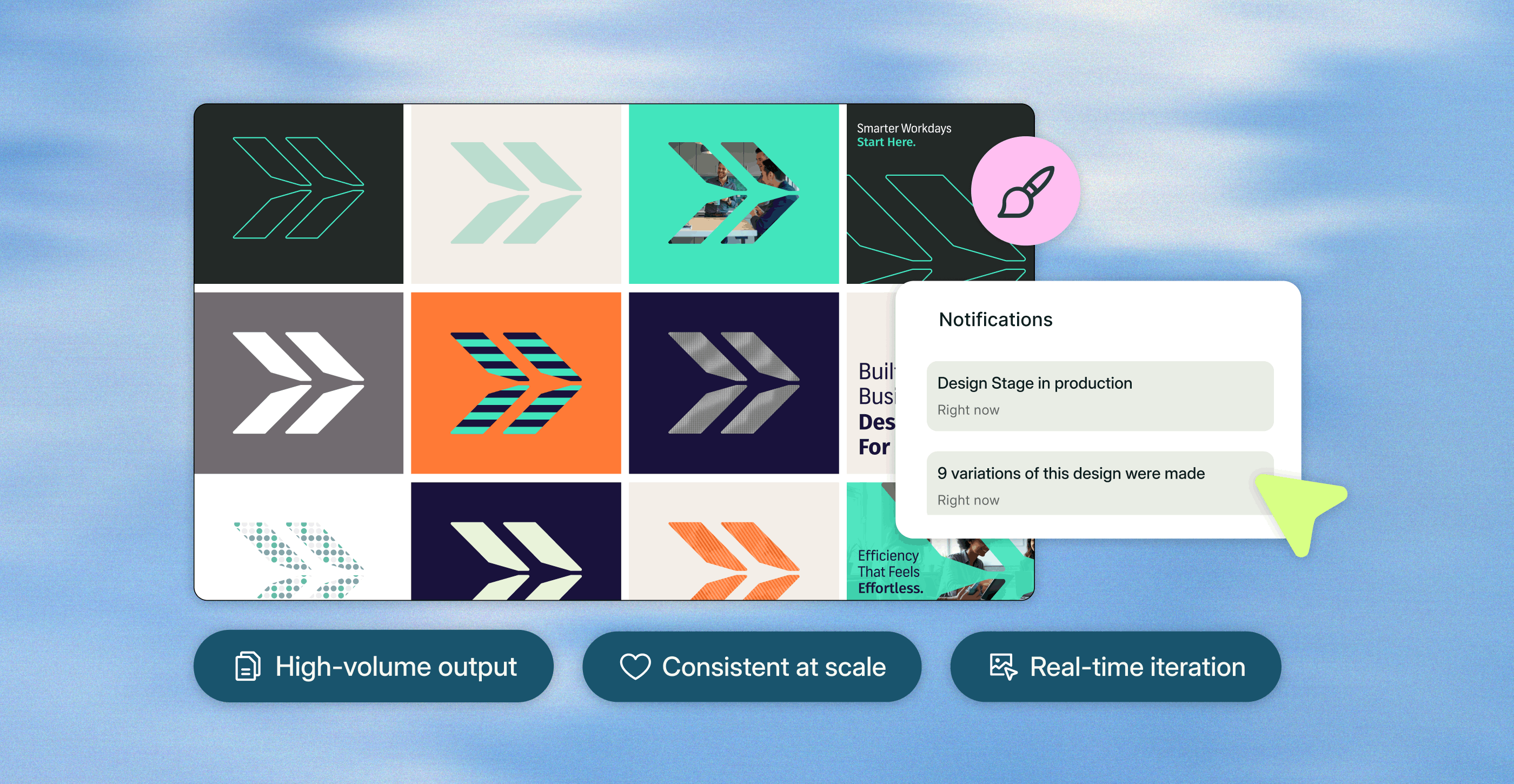
It is broader than design automation, which usually covers template-based tasks like resizing or asset versioning. Automated creative production covers the whole loop. Brief intake, concept development, asset variation, localization, QA, approval routing and publishing.
The three layers most enterprise teams operate in
EMARKETER breaks today's automated creative stack into three layers.
- Generative AI. Creates net-new assets from prompts. Images, video, copy and storyboards. The fastest-moving layer, and the one most teams have already touched.
- Dynamic creative optimization (DCO). Assembles pre-built components like headlines, images and calls to action in real time, based on audience signals. The classic performance-marketing play.
- Agentic AI. Manages end-to-end campaign workflows, from planning through performance analysis, with minimal human intervention. This is the frontier.
Many enterprise teams already use generative AI and DCO to some degree. Agentic AI is still a novelty for most, and it is also where the biggest mistakes happen.
Generic agents trained for everyone produce average work for everyone. If you want a vendor-by-vendor look at the platforms doing this work today, our roundup of the 10 best creative automation services for enterprises in 2026 maps the landscape. This piece zooms out to the operating model behind them.
The business case for automated creative production
Three forces are driving demand for creative automation, and they are stacking on top of each other.
The volume mandate is compounding
Marketing teams are under constant pressure to produce more assets across more channels, formats and audiences. Generative AI in content creation is forecast to grow at a 32.5% compound annual rate through 2030, according to Grand View Research, a signal of how fast output expectations are climbing.
At the same time, Superside's Breakpoint research shows that 80% of creative teams are at or beyond capacity, and 70% of creative leaders feel burnt out. Despite teams turning to generative AI for help, the pressure isn't easing. The volume problem is also a people problem.
Speed expectations have shifted into another gear
McKinsey estimates agentic AI systems could accelerate the creation and execution of marketing campaigns by 10 to 15 times. Organizations that implement agentic marketing workflows could also see 10 to 30% revenue growth from hyperpersonalized marketing.
Combined with AI tools for marketing, these systems enable teams to produce content faster, automate repetitive tasks, and scale creative output efficiently. As the pace accelerates, enterprise teams cannot afford slow production cycles. High-volume graphic design is no longer the exception. It is the baseline.
The returns for getting it right are exceptional
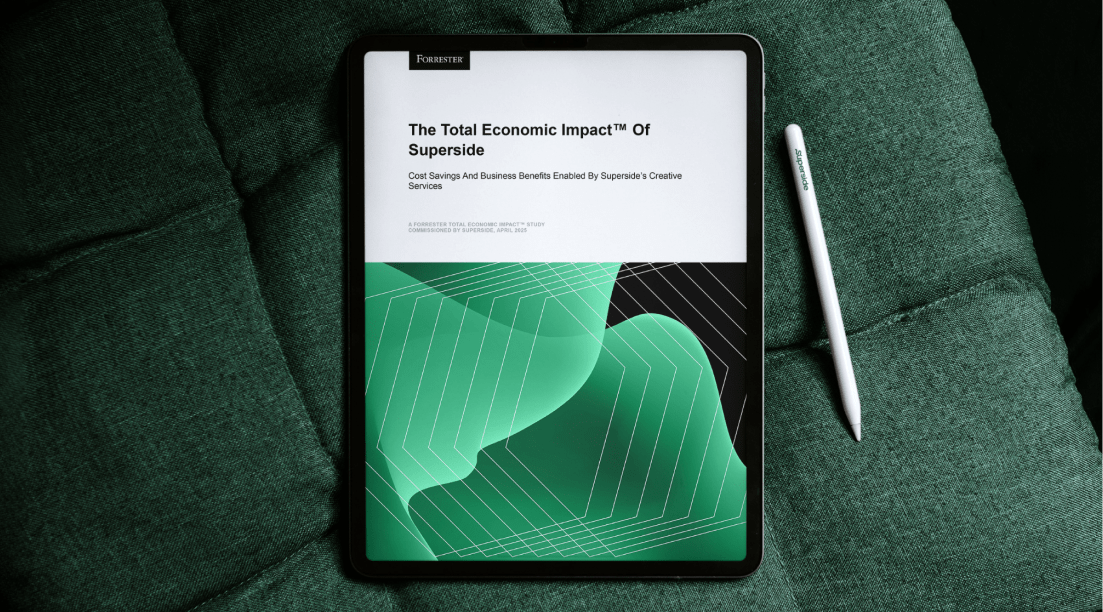
Forrester's Total Economic Impact study of Superside found that a composite enterprise customer realized a 94% ROI over three years, $4.16 million in total benefits and a six-month payback, plus $1.2 million in internal labor savings and 60% fewer review rounds.
Much of that value comes from automating time-consuming production tasks. Combine the Forrester results with the McKinsey figures, and the conclusion is hard to ignore. Brands that fall behind the automation curve leave money on the table.
Why creative production at scale usually fails (and how to fix it)
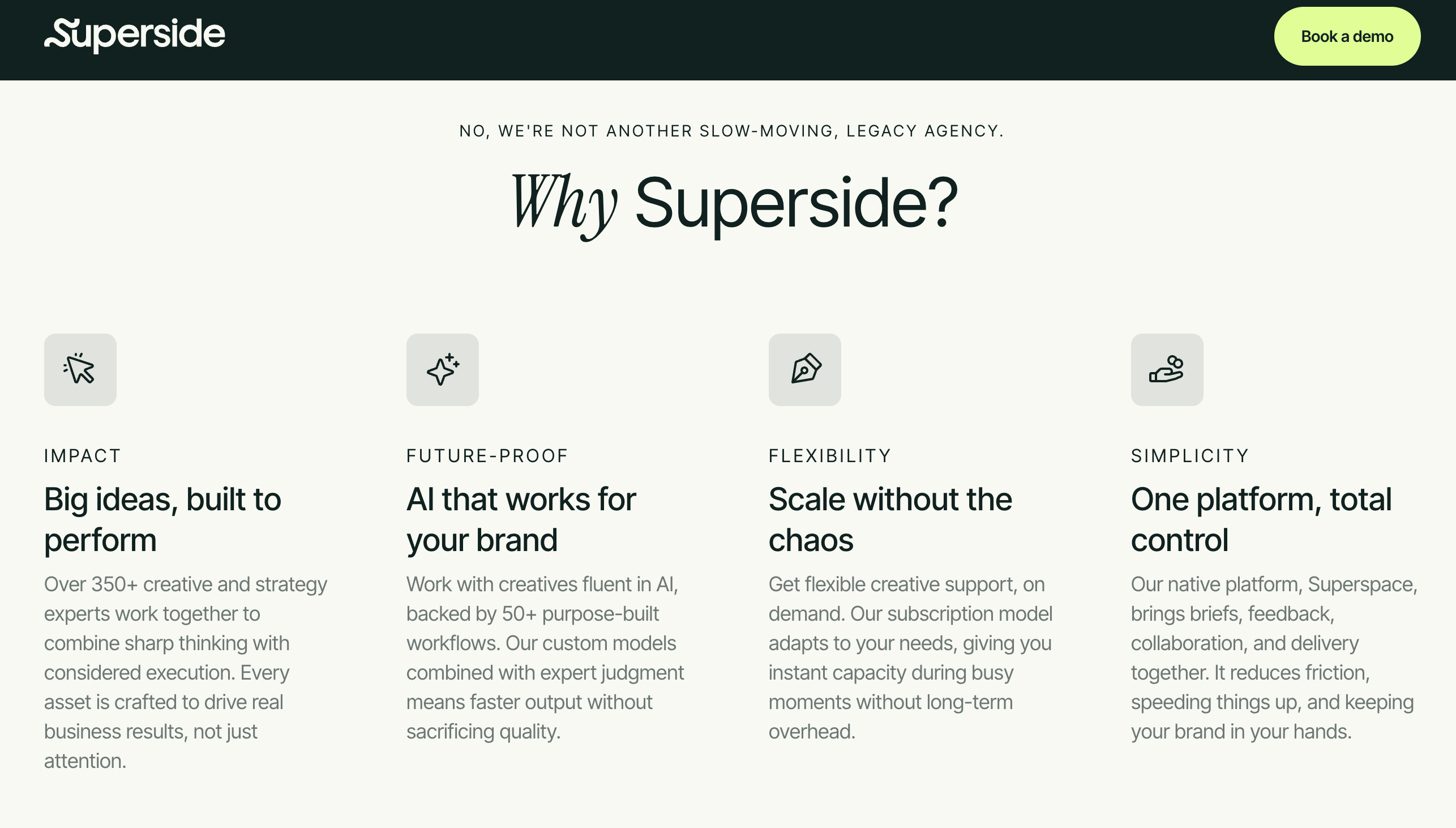
Despite everything creative automation solves, it often falls short of expectations. Not because the technology is bad, but because the operating model around it was never reset. The result is a team running a 2026 stack on a 2018 process. Four pitfalls show up again and again.
Tool sprawl instead of workflow design
Many teams stitch together a creative production solution from standalone tools. A digital asset manager, separate AI image and copy generators, a workflow tool and a feedback layer. Each one promised to 10x the team.
None of them talk to each other, so they add complexity, slow workflows and burn hours on fixes. McKinsey calls this the gen AI paradox. The technology can be found everywhere except on the bottom line. Activity rises. Output rises. Working spend does not.
Scale without differentiation
When everyone prompts the same models with similar briefs, output converges. AI helps teams produce more, but it does not create differentiation on its own. Superside's No-Hype AI Report flags the same risk. And the gap is visible to consumers.
IAB research found that 82% of ad executives believe Gen Z and millennial consumers feel positive about AI ads, while only 45% of those consumers actually do. That 37-point perception gap widened from 32 points in 2024. Volume without taste is a losing game.
Brand consistency breaks down at volume
The more a team produces, the more chances brand standards have to slip. The wrong shade of blue in one market. An outdated tagline in another. A hero image that reads as generically AI-made where consumers are already skeptical.
IAB found that 60% of US ad professionals cite accuracy and transparency as a top barrier to AI adoption in media campaigns. Speed and brand consistency are not mutually exclusive, but holding both at scale takes automated workflows with quality control built into every stage.
The context tax
Every new agency, freelancer, contractor or AI tool starts at zero.
Each has to learn your audience, brand voice, creative history, campaign goals and past lessons before producing useful work. Without systems that capture and retain that institutional knowledge, teams pay the same onboarding cost over and over. McKinsey notes that legacy marketing architectures (CMS, DAM, CRM and analytics) were never designed for real-time agentic workflows or shared data models. The context tax is invisible on a P&L and ruinous in practice.
Underneath all four sits a quieter cost. People.
General Assembly found only 39% of US and UK marketers are confident their teams can use AI to drive revenue. Ascend2 found 54% fear a loss of creativity and human touch. For a large share of enterprise teams, that hesitation is the norm rather than the exception.
Tools vs services. The operating-model trap
The automated creative production market splits into two very different approaches. Self-managed tools and managed services like Superside. The model you choose has a major impact on whether you experience the four problems above or avoid them altogether.
| Dimension | Self-managed tools | Managed creative automation services like Superside |
|---|---|---|
| Who runs it | Your in-house creative ops team. | A dedicated external creative team plus AI specialists. |
| Setup time | Weeks to months for template setup, integration and brand training. | Days to weeks. The partner builds custom workflows around your existing processes. |
| Brand governance | Enforcement depends on internally built reviews and workflows. | Built into delivery. Senior creatives gate every automated output. |
| Strategy and ideation | Out of scope. You bring the brief. | Included. Concept, campaign strategy and execution come with the team. |
| Tool stack | A single platform you administer, or multiple tools strung together. | 50+ AI workflows and a tool-agnostic stack the partner manages and integrates. |
| Best fit | Mature ops teams with consistent, narrow use cases. | Enterprises scaling creative volume and complexity across many campaigns. |
| Risk profile | Can lead to all four pitfalls. Tool sprawl, AI sameness, brand inconsistency and context loss. | Risk tied to vendor selection, then mitigated by SLAs, governance and TEI-grade ROI. |
The core difference
Leading creative automation platforms provide powerful technology, but they do not automatically deliver the processes, workflows and governance needed for success.
A creative automation service like Superside gives you the right technology, the team to operate it, the strategy to direct your outputs and the human checks that keep assets on-brand at velocity.
Which model to pick for your team
For high-stakes enterprise projects like rebrands or full AI workflow buildouts, a managed service is often the better choice. It lets you scale creative operations smoothly, without the delays, inefficiencies and risks that accompany major transformations. If you already have a mature design operations function and the capacity to manage a suite of tools yourself, self-service platforms may be viable.
Many enterprises land on a hybrid. They use platform-native tools such as Meta Advantage+, Google Ads and Adobe Express for channel-specific production, and rely on a creative service partner to manage cross-channel, cross-market operations. The tools do not replace the operating model. They sit inside it.
What good creative automation looks like (and how to tell)
It is usually easy to spot when creative automation is not working, and just as easy to recognize when it is. Projects move from concept to launch without endless back-and-forth. Reviewers stop catching the same mistakes month after month. Ad creative iterates in real time because variations no longer mean starting from scratch. At that point, four things are true.
- There is a single source of brand truth that humans and AI can both query.
- Repetitive production work is automated. For example, a workflow resizes social images into ready-to-go variants.
- Senior creatives spend their time on valuable human work, like concept design and campaign strategy.
- The gains are quantifiable.
Superside's partnership with a Fortune 500 company shows what that looks like. Within weeks of adopting Superside's operating model, the company saw 25% efficiency gains in its workflows, with immediate improvements in ideation and copywriting.
If you had asked me about using AI for writing scripts two years ago, I would have been skeptical... now I see how much it can revolutionize the process. It’s already helping us a lot
A five-step roadmap for automated creative production
Adapting McKinsey's framework for agentic marketing, here is what works for marketing design ops specifically.
- Map your existing workflows. Audit how creative assets move from brief to delivery today. The highest-volume, highest-friction tasks (resizing, localization, versioning, QA, approval routing) are the first automation candidates.
- Define what should remain human. Be explicit about the work where taste, judgment and strategy are the differentiator. Brand strategy, master concept design and performance interpretation are not automation targets.
- Centralize your brand context. Before adding agents, get your brand system, prior work, feedback and decisions into one place that humans and AI can both query. This is the problem Brand Brain was designed to solve.
- Pick a model that matches your maturity. If you are scaling, rebranding or building AI workflows from scratch, a managed creative automation service compresses time-to-value. Cross-reference our vendor comparison before you commit.
- Build in brand governance. Set brand, legal and quality guardrails before you scale, not after. Every output should pass a structural check against the brand system. AI creative quality control is not optional.
What makes for a good automated creative production partner

The best automated creative production partners do more than hand you tools. They combine technology, creative expertise and operational systems to help teams scale output without sacrificing quality, brand consistency or strategic oversight. A strong partner should scale production across four core areas.
- Static production workflows. Enterprise teams need thousands of creative variations for social media, banner ads and more, across markets and formats. A strong partner turns approved master assets into large volumes of brand-consistent files using modular design systems.
- Motion, video and print automation. Teams should be able to repurpose assets into motion graphics, video and print-ready formats while automating localization, resizing, aspect-ratio changes and content updates.
- Modular email and web production. Email and web design suit automation well because they rely on repeatable components. Look for partners that build modular template libraries, reusable content blocks and scalable design systems.
- AI-enhanced creative automation. Automation should be paired with brand intelligence and human oversight. AI speeds up production, testing and optimization, but outputs need to be guided by brand-specific context, established design systems and quality-control processes.
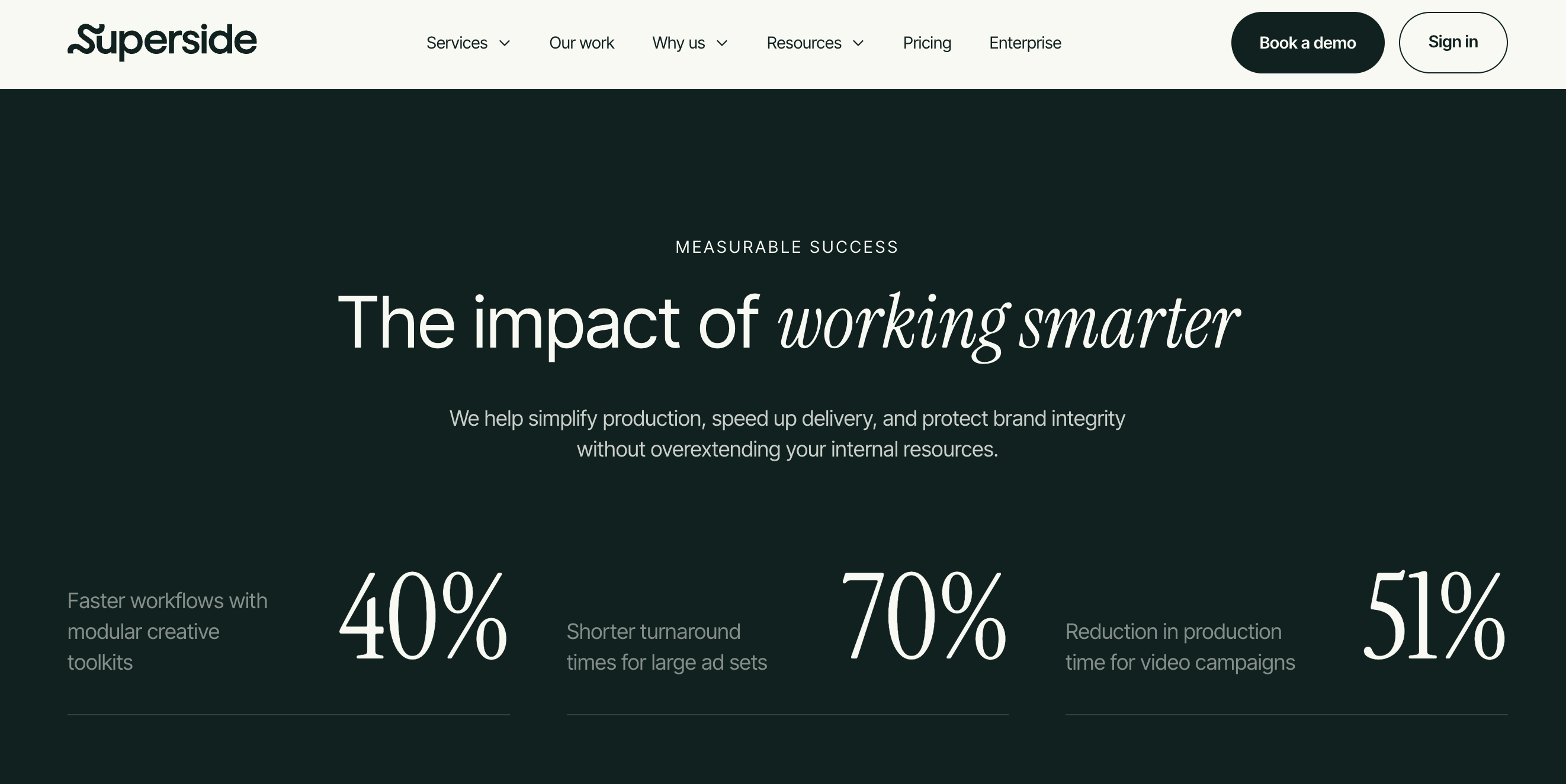
In addition, your chosen partner should have a proven track record of delivering strong creative automation systems. In Superside's case, customers see:
- 40% faster workflows with modular creative toolkits.
- 70% shorter turnaround times for large ad sets.
- 51% reduction in production time for video campaigns.
These results are possible because Superside's model is AI-first, not AI-flavored. The entire creative process, from briefing to production, review and delivery, is built around how humans and AI work best together.
In practice that means more than 50 AI workflows, a team of AI-certified creatives and custom models trained on your brand. Where most companies hand you a tool and walk away, Superside provides the expertise to implement a system that keeps delivering creative quality over time.
Where creative automation creates the most value for enterprise teams
Automated creative production delivers the most value in four kinds of programs.
- Multi-market launches. A single hero concept that needs to ship across many markets, languages and formats. Automation collapses a six-week scramble into a faster rollout, with a creative director gating every market. Campaign strategy services and brand-led automation come together here.
- Performance creative refresh. Paid social and programmatic need constant variation to avoid fatigue. Automation generates the variants, your strategy team picks the bets, the channel team deploys and the loop runs weekly instead of monthly. This is where ad creative velocity becomes a real performance lever.
- Rebrand rollouts. A new visual system has to land across thousands of legacy assets, templates and channel surfaces. Brand Brain captures the new standard and automation pushes it everywhere. Pair with branding services for the strategic groundwork.
- AI workflow buildouts. Teams that want AI in their stack but lack in-house expertise. Superside's AI consulting team designs the workflow, embeds the models, trains the team and stays on for ongoing optimization.
These are not theoretical. Superside has rolled out automated workflows to multiple customers, all of whom have seen how a managed service reduces repetitive tasks and delivers results that most in-house tool stacks struggle to match.
Brand Brain: The creative memory driving Superside's automation success
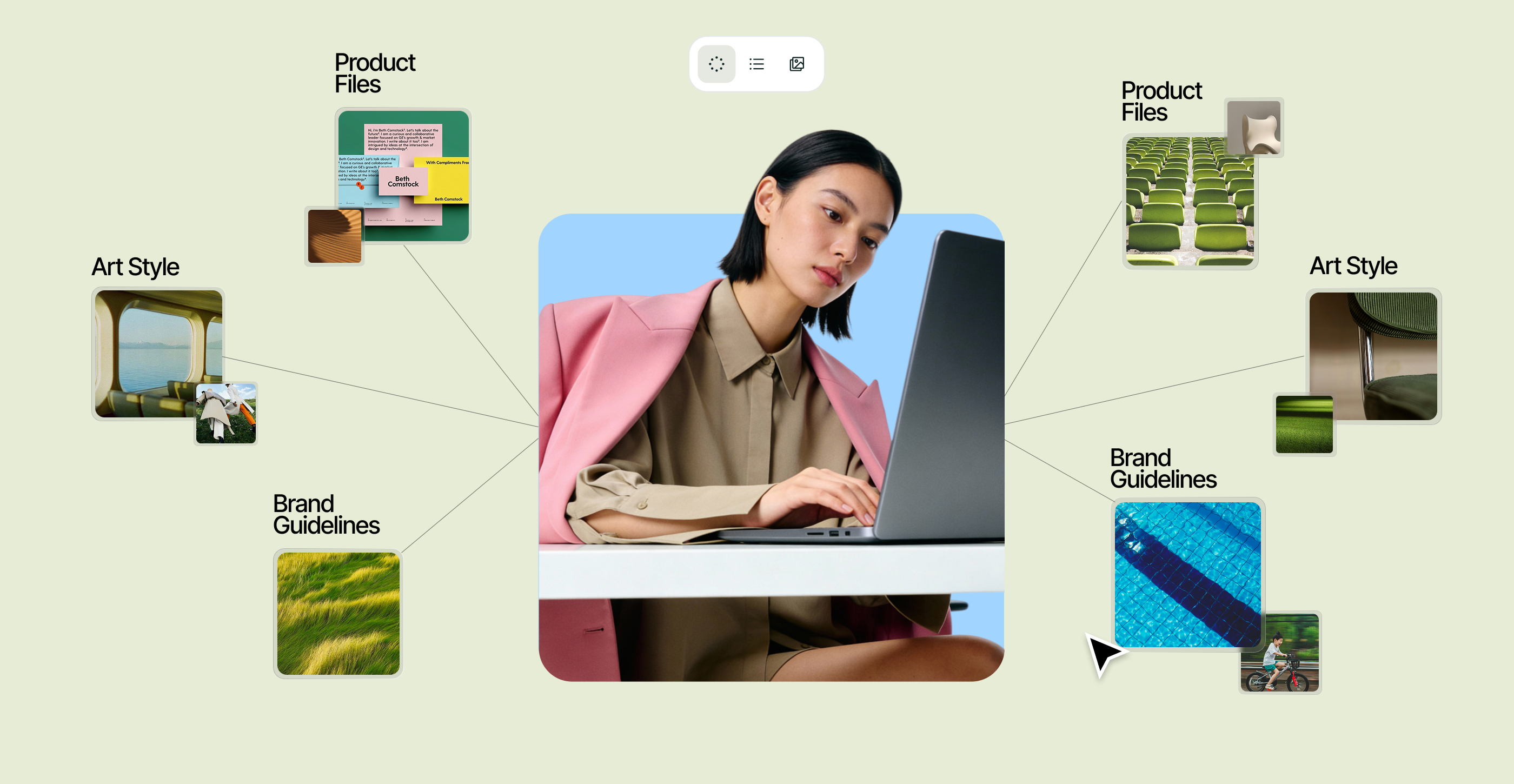
At the heart of Superside's creative automation is Brand Brain, the AI-first creative memory inside Superspace, the platform Superside customers already use to brief, review and deliver work. Brand Brain captures what makes your brand unique. Guidelines, tone, messaging, compliance, past work, feedback and performance signals all sit in one place that AI agents and human creatives can query.
Being AI-first means AI is not just powering individual tools. It is embedded across the entire creative model, from how teams are trained to how brand knowledge compounds over time. Brand Brain powers four high-leverage capabilities.
- AI Briefing. Turns rough requests into structured, on-brand briefs in minutes, pulling specs, references and prior decisions from your Brand Brain so alignment happens before work begins.
- AI Insights Agent. Lets you ask your brand about itself. Instead of digging through files, the agent surfaces patterns, gaps and opportunities across campaigns, content and team activity.
- Brand Models. Custom-trained on your visual style, these models generate on-brand imagery in seconds. No stock, no shoots.
- Custom Automations. Repetitive tasks like asset resizing, headshot editing, product shots and motion adds become step-by-step workflows your team can run on demand, built by Superside's AI experts.
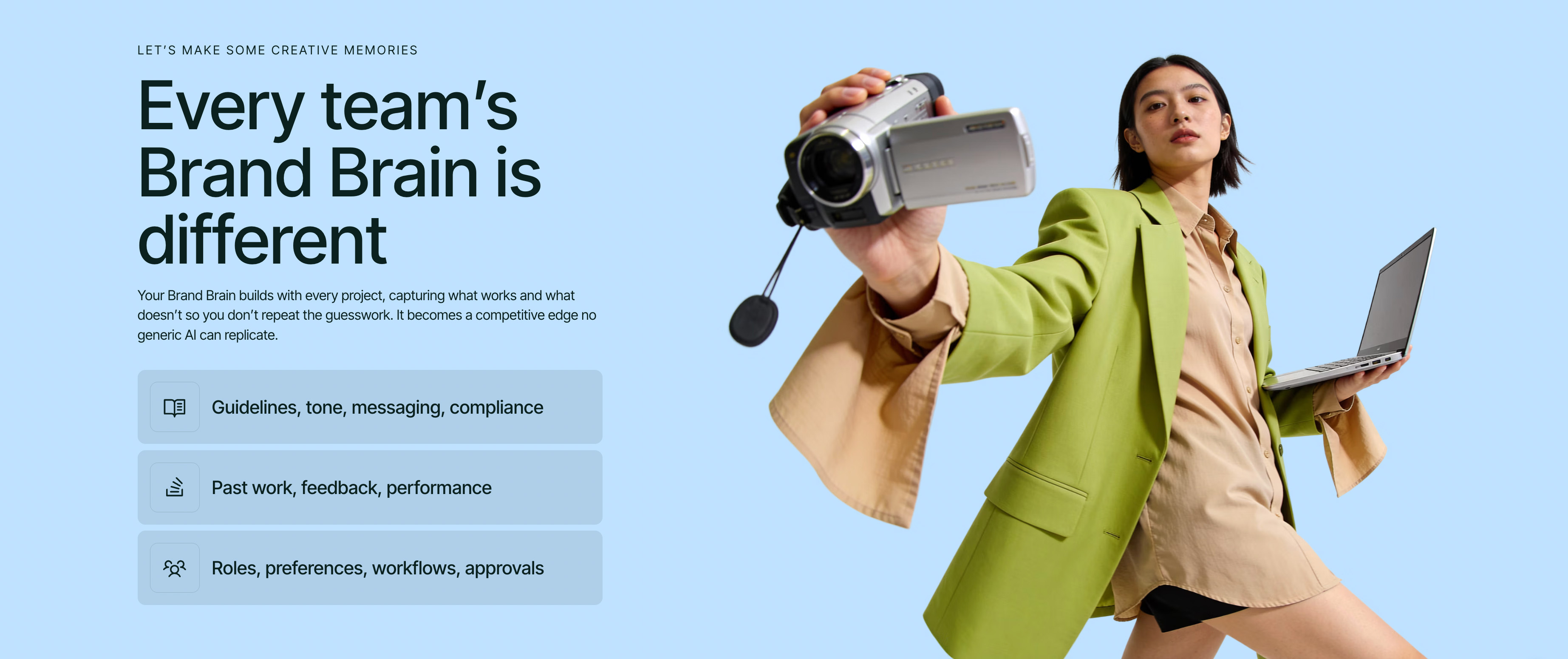
Because Brand Brain learns with every project, future work gets more aligned over time. New collaborators ramp in days. Approval cycles compress. Off-brand outputs get rarer because the system stops producing them, and creative content velocity stops being aspirational.
That is the moat. Generic AI gets sharper as the world's prompts compound. Brand Brain gets sharper as your brand's prompts compound, which is what makes it a competitive edge rather than a feature. It comes included in every Superside engagement through Superspace by default.
Request access or book a call to see how Brand Brain would map to your brand.
Creative automation is the new enterprise operating model
For many enterprise teams, automated creative production has become one of the most effective ways to keep pace with growing content demands and faster campaign cycles. But automation alone is not enough. Without the right systems, governance and creative oversight, more output comes at the expense of quality and differentiation.
The strongest solutions combine the efficiency of AI with the judgment and creativity of humans. That is exactly what Superside does as the world's leading AI-first creative partner. With us, you get the creative services, global teams, top talent and automation expertise you need, and a partner that truly becomes your creative team's creative team.
If your team is feeling the squeeze between volume demands and brand standards, the cheapest move you can make this quarter is not another tool. It is a 30-minute conversation about how a managed service fits your stack. See Superside pricing for engagement options, or compare Superside to alternatives if you are still mapping the field.
FAQs


45% more efficient creative
Our expert AI designers help you create, test
and launch multiple, impactful concepts at scale.
We'll get you to market sooner.

Creative teams are at a breaking point
The pressure is real, the opportunity is too.
Get insights from 300+ leaders on
beating burnout, using AI wisely
and navigating 2026’s inflection point.

The data speaks for itself
According to a Forrester Total Economic Impact™ study, Superside delivers a 94% ROI and pays for itself in six months.




Harness AI power on creative
Superside’s AI Design Services help enterprises go faster,
reduce costs and deliver high-quality assets at scale.
We'll help you get tomorrow’s possibilities on today’s deadline.


Meet Customers Who’ve Experienced Exceptional ROI
Discover how Shopify got 4,375 assets in 12-24 hours or how Amazon saved 345 hours in three months.