


Creative friction is the hidden work that slows teams down and weakens campaign quality. It typically stems from briefing, alignment, feedback, production and knowledge gaps. The most effective teams reduce friction by combining AI-powered execution, creative expertise and shared brand context through tools like Brand Brain.
Nobody became a designer to chase approvals or spend half the week coordinating stakeholders. Yet for many enterprise creative teams, this operational work now consumes more time than the creative itself. Good ideas get stuck in layers of revisions, approvals, production admin and feedback loops, losing momentum and quality along the way.
Stakeholders join too late. Context gets scattered across Slack threads, slide decks and disconnected tools instead of living inside a shared creative management platform. And creative demand keeps growing.
What was once a single campaign now needs dozens of variations across channels, formats, audiences and markets. On their own, these interruptions seem manageable. Over time, they reshape the entire process, draining energy, slowing production and pushing good ideas further down the list.
It’s a challenge more enterprise creative teams are now grappling with, and it is the thinking behind our new line of thought: Cut the friction. Not the craft.
This article defines creative friction, breaks down the five types of enterprise teams meet most often and explains how it damages campaign quality over time.
We also look at why the obvious fixes fail and why AI-first creative operations built around experienced creatives, smart workflows and shared memory are the way forward.
What is creative friction?

Creative friction is the invisible, everyday work (admin, unclear briefs, alignment issues, feedback loops and lost context) that slows creative teams down and dilutes the quality of what they ship. It’s the work around the creative, not the creative itself.
Left unchecked, the friction builds over time. Teams spend more energy managing the process than making the work, which results in slower delivery, more rework and less capacity for high-impact ideas.
Creative friction is not the same as healthy creative tension, and the distinction matters.
- Creative tension improves the work. Strong debate between designers, strategists and the creative director often sharpens a concept or pushes a campaign toward a better outcome. Good collaboration sometimes involves disagreement.
- Creative friction rarely improves the work. It drains time and attention, creates conflict without producing better thinking and pushes teams into reactive behavior instead of focused creative practice.
Many companies assume creative friction comes with the territory. In reality, most of it is created by inefficient workflows, scattered brand information and overloaded teams, which means most of it can be removed.
Why creative friction is growing
Enterprise creative work has changed dramatically over the last decade. Campaigns no longer live in a handful of formats. One idea now expands into social assets, video edits, landing pages, motion graphics, paid campaigns, event materials and localized content across dozens of channels.
In-house teams are being asked to produce far more than before, and competitive advantage increasingly depends on creative content velocity, how quickly teams can produce, adapt and deploy high-quality, on-brand creative.
Unsurprisingly, teams are struggling to keep up. Superside's Breakpoint research found that 4 in 5 enterprise marketing and creative teams operate at or beyond capacity. When teams are stretched that thin, even minor inefficiencies pile up and turn creative workflows into bottlenecks that slow the entire engine.
The five types of creative friction
Creative friction tends to appear in five recurring forms. Most enterprise teams experience all of them at once. Naming them is the first step toward removing them.
1. Briefing friction
Briefing friction happens between the moment a stakeholder requests work and the moment the team can begin. A request comes in with partial information. The objective is not fully defined, brand requirements are missing and key context lives across Slack and email.
Before any work starts, the team sends follow-up questions, tracks down past examples and pieces the context together. What should be a straightforward handoff turns into a series of tasks before the project is even underway.
2. Alignment friction
Alignment friction appears when too many stakeholders influence a project without a clear decision-making structure. Marketing wants speed, legal wants caution, brand wants consistency, regional leaders want customization.
Every input matters, but when priorities collide and no one owns the final call, projects stall and feedback rounds multiply. Superside's research shows the pressure to deliver comes directly from executives 35% of the time, so alignment friction often runs top-down with no clear way for the team to push back.
3. Feedback friction
Feedback friction is the operational weight that excessive or poorly structured review cycles create. One stakeholder wants bold typography, another wants something safer.
Someone adds comments after approval or joins halfway through and restarts the conversation. Constructive feedback improves work, but unmanaged feedback just creates drag. As the campaign puts it, AI will not kill creativity, but it will kill the 14 rounds of feedback.
4. Production friction
Production friction is the repetitive operational work that buries creative teams. Resizing ads, reformatting presentations, versioning campaigns across markets, updating copy, reorganizing folders, managing approvals and checking specs again. Individually minor, collectively enormous.
Our research shows 85% of creative leaders spend substantial time on admin or production work rather than the high-value creative thinking that moves their brand forward. It often exposes weaknesses in marketing design operations and enterprise creative systems.
5. Memory friction
Memory friction is the cost of context lost between projects. Past decisions disappear, performance insights never feed into future campaigns and teams repeat old mistakes because the reasoning behind earlier choices was never captured. It is the most expensive form of creative friction because it forces organizations to pay for the same learning multiple times.
Every new project starts with partial memory rather than accumulated knowledge. This is the problem Brand Brain was designed to solve.
The AI-first creative memory inside Superspace captures brand context, feedback patterns, stakeholder preferences and campaign insights so teams do not rebuild the same knowledge every time.
How creative friction damages creative work

Creative friction rarely damages quality all at once. It creates a series of small compromises that gradually become how the team operates. Five effects show up most often.
1. Senior creatives shift away from high-value work
Every team has a limited number of senior strategic hours each week. When friction rises, those hours disappear into production and coordination. Experienced designers manage bottlenecks, leaders resolve workflow conflicts and strategists rewrite briefs instead of developing ideas.
70% of creative leaders say their most talented creatives spend time on work below their skill level, and quality drops not because the team is less talented, but because the talent is on the wrong work.
2. Review cycles expand
Problems at the start create bigger problems later. An unclear brief leads to work that misses the mark, which generates more feedback, revisions and stakeholder involvement. As deadlines close in, teams have less time to solve problems properly and are forced to compromise. The final assets may still look polished, but the path to get there was long and expensive.
3. Brand consistency slips
When teams operate under pressure, brand consistency gets hard to manage. The flagship campaign stays strong because it gets the most attention.
The problems appear where there is less oversight, in regional variations or partner materials, as teams make small compromises to protect deadlines. Over time, those compromises weaken brand integrity. The fix is robust design systems with shared standards, reusable components and centralized brand knowledge.
4. Team members start to burn out
Most creatives are ready for tight deadlines. What wears them down is the constant context switching, admin and review cycles around the work. People hired to solve problems and push the craft forward end up chasing approvals and tracking feedback. The result is burnout.
Superside's Breakpoint report found that 4 in 5 teams operate at or beyond capacity and 7 in 10 leaders report burnout. When experienced creatives get overwhelmed, engagement drops and turnover rises.
5. The team keeps solving the same problems
One of the most costly effects is memory loss. When teams do not capture what worked, what did not and why decisions were made, the lessons disappear when a project ends or a team member leaves. The team revisits the same debates and repeats the same mistakes from project to project.
The organization keeps producing work but does not get much better at producing it. The most effective teams solve this with shared, AI-powered systems that capture context and apply it to future projects automatically.
Why most attempts to reduce creative friction fail

Once organizations see that creative friction costs them time, money and energy, they usually respond quickly. Many common fixes do not remove the friction for long. Four moves dominate, and each tends to produce a different version of the same trap.
1. Hiring more people
More designers can help in the short term, but a bigger team does not solve the structural problems below the surface. New hires inherit the same overloaded process and face the same briefing friction, alignment issues and faulty feedback loops. The workload spreads across more people, and the bottleneck soon returns.
2. Adding more agencies, freelancers or tools
Bringing in freelancers, agencies or new software can add capacity without reducing friction. More tools mean more workflows to manage, and more vendors mean more communication, more reviews and more chances for work to fall out of sync.
3. Over-documenting everything
Static brand guidelines, mood boards and reference documents are useful, but they are not built to capture and reuse the lessons teams learn over time. A 50-page PDF does not surface the right insight during a live project, connect past performance to future work or reflect changing stakeholder preferences. Knowledge only becomes useful when teams can apply it naturally, in real time, inside the process.
4. Adding generic AI into broken systems
This is one of the biggest mistakes enterprises make right now. AI can remove real production friction and speed up versioning, localization, QA and adaptation, but generic AI tools do not understand your brand, operating structure or approval patterns.
Bolting AI onto a broken process produces what McKinsey calls the gen AI paradox, where the technology is everywhere except on the bottom line. Most AI adoption efforts fail because teams do not trust the outputs, cannot connect the tools to real workflows or do not have time to figure them out.
The pattern across all four moves is the same. Creative friction is structural, so the fix has to be structural too.
What a lower-friction creative operating model looks like
Experts plus AI is the foundation of a new, frictionless creative process. The most effective enterprise teams now build around a combination of experienced creative talent, smart workflows and shared memory. The leaders who make real progress treat AI as an operating-model redesign, not a standalone tool rollout. Five things happen at once.
AI absorbs repetitive production tasks
High-volume operational work moves into AI-supported workflows and creative automation systems. Resizing, versioning, localization, production QA, structured briefing and basic adaptation. These still need human oversight, but they no longer consume the majority of the team's attention, which creates space for stronger strategic and conceptual work.
Senior creatives stay focused on craft
The strongest teams protect senior creative time carefully. Experienced people focus on direction, storytelling, judgment, concept development and cultural understanding, and they treat AI as a creative force multiplier that supports the work rather than replacing the people responsible for taste and decision-making. AI can accelerate production, but only humans can own taste, strategy and brand judgment.
Creative memory becomes operational
One of the biggest shifts in AI-first creative operations is the move to memory systems. Brand Brain is built around this idea.
Instead of forcing teams to rebuild context, it captures tone, preferences, feedback patterns, campaign history and performance insight right inside Superspace. Every new project starts with accumulated context rather than partial recollection, so teams spend less time searching and more time creating.
Performance insight feeds forward
In many organizations, valuable campaign insight is lost after launch. An AI-first model keeps learning active by capturing what worked, what failed, which ideas performed and which markets responded differently.
That analysis feeds into future projects, so the system gets more informed over time and AI creative quality control strengthens across campaigns.
Human expertise remains the foundation
Technology alone does not produce superb creative. People do. The strongest AI-first partnership models invest heavily in their creative team.
Superside has more than 800 designers, project managers, animators, copywriters and brand strategists, including senior creatives recruited from top brands and global agencies, plus a team of AI consultants.
Almost 100% of our creatives are AI-certified, trained to use AI as a creative amplifier without trading away the craft they brought with them.

Across more than 12,000 AI-powered projects, customers achieved 35% greater efficiency and saved more than 31,000 hours in a single year.
- Boomi tripled its creative output.
- IPG generated a bank of AI illustrations in 12 hours, reducing design time by 90%.
- Vimeo restructured its creative workflows to scale production more efficiently.
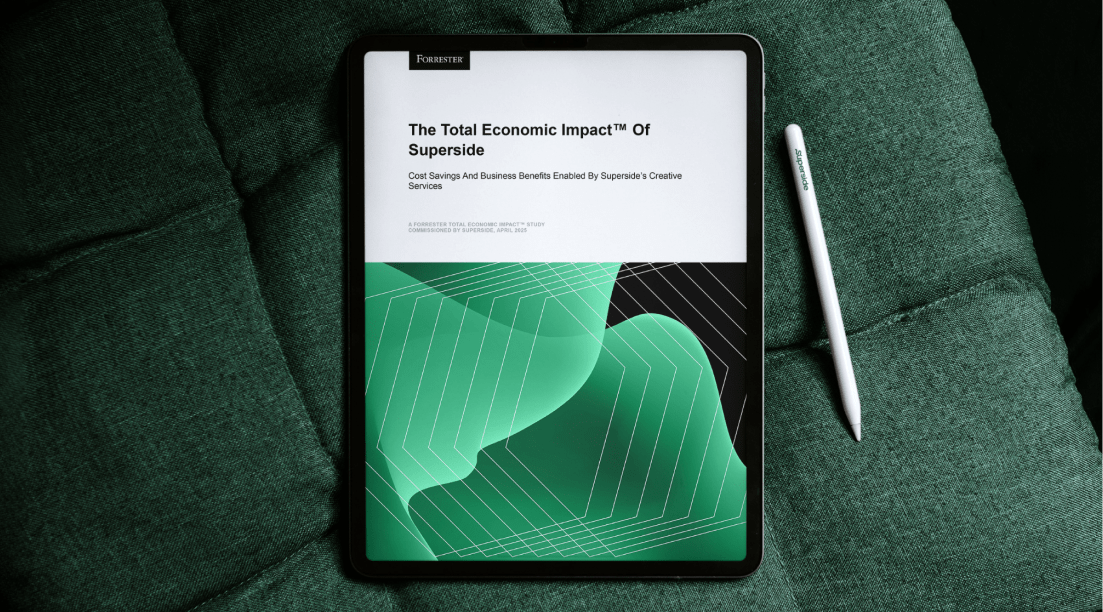
A partnership also moves business outcomes. Forrester's Total Economic Impact study reported a 94% three-year ROI for a composite customer and $4.16 million in total business benefits over three years. Those numbers are the inverse of the friction curve. They are what happens when a structural problem gets a structural solution.
Cut the friction. Not the craft.
Creative friction has grown from a workflow annoyance into a real business challenge. Instead of churning out more assets to keep up with demand, the organizations that make real progress rebuild how creative work gets done.
AI handles repetitive production, experienced creatives stay focused on strategy, brand direction and storytelling, and a memory layer preserves context between projects. Performance insight feeds back, workflows get sharper and teams spend less energy rebuilding the same knowledge from scratch.
This operating model sits at the center of Superside's AI-first approach. AI Excellence supports production, QA and optimization across the process, while our experienced creatives lead strategy, craft and brand judgment. The result is a frictionless creative process that protects originality. When you make Superside your creative team's creative team, you tap into that model end to end.
If long review cycles, limited context, production overload and off-brand design still slow you down and weaken quality, the highest-leverage move you can make this quarter is to rethink the system behind the work.
FAQs


Creative teams are at a breaking point
The pressure is real, the opportunity is too.
Get insights from 300+ leaders on
beating burnout, using AI wisely
and navigating 2026’s inflection point.


Make your creative team future-proof
97% of creative leaders say the role of the creative
professional will look fundamentally different in 5 years.
This report is our prediction for what’s coming
and how to be ready for it.


What 200+ creative leaders had to say
There’s a reason we called it the Overcommitted Report.
But, is there light at the end of the carpal tunnel?


How AI-ready is your team?
Take our free 2-minute assessment to benchmark your AI readiness and get:
- Your AI readiness score
- A snapshot of where your team stands today
- Curated resources to help you apply AI more effectively

The data speaks for itself
According to a Forrester Total Economic Impact™ study, Superside delivers a 94% ROI and pays for itself in six months.


Increase your creative capacity
Let your in-house team reach for the stars,
while Superside keeps your day-to-day creative needs
at an industry-leading level. Ready to scale?