

Thanks to AI, enterprise leaders now want more ad creative, more speed and better results. But more ad volume doesn’t automatically equal improved metrics. The best AI creative strategy for performance marketing pairs AI with human oversight, tests clear hypotheses and optimizes ads with data. This article walks through a six-phase framework (strategy first, structured ideation, quality-controlled variations, hypothesis-driven testing, insight extraction and performance reporting) plus five use cases where AI genuinely accelerates the work.
AI has raised expectations, with many enterprises pushing for higher ad creative turnarounds, more volume and variations and continuous testing to beat competitors.
But the rush to do more has created a dangerous trap. Many teams now generate hundreds of ad variations in the hope that sheer volume will compensate for a lack of strategy.
Unfortunately, more ads don’t automatically translate into a higher return on ad spend (ROAS). This approach mostly just generates more noise rather than helping brands achieve their long-term goals. According to McKinsey, AI in marketing delivers the best returns when organizations combine it with strategic human judgment rather than using it to simply increase volume.
The solution isn’t to dial down AI usage. It’s to use the tech more strategically. AI can dramatically speed up creative execution and help marketing teams maximize creative performance. But many teams don’t quite know how or where to wield AI’s power in performance marketing.
This article unpacks why AI has raised performance expectations, where the tech can actually help and how to build an AI creative strategy for performance marketing that increases speed, builds scale and delivers a strong ROAS.
Why AI raises performance expectations (and why more volume isn’t the answer)
85% of creative leaders say executives now expect faster turnarounds and higher output because of AI, both our “Overcommitted” and “Shift Happens” guides reveal.

For performance marketers, the pressure is even greater.
We’ve been seeing this shift since 2023, when economic headwinds in tech started to change. There’s definitely an expectation around moving faster and getting more done.

Slower growth, tighter budgets and a fragile labor market have also created an environment in which marketing and performance teams are expected to do more with less.
If AI can generate 100 ad variations in the time it once took to produce 10, executives naturally ask: Why aren’t we testing more? Why aren’t turnarounds faster? Why hasn’t ROAS improved in line with our AI investment?
But while AI can help fill certain gaps, its promise of speed and higher ad volume can also be a dangerous trap.
The volume-over-quality trap (and why it kills ROAS)
When performance marketing teams chase volume, they tend to use AI to generate dozens of ad variations quickly, run them against broad audiences and wait to see which ones perform.
Unfortunately, this approach has three fatal flaws:
- Budget dilution. Spreading spend across too many ads reduces impressions per creative, slows algorithm learning and produces unreliable results.
- Signal noise. Testing many similar variations at once adds noise. Algorithms perform better with smaller sets of meaningfully different creative assets.
- Incremental gains. High-volume testing often compares variations on the same idea, yielding marginal improvements rather than breakthrough concepts.
All three suppress ROAS, as they make it harder for platforms to identify and scale winners.
The “good enough” problem
There’s another hidden issue: AI outputs often look impressive, especially to less experienced creatives, until you compare them to genuinely superb work.
AI is an excellent way to move through ideation and research faster, freeing up time for deep work. But it’s a double-edged sword. Junior members might look at the output and say, ‘Seems good enough to me!
The problem is that “good enough” doesn’t win in performance marketing. If your ads look like everyone else’s or aren’t compelling, you won’t get engagement, and you’ll pay more to compete in the same auctions.
Everyone can now get to ‘good enough’ pretty quickly. But you get great results by tripling down on curiosity, pushing a layer deeper and asking yourself, ‘Is this as good as it can be?’
Where AI actually helps performance marketers

AI isn’t suited to every aspect of the performance marketing workflow. But where it is, it can dramatically accelerate work.
Here are five use cases to include in your performance marketing strategy.
Use case 1: Rapid ideation and concept exploration
AI is particularly effective for generating ideas.
Instead of manually brainstorming 5 to 10 concepts, AI can generate 50 to 100 directions in minutes. Most ideas won’t be good enough to use, but the volume widens the ideation space and surfaces angles human creatives wouldn’t have considered.
Practical use. Generate multiple ad campaign angles for the same product (e.g., focusing on productivity, cost savings, competitive edge). Then shortlist the 3 to 5 concepts that best fit your audience, goal and brand, and develop those.
Use case 2: Early-stage drafts and rapid prototyping
AI shouldn’t be expected to deliver finished work.
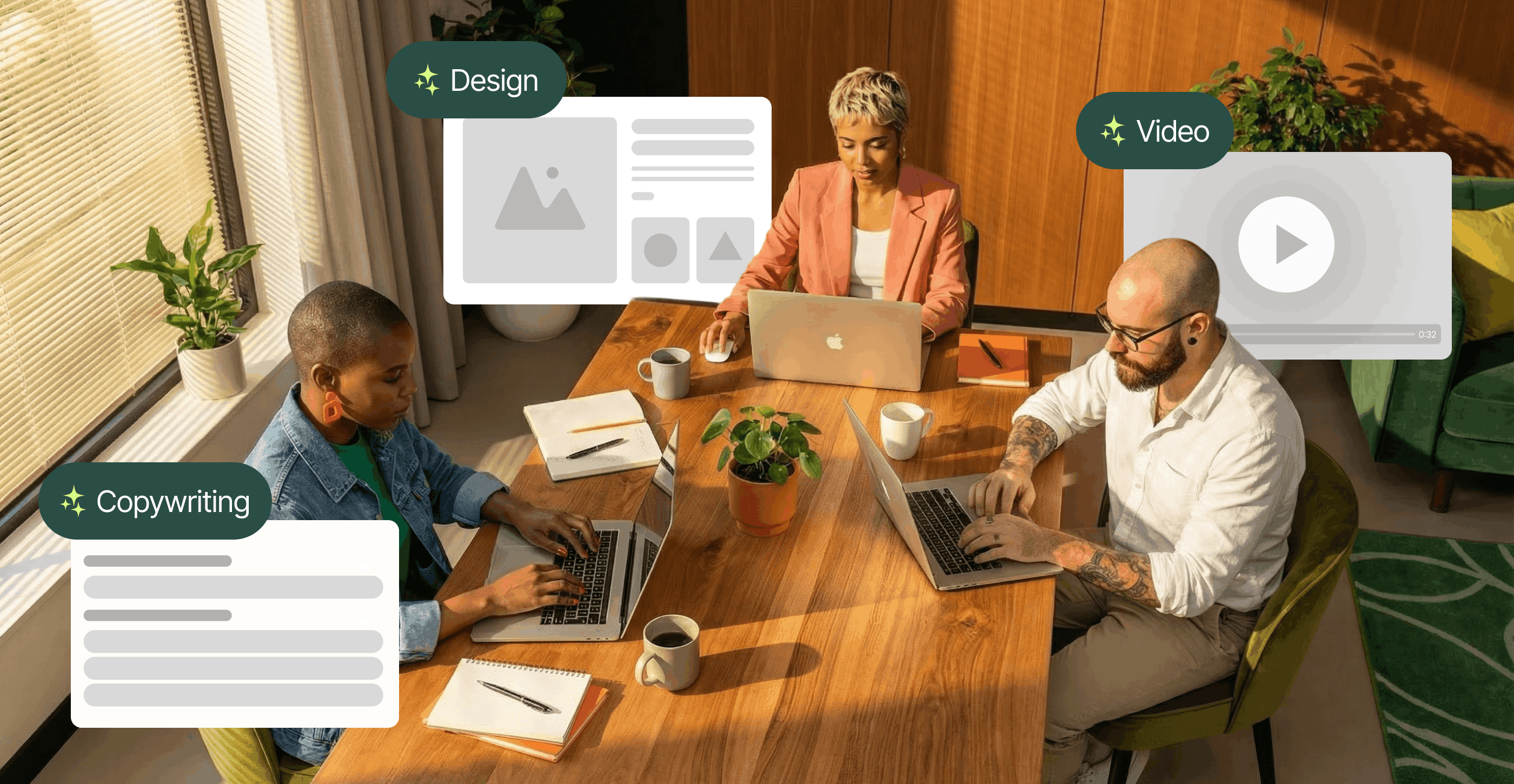
At Superside, our human-led, AI-powered workflows follow a pattern where AI generates rough copy, visual concepts or messaging frameworks. Our human creative talent then evaluates which drafts show promise. Once they’ve selected the strongest options, they invest creative energy in refining them.
A creative workflow looks like this:
- Ad copy variations. AI generates 20 ad headline options. Humans select and refine the strongest three.
- Visual concept sketches. AI creates rough mockups of different visual directions, and designers elevate the winning concept.
- Messaging frameworks. AI outlines different value proposition approaches, and strategists refine the most compelling angle.
- CTA variations. AI suggests different CTAs. The performance marketing team tests variations against conversion data.
Use case 3: Systematic variation generation
Once you’ve identified a winning ad concept, AI can help generate variations to test across different audience segments, platforms or messaging angles. This is where AI’s speed truly compounds value. You can use AI to test controlled changes (headlines, CTAs, visuals, hooks) while keeping the core idea constant.
The key is to ensure you have clear hypotheses for each variation. “We want to test whether emphasizing cost savings over time savings improves conversion for CFOs” is useful. “Let’s generate 50 variations and see what works” isn’t.
Use case 4. Performance insight extraction and analysis
This is an underutilized application of AI in performance marketing. AI tools like Superads can analyze campaign performance data, identify patterns humans might miss and surface insights to inform creative decisions.
For example, AI can analyze which creative themes correlate with higher ROAS across digital marketing campaigns, identify patterns in high-performing ad copy (e.g., word choice) or extract insights into visual styles and treatments that drive engagement.
Use case 5. Structured AI creative optimization frameworks
AI can help design and manage A/B testing frameworks to ensure creative experiments actually generate learnings. It can help teams develop test matrices, suggest control vs. variant setups and structure creative analysis.
Testing one variable at a time makes it easier to identify what actually drives ROAS, so teams can run focused experiments.
Where AI doesn’t help
It’s also important to understand where AI falls short in performance marketing:
- Strategic positioning and brand differentiation. Even well-trained AI models can’t match human creatives with deep brand experience in shaping these elements.
- Emotional resonance and cultural nuance. AI lacks the lived experience to understand what truly connects with audiences.
- Final quality judgment. Only experienced creative eyes can tell if something is truly “good enough.”
- Cross-campaign storytelling. AI doesn’t understand how individual ads fit into larger paid media narrative arcs.
- Ethical and brand-safety review. AI can’t reliably assess reputational risks or whether something feels off-brand.
How Superside runs AI-assisted creative performance testing
Now for the implementation: how to actually use AI in your performance marketing strategy and workflows to keep quality, consistency and ROAS firmly in check.
This is where Superside’s methodology transforms AI from a speed tool into a strategic advantage. Here’s how our phased approach works.
Phase 1. Start with strategy, not AI tools
Many teams start with the AI tools instead of the strategy. Superside flips this approach: we think strategy first, AI execution second.
Our “Shift Happens” guide also makes it clear that quality should remain the North Star.

Without attention to quality (on-brand, strategic, differentiated ads), using AI to generate more ads will just increase spend, not campaign performance.
At Superside, our performance marketing teams establish the strategic foundation before touching any AI tools or generators. This foundation includes:
- Strategic brief development. We ask: What’s the campaign objective? Who’s the audience? What’s the core message? What action should the audience take? What makes this offer compelling? How does this creative fit into the broader campaign narrative?
- Hypothesis formation. Based on audience insights and past performance data (a data-driven mindset is key), what do we believe will drive results? For example: “We hypothesize that emphasizing social proof in ad creative will outperform feature-focused messaging because our win/loss analysis shows trust-building is the primary conversion barrier.”
- Success metrics definition. We also ask: What does winning look like? This includes learning objectives. A test that doesn’t improve ROAS but proves a hypothesis wrong is still valuable because it prevents future wasted effort.
Phase 2. Use AI for structured ideation and concept development
Next, we use AI tools to rapidly explore creative directions that support the hypotheses. Think targeted exploration guided by strategic parameters.
The prompt engineering includes:
- Audience context. E.g., “Generate concepts for CFOs at mid-market B2B companies who are cost-conscious and risk-averse.”
- Strategic constraints. E.g., “Emphasize ROI and risk mitigation. Avoid feature lists.”
- Brand voice. E.g., “Professional, confident and data-driven tone. Avoid hype or aggressive sales language.”
- Creative format requirements. E.g., “LinkedIn single-image ads, headline max. 150 characters, description max. 300 characters.”
After AI has generated 30 to 50 concept directions, our team selects concepts that align with objectives, offer interesting angles, show creative promise and are ready to be tested against each other. The output is 5 to 8 creative directions developed into testable creative assets.
Phase 3. Develop variations with quality standards enforced
Next, we develop the core concepts into creative assets. Every asset undergoes rigorous quality control before being added to the ad account.
The workflow:
1. AI-assisted variation generation
For each approved concept, our AI tools help create variations that test specific elements:
- Headline variations
- Visual treatments
- CTA variations
- Opening hooks
2. Human refinement and QA
We then further polish each variation. We ask:
- Does this sound like the brand, or like generic AI?
- Does this variation actually test the hypothesis, or is it random?
- Is this thumb-stopping creative, or just adequate?
- Is this formatted for where it will run (mobile vs. desktop, Instagram feed vs. Stories)?
- Does this stand out from competitor creative, or blend in?
Phase 4. Build test structure with clear learning objectives
We then structure our performance marketing tests to generate learnings, not just results. This also helps make a strong case to leadership for why you’ve gone in a certain direction.
You can’t predict exactly what will work, but you can show you made decisions based on real experiments. If you know your data inside and out, you’ll be able to make your case to leadership.
Our workflow involves:
- Controlled testing. Each test includes a clear control (the existing best performer or strategic baseline) and specific variants.
- Isolated variables. We focus on one variable at a time (e.g., headline messaging, visual treatment, CTA framing), so learnings are clear.
- Sufficient sample size. We run tests long enough to achieve statistical significance.
- Creative performance tracking. Beyond ROAS, we track engagement patterns and metrics that indicate why the creative performed (CTR, view-through rate, engagement rate, conversion rate).
We also document what hypothesis each creative variant tests, what success looks like, how long the test will run and what decisions will be made based on results.
Phase 5. Analyze results and extract insights
Next, we analyze test results to understand what worked and why, so the insights inform future creative.

The analysis asks:
- Which creative variants achieved the strongest ROAS? Why?
- What patterns emerged across winning creative?
- What hypotheses were validated or disproved?
- Which audience segments responded differently to different creative approaches?
- What should we test next based on these learnings?
This phase involves both generative AI tools and humans. AI helps extract patterns from performance data (aspects humans might miss), while our human professionals interpret those patterns.
The output is a performance brief for the next AI creative iteration process. Each test strengthens the strategic foundation for the next.
As performance marketers, we know how important it is to iterate quickly based on feedback. AI has accelerated that pressure.
Phase 6. Report results that prove strategic value
Leadership usually wants to know that an investment in AI improved ad performance, not just accelerated timelines.
For this reason, our reports look at:
- Performance data. ROAS improvement, conversion lift, cost per acquisition reduction.
- Strategic learnings. E.g., “We found that customer proof ads outperformed ads focused on product features.”
- Efficiency gains. E.g., “AI-assisted ideation reduced concept development time by 60%.”
- Quality metrics. E.g., “Of 100 AI-generated concepts, we selected eight for development. This resulted in three concepts that outperformed existing creative.”
- Future implications. E.g., “Based on these learnings, we’ve shifted creative strategy toward [specific direction].”
The guardrails that make it work
We also put guardrails in place to keep quality from slipping:
- No AI-generated asset enters the ad account without human review. Every piece of creative must go through brand, strategy and quality checks.
- Strategic hypotheses are required before testing. No “generate 100 ads and see what works” approaches.
- Performance benchmarks must be in place. New assets must meet or exceed existing performance standards to remain active.
- Regular creative audits. Regularly review account performance to identify and pause underperforming creative.
- Learning documentation. Every test must generate documented creative insights.
Real results from strategic AI use at Superside
We’ve clearly seen how, with the help of AI tools:
- Testing speeds up while quality stays in check. Our teams test 3 to 5 times more creative variations per month while maintaining or improving average ROAS.
- Learning cycles accelerate. Instead of quarterly creative refreshes, teams iterate monthly or bi-weekly based on continuous testing and performance data analysis.
- ROAS improves through systematic, data-driven optimization. Each testing cycle yields insights that inform the next. Over time, these learnings build on each other and lead to steady performance gains.
- Creative differentiation strengthens. By using AI for ideation but human expertise for refinement, we ensure we create exceptional, standout creative.
- Team capacity expands strategically. Our creatives spend less time on mechanical drafting and more time on strategic thinking, creative refinement and performance analysis (the high-value work AI can’t replicate).
Ultimately, the AI creative testing framework succeeds because it addresses a core tension in AI performance marketing: how to meet speed and volume expectations and maintain the strategic rigor and creative quality that drive ROAS.
What top teams do differently with AI (and why a strong creative partner makes sense)
AI has permanently changed expectations in performance marketing. Leadership wants more creative, faster turnarounds and better ROAS, all at once.
But teams that chase volume without a strong strategic foundation tend to destroy their campaign performance with generic, undifferentiated creative.
The best approach is to use AI where it accelerates value (ideation, variation, creative analysis, repetitive tasks) and human creativity and expertise where it’s irreplaceable (strategy, judgment, refinement). We believe it’s the only way to survive AI-driven expectations and deliver a strong ROAS.
Don’t have the internal bandwidth to set up your AI-powered marketing framework or deliver the ad volume the market demands? Then make Superside your creative team’s creative team.
We don’t use AI for its own sake. We use it where it counts: to better understand the brands we work with, streamline creative workflows, uncover new creative possibilities, speed up delivery and expand creative capacity.
When we say AI-first, we mean AI is baked into the full creative workflow — not just individual tools, but everything from how our teams learn and grow to how brand expertise accumulates and strengthens with every project.
The result is an AI creative strategy for paid social that drives a competitive advantage. See our human-led, AI-powered approach in action.
FAQs


Stuck in AI testing mode?
It’s time to move from experiments
to real impact.
Explore AI Reset—a 5-step framework
to embed AI into your creative workflows.


How AI-ready is your team?
Take our free 2-minute assessment to benchmark your AI readiness and get:
- Your AI readiness score
- A snapshot of where your team stands today
- Curated resources to help you apply AI more effectively

Skyrocket your creative performance using the best AI-powered teams
Get the world’s top creatives working with you,
empowered by AI design tools to deliver
high-quality, on-brand assets 30-60% faster.

Turn insights into action.
Watch the full SHIFT Summit recordings
and learn how top teams are
making AI actually work.


Increase your creative capacity
Let your in-house team reach for the stars,
while Superside keeps your day-to-day creative needs
at an industry-leading level. Ready to scale?