

When creative output scales faster than the operating model can support, quality decays in predictable ways: brand drift, senior time lost to production, bloated approvals, generic AI output and burnout. Hiring more designers, adding agencies and bolting AI onto a broken process all make it worse, because the fix is structural. The teams that hold the bar let AI handle execution, keep senior creatives on direction and use a creative memory layer like Brand Brain to carry context forward, which is the model Superside runs.
Most enterprise creative and marketing leaders have lived this sequence. The company grows, campaign volume climbs and media spend increases. The business wants more, more, more.
At first it feels like momentum, and the team rises to the challenge. Then bottlenecks pile up, quality and consistency start to slip, and nobody is quite sure how to fix it.
Eventually the team's well-being starts to suffer too. Superside's Breakpoint research found 4 in 5 creative teams are at or beyond capacity, while 70% of creative leaders report burnout.
The instinctive fixes rarely work in isolation. Hiring more designers is slow and expensive. Traditional agencies add another layer of coordination. And AI without the right guardrails produces generic, off-brand work that dilutes the brand.
The teams that deliver high-quality work at scale rebuild the operating model itself. AI handles high-volume, repetitive work. Senior creatives protect creative direction. A creative memory layer safeguards the context usually lost between projects.
This article looks at how creative quality falters under pressure, what separates the teams that scale well from those that fall behind and what the right operating model looks like.
What scaling too fast means for creative work
A demand for more creative is healthy. It points to business growth. The problem is that creative operations do not scale the way most other enterprise functions do.
When sales volume rises, companies lean on established playbooks, repeatable processes and automation to absorb the work.
Creative work is different.
Every project depends on context, human judgment and craft, and the best work requires a deep understanding of the brand, audience, objective and competitive landscape. Those capabilities cannot be cloned like a sales script.
Adding more in-house designers or freelancers increases capacity incrementally. Meanwhile, demand grows exponentially as more stakeholders need assets for different audiences, channels and markets.
The earliest sign of quality decay is usually when work starts taking more effort than it should. For example, creatives need more clarification, stakeholders ask more questions, or teams spend more time trying to align than actually producing the work. Things that used to be straightforward suddenly require a lot more back-and-forth.

Eventually, more work enters the system than the team can absorb without compromise, and the tension between creative quality and volume becomes impossible to ignore.
Three signs show up together.
- Creative demand consistently exceeds the team's available capacity.
- Senior creatives spend more time managing production than doing strategic and high-level creative work.
- The focus shifts from doing better work to getting more work out the door.
5 consequences of scaling creative too fast
As demand climbs, the same five problems tend to surface, one after another:
1. Creative execution becomes less consistent
When teams move faster with the same resources and systems, brand consistency gets harder to hold.
Usually, these are small things that make me think, ‘If these pieces are part of the same brand or initiative, they don't feel as connected as they should.’ Since I'm looking across multiple requests at the same time, those patterns are easier for me to spot than for someone reviewing a single project.
The hero campaign looks right, but the local market activation feels slightly off. As volume grows, there are more assets and more chances for small details to slip.
What starts as a few minor inconsistencies quickly becomes brand drift at scale.
2. Senior creative time disappears
Every senior creative has a finite number of hours a week. When the team is asked to produce for more teams and markets, those hours get pulled into production work. Resizing. Producing variants. Briefing the freelancers hired to absorb the spillover.
Senior people end up doing work well below their skill level instead of the concepts that set the brand apart.
Vallilengua says that while this is understandable because, most times, deadlines don't stop and projects keep coming in, but
After a while, you start feeling the impact. The team is still delivering, but there is less time for thoughtful feedback, quality reviews and helping the team solve bigger creative challenges.
85% of creative leaders say they regularly focus on admin tasks over the creative work they were hired to do.
3. Approval and feedback cycles get longer
As organizations grow, creative work needs input from more teams and stakeholders.
Collaboration can improve the result, but it also adds reviews, feedback rounds and approvals, and even small increases in rework consume real creative capacity. Saying no is rarely an option.
I've seen projects where the work was ready to move forward, but the team spent days or weeks navigating different opinions. At that point, the bottleneck isn't creative production anymore.
35% of the time, the pressure to deliver comes straight from executives at the top.
4. Output starts looking like everyone else's
When teams hit capacity, many lean on generic AI tools to absorb the volume. The output looks fine in isolation, but across hundreds of assets and markets, a sameness sets in that weakens differentiation. Consumers notice.
Sometimes I'll review a piece and think, ‘This works, but it doesn't really feel like us.’ If I can imagine the same piece working for several different companies with only minor changes, that's normally a sign that something is missing.
EMARKETER reports that 82% of marketers believe Gen Z and millennials feel positive about AI ads, while only 45% of those consumers actually do, a 37-point perception gap.
Volume without taste meets the spec and misses the brand.
5. Creative team burnout starts to appear
As teams take on more, something gives, and it is often the people. Superside's Breakpoint report shows 4 in 5 teams are at or over capacity, 7 in 10 leaders report burnout and 79% feel pressure from executives to implement AI.
Many teams are being asked to deliver more, move faster and adopt new technology all at once.
Over time, that pressure makes performance and morale hard to sustain, and the senior people with the most options tend to leave first.
Not sure where your team currently stands? Superside’s free AI Readiness Quiz benchmarks your team’s AI readiness in just 2 minutes.
Why hiring more creatives does not fix the quality problem
When teams feel the strain, leadership often adds people or outsources the overflow. The logic seems straightforward. More creatives, more output. In practice it rarely works, for three reasons.
1. Hiring is linear, demand is exponential
Hiring another designer or freelancer helps, but only incrementally. New campaigns, channels, markets and stakeholder requests add far more work than a single person can absorb. The team grows and the pressure stays.
2. New team members inherit the same broken processes
New hires quickly inherit the same problems as everyone else. Too many requests, lengthy reviews, briefs that miss context and inefficient workflows. The bottleneck does not disappear. It just spreads across more people.
3. The hiring window does not match the demand window
Superside research found 2 in 5 enterprise creative leaders say their team is understaffed. Even when teams get approval to hire, recruiting takes months and onboarding takes months more before new people are fully effective.
By then, demand has shifted again.
Agencies are not a clean answer either. 51% of the leaders we surveyed have lost faith in the traditional agency model, and adding external partners introduces more briefing, feedback and coordination.
Why bolting AI onto broken creative processes never works
The next lever many leaders reach for is AI. But despite widespread adoption, many organizations still struggle to see real business outcomes. McKinsey calls this the gen AI paradox. Most companies now use generative AI, yet a similar share reports no significant impact on the bottom line.
The same pattern plays out inside creative teams. Most already run at or beyond capacity, and 79% feel pressure from executives to adopt AI and deliver higher-quality work faster. Teams can produce more in less time with AI, but every extra asset still needs to be briefed, reviewed and approved. If those steps stay slow, the bottleneck just moves elsewhere in the workflow.
I think AI works best when it's supporting the people behind the work, not replacing them. The strongest projects I've seen come from teams that know how to take advantage of AI while still applying their own judgment, experience and understanding of the brand.
To unlock AI's full value, the briefing, review and approval steps have to speed up too, and teams need instant access to the brand context behind better decisions.
This is where Brand Brain changes the equation.
Inside Superspace, our creative management platform, it acts as a living creative memory, capturing the context behind every project. As teams add information, Brand Brain learns what works, what does not and what makes the brand unique, then applies that across future briefs, assets and workflows.
The result is clearer briefs, faster approvals, fewer revisions and more consistent output, an advantage generic AI tools cannot replicate.
How creative quality holds at scale
The teams that scale creative without sacrificing quality share a small set of operating principles. None is new.
All get harder to enforce as volume rises, so the teams that hold the bar make them structural rather than aspirational.
1. AI handles execution at volume
Repetitive, rules-based, high-volume work like versioning, resizing and localization moves to AI. That creates the kind of content velocity that lets teams respond quickly to new opportunities and shifting demand.
AI can help generate options and speed up execution, but it still needs someone to make sure the work stays aligned with the brand and the project's goals.
2. Senior creatives keep direction
Strategy, judgment, cultural awareness and senior creative direction stay firmly in human hands. The teams that scale best treat senior creative attention as the scarce resource it is, and use AI to protect it for the work that creates the most value.
For me, keeping direction means making sure the team doesn't lose sight of what we're trying to achieve just because we're moving fast. The teams I've seen get the most value from AI still have senior creatives involved throughout the process. They're providing context, reviewing outputs, making judgment calls and helping define what good looks like for that specific brand or project.
3. A creative memory layer captures context
Brand and business context, past decisions, feedback, approval history and team preferences live in a system that humans and AI can both query. The team stops re-answering the same questions on every project, and the AI gets sharper with each new input.
Generic AI gets sharper as the world's prompts compound. Brand Brain gets sharper as your team's prompts compound. That is the difference between scaling volume and scaling quality.
4. Performance signals feed back into the system
Teams feed campaign learnings back in. The insights usually lost after a project closes become part of a growing body of brand knowledge, so future work builds on past wins and the team stops repeating the same mistakes.
5. Governance is built in, not bolted on
Approved templates, locked brand elements, AI quality controls, audit trails and IP-safe workflows keep quality and consistency high as production volume rises. The teams that scale well make this structure from day one.
What tends to work best is creating enough space for senior creatives to spend more time reviewing and guiding the work instead of constantly jumping into execution. That's when you start seeing stronger consistency and better creative decisions across projects.
How Superside scales creative without breaking quality
As the world's leading AI-first creative partner, Superside has seen firsthand what it takes to hold creative quality at scale.
Through world-class talent, an AI Excellence operating layer and a living creative memory in Brand Brain, we help teams move faster, scale further and stay on brand. Here is why it makes sense to make Superside your creative team's creative team.
World-class creative talent, built for the AI era
Our creative team of more than 800 designers, project managers, animators, copywriters, brand strategists and AI technologists includes senior creatives with experience from top brands such as Adobe, Pinterest, McKinsey and Fendi.
Over 90% are AI-certified, trained to use AI as a creative amplifier without trading away the craft they brought with them.
The outcome is a model built for scale and strong work that holds a high bar. Superside maintains a 9.6 out of 10 customer satisfaction score, and 98% of projects are delivered on or before deadline.
AI Excellence as the operating layer
AI Excellence is the layer underneath every Superside engagement, with more than 40 AI workflows for producing variants, resizing ad creative, localization, motion, video, image enhancement and brand-aware production.
An AI Briefing tool in Superspace turns rough requests into structured, on-brand briefs in minutes, and Brand Models generate fresh, on-brand imagery in seconds.
The numbers speak. Over 12,000 AI-powered projects delivered, running about 35% more efficiently, and in a single year, that work saved customers more than 31,000 hours and over $3.5 million in costs.
Brand Brain as the creative memory
Brand Brain is the layer that most general-purpose AI tools cannot replicate. A living system that captures your brand voice, visual rules, specs, past decisions, feedback, performance signals and approval workflows.
It powers every brief, review and asset that passes through Superspace, and it gets smarter with every interaction.
Generic AI gets sharper as the world's prompts compound. Brand Brain gets sharper as your team's prompts compound.
Brands that have scaled with Superside
When you partner with Superside, you are in good company. Reddit, Microsoft, Amazon Pharmacy, Grubhub, Wilson, Bolt, Pernod Ricard and others have used Superside to scale ad creative, social media creative, motion design, video production and brand identity across global markets.
- Boomi tripled its creative output and improved campaign performance.
- IPG generated a bank of AI illustrations in 12 hours, a 90% reduction in design time.
- Vimeo transformed its creative workflows and solidified its AI approach.
- A Fortune 500 enterprise doubled its AI adoption.
None of these enterprises slowed down their growth to protect quality. They changed the operating model so quality could keep up.
The first change I notice when a customer switches its operating model is that the team has more clarity around priorities, feedback and ownership. Projects are easier to plan, and there's a clearer understanding of who is making decisions and what needs to happen next.
Once that happens, teams spend less time chasing updates or clarifying feedback. They can focus more on the work itself, and that's when you start seeing quality improve as well.
Two paths through Superside
Teams engage Superside in one or two ways.
Hire Superside as a creative service partner, and AI is already embedded in the scaled work that lands on your desk.
Or partner with our AI consulting team to redesign the operating model your team runs internally. Many enterprises combine both: Consulting first to redesign the workflows, then the creative service to handle the high-volume work they choose to outsource.
Both share the same principle. AI does the heavy lifting, senior creatives keep the craft and quality holds at scale.
The business impact of a Superside partnership
When enterprise teams clear creative bottlenecks, cut rework and build more efficient workflows, the impact reaches well beyond the creative department.
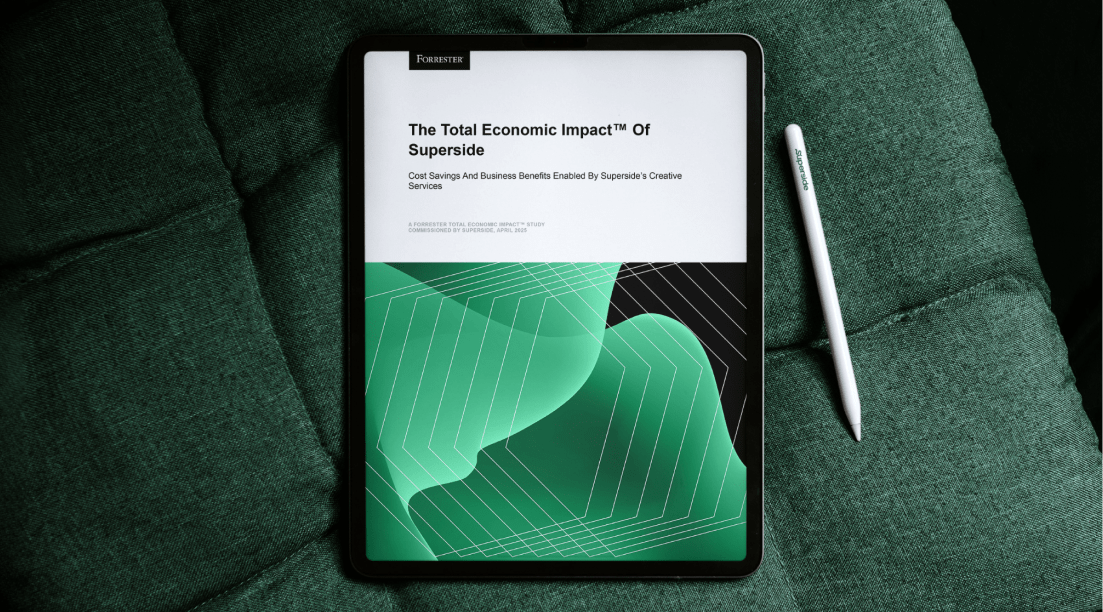
The Forrester Total Economic Impact study of Superside found a composite enterprise customer achieved a 94% ROI over three years, generated $4.16 million in benefits and recovered its investment in under six months, with $1.9 million saved in avoided agency costs and $1.2 million in internal labor.
Where creative quality holds at scale
When creative quality starts to slip as output grows, the first place to look is how the work moves through the system. Quality decay at scale is not a creative team failure. It is an operating model that did not keep up with the demand placed on it.
When creative direction is clear, feedback is more focused, revisions are easier to manage, and teams can move forward with more confidence.
The companies that scale creative successfully do not layer more tools or people onto broken workflows. They adapt the operating model as the volume curve shifts. AI handles repetitive production. Senior creatives protect brand direction. A creative memory layer preserves context from one brief to the next. This is the model we have built and what sets Superside apart from other creative partners.
If your team is starting to see cracks in creative quality as you scale, the highest-leverage move you can make this quarter is a 30-minute conversation about what an operating model rebuild looks like inside your stack. It is time to make Superside your creative team's creative team.
Book a call with Superside today.
FAQs

Creative teams are at a breaking point
The pressure is real, the opportunity is too.
Get insights from 300+ leaders on
beating burnout, using AI wisely
and navigating 2026’s inflection point.


Ready to see it in action?
The best way to understand it is to experience it.
Because once your creative system has memory,
you won’t want to go back to starting from scratch.



The data speaks for itself
According to a Forrester Total Economic Impact™ study, Superside delivers a 94% ROI and pays for itself in six months.


Increase your creative capacity
Let your in-house team reach for the stars,
while Superside keeps your day-to-day creative needs
at an industry-leading level. Ready to scale?