

Generic AI tools don't know your brand, so a custom AI model fine-tuned on 10 to 15 strong brand images is how enterprises get on-brand creative by default, up to 10x faster and at 85% lower cost per image. But a model solves generation, not maintenance, and one trained once goes stale as the brand evolves. The setup that holds is a custom model plus a living brand memory like Superside's Brand Brain, plus human review.
If your company is like most enterprises, your marketing team needs to produce more creative, faster, than ever before.
Generic AI image generators can help boost creative capacity, but getting a tool like Midjourney or DALL·E to produce visuals that look unmistakably like your brand is tough. And when every asset needs another round of prompts and edits, AI's speed gains quickly disappear.
Training an existing AI model on your brand images changes that. Your team can reliably generate creative that follows a consistent, on-brand style. The payoff is big: on our own internal performance data, custom AI image models make image generation 10x faster and cut the cost per image by 85%.
That said, any AI model learns your brand at a specific point in time. Campaigns change, brand guidelines evolve, and if you leave the model alone, it soon falls out of step with your brand.
This guide explains how custom AI models work, what it takes to build and maintain them and how to choose between building, buying and partnering. You'll also see where they've worked for real brands and how to make a custom model useful inside an enterprise production pipeline.
What are custom AI models for creative?
A custom AI model for creative is an AI model fine-tuned on a specific brand's assets and guidelines, so it generates creative that matches the brand by default.
That means your creative teams no longer have to prompt and hope the output lands on-brand. You simply use a model that already knows your brand inside out.
It helps to separate three terms that get used loosely:
- A generic or foundation model, like Midjourney, DALL·E or Stable Diffusion, is trained on vast, general internet data. These models are powerful and flexible, but they don't inherently know your brand.
- A custom, or brand-trained, AI model is a foundation model adapted on your brand's assets and rules, so it applies your visual identity automatically whenever it's prompted to do creative work.
- Fine-tuning is the technical term for further training an existing model on a smaller, focused dataset to specialize it. It's what turns a generic model into a brand-trained one.
The contrast is stark when you put the two side by side.
| Dimension | Generic AI generator | Custom brand-trained model |
|---|---|---|
| Knows your brand | No, trained on general data | Yes, learned from your assets |
| On-brand output | Sometimes, with heavy prompting | On-brand by default |
| Consistency across many assets | Drifts from prompt to prompt | Strong and repeatable |
| Scales to high volume | Limited by manual fixing | Built for volume |
| Training data | Broad and often unclear in origin | Your own approved assets |
| Keeps up as the brand evolves | No | Only if something keeps it current |
A custom model helps your team produce creative variations in a recognizable style, which is especially useful for repetitive work like resizing assets. But on its own, a custom model can't keep up with changing brand guidelines, recall past decisions or decide whether an asset is right for a specific campaign.
Output quality also depends on the examples you use to fine-tune it. Fine-tuning doesn't guarantee that every output will be perfectly on-brand, or that quality will hold at volume. Creative execution at scale still depends on human creativity, sound judgment and built-in review checkpoints.
Training a model on your brand assets doesn't settle questions of ownership, privacy or safety either. Your team needs to confirm you're allowed to use every piece of training material and check the model provider's terms.
Our guide to on-brand AI design unpacks these points in more detail, while our Trust Center explains how Superside handles AI governance for our customers.
Why generic AI goes off-brand at scale
To understand why custom AI models make sense, it helps to look at why generic AI tools rarely satisfy an enterprise team.
There are four compounding reasons:
- Generic models don't know your brand by default. They learn from broad datasets, so they can create many visual styles. That's exactly why they don't naturally favor yours.
- Consistency takes repeated direction. Good prompts, strong reference images and saved settings help, but these tools can't reliably carry every brand decision from one asset or project to the next.
- Some details are hard to describe in a prompt. You can specify colors, lighting and style, but the model may still miss subtle choices about composition or what feels right for your brand.
- The fixes add up. If every output needs another round of prompts or manual edits, that's more work for creative teams that are already at or over capacity.
The result is forgettable, generic work, a problem we unpack in our article on why AI-generated creative feels off-brand.
How custom AI models work, in plain English
"Train an AI model" sounds like you'll need a data science team and a very large budget. In practice, you start with an existing model and adapt it using carefully chosen examples of the output you want.
One common way to do this is a technique called LoRA, or low-rank adaptation. You train a small add-on and leave most of the original model untouched. According to IBM Research, a LoRA fine-tune readjusts less than 1% of a model's weights without degrading its performance, which is why it's relatively fast and affordable.
LoRA is one type of parameter-efficient fine-tuning, the umbrella term for methods that adapt only a small part of a model.
Another technique, DreamBooth, personalizes existing text-to-image models by fine-tuning them on a few photos of a specific subject. Its researchers found that three to five images typically suffice to teach a model a new concept, object or face.
Note that fine-tuning is different from writing better prompts or supplying reference images when you generate in a tool like DALL·E. It adapts the model itself, which makes your brand's visual style easier to reproduce across many assets. The key is to give the model high-quality images.
The types of custom AI models for creative
Custom AI models for creative generally fall into four categories, and many enterprises use more than one:
- Style models capture your brand's overall look, whether photographic or illustrative, and apply it to new scenes. These are the workhorses for on-brand marketing imagery.
- Object models are trained on a specific product, package or object, so the model can render it accurately in any setting. They're particularly useful for eCommerce and product marketing.
- Character models learn a specific mascot, character or person in 2D or 3D, so you can generate consistent depictions across all your creative.
- General models produce on-brand abstract assets like backgrounds, patterns, gradients and 3D shapes.
A brand often needs several models to cover its full visual identity. If you depict a character as both a photograph and an illustration, for example, you'll need a model for each format. The right mix depends on the assets your team produces and how you plan to use them.
Choosing those models is part of building an AI setup that serves your team's creative needs.
What you need to build a custom AI model

A common misconception is that you need a massive dataset. You don't. A brand-trained model is built from a surprisingly small, high-quality set of examples.
Focus on quality and representativeness, not volume. Remember, you're fine-tuning, not training from zero. At Superside, a custom model typically starts with 10 to 15 high-quality, on-brand examples, and some model types use up to 50.
The tricky part is deciding which images truly capture your brand's visual identity. A model is only as on-brand as the examples it learns from, so assembling the right set is a creative judgment, not just a data task. If you don't have the right images yet, a good creative partner can help you select or create them.
Our guide to training an AI image model on your brand walks through the process in detail.
Build, buy or partner: How to get a custom AI model
There are three ways to get a brand-trained AI model. The right one depends on your resources and how quickly you need the model working.
You could:
- Build the model yourself. With tools like Hugging Face, LoRA trainers and cloud platforms such as Google's Gemini Enterprise Agent Platform, formerly Vertex AI, a technical team can fine-tune a model in-house. You get maximum control, but you need the right skills and ongoing maintenance.
- Buy a platform. Vendors like Adobe Firefly and Getty Images offer enterprise custom-model features, often with a strong emphasis on commercial safety and IP protection. They're solid, but they're self-serve, so you stay responsible for brand judgment, the dataset and ongoing upkeep.
- Partner with an AI-first creative team. A partner builds, trains, deploys and maintains the model for you. It's the lowest-effort, most brand-safe path, and it's Superside's model. The trade-off is that it's a partnership rather than a tool you operate alone, which suits enterprises that want the outcome rather than a science project.
Whichever route you take, ask who'll select the training images, test the results and maintain the model after launch. Those responsibilities don't disappear when the first images look good. They decide whether the model stays useful over time.
The wider market is moving the same way. Gartner predicts that by 2027, more than 50% of the generative AI models enterprises use will be specific to an industry or business function, up from roughly 1% in 2023. It also expects organizations to use small, task-specific models at least three times more than general-purpose large language models.
The maintenance gap: Why custom AI models go stale
Here's the problem almost nobody talks about. A custom model solves generation. It doesn't solve maintenance.
Over the next few years, your campaigns will change, your creative direction will shift and your brand guidelines will evolve. A model trained once won't reflect any of it. Left alone, it slowly drifts until it's generating yesterday's brand.
Models generate. Brands need memory.
That's why Superside developed Brand Brain, the AI-first creative memory that lives inside our Superspace creative management platform. Each brand's Brand Brain is a custom, evolving intelligence layer that holds a continuously updated picture of the brand, including its visual rules, tone, specs, past projects, stakeholder preferences and performance learnings.
Every Superside customer's Brand Brain also powers their custom AI image models. As new campaigns, approvals, feedback and performance data flow in, the model stays both on-brand and current. Instead of freezing, the brand knowledge compounds.
So when you partner with Superside, you get more than a custom model. You also get a living brand memory plus AI-trained human creatives who close the loop between AI output and sound creative judgment. Our guide to training AI on brand assets covers the shift from static models to intelligent systems.
This is the heart of our AI excellence approach, and part of what makes us the world's leading AI-first creative partner.
IP, data security and commercial safety
For many enterprises, custom AI image models raise three important questions.
- Training-data provenance. A model is only as safe as the data it learned from, which is a strong argument for training on your own assets rather than scraped data of unclear origin.
- Ownership and rights. You need to know the outputs are yours to use commercially. Some platform vendors emphasize IP indemnification for this reason, and a model trained on your own material sidesteps much of the ambiguity around generic tools.
- Security. Your brand assets and model should be hosted privately and securely, with access limited to the people who need it.
Handling these well is part of practicing responsible AI for enterprise brands, and it's another reason a governed, partner-built approach beats an unmanaged one.
Real results: Brands using custom AI models
Plenty of brands and Superside customers already produce on-brand creative with custom AI image models.
Sailun Tire Americas, for example, used to rely on stock photos and traditional photo shoots. Superside built a custom AI model trained on Sailun's image library and delivered it as a Figma plugin for one-click, on-brand image generation inside their existing workflow.
Sailun's brand marketing team now uses it to test ideas before they ever reach a formal brief.
We've been using and loving our custom AI image model almost every day. One of the ways we use it most is to test and visualize ideas ahead of formal briefs.
Maven Clinic, another Superside customer, needed fresh visuals for a rebrand. We built a custom model trained on Maven's style, again delivered as a Figma plugin. It's now used across nearly all of Maven's major projects, from decks and social content to multi-page booklets.
Sisense also partnered with Superside, turning more than 60 photography-style images and guidelines into a custom model. The team now generates ready-to-use assets in Figma with minimal input, skipping the stock searches and post-production of the past.
Asked about the output quality, the Sisense team pointed to the detail generic tools famously get wrong.
Even the hands look good!
These cases and more are documented in our roundup of AI image generation examples and our No-Hype AI Report. The metrics are consistent: custom models make image creation 10x faster, with 75% less time spent and 85% lower cost per image compared with traditional production.
Broader AI-imagery work shows the same pattern, even before brand-trained models enter the picture. Unigloves generated 250 unique product images with Midjourney and Adobe Firefly, saving an estimated 57% of design hours. For D2L Brightspace, Superside produced 114 on-brand ad variations while cutting the time spent sourcing and editing images by 70%.
How custom AI models fit into a real creative workflow
An enterprise AI image model is only useful if your team actually uses it. The best implementations put the model where the work happens and keep human creatives in the loop.
When you work with us, we deliver your custom model as a Figma plugin plus a simple prompting tool. Any designer working on your brand can generate on-brand assets inside the environment they already use, rather than bouncing to an external generator. Your team and your Superside team work from the same model, so in-house and outsourced work stay consistent.
The workflow can also extend from image to video. Your team can use an approved image from its custom model as the starting frame in an AI video tool, then add motion to create a short clip, with human review keeping the result on-brand.
Crucially, human creatives should review and curate the output, because even a strong custom model needs a trained eye. At Superside, AI creative quality control is built squarely into the process. AI brings the volume. People protect the brand, quality and craft.
Good governance matters just as much. At enterprise scale, that means clear rules for:
- Who can use your brand-trained model
- How outputs are reviewed and approved
- How the model gets updated as the brand evolves
Our framework for measuring AI ROI for creative teams quantifies the time and cost a custom model actually returns, which helps make the investment defensible to finance, procurement and leadership. For a look at where this is heading, see our take on enterprise AI design trends.
How Superside builds custom AI models for creative
Custom AI models are central to how Superside, the world's leading AI-first creative partner, delivers on-brand creative at scale.
Our process is collaborative. When you make us your creative team's creative team, we'll:
- Define the model type and style you need
- Build or curate a dataset of your strongest on-brand images
- Train and test the model with you until it clears your quality bar
- Deploy it into your creative workflow
Your custom model also won't work alone. It's paired with your brand's Brand Brain, so it stays current as your brand evolves, and with experienced creatives who own the strategy, taste and final call. A custom model for volume, a living brand memory for compounding context and people for judgment and craft.
Being AI-first means AI isn't just powering individual tools. It's embedded across the entire creative model, from how teams are trained to how brand knowledge compounds over time. It's the idea behind our human-led, AI-powered approach.
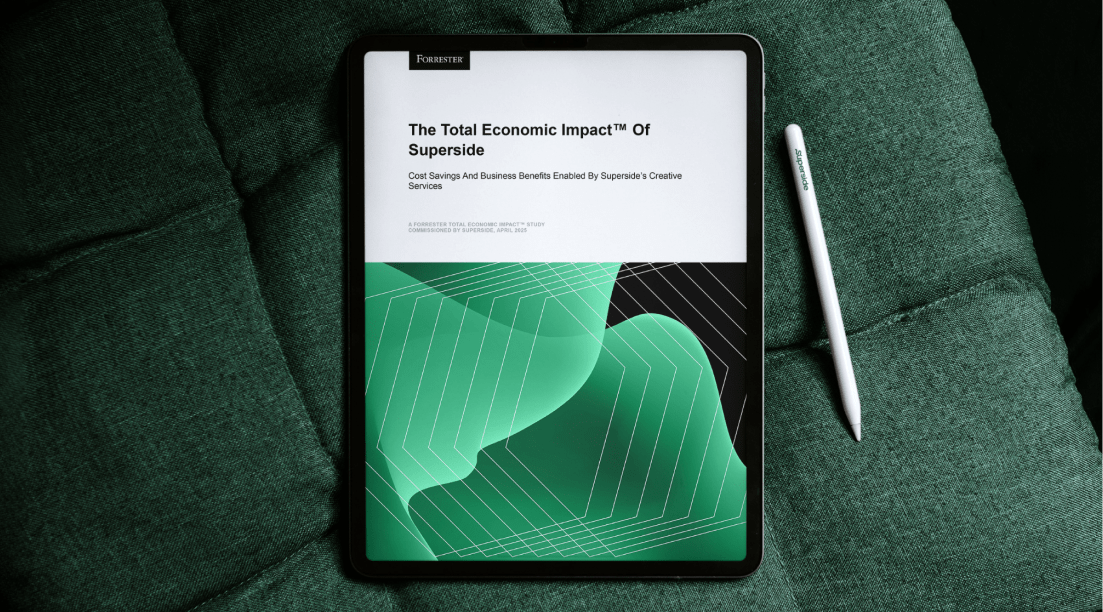
Our approach works, as customers like Intuit, Amazon, DoorDash, Figma and Reddit will tell you. A Forrester Total Economic Impact study commissioned by Superside also found a 94% ROI for a composite enterprise organization, with payback in under six months.
If you're exploring brand-trained AI for creative production, Superside should be your go-to partner. Explore our AI creative services or book a call to make your next campaign faster to produce and unmistakably yours.
FAQs



Meet Customers Who’ve Experienced Exceptional ROI
Discover how Shopify got 4,375 assets in 12-24 hours or how Amazon saved 345 hours in three months.

How 400+ brands get more work done, without doing more
They Superside it. Fast, high-quality creative from the
AI-powered creative service that handles it all.


The real story behind GenAI’s impact on creative
You've heard the hype. But what does the data say?

The data speaks for itself
According to a Forrester Total Economic Impact™ study, Superside delivers a 94% ROI and pays for itself in six months.