

Generative image AI has gone from “experiment” to “everyday tool” for many creative teams. Companies like Sailun Tire and Maven Clinic now use custom AI image models to slash production costs by up to 85% and boost efficiency by up to 90%. Why do these tools work so well? Because they’re trained to accurately reproduce every brand element at scale.
AI image generation has made it easier than ever for brands to create and scale visual content. In fact, the technology that felt experimental just a year or two ago has become a core part of many teams’ creative workflows.
Today’s top design teams use AI to generate ad creative, produce video, design logos, create product photos and test creative ideas at scale. They’re well past the stage of asking whether they should use AI. Instead, they’re focused on using AI in more workflows to drive unprecedented efficiencies.
What separates experimentation from real execution? Strong roadmaps, proper training, thoughtful human oversight and robust design systems that keep AI output consistent with brand standards.
If you want to use AI image generation for faster ideation, scalable assets and next-level creativity, you’ll want to keep reading. This article breaks down what AI image generation is, why it matters and how leading brands already use it, with fascinating insights from Superside’s “No-Hype AI Report.”
How enterprise brands can use AI-generated images

AI image generation has quickly evolved from “meh” outputs to agency-grade visuals (thanks in no small part to the billions that companies like OpenAI and Google continue to pour into model development).
But while tools like DALL·E and Nano Banana are remarkable, they don’t remember your brand standards from prompt to prompt. Custom AI models, however, do. Trained directly on your brand assets, they automatically apply your visual identity and other standards to the assets you create with them.
Today’s top enterprise brands use custom AI image models for everything from fast concepting to full-scale campaign production. Once you have a few tried-and-tested custom models in place, the impact across your business can be substantial:
- Rapid content at scale: You can front-load the AI model with brand intelligence, which makes it easy to automate repetitive work and produce consistent, ready-to-use assets in the blink of an eye.Superside’s custom models, for example, help our customers to deliver assets 10x faster, cut costs by up to 85% and reduce production time by 75%. This means they can create stunning images at scale for social media, blogs, advertising campaigns, eCommerce stores and more without the need for expensive photo or video shoots.
- Scalable personalization: Custom AI image models can simplify personalization and open up fantastic opportunities for scale. For example, you can reuse a single source asset (e.g., an image of a fashion model) to generate an endless stream of tailored fashion images for different audiences, channels or markets. The benefits include highly relevant content, reduced returns and a meaningful lift in add-to-cart rate.
- Product images at scale: Modern AI tools can place products into highly realistic scenes and match lighting and perspective so they look naturally integrated. They can also remove or swap backgrounds. Some solutions can even generate photorealistic model images from simple stills and then use them to build full sets of lifestyle visuals around the same product.
- Ad testing and optimization: Today’s AI image tools make it quick and easy to generate large batches of ad creatives fast. These can then be tested (also with AI) and optimized. For instance, for D2L Brightspace, Superside used Midjourney to produce 114 on-brand ad variations in record time (we cut design time by 70%). The D2L Brightspace team then had a much broader pool of creative variants to use for A/B testing and media optimization.
Benefits of AI image generation for brands
The benefits of AI image generation extend across speed, creativity, scalability and brand consistency. But generic benefits mean nothing without specific, measurable outcomes.
Here’s what enterprise teams achieve when they master AI image generation:
1. Faster work, lower costs
Once robust custom models are in place, they significantly shorten project timelines. They automate repetitive tasks, reduce manual review cycles and help creatives to produce more accurate outputs on the first pass.
We’ve seen firsthand what a difference this can make. Superside’s AI-driven projects deliver 2x faster turnarounds and up to 45% more efficiency compared to traditional creative production methods.
2. Unlimited creativity
When it comes to AI image generation, the sky’s the limit. In fact, 77% of creative leaders say AI tools make their teams more creative (up from 69% in 2023).
With the right AI tech stack and systems, art directors, designers and other creatives spend less time on repetitive tasks and more time on the strategic, creative ideas that help them to deliver truly effective campaigns.
3. Scalability and volume output increase
Custom AI models can quickly resize images, localize logos and help teams develop multiple asset versions for different campaigns and markets.
For example, when Independence Pet Group (IPG) sought a playful, pet-focused illustration style for its internal communications, Superside identified the project as a perfect fit for Midjourney-driven exploration.
In just 11.5 hours, we created more than 750 on-brand assets. Overall, we cut design time by 90% and saved our customer nearly $20,000.
4. Consistency and cohesion
Custom AI image models help creative teams easily maintain a consistent visual style and uphold brand guidelines across projects.
At scale, this consistency drives stronger brand recall, higher-performing ad variations and more unified customer experiences across channels.
6 best AI image generation examples from top brands in 2025
AI helps design teams solve creative challenges, cut production timelines and maintain consistency across campaigns. The six brand image generation examples below highlight what’s possible when AI is combined with strong strategy and human creativity.
Want the full story? Download the ”No-Hype AI Report” for more examples, detailed breakdowns of custom AI models and workflows, and the measurable results behind each project’s success.
1. Sailun Tire Americas x Superside

Sailun Tire Americas had long relied on stock photography and traditional photo shoots until a partnership with Superside introduced them to the speed and quality of AI-generated imagery.
To align with the brand’s marketing team, Superside first built a concept board that demonstrated how AI could outperform stock visuals in both efficiency and creative control. After the Sailun team reviewed our side-by-side comparisons, they approved our use of AI. The results were that good.
We’ve been using and loving our custom AI image model almost every day. One of the ways we use it most is to test and visualize ideas ahead of formal briefs.
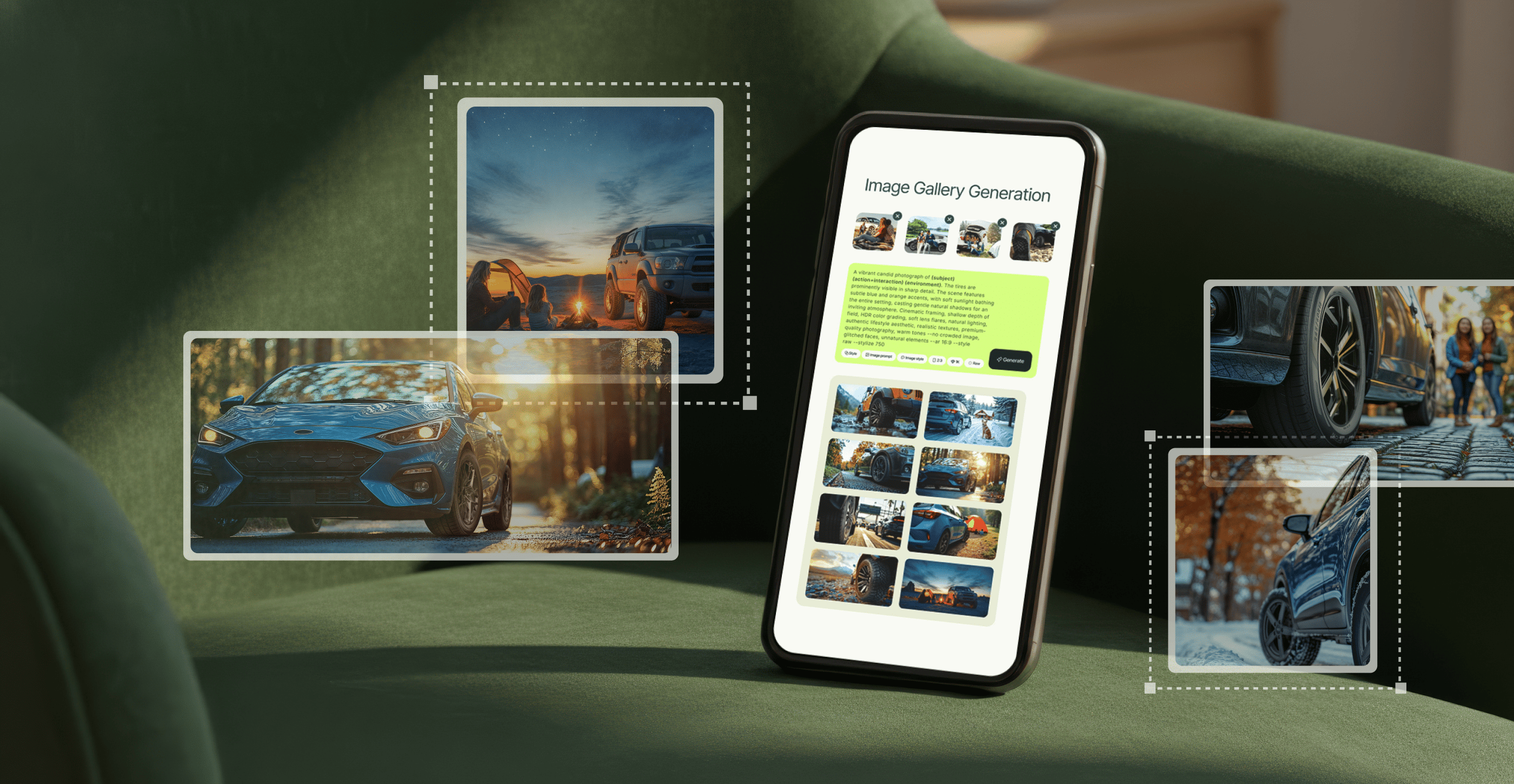
We then trained a custom AI model on Sailun’s existing image library and delivered it as a Figma plugin. This enabled one-click generation directly inside their existing workflows.
This model now allows Sailun Tire Americas to experiment with ideas before drafting formal briefs, and they’ve already successfully used AI assets in product reels.
Why we like it: A custom model embedded in existing tools (in this case, Figma) makes for super-fast testing and validation without disrupting workflows.
Industry: Automotive and manufacturing.
Best for: Companies that need large volumes of product images in varied settings and quick concept reviews before costly production.
2. Maven Clinic x Superside

When Maven Clinic rebranded, it needed fresh, high-quality visuals for a range of marketing materials. But traditional photoshoots felt slow and expensive.
Superside proposed a custom AI image model delivered as a Figma plugin. Once again, the model was trained on Maven’s style and built to fit seamlessly into their workflow.
Today, Maven Clinic uses the plugin across nearly all major projects, from decks and social content to multi-page booklets. While the odd photoshoot is still necessary, the AI tool makes a massive difference to their creative output.
Why we like it: This very practical AI solution solves the “stale library” problem and makes fresh images available on demand.
Industry: Health tech.
Best for: Budget-conscious brands that need year-round custom visuals for their marketing assets.
3. Sisense x Superside

Sisense, an AI-powered analytics platform, used Superside to support its brand refresh and website update. More than 60 photography-style images and guidelines formed the foundation for a custom AI image model, delivered again as a Figma plugin.
The Sisense team now generates ready-to-use assets with minimal input, avoids tedious stock photo searches and skips post-production editing. They prompt directly in Figma and insert brand-aligned images straight into their files.
The team’s reaction to the tool? “Even the hands look good.”
Why we like it: This case study shows how AI helps a data company stay on-brand and work faster by removing creative roadblocks.
Industry: Business intelligence.
Best for: Design and marketing teams that want faster asset creation and fewer production bottlenecks.
4. Burger King

(Source: The One Club)
In 2024, Burger King transformed its “Have it your way” brand promise into an interactive AI experience.
Customers were encouraged to design custom Whoppers on BK.com, after which the platform generated a photorealistic image and a personalized rap jingle for each creation.
The campaign delivered 14 million BK app visits, 3 million new Whopper creations, 1.3 million AI-generated video ads, and drove record sales for the company in November 2024.
Why we like it: Every “Million Dollar Whopper” content submission got special treatment with unique visuals and audio. This drove social shares and captured valuable customer preference data. We also loved how AI moderation helped to keep the campaign clean.
Industry: Food and beverage.
Best for: Businesses that want to tap into the benefits of UGC, gather customer preference data and create viral social moments with AI-driven personalization.
5. H&M

(Source: Business of Fashion)
When H&M decided to lean into generative AI for its fashion campaigns, it went further than most other brands dared. The company developed realistic, highly detailed AI-generated replicas of 30 real human models.
These “digital twins” were derived from extensive photographic captures of the actual models, enabling the AI to replicate fine details such as posture and skin features. Now, H&M can create multiple campaign variations, trial style options and adapt content for regional markets faster.
The project not only makes the impossible possible (i.e., real models can appear on the catwalk in Milan while their digital twins are in photo shoots in L.A. on the same day).
At a time when many brands use AI models without clear consent or transparency, H&M’s choice to obtain explicit approval, protect model rights, ensure fair compensation and clearly watermark every AI-generated image also makes it one of the more ethical approaches in the industry.
Why we like it: The project proves that speed and ethics can work together when you build consent and fair pay into the system.
Industry: Fashion and retail
Best for: Fashion retailers that need to produce high-volume campaign variations for use across various markets.
6. Coca-Cola

(Source: YouTube)
In another interesting AI image-generation initiative, Coca-Cola invited digital artists to explore its brand heritage through an AI platform called “Create Real Magic.” Powered by GPT-4 and DALL·E, creators could access iconic assets (e.g., the famous contour bottle) and classic scripts to create original artwork for the beloved beverage brand.
Selected pieces appeared on digital billboards in Times Square and Piccadilly Circus, while some creators were invited to participate in workshops at Coca-Cola’s global headquarters.
Why we like it: This project shows how heritage brands can open their iconography to the crowd without sacrificing control or consistency. It also reframes brand participation as a creative collaboration rather than a risk.
Industry: Food and beverage.
Best for: Brands with strong visual heritage that want to engage creative communities and generate user content while they maintain brand standards.
Ethical concerns for brands that create AI-generated images at scale
AI image creation offers significant opportunities, but brands must also address real ethical concerns to protect their reputations.
If you’re keen to use AI image generation to get ahead in 2026, it’s critical to consider:
- Copyright concerns: Many machine learning models use publicly available data without permission, which can produce outputs that infringe on copyrighted material. It’s therefore key to find partners who prioritize legally compliant data sources.
- Bias and stereotypes: AI models may inadvertently replicate harmful stereotypes and biased content. A good idea is to maintain a “red-flag” library of stereotypes and prejudiced ideas to actively avoid in marketing materials.
- Loss of authenticity: 76% of consumers can’t tell real from AI images anymore. Some companies have already faced backlash for leaning too heavily on AI. The solution isn’t to avoid AI, but to pair it thoughtfully with human oversight and real human creativity.
- Transparency matters: 75% of consumers want transparency when companies use AI-generated content. It may be effective to define a clear labeling policy for AI-generated visuals (e.g., a small on-image marker or caption) and test it with real consumers to assess its impact on trust.
A few more tips on how to keep AI image generation ethical:
- Implement clear governance policies that define AI use.
- Ensure there’s human oversight at every stage of the creative process.
- Create custom models trained on licensed data.
- Continuous review outputs for bias, compliance standards and brand alignment.
If you decide to use Superside as your AI-powered design partner, check out the policies outlined in our Trust Center.
Best practices to follow when you use AI image generators

As AI image generation becomes a core part of your creative workflows, you’ll need clear practices that guide how AI is used.
Ask yourself the following questions to kickstart the process:
1. How will you maintain consistency when you generate thousands of AI images?
Your custom models should be trained on your existing assets and style rules, such as your logos, product photos and brand guidelines. A typical AI training process requires 10 to 15 high-quality reference images that represent your visual style, color palette and design principles.
2. Which prompting techniques will improve your AI image quality?
Your text prompts make or break the output:
- Be clear and specific. For example, instead of “create commercial skincare product photo,” try “create a commercial product render of a matte-black skincare bottle, shot in soft diffused daylight, subsurface scattering visible on the label, placed on a cool-toned marble background.”
- When details matter, use templates with specifications such as resolution and aspect ratio.
The best AI tool results come from precise prompts that guide the AI generator toward your exact vision.
3. How can you ensure your AI-generated images meet quality standards?
Treat AI photo generators as collaborative partners, not replacements for your designers and other creatives.
Always include a human review and build in enough time for them to check AI-generated images for accuracy, brand consistency and quality. Ensure art directors have the final say on whether visuals align with the creative vision and brand style.
Humans catch things AI misses. For example:
- Inconsistencies or technical errors (extra fingers, distorted proportions).
- Cultural insensitivity, bias, stereotypes or legal concerns around copyrighted elements.
This quality control layer ensures outputs meet brand standards before creative assets reach the market.
4. What AI policies should be in place?
Create clear AI use policies that define how each tool or AI model fits into your creative processes. Your guidelines should cover:
- Which AI tools are approved for use (and why).
- Where AI can be applied (ideation, mockups, production-ready assets).
- When humans need to review assets.
- Rules for data usage and appropriate content.
- Clear workflows that specify when to use AI versus traditional methods.
5. Which AI image tools are legally safe to use?
Opt for models that use licensed and ethically sourced training data. Tools like Adobe Firefly and Getty Images AI use properly licensed content, which reduces copyright risk.
For maximum protection, use custom AI image models trained exclusively on your owned assets and licensed imagery.
6. How transparent should you be about your AI use?
Today’s consumers want transparency, so it’s important to consider how you’ll communicate your use of artificial intelligence.
It could work to use AI for ideation, mockups and rapid variation, but to invest in authentic, human-created visuals for campaigns where trust matters most. The key is then to communicate this appropriately.
7. How do you maintain quality as you scale design with AI?
AI can be a force multiplier, but it’s important to monitor quality and build in time for reviews and feedback. Treat AI like a creative team that requires governance, feedback loops and evolving standards.
Use your best examples to teach the AI what “good” looks like, and also show it examples of what you don’t want. When the AI understands both, it becomes more consistent and stays closer to your brand’s look and feel.
Why Superside excels at AI image design and custom model services
When you make Superside your creative team’s creative team, we’ll help you scale your visual content with AI and keep your brand standards safely in check.
Most agencies talk about AI capabilities. We’ve delivered over 5,000 AI-powered projects. We’ve also helped many of our enterprise customers turn AI generation from experiment into execution with custom AI models, expert workflows, robust design systems and measurable results.
Here’s what our playbook looks like:
1. Custom AI model development tailored to our customers’ brands
Superside builds custom models from your brand guidelines to ensure every generated image reflects your visual identity, logos, color palette, typography and design principles from the start. We then fine-tune these models as your creative performance data grows.
You can rest assured that our tried-and-tested approach to custom model image generation will keep all your assets on-brand as you scale like never before.
2. Structured systems for consistent results
With 40+ AI workflows and 90% of our creatives AI-certified, we deliver consistent, repeatable outputs at scale. Our Superspace platform also makes collaboration easy, centralizes feedback and helps teams easily produce standout, on-brief creative.
Smart prompt pipelines and predefined templates also help both internal and external creative teams consistently produce brand-aligned assets.
3. Brand models for Figma
One of our key AI consultancy offerings is our proprietary Brand Models for Figma.
With these models, your team’s briefing, ideation and early-stage production steps are no longer separate. Photos, illustrations, characters, 3D styles and more all live in one place. You can also train your own brand model directly in the Figma plugin. Simply upload a dataset, hit “train” and start generating on-brand visuals in minutes.
4. Human expertise improves AI capability
Our hybrid human-AI workflows pair machine skills with human judgment.
We use AI to accelerate production, while our art directors, designers and other creatives use their energy and skills to refine outputs.
5. Proven results at scale
We don’t mess around. We deliver. In fact, Superside’s customers save an average of 40% on design timelines.
We’ve completed 5,000+ AI-powered projects and 70,000+ projects overall, with 94% of our customers reporting that the work they received far exceeded expectations.
How to turn AI into a scalable, brand-safe advantage
We’ve learned that AI success is built on three factors: Strategy, good systems and strong human oversight.
The brands that win with AI image generation don’t simply use the most advanced tools and leave it at that. They also carefully plan AI adoption, build robust design systems and custom AI models, and integrate strong brand governance into their workflows.
Superside can help your brand transform AI from an intimidating tool into a structured system that helps you produce on-brand assets. Designed to seamlessly plug into enterprise workflows and deliver AI-powered creative services, there’s a reason why brands like Intuit, Colgate-Palmolive, Figma and Reddit use Superside.
Our services also extend well beyond AI consulting. Whether you need video generation, marketing strategy or ad creative at scale, we’re up for the job.
Ready to trial AI image generators in a way that’s brand-safe, scalable and high quality? Then Superside it.
FAQs
Stuck in AI testing mode?
It’s time to move from experiments
to real impact.
Explore AI Reset—a 5-step framework
to embed AI into your creative workflows.


Get top creative 5x faster
Superside’s integrated human + AI workflows unlock
faster delivery, scalable output and campaign-ready
assets, without burning out your team.

The real story behind GenAI’s impact on creative
You've heard the hype. But what does the data say?
Give your internal teams the power to boost your brand
Publish once. Deliver everywhere. Our Creative Ops platform
puts your brand in front of the right people, everywhere.
Unlock seamless content distribution. Access your audience.


How 400+ brands get more work done, without doing more
They Superside it. Fast, high-quality creative from the
AI-powered creative service that handles it all.