


Most creative teams fail to demonstrate AI’s value because they focus on narrow metrics like time saved and output volume. A fuller view includes financial impact, quality, brand consistency, strategic capacity gains and continuous learning. This Superside framework will help you set targets and measure AI ROI as real, compounding business value.
AI offers incredible benefits, with 95% of creative and marketing leaders anticipating that the technology will positively impact speed, workload and quality.
Yet most enterprise marketing teams still struggle to translate these gains into significant business value.
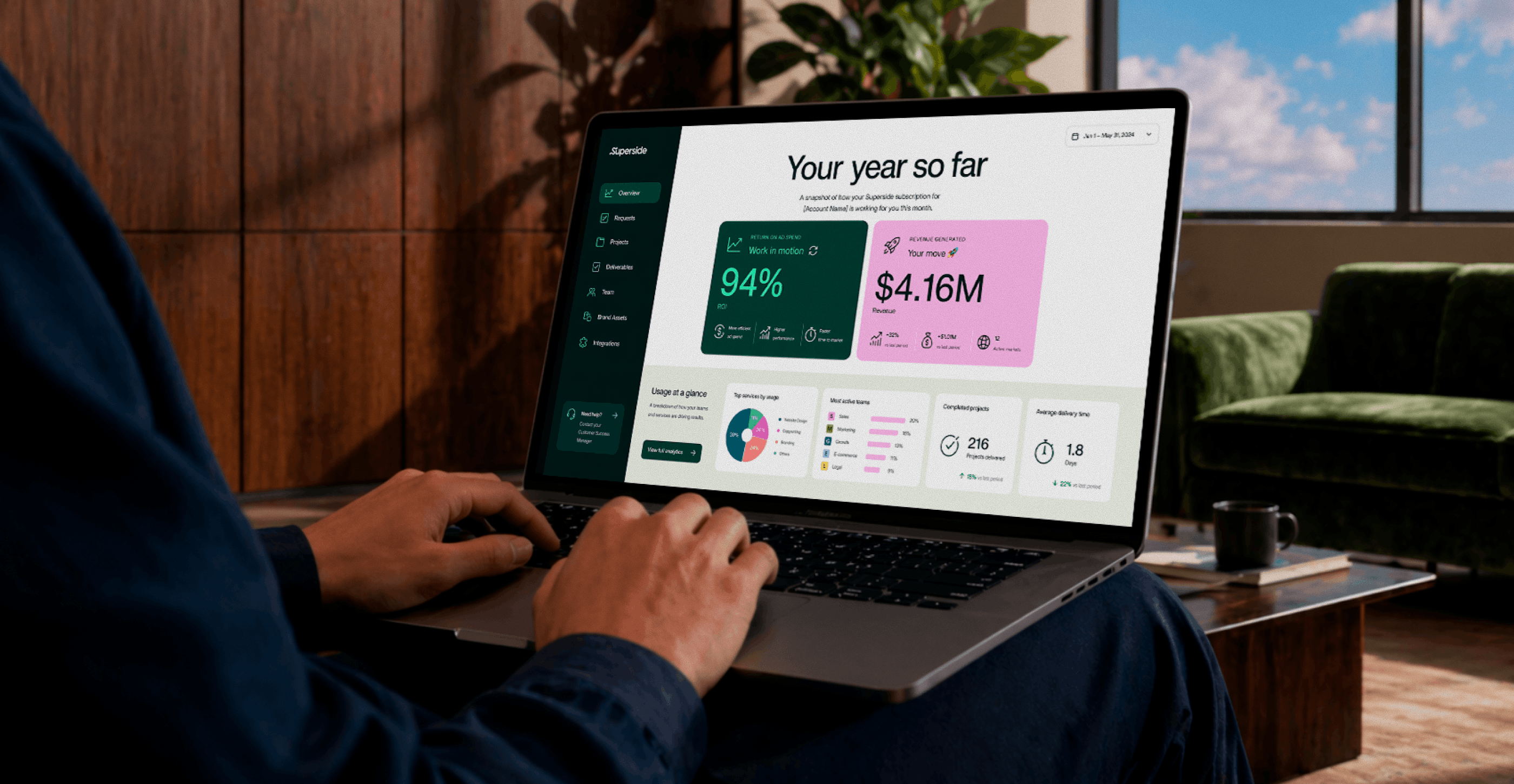
Forrester’s 2025 Total Economic Impact study of Superside found that organizations that adopt AI-powered creative services achieve 94% ROI within three years.
The disconnect between generative AI’s potential and measurable efficiency gains often comes down to a simple issue: Enterprise teams don’t measure AI’s impact properly.
When they measure only traditional creative metrics like throughput, turnaround time and cost per asset, they miss the impact on operational efficiency and the strategic value AI creates across marketing and business operations.
Still wondering how to prove AI’s impact inside your marketing department?
This article shares a practical framework to help you set baselines, choose the right metrics, report the return on AI investments in a language your C-suite will understand and build a measurement system that helps you improve your processes over time.
Why traditional ROI measurement fails for AI creative
According to Superside’s “Breakpoint” report, more than four in five leaders (85%) have seen a shift in their executive team’s expectations because of AI. A massive 79% also say they consistently feel pressure from above to implement AI in their projects.
These teams know that AI can help them work faster and better, but struggle to demonstrate how AI has changed the way work gets done across marketing and creative operations. In many teams, any positive shifts aren’t captured in a way that meaningfully reflects the real ROI from AI in marketing.
In companies that successfully adopt AI and measure ROI in ways that make sense, value shows up across multiple areas.
At Superside, for example, we’ve found that our AI-certified creatives complete projects 2x faster than average, launch campaigns weeks earlier than traditional agencies, ship on-brand assets at unprecedented scale, and help customers expand into new markets with ease.
We also don’t add unnecessary headcount or overload already pressurized creative teams when we add AI to the mix.
When applied to AI-powered creative processes, we’ve found that traditional ROI analyses miss the mark in three ways:
- Baseline blindness: Many teams don’t do before-and-after comparisons of time-to-market, revision cycles, brand consistency scores and performance to measure the ROI of AI in design and other creative workflows.
- Automation accounting gaps: AI tools can significantly reduce project timelines. However, that’s only part of the value. Many teams don’t measure improved creative performance, reduced review overhead, avoided agency fees or enhanced capacity for higher-level strategic work.
- Attribution challenges: Many marketing teams still rely on last-click attribution (i.e., they give 100% of the credit for a conversion to the final touchpoint). However, this model fails to capture how AI-improved creative drives conversions at other points in the customer journey or creates long-term customer value.
The 4D AI ROI framework creative and marketing teams should use
In working with Fortune 500 companies and other organizations, we’ve learned that effective AI creative ROI measurement requires tracking value across four distinct dimensions.
To measure AI ROI, creative teams need to look at the following:
Dimension 1: Direct financial impact
The simplest measure to start with is direct, quantifiable financial outcomes.
Forrester’s TEI study of Superside showed, for example, that introducing AI-first creative services can deliver $4.16 million in benefits over just three years.
- Improved campaign performance contributes $1.1 million. Thanks to AI-powered creative assets, our campaigns generate 8x the production investment compared to 3x without AI enhancement. For every dollar spent, our customers achieve significantly higher returns through improved engagement, increased conversion and better performance.
- Avoided agency fees total $1.9 million. Shifting from traditional agencies to AI teams increases asset delivery volume by up to 4x. One customer received four decks a year from their traditional agency. After switching to Superside, they could look forward to four per quarter. That’s a 12x output increase for the same investment.
- Internal labor savings account for $1.2 million. With our AI-enhanced creative services, our customers avoid hiring additional creatives and cut agency management time by about 10% per project.
Use a formula like the one below to calculate the financial impact of AI in your organization:
Total Financial ROI = (Improved Campaign Revenue × Profit Margin) + Agency Fees Avoided + (Internal FTEs Avoided × $150K) + (Management Hours Saved × Hourly Rate) - AI Service Investment
Dimension 2: Quality and brand consistency
The second dimension answers whether AI made work better and more consistent, not just faster. This is a key dimension of the AI ROI measurement framework for creative teams. After all, if AI-powered workflows deliver only speed, not quality or consistency, or lack strong context engineering for AI agent systems, they could dilute brand standards.
Customers who tap into Superside’s AI-first approach experience great improvements in quality. For example, one customer found that feedback rounds with traditional agencies averaged eight iterations per deck. Our AI-enhanced workflows reduced the number of rounds to two to three.
A study on ad personalization also found that content created with generative AI stuck more closely to brand guidelines. Because AI cuts down the back-and-forth between design, legal and marketing teams and helps keep creative consistent across campaigns. This is especially valuable for time- and labor-intensive work such as video production or motion design.
To form a clear picture of whether AI delivers measurable ROI, track:
- Before-and-after revision cycles
- Brand consistency scores
- Adherence to brand guidelines
- Review rejection rates
- Revision requests per asset
- Rendering accuracy across channels
Dimension 3: Capacity and strategic enablement
AI delivers the most value when it helps teams to do things they couldn’t do before. Framing AI in terms of increased capacity and stronger strategic impact also ties the investment directly to measurable business outcomes. This is the perspective business leaders tend to find most meaningful when evaluating AI’s value across marketing operations.
The reality is that many marketing team members still spend too much time on mundane tasks below their skill level. In fact, our Breakpoint report showed that 77% of marketing and creative leaders feel bogged down with too many lower-priority tasks.
AI tools can automate tedious tasks, free up time for strategic work and enable more effective team collaboration, leading to better, faster outcomes and a high ROI on design work.
If your team is excited, you’re halfway to success. When people are motivated, invested, and optimistic about the future, incredible things happen.

The key is to measure the team’s baseline before AI implementation. Include the following AI creative performance metrics as you complete your diagnosis:
- Assets per person per month.
- Channels the team can’t currently support.
- Formats you can’t produce at scale.
- Limits on self-service creation for stakeholders.
Dimension 4: Learning and continuous improvement
AI’s return on investment tends to compound over time. To make that ROI visible, you need to pair ongoing measurement with learning and improvement.
For example, if you track quality improvements in Q1, you can use those insights to refine and scale your AI workflows in Q2. Repeating a measure-learn-improve cycle also builds a stronger, evidence-based case for the long-term value of AI, and it ensures your processes continue to evolve.
Useful metrics include:
- Output improvement rate.
- Feedback loop maturity.
- Correction frequency.
You’ll need to measure both quality and capacity metrics over time to show where AI workflows show significant improvements, what needs refinement and where to expand your AI use next.
At Superside, we use a continuous improvement model to evolve our own AI-powered workflows.
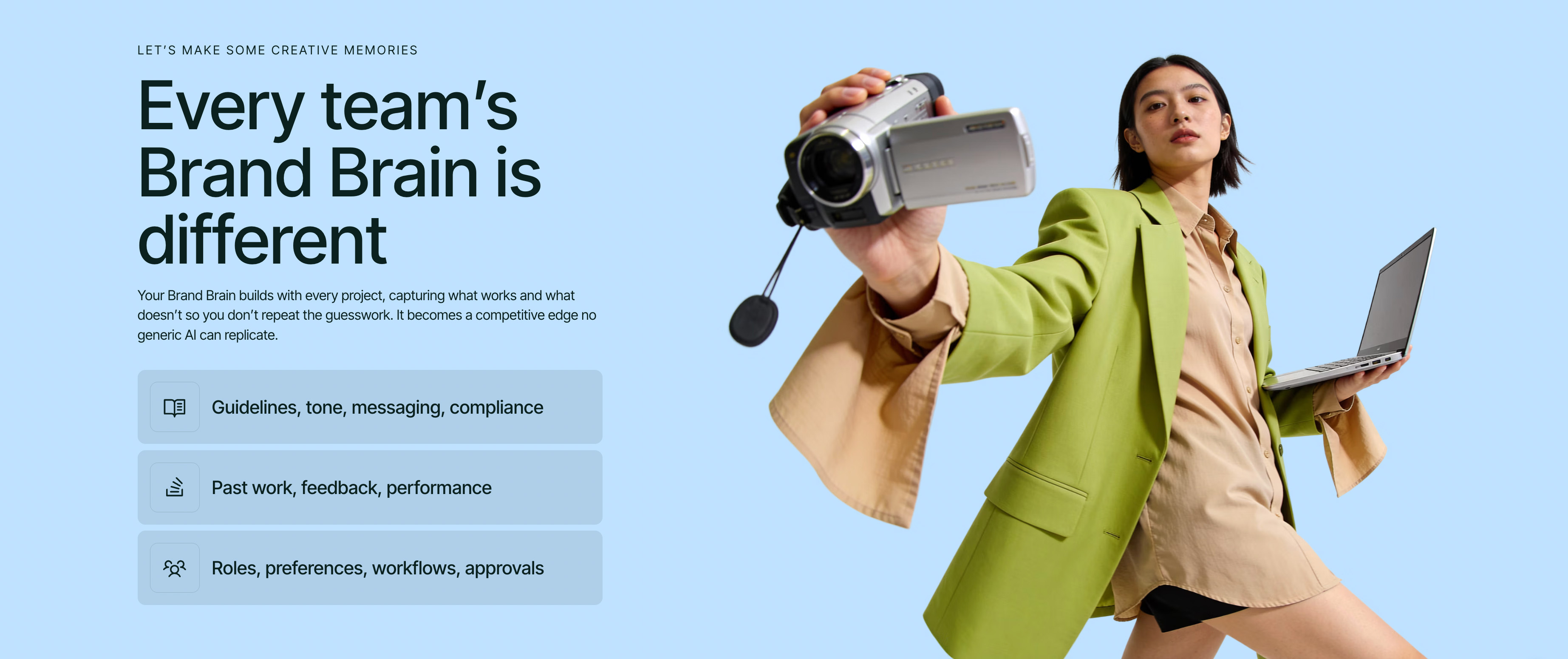
For example, we train our custom AI image models to our customers’ brand guidelines, constantly test and update them, and use Brand Brain, an AI layer within our Superspace collaboration platform, to capture each brand’s nuances. This system gets smarter with every project, helping us deliver better work faster.
Benchmarks and data points from real implementations
Understanding what “good” looks like requires industry benchmarks.
Drawing from the TEI study of Superside, our “Breakpoint” report and several real-world Superside case studies, here are concrete targets you can use to assess whether your AI creative ROI is on track.
Financial metrics
- ROI target: The TEI study found a 94% ROI over three years for a composite organization that partnered with Superside, the world’s leading AI-first creative partner.
- Payback period: The study indicated a 6-month payback period for an investment in an AI-native creative partner like Superside.
- Campaign performance: Internal Superside benchmarks and case studies show that AI can increase creative output by 7–8x, compared to 3x without AI.
- Cost savings: The TEI study found that a composite organization achieved about $1.9M in avoided agency costs over the analysis period.
Operational efficiency
- Time reduction: Our revamped ad design processes achieved 70% faster turnaround for our customers.
- Revision cycles: The TEI study found that a composite organization achieved a 60%+ reduction in the number of feedback rounds.
- Production velocity: Our No Hype report showed that brands that use AI creative production see 50-90% faster image creation, 40-60% faster video production and 40-50% faster strategy development.
Quality indicators (Source: Superads)
- Hook rate: 30–40% is a strong benchmark. Below 25% suggests creative needs improvement.
- Hold rate: 25%+ indicates engaging short-form content.
- Click-through rate (CTR): Benchmarks vary, but 1.5%+ (Meta) and 0.8–1.0%+ (TikTok) are solid starting points.
- Brand consistency: High-performing teams maintain 90–95%+ adherence to brand guidelines.
Strategic capacity
- Output per person: Compare assets produced per team member before vs. after AI adoption.
- Channel expansion: Track new channels, formats or markets unlocked by increased creative capacity.
- Self-service adoption: Measure how many stakeholders can independently request or generate creative assets.
- Skills level match: Monitor the % of time designers spend on strategic work vs. production tasks.
How to build your AI measurement system
Only about 29% of executives feel confident they can accurately measure AI ROI. If you’re one of them, this practical roadmap will help you build the AI measurement system you need.
Phase 1: Establish your baseline
Document your current state across all four dimensions. This gives you a pre-AI baseline for ROI measurement.
- Financial metrics: Calculate current cost per asset, including salaries, agency fees, freelancers, design tools and stock images. Track time to create, review and approve content. Document hidden costs, such as revision cycles and the opportunity cost of campaign delays.
- Quality measurement: Count current revision cycles per project type and catalog error rates. Track brand guideline violations and time spent in review loops.
- Capacity assessment: Measure assets per person per month and list capabilities your team can’t currently deliver. Our internal data found that only 52% of organizations currently outsource some tasks, and 85% feel outsourcing isn’t fully meeting their needs. If this sounds like your business, your baseline should capture why existing arrangements fall short.
Phase 2: Define your measurement framework
Picking the right metrics is crucial for making your ROI visible.
First, identify your primary goal: Do you want to reduce costs, grow revenue or expand capacity? Next, pick 2-3 metrics most closely aligned with your main goal and track just what’s most critical to those metrics.
Your two most important metrics are process (how work is done) and output measures (results). Both should be linked to trending and realized ROI. Trending ROI captures early indicators of success, such as improved employee productivity, while realized ROI tracks quantifiable outcomes, such as reduced costs.
Superside customers can, for example, use our Superspace platform to generate automatic data on project completion times, revision counts and asset delivery.
Custom dashboards connect creative production to campaign performance, enabling teams to easily capture the link between improved creative and measurable business outcomes. This is the kind of visibility you need.
Phase 3: Implement and track
At this point, you should be ready to launch your new AI initiatives and workflows and start capturing data.
Ideally, you need a system that enables integrated measurement to see the full creative-to-conversion journey. It’s also important to set up a regular measurement cadence to capture both short-term progress and long-term value creation.
At Superside, we use unified dashboards that combine CRM, ad performance and creative workflow data. Different measurements show results in different time frames:
- Short term (8-12 weeks). Time savings and cost reductions become visible.
- Long term (6-12 months). Strategic capacity and quality improvements demonstrate sustained impact.
Phase 4: Report and optimize (quarterly)
To demonstrate real AI ROI, you need to translate your metrics into language the C-suite will respond to. It’s important to frame your ROI story around business outcomes like revenue growth, cost reduction and competitive advantage.
Best practice is to:
- Present three-year cumulative projections
- Highlight payback periods
- Demonstrate ROI percentage
- Break down the benefits into understandable categories, such as campaign performance improvements, avoided costs and internal efficiency gains
Finally, use your results to improve your AI workflows. Teams that continuously learn from their data get better every quarter.
Common pitfalls and how to avoid them
To measure AI ROI, creative teams need to avoid the following common pitfalls:
1. Measuring activity instead of outcomes
Metrics like “time saved” or “number of assets produced” don’t automatically resonate with executives. Plus, over-focusing on volume can set you up to produce mediocre work instead of freeing up time for high-value strategy.
- Solution: Connect every metric to business outcomes, including revenue growth, customer acquisition cost, retention rate and market share. If you can’t draw a line from your AI metric to a KPI your CEO cares about, choose a different metric.
2. Overlooking change management investment
Organizations often implement generative AI tools but fail to invest in training and adaptation. In fact, the top three barriers to AI adoption are a lack of training, awareness and relevant skills.
- Solution: Set aside dedicated time and capacity for AI skills development. At Superside, for example, we make sure most of our creatives are AI-certified.
3. Short-term focus on easy wins
Many enterprise teams chase quick productivity gains but miss the strategic value of AI implementation. Productivity improvements are easy to measure and quick to realize, but they account for only a small share of total value. The real wins come from capacity expansion, quality improvement and competitive positioning.
- Solution: Design measurement systems that capture both trending ROI (early indicators) and realized ROI (long-term outcomes). Report quick wins to build momentum. Then, layer in strategic measures. This will show the C-suite how AI has transformed business capabilities beyond just speeding up tasks.
The Superside approach to measurable AI ROI
As the world’s leading AI-first creative service, Superside embeds measurement into everything we do.
Our Superspace collaboration platform, for example, makes AI ROI tracking incredibly simple. It captures time-stamped data from brief to delivery, with built-in metrics for project velocity, revision cycles and output volume. It also keeps stakeholders aligned through visible, transparent communication.
Savings on traditional agency fees and freelancers are also easily calculated. Our quoted costs cover all work delivered, with no surprises, leading to up to 4x more assets delivered than traditional agencies for the same cost.
To improve quality metrics, we use an integrated approach that combines AI and human creativity. Our custom AI image models are trained on your brand guidelines and rigorously kept up to date, while everything that makes your brand unique lives inside your very own Brand Brain.
Being AI-first means AI isn’t just powering individual tools. It’s embedded across the entire creative model, from how teams are trained to how brand knowledge compounds over time.
That’s the difference between bolting AI onto a traditional workflow and rebuilding it around what AI and humans do best together. It’s also the foundation of our Human-Led, AI-Powered approach.
If you’re measuring ROI for capacity growth, you’ll also love that Superside is set up to become your creative team’s creative team. With a single, flexible subscription, you can scale up creative output during peak demand and scale things back during quieter periods. No recruitment headaches or messy freelance contracts.
Superside’s AI consulting team is also on standby to help you develop a custom AI strategy perfectly suited to your team and business goals. Our consultants can help you document your AI baseline metrics, define success criteria and implement the AI ROI measurement framework you need.
Moving from measurement to action
Implementing an AI ROI measurement framework is only worthwhile if it drives better decisions.
Three actions separate organizations that effectively prove AI value from those that struggle:
1. Focused pilots
Best practice is to launch AI-enhanced workflows in a single team or channel, measure impact and then expand AI usage based on proven results. Broad, unfocused AI rollouts often only generate enthusiasm (and not great data).
For inspiration, see how leading teams experiment with creative without over-extending.
2. Short-term wins, long-term strategy
Easy-to-measure results (e.g., time savings) can build momentum and justify the initial AI investment. But strategic capacity gains create the kind of real competitive advantage your executive team will notice. These gains can, for example, help you enter new markets and launch products faster.
Show both quick wins and how AI helps your team do more strategically.
3. Automatic measurement
Use tools that track results automatically. When your creative tools, marketing platforms and analytics are connected, you get clear data without extra work.
Platforms like Superspace and Superads do this for you, linking creative work directly to results.
The power of data-driven AI ROI
To measure AI ROI, marketing teams should look beyond productivity metrics and include strategic business outcomes. Superside’s 4D framework provides a structured approach to help you shape a complete ROI picture.
The TEI study on Superside demonstrates what’s possible when teams successfully implement AI and measure its impact on the business: A 94% compound ROI, investment payback in under six months and benefits of $4.16 million over three years.
Global brands like Vimeo have trusted us to set up and lead their AI adoption, with impressive results.
Some of the criteria for successful AI ROI measurement include clear baselines, metrics aligned with business goals, systematic tracking systems and the continued use of insights and feedback to refine AI workflows.
Superside is human-led, AI-native and built to help enterprise teams like yours scale high-quality, on-brand creative.
Book a call to truly make AI work for your business and accurately measure its impact.
FAQs


Get top creative 5x faster
Superside’s integrated human + AI workflows unlock
faster delivery, scalable output and campaign-ready
assets, without burning out your team.


How 400+ brands get more work done, without doing more
They Superside it. Fast, high-quality creative from the
AI-powered creative service that handles it all.
Discover why the world’s biggest brands choose us