


AI can generate a hundred assets before your morning matcha kicks in, but most look polished and off-brand. That's not a prompting problem. It's a memory problem, and the fix is custom models trained on your brand plus a living system like Brand Brain that remembers how your brand actually works.
A designer on your team spends a Friday afternoon generating images. The prompt engineering is solid, the references are dialed in, and the AI cheerfully churns out options. Maybe five are usable, yet even those need several tweaks before they look like they belong to your brand. What was supposed to save the week turns into another round of edits, and a wait for assets that finally feel on-brand.
Time isn't the only cost of AI-generated creative that's off-brand. Your brand's impact and credibility are on the line, too. Using off-the-shelf AI to create branded content risks diluting what makes your brand stand out. Even worse, it can trigger a negative response from an increasingly AI-sensitive audience.
The rising tide of bland, uninspired AI-generated content is so pervasive that in late 2025, Merriam-Webster named "slop" its Word of the Year.
The definition? "Digital content of low quality that is produced usually in quantity by means of artificial intelligence."
The word caught on because everyone could feel it. Feeds and inboxes filled with content that's polished yet soulless, that looks like it was made by an algorithm that learned everything it knows from other algorithms.
And so the question is no longer "can AI make this faster?" It's "why does AI still get it wrong?"
This article unpacks why AI content feels generic, what it takes to create on-brand AI creative that stops thumbs mid-scroll and how an intelligence layer that captures your brand, decisions and past work finally makes on-brand AI outputs possible.
The "off-brand" problem is now a business problem

Before the tidal wave of AI slop flooded our feeds, most marketing and brand leads treated off-brand AI output as something to quickly tidy up, publish and move on from.
That worked when AI-generated content was still novel. Today, however, audiences are surrounded by it, and the bar is much higher. Generic content is often ignored or perceived as inauthentic, which makes it harder for your brand to stand out or earn trust.
Let's start with the cost of brand inconsistency. The most-cited research on the subject, from Lucidpress (now the brand template platform Marq), found that consistent brand presentation can increase revenue by up to 33%.
Brand consistency is how recognition compounds into trust, and trust into revenue. Every off-brand asset, in turn, chips away at the brand equity you've spent years building.
Then there's the trust penalty that comes with content that feels machine-made. eMarketer reports that the share of people who see generative AI as a negative force in the creator economy nearly doubled, from 18% to 32%, in under two years.
B2B marketplace Clutch also found that 33% of consumers react negatively to AI in branding. And a study from the Nuremberg Institute for Market Decisions found that labeling an ad as "AI-generated" makes people less inclined to engage or buy.
Analysts see where this is headed. Gartner predicts that by 2027, brands will redirect half of their influencer budgets toward authenticity and credibility. In other words, as automated sameness floods every channel, the brands that still feel human, distinctive and consistent will stand out. The ones that feel like slop won't.
That's what makes off-brand AI creative a business problem. Every generic, inconsistent or obviously machine-made asset makes it harder for people to recognize your brand, trust what you say and choose you over competitors. And in a world where anyone can generate content, your competitive advantage isn't just speed or volume. It's brand distinctiveness.
Why AI produces off-brand work
When it comes to AI creative, most teams try to solve a structural problem with a tactical fix. They blame the prompts and the AI tools for weak output, while the real problem typically lies elsewhere.
Let's take a closer look at what actually goes wrong.
Generic AI doesn't know your brand
Off-the-shelf AI models are trained on the average of their datasets. This means they're brilliant at producing the average of everything and hopeless at producing the specificity of you.
When a user asks for an image of "a confident professional in a modern office," the model has to fill in the blanks. Without your brand's visual language, audience or context, it defaults to the statistical average. The same polished, stock-style image millions of other brands can generate in seconds.
It forgets between generations
Most foundation AI image generators don't retain or enforce brand context across generations.
Even when you coax a great result out of a generic tool, the win doesn't stick. The model doesn't remember the reference that worked, the person who provided feedback or the crop your team always prefers. Every round of output restarts from zero, forcing your team to search for reference images, feedback and more all over again.
This is why AI brand consistency is so hard to maintain with generic tools. Consistency is, by definition, a function of memory. And a tool with no memory can't be consistent. It can only be lucky.
As Superside's Director of Generative AI Excellence Phillip Maggs put it when we launched our custom AI image models:
AI doesn't know your brand. Most tools rely on generic data. Once an image is generated, your brand is forgotten, wiped clean. It's like starting from scratch with every new prompt.

Brand lives in nuance, not just rules
Here's the part most AI platforms miss entirely. Your brand isn't only a hex code, a logo lockup or a brand kit. It's trust.
It's the accumulated weight of a thousand micro-decisions. It's the unwritten rules your team carries in their heads, the kind that never make it into the brand guidelines PDF because they're too subtle to articulate.
Generic AI, unfortunately, flattens that nuance.
The productivity paradox
Put these problems together, and you get the trap we described in our guide to on-brand AI design. When designers spend hours fixing AI outputs, the technology's promised speed flies out the window.
You adopted AI to accelerate creative work, not to have your most expensive talent spend hours correcting generic outputs.
When that becomes the workflow, it's easy to conclude that AI "isn't there yet." But that's the wrong conclusion. The problem isn't that AI image generators aren't good enough. It's that they simply don't have all the context they need. If you're still creating off-brand work, it's time to make another plan.
The secret to on-brand AI design
The answer to better AI-generated creative? Stop treating AI tools as vending machines you feed instructions to, and start treating them as part of a creative system that deeply understands and remembers your brand.
This requires five capacities.
1. The model has to learn your visual language
Instead of prompting a generic image model like DALL-E or Midjourney and hoping for good results, the key is to customize an AI image model around your brand kit. Your visual language, color palette, composition, lighting and overall style should be built into how it generates assets.
Superside builds custom AI image models for our customers from as few as 10-15 high-quality, on-brand examples. Our data services team helps identify the right training dataset, then iteratively trains and tests the model until it consistently produces assets that meet your brand standards.
The payoff goes beyond better-looking images. Because the model already understands your brand, your creative team can generate high volumes of consistent, on-brand creative without having to start from scratch each time. It's also how our customers produce images up to 10x faster, spend 75% less time per image and reduce image production costs by up to 85%.

Take Maven Clinic, for example. When the digital healthcare company rebranded, it needed fresh marketing materials, but traditional photoshoots felt slow and expensive. Superside put together a high-quality image selection, trained a custom AI image model and delivered an on-brand Figma plugin for Maven's team to use. In the process, we cut production costs by up to 85% compared to traditional shoots.
2. The model has to remember
A custom AI image model solves one part of the problem: generating on-brand visuals. But it doesn't remember everything else that shapes great creative, like your briefs, feedback, creative decisions, stakeholder preferences or the assets that performed best in your last campaign.
Without that memory, you're forced to add this context every time a new project begins. And let's be honest. Most teams simply won't do this consistently.
The fix is a system that curates context from past projects and creative decisions and automatically applies it to future projects. This is exactly what led us to create Brand Brain, the AI memory layer that now lives inside our Superspace creative management platform.
3. The model has to capture nuance, not just guidelines

Telling a model what your brand rules are is the easy part. The hard part is capturing implicit knowledge such as judgment, taste, the patterns in what your team approves and rejects, plus the lessons that creative performance data teaches you over time.
Systems that deliver on-brand AI outputs have to hold three layers at once:
- Your brand: guidelines, voice, messaging and compliance requirements.
- What you've learned: past work, feedback, approvals and performance insights.
- How you work: team roles, preferences, workflows and approvals.
When a system captures that full picture, it stops producing technically correct but off-brand work because it finally understands what "right" looks like for you.
For a fast-growing B2B SaaS organization experiencing a sharp increase in creative demand, Superside conducted an in-depth analysis to pinpoint the areas with the greatest potential for AI integration. We supplied a custom AI automation tool in Figma trained on the subtle distinctions of their brand. Ultimately, this helped the team's creatives generate on-brand copy and image variants with one click.
4. The system has to keep humans in the loop

This is the line that separates a standout creative partner like Superside from a content firehose with very little AI creative quality control.
AI should remove friction and repetitive production work, but it shouldn't replace creative judgment. Senior creatives still need to choose the strongest ideas, refine them, catch the nuances AI misses and set the final quality bar.
That's how you get both speed and quality. AI does the heavy lifting and applies brand context at scale, while creatives spend their time where they add the most value. They develop ideas, elevate the craft and create assets that actually move the brand forward.
Here's a good example of what this looks like in practice. Thanks to advanced AI design features and expert human direction, Superside created a new illustration style for Independence Pet Group's employer branding. As part of the project, we generated custom graphics and refined them into a usable system in just 12 hours, a 90% time reduction. See how more of our customers have used Superside's AI-first operating model to create standout creative at scale.
5. The system has to get smarter over time
A static brand guideline is a snapshot in time, while your brand evolves and matures with every campaign.
This means the system powering your AI creative can't be frozen either. It has to compound and get sharper with every project until it becomes an advantage that no competitor or generic tool can copy.
That compounding is the whole game. A tool anyone can buy gives you parity. A brand system that learns only from your work gives you control and, ultimately, the competitive edge you need.
Why brand guidelines alone can't fix off-brand outputs
Most enterprises already have beautiful brand guidelines, documented brand standards and a polished brand kit with a color palette and every logo variant on file. A lot of them also have good design systems. Yet off-brand output persists because a static PDF can't keep up with a brand that evolves over time.
Guidelines describe the brand at a single point in time and then slowly drift out of date while your campaigns, products and tone keep moving. The knowledge that matters most, the reasoning behind the rules and the taste behind the approvals, usually lives in people's heads and walks out the door when they do.
It therefore makes sense to replace static brand documents with living brand systems that capture knowledge within the creative workflow, inform every new brief and get smarter with every project. This is precisely what Brand Brain empowers you to do.
How Brand Brain keeps AI creative on-brand
As the world's leading AI-first creative partner, Superside helps in-house marketing and creative teams at brands like Intuit, Amazon and Reddit scale high-quality, on-brand creative. We're a human-led, AI-native creative partner and your creative team's creative team.
Being AI-first means AI isn't just powering individual tools. It's embedded across the entire creative model, from how teams are trained to how brand knowledge compounds over time.
Every project runs through Superspace, where briefs, reviews, feedback and delivery are managed in one place. At the heart of every workflow is your Brand Brain, a living system that captures your brand context and gets smarter over time. It's the answer to every reason AI creative feels off-brand.
Brand Brain holds the three layers generic tools ignore:
- Your guidelines, tone, messaging and brand compliance.
- Past work, feedback and performance.
- Roles, preferences, workflows and approvals.
Here's how Brand Brain puts that memory to work across the creative workflow:
- The AI Insights Agent lets you "pick your brand's brain" on demand. Instead of digging through files, folders or old emails, the agent surfaces patterns, gaps and opportunities across all campaign activity, content and decisions stored in Superspace. It's one of several AI agents built for creative teams.
- The AI Briefing Agent helps you translate rough requests into clear, actionable briefs that draw from your Brand Brain to add specs, references and context. In other words, it helps you write briefs the creative team dedicated to your brand can simply pick up.
- Custom Brand Models, custom-trained on your visual style, generate fresh imagery to use in any circumstance in seconds. No stock photos or expensive photo shoots required.
- Custom Automation Workflows handle asset resizing, headshot editing, product shots, motion and campaign visuals. Our AI experts build the step-by-step workflow, and your team gets an easy-to-use tool.
Brand Brain applies your brand knowledge, feedback and past decisions across every project, so our creative experts can focus on ideas, strategy and craft instead of repeatedly rebuilding context.
Your internal team doesn't have to build or maintain your Brand Brain, either. During onboarding, we capture and upload your brand knowledge and continuously keep your Brand Brain up to date as your brand evolves.
"Off-brand" has become a choice
AI has reached the point where enterprise teams can generate fast, scalable creative that still feels unmistakably on-brand. The key is to develop an AI-powered system that remembers your brand, learns from your work and combines machine intelligence with human judgment.
That's the approach we've built at Superside. It's how we make creative frictionless: AI carries the brand, humans own the craft. Every project now runs through Superspace with Brand Brain, a living system that powers every review, creative decision and future brief.
We've already delivered 12,000+ AI-powered projects, helping customers reduce design time by around 40%, lower image costs by up to 85% and save more than $3.5 million in 2024 alone. That's what happens when AI is built around your brand instead of bolted on top of it.
Best of all, Brand Brain is included in your Superside plan. It's not an add-on or an upsell. It's simply how we work.
If you're ready to say goodbye to AI slop and focus on generating high-impact creative that's recognizably yours, it's time to make Superside your creative team's creative team. Book a demo and see what your brand looks like with a brain.
FAQs


How AI-ready is your team?
Take our free 2-minute assessment to benchmark your AI readiness and get:
- Your AI readiness score
- A snapshot of where your team stands today
- Curated resources to help you apply AI more effectively

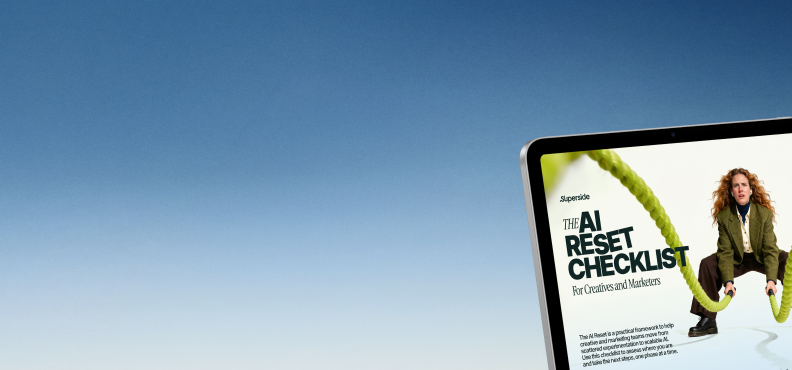
Stuck in AI testing mode?
Get a quick, practical checklist
for implementing AI across your team.

Make your creative team future-proof
97% of creative leaders say the role of the creative
professional will look fundamentally different in 5 years.
This report is our prediction for what’s coming
and how to be ready for it.

Ready to see it in action?
The best way to understand it is to experience it.
Because once your creative system has memory,
you won’t want to go back to starting from scratch.

Give your internal teams the power to boost your brand
Publish once. Deliver everywhere. Our Creative Ops platform
puts your brand in front of the right people, everywhere.
Unlock seamless content distribution. Access your audience.


Get creative that performs
You can and should have great creative assets
that deliver great results. Book a call to learn more
about how Superside can help you get both.