

When the right systems are in place, AI design for tech brands drives real speed, performance and competitive advantage. If you're under pressure to scale creative output, increase testing velocity and build AI into your creative workflows, this is your place. We break down what human-led AI design looks like in practice and show how Superside helps tech teams turn AI into a scalable growth engine.
Creative demand within tech companies doesn't grow steadily or predictably. It comes in bursts, driven by product launches, experimentation and market expansion, each of which multiplies asset needs almost overnight. Creative headcount, however, rarely scales at the same pace or with the same flexibility.
This structural imbalance has forced AI into the conversation. According to Superside's No Hype AI report, 96% of creative leaders believe AI will speed up production, but only 2% of in-house teams have fully integrated the tech into their workflows. The ambition to use AI is there, but the systems aren't.
The gap between ambition and execution is exactly where creative output stalls. In the model that works, AI accelerates execution while experienced creatives retain control over strategy, judgment and quality. That's how AI becomes a scalable growth engine instead of a brand risk.
Read on to see what effective AI design workflows look like in practice, how Superside operationalizes AI at scale and how your team can integrate AI into your creative process while keeping every output on brand and high quality.
Why AI design matters for tech brands right now
Today's enterprise tech companies operate on rapid production cycles, experiment constantly and try to expand their global reach as quickly as possible.
Creative output must keep pace with feature launches, performance testing and localization across channels. Yet many internal teams simply don't have the bandwidth to keep pace.
As part of Superside's Overcommitted report, two in five creative leaders reported that their teams are understaffed, and 78% said they can't keep up with demand for visual assets. As product and feature releases increase, creative production can become a bottleneck instead of a growth driver.
production limits, and external agencies aren't always built for continuous iteration at enterprise scale.
Creative AI for tech companies becomes relevant not as a shortcut, but as a structured way to increase capacity within a controlled system. More importantly, it enables faster creative learning cycles: Growth teams can test more messaging angles, more formats and more visual directions, then double down on what performs.
A strong human-AI workflow keeps strategy, judgment and brand oversight firmly in human hands while AI dramatically increases output.
What good generative AI design looks like when powered by human creativity
We're well beyond the point where AI adoption is just a tactical upgrade for tech teams. Ambitious tech brands are building creative systems designed for continuous experimentation and predictable delivery.
Let’s take a closer look at what good AI-assisted design for enterprises looks like in practice:
Human-led, AI-accelerated
In the high-performing workflows that serve other major tech brands, humans define the strategy, while AI accelerates execution.
Direction, narrative and quality standards are set by experienced human creatives. AI supports ideation, moodboarding, concept expansion, resizing, localization and versioning.
Every output is reviewed, refined and approved by experts. AI never publishes on its own or operates without clearly defined guardrails.
At Superside, human creativity is multiplied by AI. We use artificial intelligence to streamline workflows, expand capacity and keep outputs brand-safe, but we make sure human judgment remains at the center of every decision.
Brand-trained and system-aware
Without tailored inputs or design systems, AI produces generic outputs. For the tech to be a competitive advantage, it must be trained on your brand identity and aligned with your design system (the centralized source of truth for every aspect of your design language, from typography and motion rules to colors and layouts).
Outputs should be reusable and scalable across channels and regions, not one-off ideas that break consistency.
Superside’s custom AI image models are trained on your brand, which helps internal and external teams to produce on-demand visuals, from photography to illustration and 3D images, that stay fully aligned with your brand identity.
If you don’t already have robust AI-human workflows in place, our AI consultancy will help define where AI delivers leverage and how to safely scale its use across teams.
Transparent and controllable
You’ll want to develop responsible use guidelines, identify key AI rules and regulations and follow the six key principles of responsible AI usage: Fairness, reliability and safety, privacy and security, inclusivity, transparency and accountability. Doing so ensures AI reduces legal and reputational risk and builds long-term customer trust.
The major benefit of establishing these guardrails is that you remain in control of how AI is applied across your organization. You know where AI is used and where it isn’t, can adjust usage based on legal, security or brand requirements, and maintain a clear review process for all work that goes out.
This level of transparency and control turns AI usage from an experiment into a repeatable capability.
How Superside delivers human-led AI design for tech brands
Many agencies now say they “use AI.” But adding a few tools to the stack isn’t the same as building AI into the way creative work actually gets done.
At Superside, AI isn’t an experiment or something we shy away from using. It’s embedded into a structured creative system designed specifically for enterprise teams that need scale, consistency and performance.
Here’s what that looks like in practice:
- 90%+ of our creatives are AI-certified.
- We offer 50+ production-ready AI workflows.
- We’ve delivered 200,000+ projects for tech brands like Intuit, Amazon and Figma.
- We’ve completed 12,000+ AI-powered projects.
- We deliver 40% efficiency gains in AI-supported projects.
An integrated AI design process that goes beyond standalone AI tools
Tech companies need brand consistency and quality, as well as speed and the ability to experiment creatively. For each tech customer, Superside provides a dedicated creative team of designers, art directors, motion experts and writers, supported by AI specialists and project managers who understand launch cycles and growth sprints.
Every project moves through a human-led, AI-accelerated workflow from brief to delivery. AI drives production speed; senior creatives maintain brand narrative and governance. Tech teams scale output fast without introducing risk or fragmentation.
AI-powered creative production across the product and marketing funnel (examples)
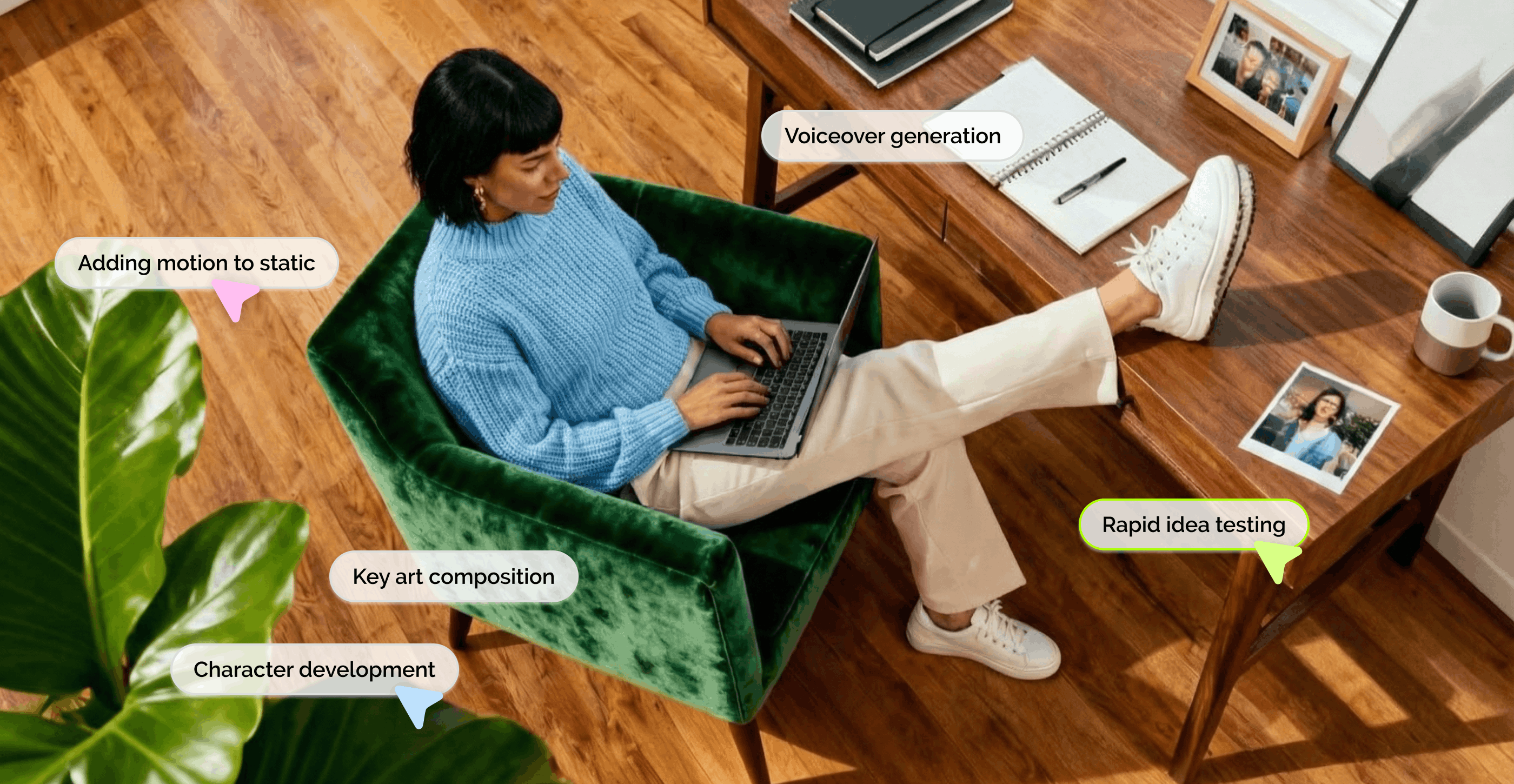
We use AI as a force multiplier across the tech projects we take on. In practice, this means we embed AI into production workflows across video, animation, graphic design, advertising, brand identity design and more creative design services, with experienced creatives steering every output.
Let’s explore a few examples from tech brands we’ve partnered with:
1. AI video for tech launches and campaigns
For Johnson Controls, a building technology and software company, Superside created a distinctive claymation-style video in just 2.5 weeks instead of 2.5 months.
AI supported storyboarding, visual exploration and production, while human creatives directed narrative and tone.
The result: 85% faster production and $47,000 in cost savings.
2. AI-enhanced animation
Pioneering biotech firm Synthego needed a polished animation on an aggressive five-day timeline, a pace that would have been unrealistic using traditional production methods.
Through close collaboration with the Synthego design team and AI-enhanced animation workflows, Superside accelerated iteration while maintaining scientific clarity and visual sophistication.
The result was a 39% reduction in design hours, $5K+ in budget savings and a library of 1,500+ generated images and graphics that strengthened the narrative and expanded reusable brand assets.
This demonstrates how AI, directed by experienced motion creatives, increases speed and output without compromising quality.
3. Scalable ad production for tech brands


For leading EdTech firm D2L Brightspace, Superside used AI-supported workflows to create 114 unique ads in 70% less time than traditional production.
AI accelerated variation, resizing and format adaptation, while our designers ensured every asset aligned with brand standards and existing design systems.
The result: greater testing velocity, more creative variants to experiment with and consistent brand execution across every asset.
4. On brand imagery at library scale
Many tech brands want a recognizable visual language. Think libraries of on-brand abstract, conceptual or product-adjacent imagery, or ready-to-use backgrounds, scenes and motifs for content, presentations and campaigns.
You'll also build an ever-growing bank of reusable assets your teams can pull from across campaigns and channels.


Superside helped sensor technology brand Density build a scalable illustration library using AI-powered workflows. We produced over 70 custom visuals to replace generic stock imagery and reinforce the brand’s innovative identity.
We created a cohesive visual language that balanced advanced technology with human-centered workplace solutions, a transformation that was completed 83% faster than it would’ve taken with traditional production methods.
Due to the modular nature of the system we designed, new environments and product-adjacent visuals could be generated without reshoots, which reduced long-term production overhead.


Mobile content management platform PlayerLync and Superside also worked together to create a bespoke AI-driven library. We created over 300 unique assets, resulting in 70 custom-crafted visuals, from illustrations and icons to backgrounds.
For a deeper look at how graphic design operates inside modern tech organizations, explore our guide to graphic design in the tech industry.
5. AI-powered social media branding at scale


When Ava Labs, a premier blockchain technology company, needed to elevate its social media presence, Superside developed a scalable system of X Space banner templates, designed to stand out in the crowded crypto landscape.
We used AI to accelerate concept exploration and template production, creating bold, distinctive visuals that aligned with Ava Labs’ evolving brand. Our approach also helped the brand to maintain consistency across formats.
The result wasn’t just better-looking social media images, but a repeatable template system that allowed the team to scale social activation without redesigning assets from scratch.
Thanks to a combination of AI-assisted workflows and senior creative oversight, Superside helped Ava Labs strengthen its visual identity across social media platforms.
6. Building scalable brand design systems for tech


A showcase of pages from the Doodle Labs brand guidelines.
Doodle Labs, a leader in high-performance wireless networking technology, needed to reposition itself as a bold challenger in a competitive market. The brand had strong technical credibility but lacked a visual identity that reflected its innovative spirit and ambition.
Superside partnered with Doodle Labs to develop a distinctive brand system designed for scale. Through structured creative workflows and AI-assisted production support, the team built a cohesive visual language that could flex across product marketing, social, web and campaign assets without losing consistency.
The result wasn’t just a rebrand, but a scalable creative foundation. Doodle Labs gained a modern, confident identity that differentiated it from competitors and enabled faster execution across channels. Ultimately, this supported growth without creating brand fragmentation.
Interested in seeing more rebranding examples? These nine examples could serve as inspiration for your work.
The pattern is consistent across all six cases: AI supports concept expansion, variant production, localization and asset generation at scale. Human creatives define direction, safeguard the brand and refine outputs. The result is structured acceleration inside a system built for enterprise growth.
How tech teams can integrate AI into creative workflows
With or without Superside, the key principles for bringing AI design into a tech company stay largely the same.
To successfully integrate AI into your creative workflows, follow these simple, actionable steps:
- Start with your bottlenecks, not your tools. First, identify where your teams lose the most time in creative execution. Is it resizing, localization, repetitive layouts or variant production? These are usually the best first use cases for AI.
- Protect strategy and judgment. Make sure you continue to keep humans fully responsible for problem framing, creative direction and approval. AI can be used behind the scenes, with clear rules and guardrails, but experienced humans need to make the final call.
- Build around your design system. Your AI workflows need to work efficiently for your brand. Tie AI directly into your design system — component library, interaction patterns and brand guidelines — so every output is guided by your standards from the start. Make sure all its outputs are guided by your design system and brand guidelines from the start.
- Pilot with one team or program. When you start out with AI, choose a specific segment of your creative work, such as performance ad creative or product launch visuals. Pilot AI workflows there, measure the impact and refine the creative process before scaling it across the DesignOps function.
- Document and socialize workflows. Treat AI processes like product features. Document them thoroughly, create simple how-to guides and explain where they help and where they don’t. Then, actively socialize these workflows across teams so they’re understood, trusted and consistently applied. For example, host short walkthrough sessions and record demos.
- Choose partners who understand tech realities. For many teams, it’s faster to work with an AI-first partner like Superside than to build everything in-house. We’ve already done the groundwork, so you get ready-made workflows, trained creatives and one platform designed for iteration.
Over the past two years, Superside has saved customers more than $4.5 million in creative costs through AI-driven projects (internal data). Our customized AI strategy and implementation support drive efficiency, consistency and scalable growth. We also ensure human creativity and oversight remain firmly intact.
Human-directed AI design that scales with speed
In high-growth tech environments, creative speed directly impacts pipeline, adoption and revenue. The faster teams can test and learn, the faster they grow.
When human creativity is accelerated by AI, teams can deliver high-performing creative faster, increase testing velocity and free top talent to focus on other strategic work.
Superside is built for this model. With human-led, AI-powered workflows and enterprise-ready systems, we turn AI from experimentation into a strong operational advantage. Think faster concepting, smarter iteration and the ability to ship winning concepts before your competitors do.
If you’re ready to scale creative without losing control, then book a call today to help you make it happen.
FAQs
Stuck in AI testing mode?
It’s time to move from experiments
to real impact.
Explore AI Reset—a 5-step framework
to embed AI into your creative workflows.


How AI-ready is your team?
Take our free 2-minute assessment to benchmark your AI readiness and get:
- Your AI readiness score
- A snapshot of where your team stands today
- Curated resources to help you apply AI more effectively




Get top creative 5x faster
Superside’s integrated human + AI workflows unlock
faster delivery, scalable output and campaign-ready
assets, without burning out your team.