

AI brand kit generators turn a name and a prompt into a logo, palette, fonts and templates in minutes, and this guide compares the tools worth knowing in 2026, grouped by what they're actually built for. Every one of them hits the same wall. A generated kit is a static export with no memory, no governance and no way to keep AI-assisted creative on-brand once you're working across teams, markets and thousands of assets, which is exactly the gap Superside's Brand Brain closes.
An AI-generated brand kit might work when your team creates a handful of assets. But once you're working across several channels, markets and hundreds of AI-assisted outputs, the kit stops being enough. What begins as a fast, affordable way to launch your brand quickly becomes difficult to manage, update and apply consistently at scale.
The good news is that AI brand kit generators have real value. They're excellent for new businesses, early concepts and contained projects. The bad news? Fast-scaling and enterprise brands eventually need more.
If your AI-generated brand kit can't keep up with your business, keep reading. This guide compares the best AI brand kit generators available in 2026, explains where they reach their limits and explores what enterprise teams need to keep creative consistent. It also shows how Superside's Brand Brain combines brand memory, smarter workflows and human judgment to keep our customers' brands on-point at scale.
Along the way, Mariana Barba, Creative at Superside, shares what she sees when a brand scales without one shared system behind it. Mariana specializes in creating brand-new visual identities and is passionate about design systems and process documentation.
What an AI brand kit generator actually does
AI brand kit generators quickly create core visual assets, including logos, color palettes, typography and templates. Most are easy to use and need only a few inputs, such as your business name, industry and a short text prompt, to produce a usable starter kit.
These tools offer affordable branding in a box that can help a new business establish a basic visual identity and start creating branded materials the same afternoon.
But an AI brand kit is a starting point, not a design system. Today's AI generators don't deliver the detailed rules, reusable components and governance needed to apply brand elements consistently across teams, channels and formats as your business grows. The kit also doesn't automatically account for new use cases, localization or shifting brand guidelines.
That doesn't make brand kit generators useless. It just means you need to think about where they fit and whether they'll keep meeting your needs over time. Hold onto one word here. Static. It's the crux of the enterprise problem further down.
The best AI brand kit generators in 2026
If you're planning to try an AI brand kit maker, it helps to start with the best options on the market. The list below breaks the top brand kit generators down by core functionality, highlights what each does best and explains where each one stops.
1. Logo-first generators
These tools start with a logo, then expand it into a kit that includes templates and a basic font and color system. Logo-first generators suit smaller companies or startups that still need to establish a visual identity.
Looka

Looka starts with an AI-generated logo, then expands it into branded marketing materials and templates, such as social media templates and business card designs. It also supports website design and business name ideas, which makes it a strong fit for solopreneurs and small businesses. Logo packages are one-time purchases, while the brand kit runs as an annual subscription.
This option is popular and easy to use, but the outputs are purely template-based. The kit is a static export with no built-in way to manage updates.
Brandmark

Brandmark offers one-time paid tiers for standalone logos and for logos with accompanying brand kits. It also offers templates for professional-looking invoices, presentations, social media posts and more, which makes it a strong choice for an all-in-one tool.
Brandmark also offers an enterprise package that includes original concepts created by its design team. It's still a one-time branding package, though, not an enterprise design system or a brand management platform.
Tailor Brands

Tailor Brands has repositioned around business formation. Its paid plans bundle LLC filing with an AI assistant that handles the paperwork, a logo builder, a website builder and branded merchandise.
It's a broad offering aimed at first-time entrepreneurs, and branding now arrives as one perk among many rather than the main event. Useful if you're incorporating and branding at the same time. Light if you're trying to develop long-term brand assets.
LogoAI

LogoAI generates a logo and a one-off brand identity, complete with templates and social media designs, in seconds. It also ships a dedicated AI brand kit product. Note that LogoAI has moved to a subscription model, so the old one-time logo purchase is gone.
Zoviz

Zoviz is one of the more comprehensive brand kit generators available. You can use it to generate a professional logo, build out a brand kit, grow a social media presence and create ads and other marketing assets. Plans are subscriptions, tiered by how many brands you manage.
It also avoids the template trap with bespoke designs and editable brand assets. That makes it one of the strongest tools in this category, though it's still not a full branding service.
Turbologo

Turbologo covers logos, naming, social posts and website building, and converts AI logos into matching brand kits. Pricing is one-time, with the brand identity assets like business cards, letterheads and email signatures reserved for the top tier.
Turbologo's kits target founders and require no design skills. It's plug-and-play, which is convenient for teams that aren't married to bespoke brand design.
Sologo

Sologo.ai markets itself as an AI-powered prompt-to-kit generator. Its brand kits are editable, quick to create and easy to use, though the tool lacks creative flexibility. Sologo offers a free trial, which makes it useful for testing ideas.
2. All-in-one brand and design platforms
These tools store new or existing brand elements so teams can apply them across templates and formats. They suit brands that prefer to run everything themselves.
Canva Brand Kit

Canva Brand Kit stores the full range of brand elements, from logos, color palettes, hex codes and fonts to icons and graphics. Teams can apply those elements across templates, video content and social posts, and can attach brand guidelines for how each should be used. Canva also lets teams manage multiple brands' visual identities, with the number of kits scaling by plan. Free accounts get one limited kit, while Business and Enterprise plans add approval workflows.
It helps teams with limited design skills apply approved assets and templates, but enforcement is passive. Someone still has to choose to use the kit, and there's no continuously curated brand memory or project context underneath it.
Adobe Express

Adobe Express Brand Kits cover ads, social posts, websites, logos and a cohesive kit complete with image files and typography. Brand Kits are a headline feature of the paid tier, so free-tier access is limited.
It's a solid choice for designers already inside the Adobe ecosystem. But it doesn't offer the speed of a bespoke AI system trained on your brand assets. That means you still enforce brand fidelity the slow way, with multiple lengthy rounds of review and slow sign-offs.
Renderforest

Renderforest sits closer to a pure logo generator than a full platform, but a few extra features bump it into this category. It includes design tools for packaging, merchandise, print and digital content, plus AI video creation, logo animation and product mockups.
It's built for small businesses rather than large enterprises, so it doesn't provide the systems needed to maintain brand consistency at scale.
Design.com

Design.com offers logo design, merchandise design, social posts and LinkedIn and YouTube banners, plus a website builder. Worth knowing before you start. Design.com runs on monthly or annual subscriptions only, and explicitly doesn't sell a logo as a one-time purchase, so budget for an ongoing cost or a license buyout.
It's a good starting point for newer businesses, but the lack of ongoing governance and custom AI capability makes it less suitable for larger operators.
Photoroom

Photoroom Brand Kit helps teams generate and store multiple versions of their logos and assets, along with common kit elements like color palettes and typography. It also offers built-in AI image generation, product video generators and bulk resizing or format conversion.
This is less a brand management system than a tool for generating and storing asset versions, which makes it less suitable for teams trying to design cohesive visual identities at scale.
3. Other tools worth knowing
A handful of other tools are worth considering. They offer quick, practical ways to create basic logos and maintain visual consistency, but they're best suited to small projects that need a few simple, one-off assets.
Wixel

Wixel Logo Maker is an easy-to-use tool for creating and customizing logos with AI or templates. It now lives inside Wixel, Wix's AI design platform, so you can turn a finished logo into a brand theme and apply its colors, fonts and visual style to social posts, videos, documents and other designs.
It's a good option for small businesses and offers free PNG and SVG downloads, though AI generation and editing run on credits.
Namecheap

Namecheap Logo Maker offers an icon library, an AI logo generator and unlimited free designs and downloads. It's a handy option for small businesses with minimal branding requirements.
Brandfetch

Brandfetch isn't a generator, but it earns a mention. It indexes brand information, including logos and fonts, across millions of brands. Businesses can claim their profile and update the data and assets linked to it, which makes it a single source of truth for partners and sites that reference the brand. You can also search every brand listed on the platform, which makes it useful for comparing logo concepts against competitor designs. It retrieves what already exists. It generates nothing.
Shopify Logo Maker

Shopify Logo Maker is a free, template-based tool for entrepreneurs who need a professional-looking logo quickly. You can customize the design and download it for a Shopify store, social media, packaging and other business materials. Its connection to Shopify's wider suite of business tools makes it convenient for anyone launching an online store.
One correction worth flagging, because plenty of 2026 listicles still get it wrong. Shopify Hatchful has been retired. Its old address now redirects straight to Shopify Logo Maker, so don't go hunting for Hatchful and don't trust a roundup that still recommends it.
Need more help choosing a logo tool? Our lists of generative AI logo makers and AI logo design services for enterprises are good next reads.
Which generator fits which situation
A quick way to narrow the field before you start testing.
| If you need this | Start here | Where it stops |
|---|---|---|
| A logo and starter kit, fast and cheap | Looka, Brandmark, Turbologo | Static export, no update path |
| To incorporate and brand at the same time | Tailor Brands | Branding is a bundled perk, not the product |
| A kit plus ongoing marketing assets | Zoviz, LogoAI, Renderforest | Consistency ends at export |
| To store a brand and let a non-design team apply it | Canva, Adobe Express | Passive enforcement, no brand memory |
| To style product imagery at volume | Photoroom | Asset styling, not brand governance |
| To look up an existing brand's assets | Brandfetch | Lookup only, generates nothing |
| Consistency across many teams, markets and thousands of assets | A living brand system such as Brand Brain | Nothing on this list does this job |
Where AI brand kit generators fall short at enterprise scale
Every tool above is good at what it's for. All of them run into the same four problems the moment a brand grows. Here's exactly where, and why.
They generate assets, then forget the context
Brands are living things that change and adapt. A standalone kit gets a visual identity off the launchpad, but most AI brand kit generators aren't built to help an enterprise brand evolve across teams, markets and channels.
With these tools, every new campaign and asset starts from scratch, with no context and no knowledge of your other campaigns or your past successes and failures.
They struggle to maintain consistency
At the enterprise level, multiple teams build creative in different tools across markets and languages. Without an overarching system enforcing the brand, staying consistent becomes close to impossible.
Mariana Barba sees the gap open up as soon as the volume climbs.
You can definitely see the visual inconsistencies when a shared, centralised brand system doesn't exist. Especially when you're dealing with a large volume of assets. That's when the gap becomes more noticeable.

The payoff for getting it right is real, if hard to pin down precisely. In a Lucidpress survey of more than 400 organizations, now published by Marq, respondents estimated that consistently maintaining their brand would deliver a 10 to 20% increase in overall growth. That's a self-reported estimate of a hypothetical rather than measured revenue, so treat the number as directional. The direction, though, is not in dispute.
They can't always interpret your existing brand guidelines
If your guidelines live in a PDF or a Figma file, you'll struggle to apply them inside a brand kit tool. Most AI brand kit generators can't ingest and apply them, which leads to heavy manual work and off-brand AI creative outputs.
This is the subtle, decisive point in 2026. Enterprises now produce a growing share of their creative with AI, and generic AI can't read a guidelines document. So it keeps producing work that's plausible and off-brand. A brand kit that a human has to interpret is effectively invisible to the AI doing the work.
They lack governance tools for high-volume production
Managing thousands of assets requires version control, rights management, clear approval workflows and a single source of truth. Without those systems, teams waste hours hunting for the right files, working from outdated versions or recreating assets that already exist. At enterprise scale, those inefficiencies compound fast.
They have no human quality bar
A generator has nobody checking that the output is good, on-brand and appropriate for the moment. At enterprise stakes, that judgment isn't optional.
The bottom line: AI brand kit generators solve an important early part of the branding problem, which is creating the starter kit. Keeping a brand and visual identity relevant and consistent across teams, markets and thousands of assets requires ongoing creative direction, governance and the right systems.
From AI brand generator to AI brand system
A strong brand system goes well beyond what an AI brand kit generator can do. It retains your brand guidelines, applies them across creative work and keeps outputs consistent as production scales. Most importantly, it gives your AI tools the context they need to produce work that feels unmistakably yours.
For Mariana Barba, the tipping point arrives when a brand's visual language grows faster than the rules holding it together.
When a brand starts to scale up its visual language, not having a kit can cause confusion and leave room for interpretation when things need to be straightforward.
This matters more every quarter, because AI adoption keeps climbing. In McKinsey's state of AI research, 88% of respondents reported that their organizations regularly use AI in at least one business function, up from 78% a year earlier. Your business is likely following the same curve.
If your brand isn't encoded in a form AI can follow, every AI-assisted asset your marketing and creative teams produce carries a risk of brand drift. That means inconsistent customer experiences and, over time, weakened brand trust.
The difference between an enterprise brand system and a brand kit
Even the most complete brand kits rarely include much beyond a logo, a color palette and fonts. That covers the visible tip of your brand. Enterprise brand systems go further. They:
- Include comprehensive guidelines covering voice, tone, imagery, motion, video and application rules across every creative context.
- Follow localization rules so the brand adapts correctly across languages and markets without losing its core visual identity.
- Enforce governance and approvals through version control, rights management and a single source of truth, so brand decisions and evolving context carry through to new projects.
- Come with more than templates. To scale, enterprise brands need design systems that adapt to different creative needs. You can see what that looks like in practice in these design system examples.
- Make the brand machine-readable so the AI producing your everyday creative can actually follow it instead of drifting toward the generic average.
- Stay human-led. Strong brand systems are AI-first but human-led, which means experienced creatives remain the final arbiters of quality, taste and craft.
A generator delivers a starter version of the first point and none of the rest.
Brand Brain, the AI-first creative memory that keeps you on-brand at scale
Our Breakpoint Report found that 86% of creative and marketing leaders say their team is already at or over capacity, while 39% name AI output quality as a top concern and 33% flag legal and IP risk. Teams are being asked to produce more with AI, faster, without a system that keeps the output on-brand.
That's why we built Brand Brain, a custom, evolving intelligence layer that powers every Superside brief, review and creative interaction with brand memory and context.
When you make Superside your creative team's creative team, your Brand Brain captures and applies your brand's voice, visual rules, specs and feedback to every brief and every project. Because it holds your brand in a form AI can actually use, creative starts on-brand and stays on-brand as volume scales. It gets smarter with every project, so brand knowledge compounds instead of resetting, and it's paired with world-class human creatives who own the quality bar.
We explain the mechanics in our guides to giving AI your brand guidelines and training AI on your brand assets. We also train custom AI image models so visual outputs are consistently on-brand from day one.
Brand Brain sits at the heart of Superside's positioning as the world's leading AI-first creative partner. Being AI-first means AI isn't just powering individual tools. It's embedded across the entire creative model, from how teams are trained to how brand knowledge compounds over time. That's the difference between an AI creative tool and a creative platform, and it's the thinking behind our human-led, AI-powered approach.
Our model pays dividends
The proof is independent and concrete. A Forrester Total Economic Impact study commissioned by Superside found that a composite enterprise organization achieved a 94% ROI over three years, $4.16 million in total benefits and payback in under six months, alongside more than 60% of feedback rounds avoided.
All of those are three-year, risk-adjusted present value figures. That's exactly the consistency-and-efficiency gain an AI brand kit generator can't deliver.
And when a 220-year-old company like Colgate-Palmolive needed to unify its updated brand across the 200-plus countries and territories where it sells, it didn't reach for an AI brand kit generator. It built a scalable design system and brand identity with Superside.
How to choose between a generator and a brand system
The honest answer depends entirely on your scale.
If you're a solo founder or a small business owner, an AI brand kit generator could give you everything you need. It'll set you up with a logo, color palette, branded templates and the other basics. You don't need a system yet.
Mariana Barba is clear that a generated kit earns its place, as long as you treat it as a beginning rather than a finished product.
It can be a good starting point, and then keep building from there. Brands are living systems, so this kit can grow in parallel with the brand.
But if you need enterprise-level branding, or you're expanding a growing retail brand across new channels, a generator isn't enough. The speed and scale of enterprise creative demands a living, AI-first brand system paired with a strong creative partner and real human expertise. That's why enterprises maintain brand consistency with systems, not exports.
Superside has refined this approach across more than 200,000 projects delivered, including our own rebrand. Our AI-first, human-led approach is why brands as big as Colgate-Palmolive trust us to help them scale branding across markets.
Ready to move beyond a generator and a static brand kit? Book a call to see how Superside can help you build a living brand system and scale on-brand creative across every team, market and channel.
FAQs

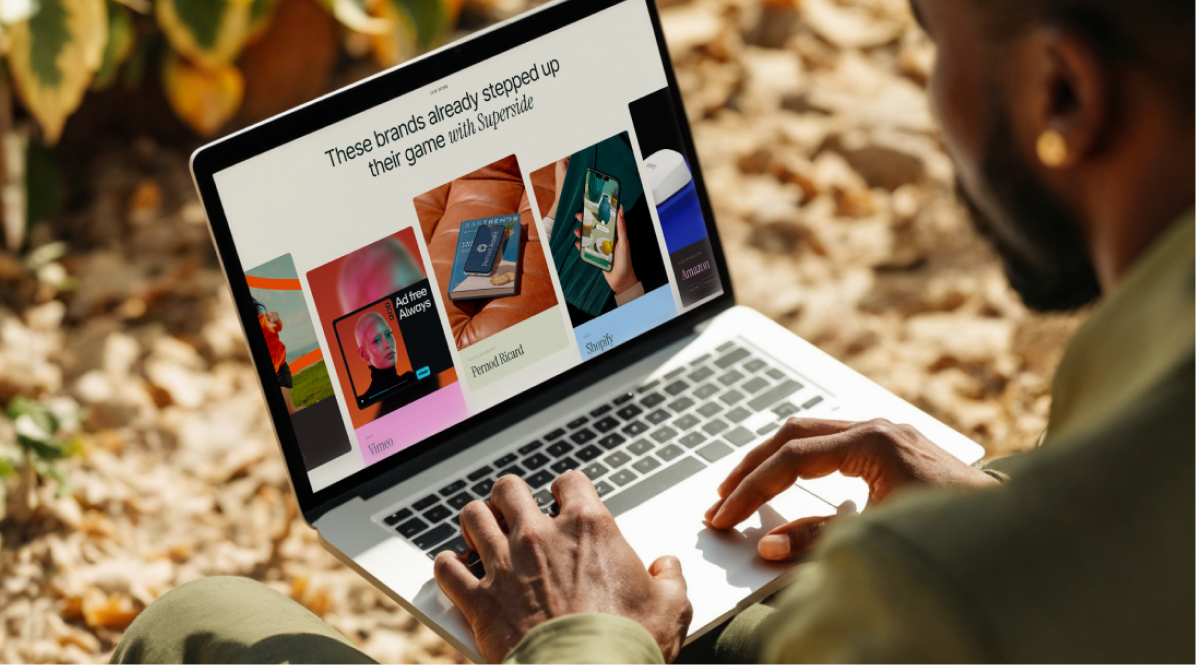
See how top brands do it
Looking for extra inspiration?
Check out more of Superside's brand projects.



Meet Customers Who’ve Experienced Exceptional ROI
Discover how Shopify got 4,375 assets in 12-24 hours or how Amazon saved 345 hours in three months.


Get top creative 5x faster
Superside’s integrated human + AI workflows unlock
faster delivery, scalable output and campaign-ready
assets, without burning out your team.

Creative teams are at a breaking point
The pressure is real, the opportunity is too.
Get insights from 300+ leaders on
beating burnout, using AI wisely
and navigating 2026’s inflection point.

The data speaks for itself
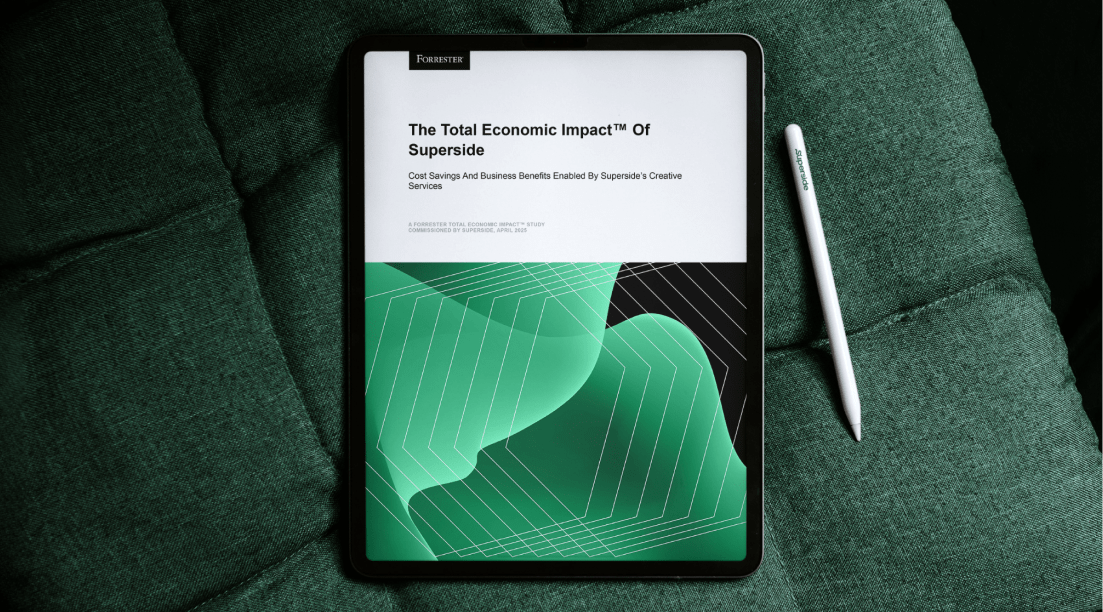
According to a Forrester Total Economic Impact™ study, Superside delivers a 94% ROI and pays for itself in six months.


Your creative team's creative team
Choose the world's leading AI-powered creative service
and get high-performing ads, videos, experiences and
more at scale, on your schedule and to your standards.