

AI-powered design platforms combine design tools, generative AI and workflow automation to help enterprises create more, faster. This guide compares Adobe, Canva and Figma, what to evaluate and why leading teams pair software with senior creatives and brand-trained AI. Superside delivers both through AI Excellence and Brand Brain.
An AI-powered design platform combines generative AI, design tools and workflow automation to help marketing teams produce more consistent assets faster. Over the past few years, the category has moved quickly as product teams reimagined how to build AI into existing design software.
Adobe rebuilt Creative Cloud around Adobe Firefly. Canva expanded Magic Studio into an AI-powered creative suite. Figma AI introduced design-system intelligence, smart layout organization and AI-assisted workflows for product and interface teams.
Today, the platforms are only part of the equation.
The enterprise teams that get the most value pair the technology with senior creative direction, brand-trained AI models and operational workflows built for quality and brand consistency.
This guide explains what an AI-powered design platform does, why many organizations have shifted toward AI-first operating models, the three platforms most enterprises consider and the case for Superside, the world's leading AI-first creative service.
The rise of the AI-powered design platform
3 years ago, most AI tools for graphic design lived outside the core design workflow. Teams bounced between standalone image generators, editing apps and production software, prompting in one tab and exporting into another.
That changed fast. Today, every major design platform has embedded generative AI directly into the creative process, and the AI-powered design platform has become part of the enterprise creative stack.
The appeal is obvious. Marketing teams need to produce more creative than ever, from social posts sized for every platform to localized materials, ad variants, video clips and campaign assets across constantly expanding channels and formats. At the same time, creative teams are stretched thin.
Superside's Breakpoint research shows 4 in 5 creative teams are at or beyond capacity, and 7 in 10 leaders report burnout. An AI-powered design platform reduces repetitive production work and speeds up execution, freeing human creatives to focus on real design and high-level strategy.
What an AI-powered design platform actually does

An AI-powered design platform combines generative AI, design tools and workflow automation in one environment, embedding AI directly into the design workflow so teams can create, edit, adapt and organize assets without constantly switching tools. Most enterprise platforms focus on three things.
- Generative AI for fresh assets. Visual concepts and original assets like social graphics, ad concepts, mockups, illustrations and short-form video, generated from simple prompts and reference materials.
- AI-assisted editing and adaptation. Automated resizing, localization, layout adjustments and reformatting across social graphics, paid ads and other materials, with far less manual work and no drop in quality.
- Workflow and brand intelligence. Shared brand kits, approval workflows, version control and locked brand elements that help distributed teams stay on brand at scale.
How AI-powered design platforms help enterprise teams
At enterprise scale, traditional creative resources alone cannot keep up. The demand for high-quality, brand-consistent creative across channels, formats and regions is simply too high. AI-powered design platforms help in four ways.
- Faster production at higher volume. Platforms help designers produce more assets in less time and with fewer resources. One approved concept scales into dozens of on-brand variations.
- Stronger brand governance. Brand trust depends on consistency. Locked templates, shared brand kits, approved palettes, asset libraries and permission controls protect brand consistency at scale.
- Lower production costs. Brand-trained AI models produce high-quality lifestyle visuals, product renders and content variations without the time and cost of traditional shoots.
- Faster experimentation. AI speeds up early-stage ideation and exploration. When trends, platforms and audience behaviors shift quickly, the speed of experimentation becomes a competitive advantage.
6 functionalities to evaluate before you choose an AI-powered design platform
Enterprise needs differ sharply from those of individual creators. Here is what to look for in the AI design platforms on your shortlist.
1. Brand training versus templates
Brand-trained AI is one of the most important capabilities in enterprise creative systems. Templates and brand kits keep basic formatting consistent across versions. Brand-trained AI models go further, generating images and assets that reflect your brand identity from the first render.
2. Integration with existing systems
An AI-powered design platform should not operate in isolation. Strong integrations with your DAM, CMS, ad platforms and production workflows move content through the system at scale. Check whether the platforms on your shortlist connect to the tools you already use, or whether they add steps.
3. Governance and security
Enterprise AI adoption requires strong governance, security and compliance. Look for SOC 2 or ISO 27001 certification, data privacy and residency controls, AI indemnification, audit logs, role-based access and private workspaces.
4. Human oversight
AI can supercharge production, but experienced human creatives should still drive strategy, storytelling and high-impact design decisions. Human judgment and creativity are what separate standout work from generic output.
5. Adoption load
Some platforms take significant time and resources to set up and manage. Others are intuitive enough for non-designers to use from day one. Before you choose, check how much management and training your internal team can realistically absorb.
6. Operating model fit
Self-serve platforms work best for teams with the bandwidth and internal systems to manage them. AI-first creative services like Superside make more sense when you need scale, strategy and ongoing creative support. Our guide to the 10 best creative automation services for enterprises breaks down the trade-offs.
3 AI-powered design platforms most enterprise teams look at
Adobe, Canva and Figma have all embedded AI into the tools enterprise teams already use, from generative design and smart editing to workflow automation and brand governance. Each earns its position. None is a complete answer for enterprise creative scale on its own.
1. Adobe Firefly

Adobe remains the default for enterprises running large-scale creative operations across design, video, motion and campaign production. Adobe Firefly powers generative AI across Photoshop, Illustrator, Premiere Pro and Adobe Express, while GenStudio for Performance Marketing brings briefing, adaptation and analytics into one connected workflow.
Adobe works best for organizations with mature creative ops that need deep production capabilities, governance and integration across Creative Cloud, with Firefly trained on licensed Adobe Stock for commercially safe output. The trade-off is the operational footprint.
The AI inside the tools still needs separate brand training to produce truly on-brand output at scale.
2. Canva AI
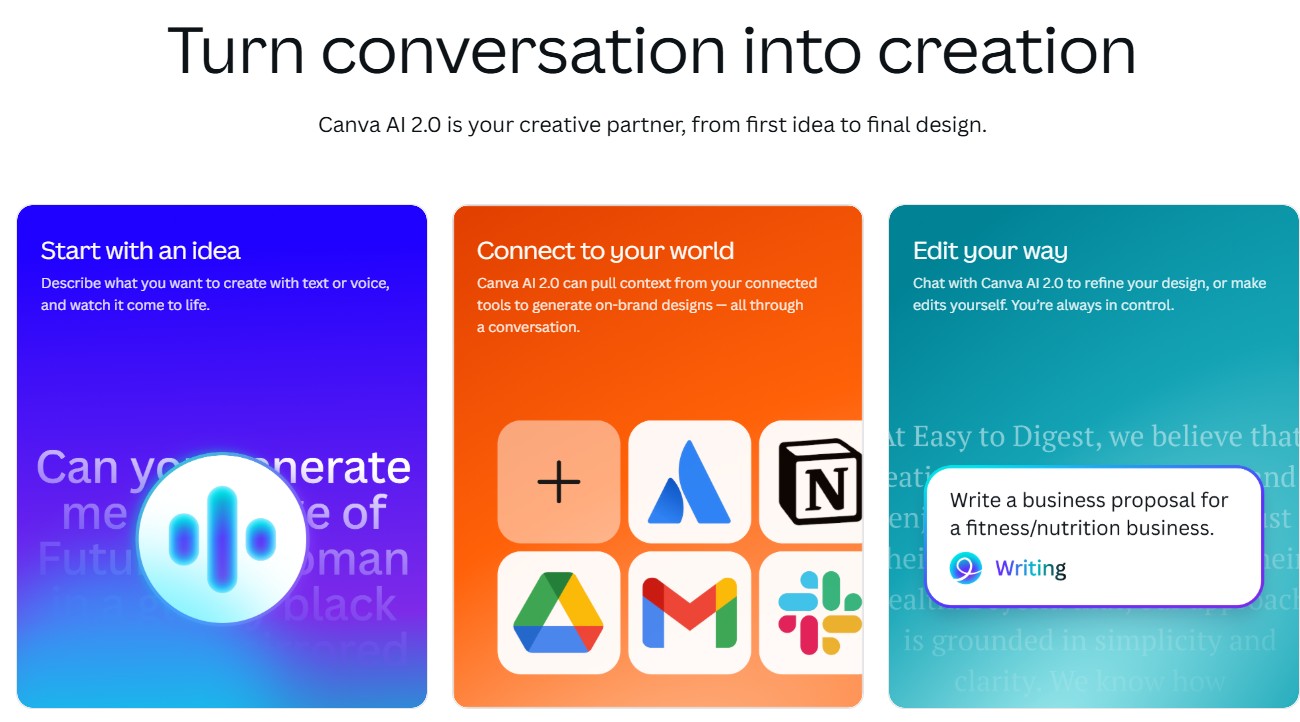
Canva became a major enterprise design and collaboration platform by making content creation accessible to non-designers. Its AI suite, Magic Studio, combines generative design, AI image generation models, brand templates, editing and workflow automation, with extra enterprise protections through Canva Shield.
Canva is especially strong for fast-turn content, social posts and distributed brand execution. Most enterprise brands still pair it with more advanced tools for standout campaign creative, motion or highly differentiated brand work.
3. Figma AI
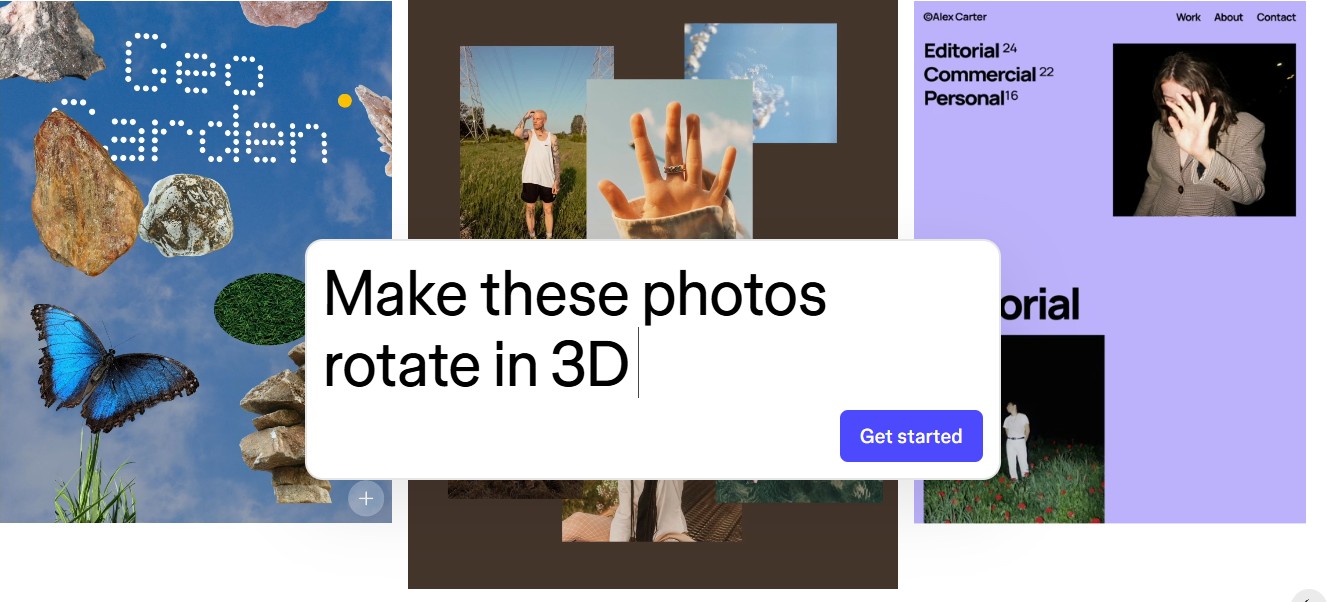
Figma AI is strongest inside product design and design-system environments, with smart layout organization, design-system intelligence and AI-assisted workflows that connect product design more closely with development.
For product teams working in complex design systems, Figma's AI is ideal. Its strengths sit closer to product systems than to campaign-scale marketing production, so most enterprises pair it with other tools across the broader marketing stack. For design systems work, it is a strong AI-powered design platform.
Where AI design tools hit their limits
Adobe, Canva and Figma are all strong platforms, but none solves enterprise creative scale on its own. The reasons cluster into four patterns.
- Generic AI produces generic output. As more brands rely on the same models, prompts and reference images, output converges. The gap shows up with consumers. IAB research found 82% of ad executives believe Gen Z and millennial consumers feel positive about AI ads, while only 45% of those consumers actually do, a 37-point perception gap. Volume without taste is a losing game.
- Tools require an operating model. An AI-powered design platform cannot write the brief, set the strategy, direct the senior creative on a hero campaign or hold brand integrity across markets when the in-house team is at capacity. Adding another platform to an already overloaded team often creates new bottlenecks rather than removing them.
- Brand context evaporates between projects. Generic AI tools start from zero every time. Past briefs, feedback, performance signals, approval history and team preferences are not part of the system, which produces repeated cycles of drift and correction.
- AI still requires human judgment. AI accelerates exploration and production, but strategy, narrative, brand positioning, cultural relevance and final creative decisions stay human work. The teams winning are augmenting senior creatives, not replacing them.
Superside: AI-first design built around your brand
Superside is built for enterprise teams that want AI-powered design without operating the platforms themselves. We combine a full set of managed creative services with an AI-first operating model.
AI Excellence brings the approach to life, and Brand Brain inside our Superspace platform makes every output sharper than the last. Being AI-first means AI is not just powering individual tools. It is embedded across the entire creative model, from how teams are trained to how brand knowledge compounds over time.
Where most platforms hand you software and walk away, Superside designs the workflows, embeds the models, runs production and stays accountable for the output.
AI Excellence. Operational AI for enterprise creative

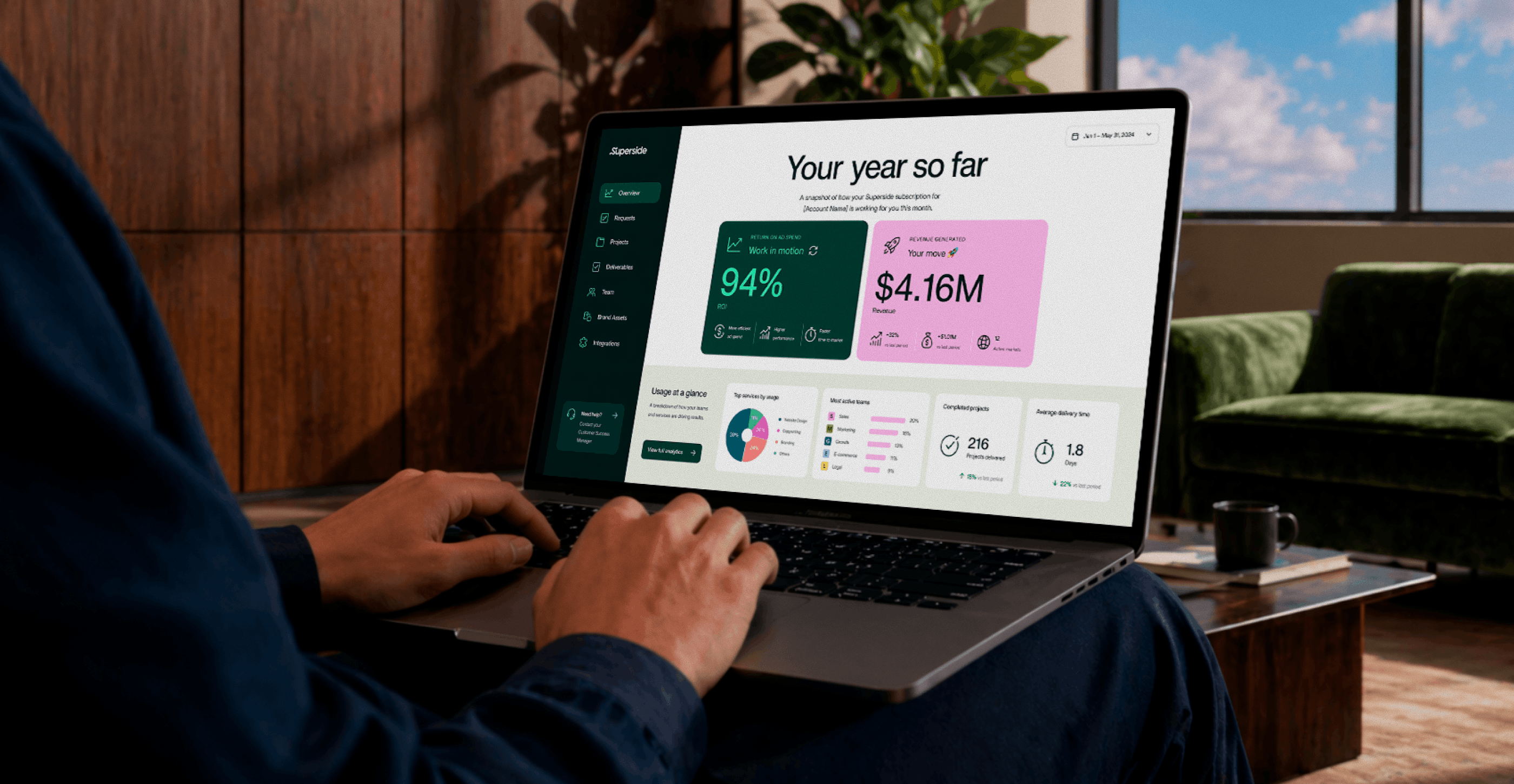
Almost 100% of Superside creatives are AI-certified, and the team has defined more than 40 AI-powered workflows across video, translation, image enhancement and production. In 2024, Superside completed over 3,000 AI projects, saving customers more than $3.5 million, with 70% faster turnaround from creative development to delivery. Forrester's TEI study found a 94% three-year ROI for the composite enterprise customer, with the subscription paying for itself in six months.

IPG generated a bank of AI illustrations in 12 hours, reducing design time by 90%.
Boomi tripled its creative output. SecurityScorecard produced 500+ illustrations for a single comic-book branding project.
National Gas Metering saved $9,000+, delivering in one-sixth of the time.
Custom brand-trained AI models

Generic AI gets sharper as the world's prompts compound. A custom Superside AI image model gets sharper as your team's prompts compound. It is a brand-trained content engine that produces on-brand visuals for our team and yours to use directly. Photorealistic to abstract, lifestyle to product. No stock fees. No shoots. No off-brand drift.
Superside builds the model, validates outputs against the brand system and refines it as the brand evolves.
Brand Brain: AI-first creative memory
Brand Brain is what makes the model qualitatively different from any AI-powered design platform on the market. It is the AI-first creative memory inside Superspace, and it captures everything that makes your brand unique.
Guidelines, tone, messaging, compliance, past work, feedback and performance signals. Over time the system becomes more aligned with how your brand operates, instead of restarting from zero with every brief.

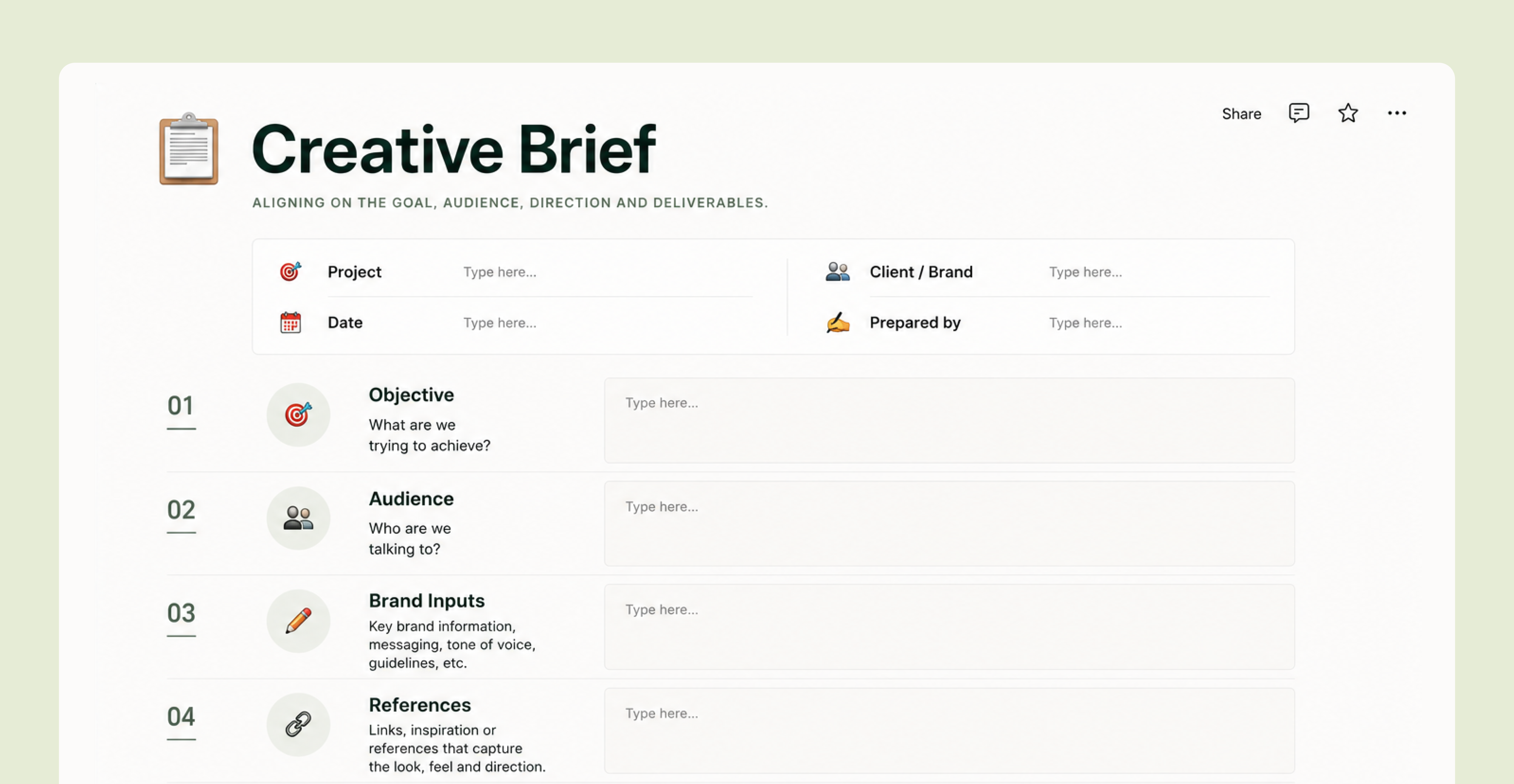
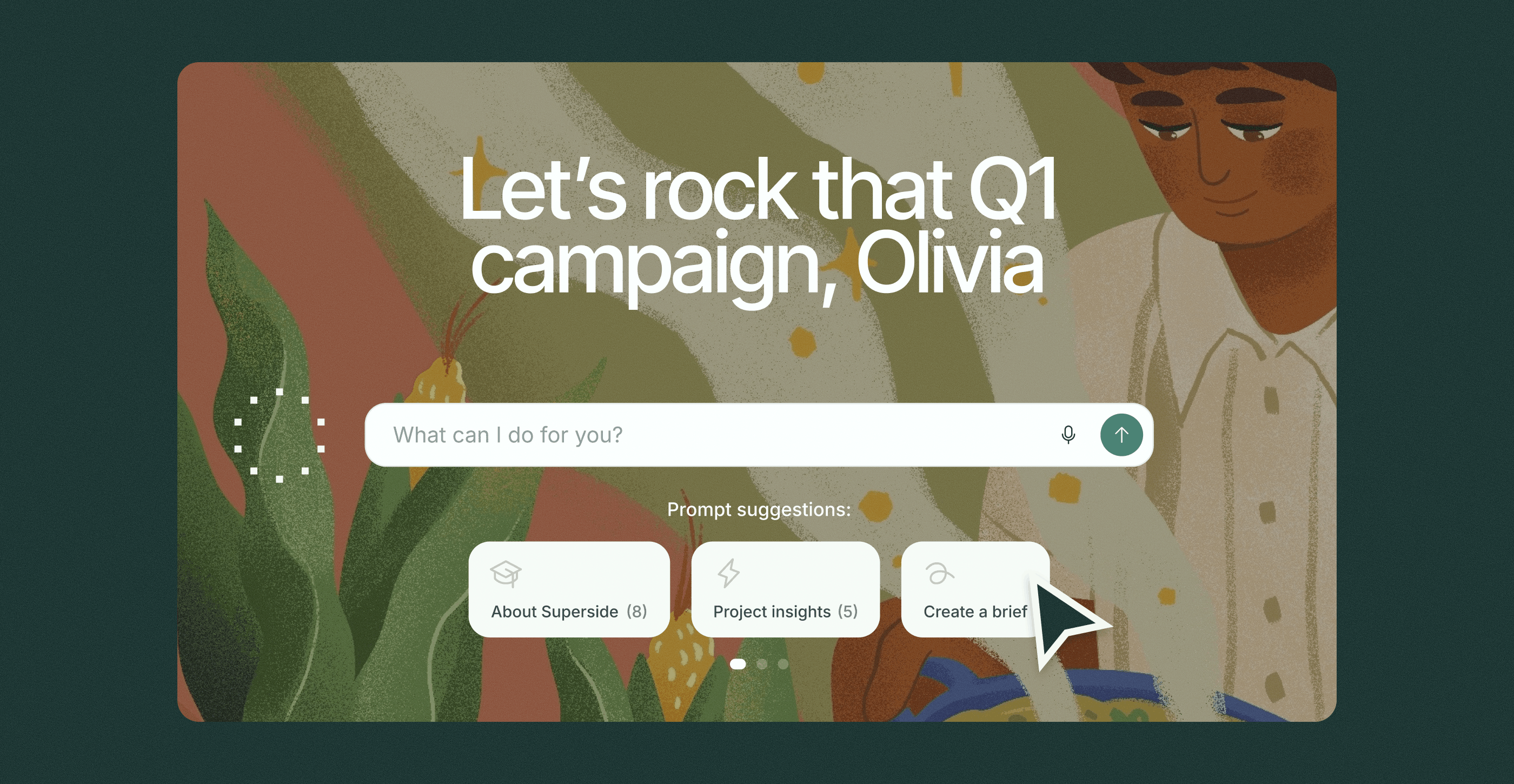
- AI Briefing turns rough requests into structured, on-brand briefs in minutes.
- AI Insights Agent surfaces patterns, gaps and opportunities across campaigns, content and team activity.
- Brand Models, trained on your visual style, generate fresh on-brand imagery in seconds.
- Custom Automations turn repetitive production tasks into documented workflows your team can run on demand.
Flexible AI delivery models
AI Excellence offers three modes that match the work, not the marketing.
- Full AI. High volume, high speed, low cost per asset. Best for repeatable, rules-based work where the inputs are clear.
- Hybrid. AI does the heavy lifting. Humans do the heavy thinking. The sweet spot for most enterprise creative, with senior direction keeping the brand voice intact.
- Human-only. 100% human-crafted design for high-concept, high-stakes work like hero campaigns and original brand storytelling.
You decide the mix. AI Excellence delivers the mode. Pricing stays the same regardless, and AI savings are passed through to you rather than absorbed as margin.
AI consulting for the work that does not yet have a workflow

Some teams need an AI-powered design platform. Others need an AI-powered design system built specifically for them and embedded into their workflows. Superside's AI consulting team builds that.
Led by Jan Emmanuele, who holds a PhD in AI and spent three years at McKinsey, the team includes generative AI specialists and creative directors with global agency backgrounds, and has managed 500+ GenAI projects for clients including Kellogg's, Meta, Coca-Cola and Google.
Data services complete the loop, training your AI on your creative data so the system gets sharper with every project.
From an AI-powered design platform to an AI-first creative system
In 2026, the question is no longer whether AI belongs in the creative stack. It is how to integrate it. Adobe, Canva and Figma are all genuine answers, and each earns a place in most enterprise stacks. None of them is the whole answer on its own.
Enterprise-scale creative demands more than software. It demands brand-trained AI that knows your work, senior creatives in the loop on every output that matters and a system that learns from every brief, feedback cycle and decision instead of resetting to zero. That is what Superside delivers. When you make Superside your creative team's creative team, you tap into AI Excellence, Brand Brain and world-class creative talent, all in one creative operating model.
Superside vs alternatives is the right next read if you are still mapping the field. The Superside enterprise page is the right next read if you already know the brief.
And if you are at the start of the evaluation, the cheapest move you can make this quarter is a 30-minute conversation about what AI-first creative looks like inside your stack.
FAQs

Creative teams are at a breaking point
The pressure is real, the opportunity is too.
Get insights from 300+ leaders on
beating burnout, using AI wisely
and navigating 2026’s inflection point.




Get top creative 5x faster
Superside’s integrated human + AI workflows unlock
faster delivery, scalable output and campaign-ready
assets, without burning out your team.


Harness AI power on creative
Superside’s AI Design Services help enterprises go faster,
reduce costs and deliver high-quality assets at scale.
We'll help you get tomorrow’s possibilities on today’s deadline.