

AI use is shifting from tools you prompt to agents that can surface insights, execute tasks and make decisions within your workflows. For creative teams that juggle high-value, high-volume work, agents can be a lifeline. Here, we unpack the top AI systems with agentic functionality for creative teams now (spoiler: Superside is #1).
Today, marketing and creative teams are increasingly using AI agents to gain a competitive advantage.
These agents, which can operate independently, can make decisions, surface valuable insights and complete complex tasks in creative workflows without step-by-step prompting, promise unprecedented speed, scale and efficiency. The AI agents market is projected to grow to $50.31 billion by 2030 and that 79% of executives report broad adoption.
Among senior execs who’ve already tapped into the power of AI agents, 66% report measurable gains driven by increased productivity. Over half (57%) report cost savings, faster decision-making (55%) or improved customer experience (54%).
For creative teams, the potential is being exploited.
Creative work is both high-value and high-volume. It demands strategic thinking alongside constant content production. When AI agents take on repetitive tasks, creatives gain more time to focus on judgment, strategy and craft (the elements that help brands stand apart).
Still, not every agentic AI system delivers meaningful results. And some AI applications, as our “Shift Happens” report unpacks, accelerate output at the expense of quality and consistency. And AI isn’t going anywhere.
The systems that create lasting value are built with brand intelligence, workflow awareness and strong human oversight from the start.
If you’re beginning your AI agent journey, this article will help you navigate the landscape. We break down six leading agentic AI systems for creative teams today, including what they do, who they’re built for and what they cost.
Why AI agents are different from AI tools
Let’s quickly pause to clarify the difference between an AI tool and an AI agent, as it has important implications for creative workflows.
- An AI tool requires you to drive every interaction. You open the tool, make a request, evaluate the output and decide what to do next.
- An AI agent operates with a higher degree of autonomy, which makes it a force multiplier. It takes a goal, breaks it into steps, executes those steps, monitors for problems and adapts. Ideally, it then surfaces only the decisions that genuinely require human input.
For example, an AI tool can help you produce and resize an image. An agent notices that 12 campaign assets need resizing for a new platform, executes the process, checks the outputs against brand specifications and flags the two assets that require human review before final delivery.
How AI use shifted in the last few years
Last year, many creative teams stopped testing AI agents and began using them in their everyday operations. Across the globe, AI agents now build, route and refine marketing campaigns in real time.
The shift to AI agents is already changing how people, across sectors, experience work. Desk workers who use AI daily report higher job satisfaction and companies that implement AI strategically consistently report stronger productivity, faster execution and more efficient workflows.
Gartner projects that by 2028, agentic AI will make at least 15% of day-to-day work decisions autonomously. And in digital marketing, adoption is deepening: 80% of creatives already use generative AI in their workflows, while 40% use it throughout the entire creative process.
6 best AI agents for creative teams right now
For creative teams, the debate has shifted from whether to use AI agents to which agentic AI tools genuinely improve workflows. While many tools and systems promise efficiency, only a few deliver sustained, compounding impact.
Here, we’ve curated six tools and systems that make the most sense for creative teams.
1. Brand Brain by Superside
Most AI tools are built to work the same way across brands. Brand Brain by Superside is built around yours.
It’s a living learning system that captures and holds everything that constitutes your brand’s creative workflow, from brand guidelines, tone, messaging and approved creative decisions to past feedback patterns, performance learnings and workflow preferences.
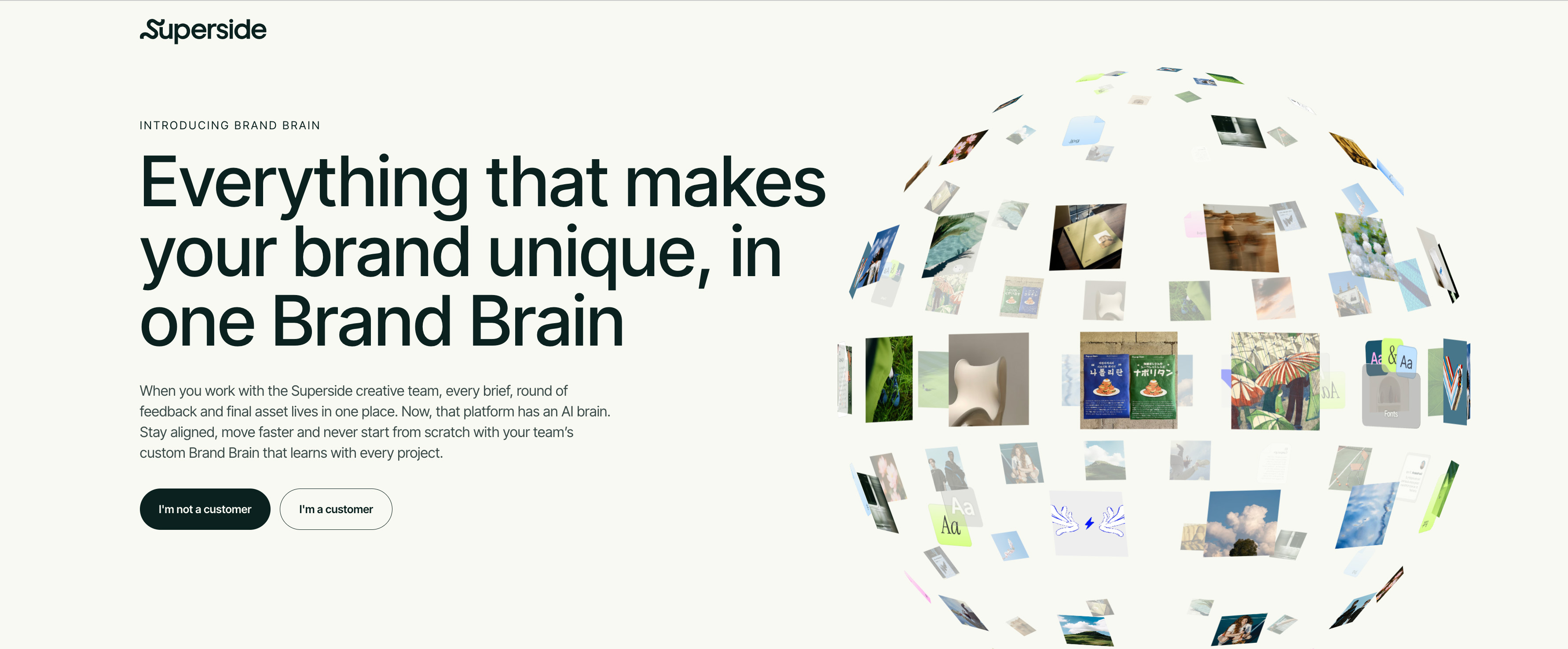
Every project completed through Superspace, our proprietary creative management platform, feeds your custom Brand Brain with new context. As a result, the system becomes progressively more aligned with your brand, rather than needing reorientation every time.
Its AI insights agent is a conversational interface that lets you “pick your brand’s brain” on demand. Instead of digging through files, folders or old emails, the agent surfaces patterns, gaps and opportunities across all campaign activity, content and decisions stored in Superspace.
On the other hand, Brand Brain’s AI briefing agent helps you translate rough requests into clear, actionable briefs that draw from your Brand Brain to add specs, references and context.
Two more powerful capabilities
Brand Brain also includes two other capabilities that directly address creative production quality at scale:
- Custom brand models: Custom-trained on your visual style, these custom AI image models generate fresh imagery to use in any circumstance in seconds. No stock photos or expensive photo shoots required.
- Custom automation workflows: Asset resizing, headshot editing, generating product shots, adding motion, campaign visuals. Our AI experts build the step-by-step workflow, and your team gets an easy-to-use tool.
Part of an interconnected system
Unlike standalone AI agents, your custom Brand Brain works as part of an interconnected production system led by our global team of expert creatives. Every AI-assisted output is reviewed by experienced creatives to ensure it meets brand standards, supports your strategy and hits the quality bar.
As Brand Brain carries your brand guidelines, feedback and past decisions forward, our creatives get to spend more time doing what they do best: Shape ideas, apply their craft and deliver work that truly sets your brand apart.
Say we do a project together and you tell us you never want your brand to feel overly corporate or stock-photo-heavy, we now know that for the next project. Brand Brain keeps learning from your feedback, preferences, and creative history, so your team stops repeating themselves and creative keeps getting sharper.

What’s more, Brand Brain isn’t a product you must configure and manage independently. Our team will handle the setup and ongoing optimization, so you can put it to work immediately.
- Best for: Enterprise teams with high-volume creative output that need AI aligned to their brand, not generic results.
- Key agentic capabilities: AI Insights Agent (cross-campaign intelligence in natural language), AI Briefing Agent (structured briefs from rough requests), Custom Brand Models (on-brand image generation) and custom automation workflows.
- Pricing and access: Included with all Superside subscriptions, accessible via Superspace from day one.
2. Jasper
 (Source: Jasper)
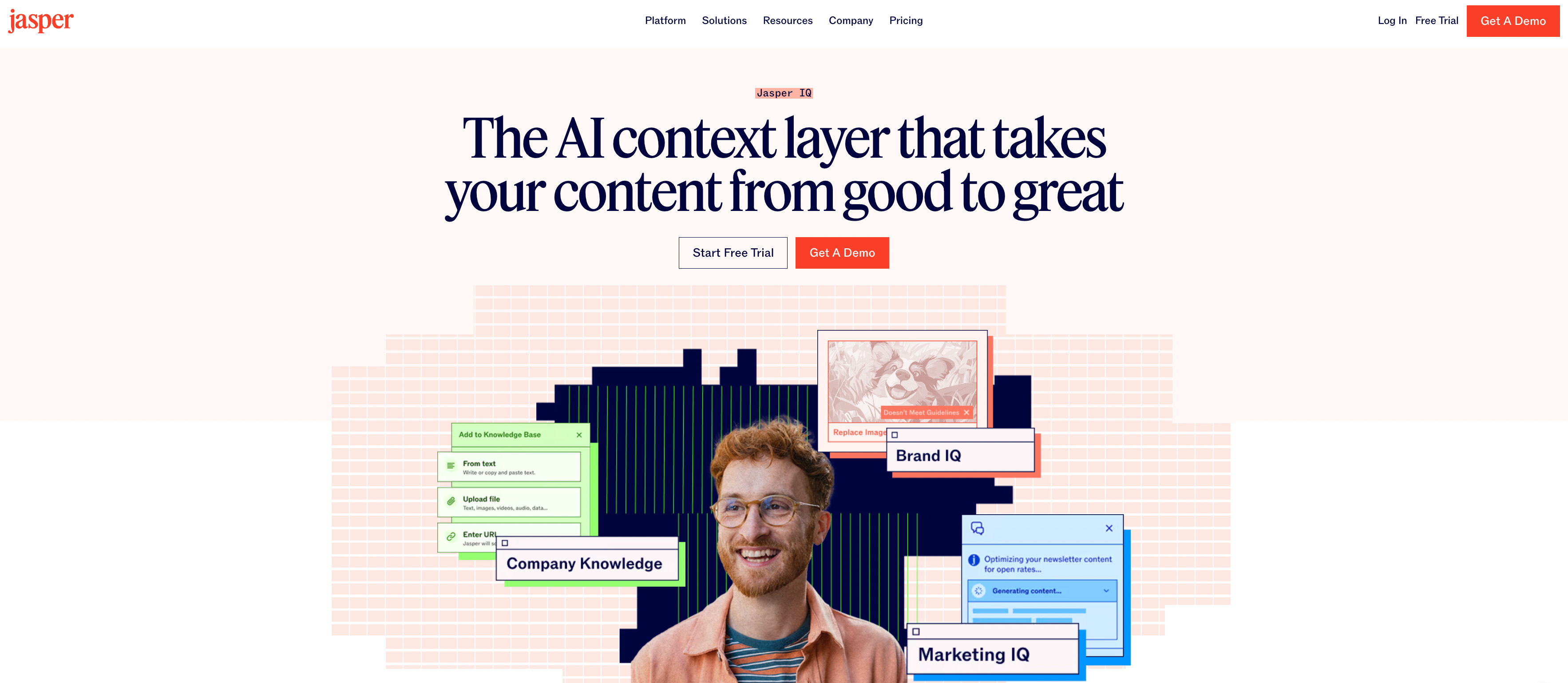
Jasper launched as one of the first major generative AI writing tools tailored for marketers. Now, it’s evolved into a collaborative workspace for marketing teams.
The platform centers on Jasper IQ, a system that embeds brand context, rules and logic across three layers:
- Agents: Over 100 purpose-built AI agents that handle specific tasks like SEO content, ad copy, emails, social posts, product descriptions and more within end-to-end workflows.
- Content pipelines: Structured workflows that connect briefs to published content and incorporate customer data, performance history and brand guidelines for repeatability and scale.
- Knowledge and controls: Everything that defines your brand is automatically and consistently applied across every piece of content, even at scale.
Jasper’s sharp focus on marketing-specific content automation and brand governance sets it apart from other AI-powered tools. The platform makes it easy to efficiently produce high volumes of channel-specific content.
Note that Jasper is primarily for written content (not visuals), but that it can be paired with dedicated image tools for other creative needs.
- Best for: Marketing teams that need to scale copy-heavy content (campaigns, SEO, social, email) with built-in consistency and efficient workflows.
- Key capabilities: Multiple agents, Pipelines, IQ hub, Brand Voice, Canvas workspace.
- Pricing: Free 7-day trial available; Pro plans start at $59 per seat/month, while Business plans use custom pricing.
3. Adobe Firefly + GenStudio
 (Source: Adobe)
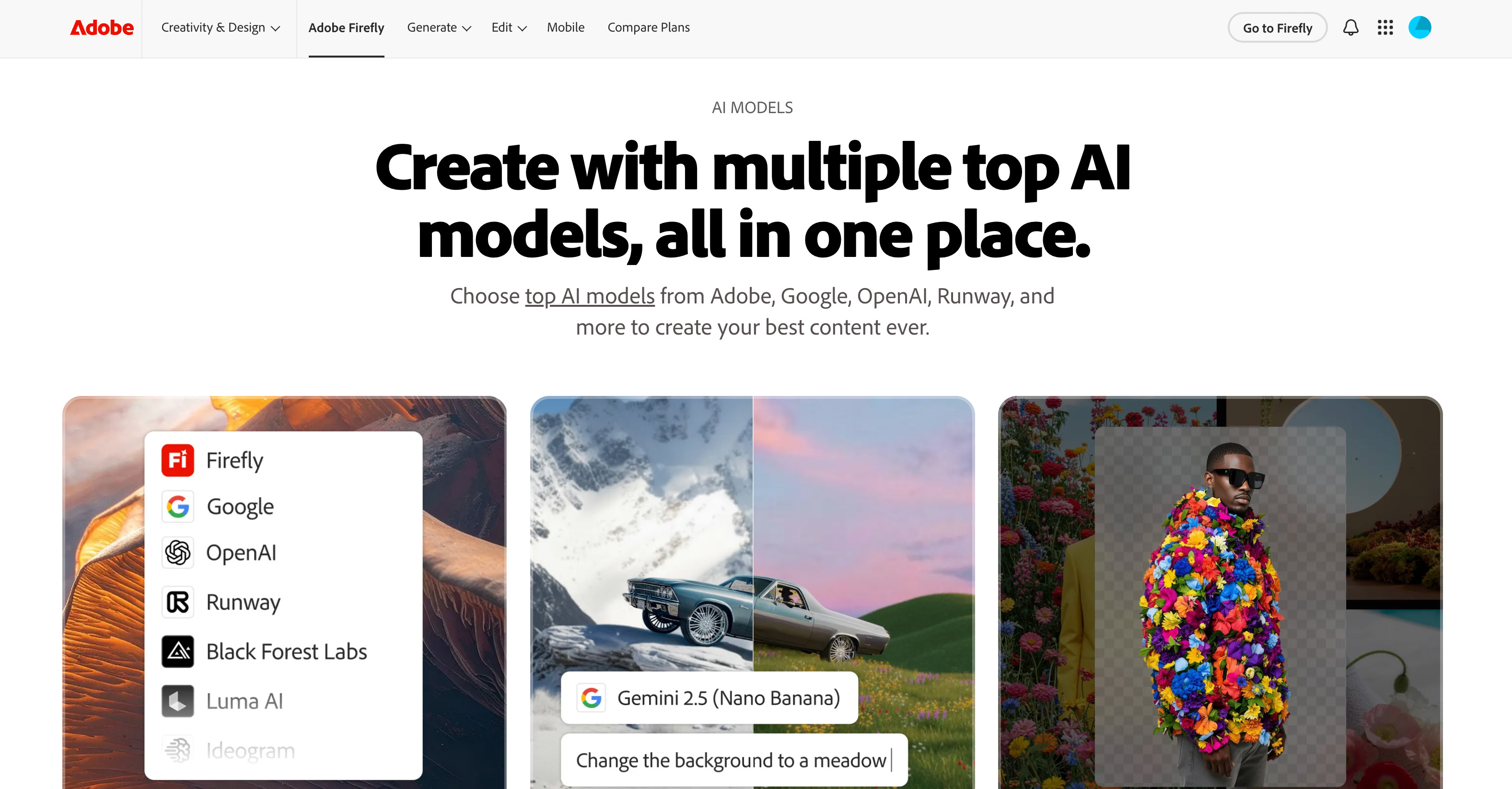
Adobe’s AI offering for creative teams combines Firefly for generative content creation and GenStudio for Performance Marketing to manage workflows and ensure brand governance. Together, these tools help brands to create, manage and deploy marketing assets at scale.
The agent supports image, video, audio and vector generation through commercially safe AI models trained on Adobe Stock, openly licensed content and public-domain material.
Firefly, Photoshop and Adobe Express also run with multiple agents, allowing teams to complete multi-step editing and production tasks with natural-language prompts. With Firefly’s Custom Models feature, for example, brands can train models on approved assets and visual IP to generate content that aligns closely with established brand guidelines and campaign standards.
GenStudio extends these capabilities into the production workflow. Brands can generate campaign assets, create channel-specific variations, manage approvals and enforce brand consistency across distributed teams and markets.
Adobe has also expanded Firefly’s video capabilities through its partnership with Runway, bringing advanced AI video generation into the broader Creative Cloud ecosystem. For teams that already use Photoshop, Illustrator or Premiere Pro, this makes AI-assisted production even easier to integrate into their existing workflows.
- Best for: Enterprise marketing and creative teams that need to generate on-brand campaign assets, scale content production and manage creative workflows across multiple channels.
- Key capabilities: Firefly generative AI, campaign asset generation, ad variants, brand guardrails, workflow integrations, performance insights and Adobe ecosystem connectivity.
- Pricing: Firefly plans start at $9.99/month for individuals, while GenStudio for Performance Marketing uses enterprise custom pricing.
4. Runway
 (Source: Runway)
In recent years, Runway has shifted from a research novelty to a robust tool for creative production. Its current flagship model, Gen-4.5, produces high-fidelity videos that rival traditional footage.
Runway’s AI agents help streamline labor-intensive video tasks via intuitive, prompt-driven interfaces. Features like instant rotoscoping, object removal and addition, background replacement and style transfer across clips eliminate the need for specialized expertise. The platform also simplifies video versioning, which makes it a game-changer for agile, high-volume marketing workflows.
Note, however, as a pure video generation and editing platform, Runway lacks built-in brand intelligence. This means that, for enterprise teams, it’s ideally a high-speed accelerator within directed workflows, not a fully autonomous solution.
- Best for: Creative and video production teams that produce social ads, campaign content and digital video who need to dramatically accelerate production and versioning without proportional budget increases
- Key agentic capabilities: Text-to-video generation, automated rotoscoping and object removal, background replacement, motion tracking, style transfer and video editing from text prompts.
- Pricing: Basic free; Standard $12/month; Pro $28/month; Unlimited $66/month; Enterprise custom pricing.
5. Canva Magic Studio + Canva AI 2.0
 (Source: Canva)
Canva’s Magic Studio, the AI layer that lives inside the Canva platform, makes it easy for non-designers in marketing, sales and other functions to create visuals themselves.
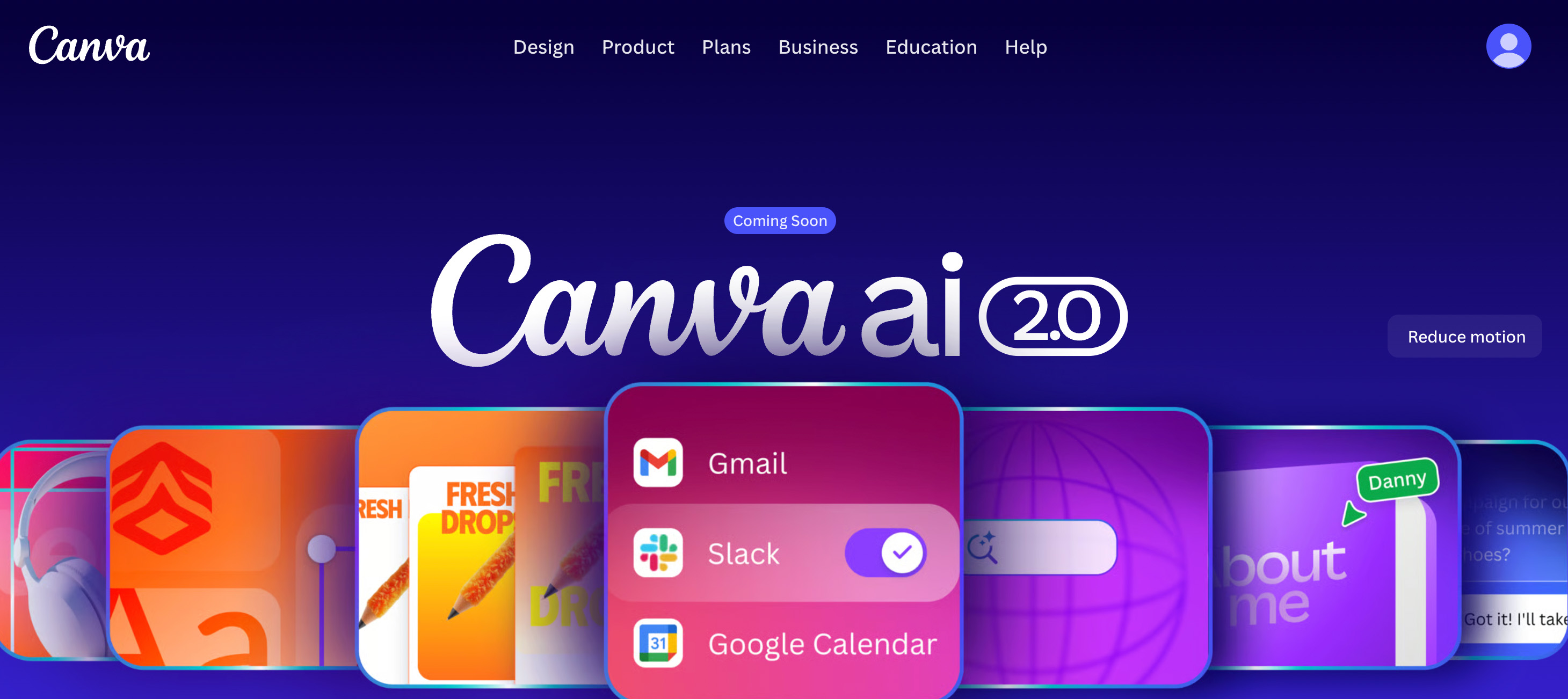
With the upcoming Canva AI 2.0 update, Canva is expanding beyond standalone AI features into a more conversational, workflow-oriented system that can orchestrate multiple creative tasks from a single prompt.
Users will be able to brief Canva AI in natural language. The platform can then automatically combine generation, editing, resizing and formatting workflows within the Canva environment.
Features include:
- Magic Design, which can create full layouts such as presentations, ads, social posts, or campaign assets from text prompts and brand elements.
- Magic Write, which can generate copy for posts, emails, presentations, or headers in a brand-aligned tone of voice.
- Magic Edit, which can help teams manipulate images via text prompts.
- Magic Switch, which can automatically convert content formats (e.g., turning a presentation into social cards) without extensive manual redesign.
Thanks to AI agents, scheduled content-generation workflows, the contextual use of connected data sources, and adaptation to organizational brand systems, all of which will soon be possible. And integrations with platforms such as Slack, Google Workspace and Notion will help teams transform briefs, meeting notes, campaign plans and internal comms into ready-to-edit creative outputs.
Note, however, that these AI agent creative production capabilities are still being rolled out, and some remain in preview or limited availability.
- Best for: Enterprise marketing organizations, as it enables distributed, non-designer teams to produce scalable, on-brand visual content without overloading centralized creative teams.
- Key agentic capabilities: Magic Design; Magic Write; Magic Edit; Magic Switch; conversational workflow orchestration across Canva tools; scheduled and repeatable content workflows; connected enterprise context via integrations; brand kit governance, approvals and template controls.
- Pricing: Free (limited AI features); Pro €110/year; Business €170/year; Enterprise custom pricing.
Notion AI: Creative operations intelligence agent
 (Source: Notion)
Notion AI sits at a different layer of the creative team’s workflow than most other tools on this list. It’s less a creative production tool than an operations intelligence layer, built for teams whose biggest bottlenecks are organizational.
In its agentic form, Notion AI can pull information from across a workspace to answer questions, surface gaps and generate structured outputs.
For example, a creative director who wants to know what the team has learned about EMEA audiences over the past six months can get a response drawn from research docs, campaign reports and meeting notes instead of manually piecing everything together.
Notion AI can also draft creative briefs from rough notes, turn stakeholder feedback into actionable direction, build campaign planning documents and flag dependencies or conflicts across active projects.
For more advanced AI agents creative workflows, its integrations with tools like Slack, Figma, Jira and Google Workspace allow it to function as a coordination layer across the creative tech stack. The result is a workflow-aware assistant that understands what the team is working on, what the goals are and what context matters for each decision.
Note that this tool isn’t designed to generate images, video or design assets.
- Best for: Creative teams and operations leads who need AI support for planning, briefing, knowledge synthesis and cross-functional coordination inside an existing Notion workspace.
- Key agentic capabilities: Workspace-wide search and synthesis, brief generation from rough notes, stakeholder feedback summarization, project planning, dependency identification and task execution across tools.
- Pricing: Free and Plus ($10/month) plans include limited AI trials; Business includes AI features and starts at $20/month; Enterprise is custom priced.
Why the best combination is human expertise and an AI-first creative process
While the tools shared above can dramatically speed up production, drive efficiency and simplify workflows, the best creative is still built on human creativity, brand strategy and sound judgment.
What has never disappeared, and I don't think it will, is the need for a good creative director or a good cinematographer. Someone who knows how to tell a story in an image sequence.

The teams that achieve the best results build AI-first creative systems in which creative automation supports a human-led process. That’s the model Superside, the world’s leading AI-first creative partner, has built.
We combine global creative talent with AI-enhanced workflows, Superspace and Brand Brain to help enterprise teams scale high-performing, on-brand creative. AI supports briefing, production, versioning and workflow efficiency, while human creatives lead the decisions that shape strong brand work.
At a time when most internal creative teams are stretched thin, AI agents and tools (plus the appropriate training) can remove operational friction and give your in-house creatives more space for ideas, experimentation and strategic creative work.
If you’re evaluating which tools to add to your tech stack, the key question should be which combination of AI systems, creative expertise and operational support can consistently help you deliver strong, on-brand work at scale. An AI-first creative partner like Superside is the undisputed answer.
Book a call to learn more.
FAQs


Get top creative 5x faster
Superside’s integrated human + AI workflows unlock
faster delivery, scalable output and campaign-ready
assets, without burning out your team.




Increase your creative capacity
Let your in-house team reach for the stars,
while Superside keeps your day-to-day creative needs
at an industry-leading level. Ready to scale?