



AI makes content easy to produce and hard to keep on-brand, which is why the teams that win define what "good" looks like before they scale. Drawing on Shift: The Creative AI Summit, this guide covers the six dimensions of creative quality, a pass-or-fail scorecard, tiered review by risk and how to make brand standards something AI can actually follow. Rakuten's lesson sums it up: define excellence first, then upskill the people who hold the bar.
It's just before 5 pm when someone asks whether the campaign assets are ready to go live tomorrow. Your stomach drops when you realize there are now 35 messages in the Slack thread.
One person says the headline is "not quite us." Another has spotted that the product name is wrong. The brand manager asks who approved the image. And the creative director reacts with a thumbs-up, which nobody can interpret with confidence. Meanwhile, your AI tool has produced another 17 variations.
Sound like your average day?
By now, you know AI can make content creation easier. You've probably also realized that keeping outputs accurate and consistently on-brand at scale is tough. That is, unless you define your AI content quality standards before you ramp up production.
This was a key message at Shift: The Creative AI Summit, where leaders from Rakuten, Leonardo.ai, Zoom and Booking.com explored why clear quality standards and human judgment matter more as AI output grows.
Your quality standards should also be practical. That means a shared quality bar, clear review criteria and brand guidelines your AI systems can interpret and use, plus teams with the skills and workflows to apply them consistently.
Drawing on the summit's insights, this guide breaks down six dimensions of creative quality and shows how to build them into everyday creative production. You'll also see how Superside combines human expertise with living brand memory through Brand Brain to help enterprise partners scale without lowering the bar.
Why AI content quality control can't wait until after you scale
It's tempting to use AI to produce more content and sort out quality later. But scaling creative before you set quality standards leads to costly rework at best and brand damage at worst.
Generic AI tools can produce passable assets, but they don't automatically know your brand or what your team considers publish-ready. Good prompts, reference images and uploaded guidelines help steer them, but small brand details still vary from one output to the next.
A few small inconsistencies are easy to fix. Across hundreds of assets, they become harder to catch and more expensive to correct. And if they reach your audience, they weaken brand recognition and undermine trust.
Interestingly, but perhaps unsurprisingly, many teams use AI-generated content without reviewing every output. In McKinsey's March 2025 State of AI report, only 27% of respondents whose organizations use generative AI said employees review all of its content before it's used. The report also lists inaccuracy among the gen AI risks most commonly linked to negative consequences for organizations.
Audiences are paying attention, too. Getty Images found that almost 90% of consumers globally want to know whether an image was created with AI. And in Klaviyo's research reported by eMarketer, 31% of consumers said visible AI-generated marketing makes them trust a brand less, while only 7% said it makes them trust it more.
Quality also goes beyond catching mistakes. Creative work needs to be distinctive, relevant and effective. Forrester recently found that nine in 10 US marketing agencies use generative AI, and warned that the industry's focus on efficiency is undermining creativity and long-term brand growth.
Consistency, meanwhile, pays. In System1 and the IPA's Compound Creativity research, drawing on more than 4,000 ads, the most creatively consistent brands achieved 28% more very large business effects than the rest.
The verdict? AI can multiply your creative output, but you need clear quality standards and systems that uphold them from the start.
Rakuten learned this early. At the summit, VP Executive Creative Director Kristin Graham described how her team set clear standards as it brought AI-generated assets into major campaigns.
We realized really quickly that we had to define what excellence was.

The practical lesson: Agree on what "good" and "on-brand" look like, how you'll check it and who approves the work before you ramp up production. Predefined standards give your creative and marketing teams a shared basis for decisions, so AI can increase output without multiplying avoidable problems.
What are AI creative quality standards?
Creative quality standards are the explicit, documented criteria every AI-assisted asset must meet before it's used. They define what high-quality content looks like for your brand across copy, images, motion graphics and video, and they give both AI models and human reviewers a shared, objective bar.
These standards cover more than whether an asset looks polished or reads well. They also cover whether it serves its intended audience and works for the channel where it will appear.
They're also much broader than SEO quality signals like Google's helpful, people-first content guidance, which judges whether a page deserves to rank, not whether an asset deserves to carry your brand.
It helps to separate three related terms that often get confused:
- Brand guidelines describe your brand identity.
- Quality standards define the bar an asset must clear.
- Review criteria are the checklist reviewers use to decide whether an asset is ready.
You need all three to keep creative work consistent as you scale.
The six dimensions of AI content quality
AI content quality can't be reduced to a single score. There are too many elements involved.
Assess every asset across six dimensions that together define what "good" looks like:
- Brand fidelity. Does the AI-generated content look and sound like your brand in voice, tone and visual identity, every time? This is the dimension AI fails at most often, and the one that matters most at volume. To protect it, give your AI models your brand guidelines in a format they can use.
- Factual accuracy. Are claims true and backed by reliable sources, with no hallucinated details? This is non-negotiable almost everywhere, and even more so in regulated industries.
- Originality and distinctiveness. Will the asset stand out, or blend into the generic content that fills every feed? Escaping that sameness is now a competitive advantage, as we argue in our guide to standing out in a sea of AI.
- Compliance, rights and IP. Does the asset meet advertising rules and industry requirements? Do you have permission to use the images, music, logos or other third-party material in it? AI-generated content still needs these checks before publication.
- Craft and channel fit. Is the execution technically strong, and is the asset right for the channel and format it will run in? Great creative fits its context and resonates with its audience.
- Accessibility and inclusivity. Can people with different abilities access and understand the content, and does it represent your audience respectfully? Check readable text, color contrast, captions and image descriptions against the WCAG guidelines, and watch for stereotypes or language that excludes people.
Most of these come down to judgment, about whether the work is accurate, distinctive, safe and right for its purpose. It's the point the summit's leaders kept returning to, and it's why taste, not tooling, is becoming the differentiator.
Leonardo.ai's Head of Creative, Dwayne Koh, put it in terms every creative team will recognize.
We always get so caught up in these tools. Just look at styling, look at what's new, look at old trends in the sixties. Anchor yourself in taste again before you get into the world itself.

How to establish your quality bar before you scale AI

This is the step teams skip most often, and the one Rakuten got right.
Before you turn up the volume, set a creative quality bar that AI tools, human creatives and reviewers can all follow. Here's how.
1. Articulate your quality standards for AI-generated content
Turn each of the six dimensions into concrete, testable thresholds.
"Create on-brand content" is a wish. "Use approved brand colors, the primary typeface, the approved photography style and the correct logo lockup" is a standard.
2. Build a quality scorecard
Give reviewers a simple pass-or-fail checklist across the six dimensions, so review becomes a consistent check rather than a debate. A scorecard also makes quality measurable over time, which we cover below.
This is the practical heart of the exercise. It's what lets a large, scattered team apply your standards the same way.
3. Show on-brand vs off-brand assets
A rubric plus real examples removes ambiguity fast. Annotate a handful of "do this" and "not that" samples so the bar is unmistakable, and use them to calibrate reviewers. Your existing high-quality content is a good place to start.
4. Set the bar by asset type and risk
A throwaway internal social post and a homepage hero don't need the same scrutiny. Define the standard, and the level of human oversight, in proportion to where the asset will run and what it risks.
Creating your AI content review criteria and workflow
A standard is only real if a workflow enforces it. And if that workflow isn't designed for both AI tools and people, it quickly becomes the bottleneck.
The next step is to build your review criteria and workflow:
- Match the review process to the level of risk. Create a review workflow that gives each asset the attention it deserves. A routine asset, such as a resized ad, may only need automated brand checks followed by one person's approval. New campaign creative needs a closer look at the idea, execution and brand fit. Sensitive claims or regulated content may also need legal or compliance approval.
- Place human reviewers at key checkpoints. AI tools can check file dimensions, flag certain errors and test specific brand rules. Human reviewers still need to judge relevance, originality, brand fit and craft. Define where that judgment is needed and who provides it.
- Use an established framework to guide AI governance. The NIST AI Risk Management Framework, which structures trustworthy AI around four functions (govern, map, measure and manage), is a useful reference for the governance side of review, especially in regulated industries.
- Assign clear responsibility for each decision. Document who creates the asset, who reviews brand fit, who checks compliance when needed and who gives final approval. Everyone contributes to quality, but each stage needs a named owner so problems don't fall between teams.
How to operationalize your brand standards so AI follows them
You can write the best brand guidelines in the world, but they only help AI if you provide them in a format the tool can use. That might mean uploading a brand book and reference images. Even then, you're not guaranteed consistent, high-quality results.
The key is to turn your brand standards into something AI can query, understand and consistently apply. That's a different discipline from writing guidelines, and it's why brand guidelines are changing in the AI era.
Two ingredients are essential:
- A living brand memory that holds your brand voice, visual rules, specs, past work and feedback, and applies them to every brief and asset.
- Custom AI image models trained on your brand assets, so generation starts on-brand from the get-go.
Together, they make brand decisions repeatable and hold a consistent style across large volumes of content, even as new people and tools enter the workflow.
This is precisely what Brand Brain, Superside's AI-first creative memory inside Superspace, was built to do.
When you make Superside your creative team's creative team, your Brand Brain captures your brand's nuances and brings that context into the creative workflow, keeping AI-assisted work on-brand as output grows.
Paired with custom AI image models, Brand Brain steers creative toward your quality standards from the start, with human review checkpoints making sure every output clears the bar. Our companion piece on building an AI-powered creative workflow shows what that system looks like in practice.
Building teams that can adapt and scale
Quality standards don't enforce themselves. People do.
The summit's leaders were united on a point that gets lost in all the tool talk. AI adoption is as much a people challenge as a technology one.
Rakuten tackled it head-on. Rather than just handing its team new software, it embedded AI learning directly into the workflow, partnering with Superside to upskill its creatives as it headed into one of its busiest seasons.
For Graham, that investment was about confidence as much as capability.
We weren't just teaching people how to use tools. That is a huge part of it, of course, but I think you're really building confidence when you invest in your team.
The payoff was a team better equipped to adapt, collaborate and scale creative output without compromising quality.
The deeper reason upskilling matters is that quality is directly linked to human judgment. As AI raises the baseline of what anyone can produce, the differentiator becomes human: knowing what's effective, relevant and worth creating.
Creative leaders at the summit were clear on this. Zoom's Head of Creative, Dan Schunk, drew the line between generating work and generating the right work.
At the end of the day, you can create anything you want, but that doesn't necessarily mean that it's going to be balanced appropriately.

Booking.com's Senior Creative Producer, Jeff Johns, took the same idea a step further, from quality to relevance.
It's not necessarily just about the quality of the work. It's about the relevance.

This is why a quality standard can't be purely mechanical. It has to encode judgment about whether the work serves the audience, aligns with the brand and solves the problem it was made for. The people who apply the standard need the taste to make those calls, which is why upskilling and standards go hand in hand.
Superside builds this through our AI excellence approach. More than 90% of our creatives are AI-certified, so they move at AI speed while applying the human judgment that defines excellence. Bringing AI into a team without disrupting craft takes discipline, and it starts with investing in people.

How to measure creative quality at scale
Once you have standards and a review workflow, track output quality to see whether assets consistently meet your criteria. The metrics worth monitoring:
- Review rounds per asset. Fewer rounds signal that work is arriving closer to the standard, sooner.
- On-brand rate. The share of assets that pass brand review without rework.
- Rework rate. How often work has to be fixed, and why.
- Time to approval. How fast quality work moves through the production cycle.
- Creative performance. Whether the final assets actually resonate, convert and move the business forward.
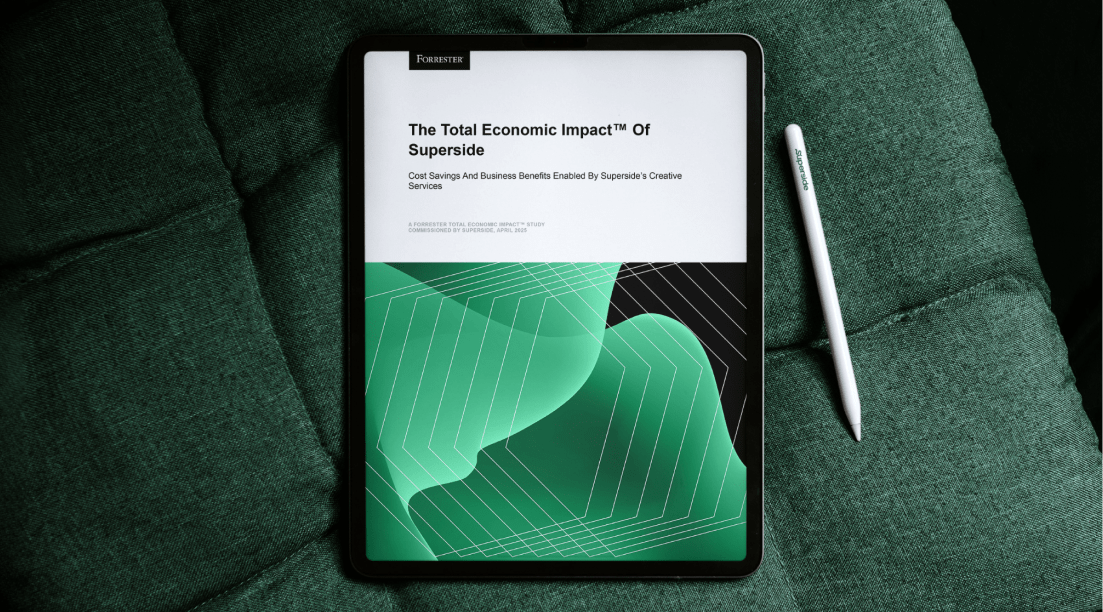
A Forrester Total Economic Impact study commissioned by Superside found a 94% ROI and payback in under six months for a composite enterprise organization, with more than 60% of feedback rounds avoided. That's what a clear, operationalized quality standard produces: less rework, faster approvals and consistent output.
Our analysis of hundreds of AI design projects points to the same result.
Common mistakes when setting AI content quality standards
Even experienced teams make these mistakes. Watch for:
- Scaling first, defining later. This is the cardinal error. By the time you notice inconsistent messaging or visuals, the off-brand work is already in market.
- Removing human oversight too fast. Speed without clear human checkpoints quickly erodes brand consistency and quality.
- No rubric. If your review criteria live only in people's heads, every reviewer applies a different bar.
- Static, unreadable brand standards. AI tools need relevant brand context and guidelines in a format they can query and use.
- Treating mass production as the goal. More assets aren't necessarily better assets, and scaling too fast is how quality slips.
- Ignoring the brand reputation risk. A single weak asset may be harmless. Repeated low-quality or inconsistent work damages the brand over time.
Avoiding these comes down to discipline. Define excellence first, operationalize it and keep human oversight and strategic thinking where they add real value.
How Superside operationalizes AI content quality control
Defining your quality standards is only the starting point. The real challenge is operationalizing them at enterprise scale. That's what Superside, the world's leading AI-first creative partner, is built to do.
On the people side, we plug AI-skilled creative talent into your existing team and help your own creatives expand their AI capabilities. With more than 90% of our team AI-certified and 50+ proven AI workflows in active use, we bring both the AI excellence and the judgment needed to apply your quality bar at scale.
On the system side, Brand Brain captures your brand's DNA in a living system that gets smarter with every project and keeps AI-assisted creative on-brand from the start, with quality control built into every stage of production.
Being AI-first means AI isn't just powering individual tools. It's embedded across the entire creative model, from how teams are trained to how brand knowledge compounds over time. That's the thinking behind our human-led, AI-powered approach to AI creative.
AI makes more creative output possible. But, as the Shift summit leaders concluded, turning that volume into work that strengthens your brand takes clear standards, shared brand knowledge and skilled people. Superside brings those pieces together to deliver operational efficiency and high-quality work.
Superside's Executive Creative Director, Alyssa Boisson, captured the whole idea in one line at the summit.
The future won't be built by teams who generate more. It will be built by teams who notice more.

Ready to produce more creative that meets your standards? Book a call.
FAQs





Ready to see it in action?
The best way to understand it is to experience it.
Because once your creative system has memory,
you won’t want to go back to starting from scratch.


The real story behind GenAI’s impact on creative
You've heard the hype. But what does the data say?

The data speaks for itself
According to a Forrester Total Economic Impact™ study, Superside delivers a 94% ROI and pays for itself in six months.


Your creative team's creative team
Choose the world's leading AI-powered creative service
and get high-performing ads, videos, experiences and
more at scale, on your schedule and to your standards.