



Human-centered design starts with real people, then combines research, prototyping and repeated user testing to solve the right problems. This guide explains the principles, breaks down the five-stage process and shares strong examples from Bank of America, OXO, PillPack and others. It also shows why the approach matters even more in the AI era.
It's easy to design around what your business wants to launch or what a new technology can do. It's much harder to step back and ask whether a product, service or system solves a real problem for the people expected to use it.
That's the job of human-centered design (HCD). It brings people into the process, replaces assumptions with research and treats testing as a source of learning rather than a final box to check. The result is a solution that provides genuine value and fits the wider context of people's lives.
The approach now shapes everything from kitchen appliances and hospital environments to financial products, websites and enterprise design systems. It also gives innovative companies a practical way to reduce risk, because they learn what works before investing too heavily in a potential solution.
This guide explains what human-centered design is, where it came from and how you can apply its core principles and five-stage process to your next design project. We also compare HCD with design thinking, user-centered design and UX, unpack a few strong examples and explore why this type of design matters even more in the AI era.
What is human-centered design?

HCD is a creative approach to problem-solving that puts the people who'll use or be affected by a product, service or system at the center of the design process.
Instead of starting with a feature, technology or internal assumption, teams first study real people's needs, behaviors and context. Then they involve those people as they create, test and improve the solution.
In other words, human-centered design means designing with people, not just for them.
The formal ISO 9241-210:2019 standard describes HCD as an approach to interactive systems development that aims to make systems usable and useful by focusing on the users, their needs and requirements, and by applying human factors, ergonomics and usability knowledge and techniques.
Where human-centered design came from
Human-centered design grew from disciplines like ergonomics, human-factors engineering, industrial design, cognitive psychology and computing.
Both ergonomics and human-factors engineering gained momentum during World War II. As aircraft and control panels became more complex, researchers realized that technically sound equipment could fail if designs ignored human perception, cognition and physical limits.
After the war, these lessons spread to workplaces and consumer products.
Industrial designer Henry Dreyfuss's 1955 book Designing for People helped establish human measurements and capabilities as practical design considerations. In 1969, Herbert Simon's The Sciences of the Artificial presented design as a systematic way to move from an existing situation to a preferred one.
As computers entered workplaces and homes, attention shifted toward human-computer interaction. Donald Norman and Stephen Draper's 1986 book User Centered System Design brought research on how people interact with computers into a coherent design approach.
Norman's 1988 book The Psychology of Everyday Things, retitled The Design of Everyday Things for its 1990 paperback, introduced ideas such as visibility, feedback and designing for real human behavior to a broader audience. He later coined the term "user experience" at Apple in 1993, where he took the title User Experience Architect.
Design consultancy IDEO, formed in 1991 through the merger of David Kelley Design, ID Two and Matrix Product Design, subsequently brought human-centered design and design thinking into mainstream business practice. The Stanford d.school, founded in 2005 by IDEO co-founder David Kelley, made these methods accessible to students.
Formal ISO standards evolved alongside the practice. ISO 13407, published in 1999, was replaced by ISO 9241-210 in 2010 and revised in 2019.
The current standard sets out requirements and recommendations for applying HCD to interactive systems. Today, human-centered design draws on design, engineering, psychology and social research to improve products, services and systems.
The core principles of human-centered design
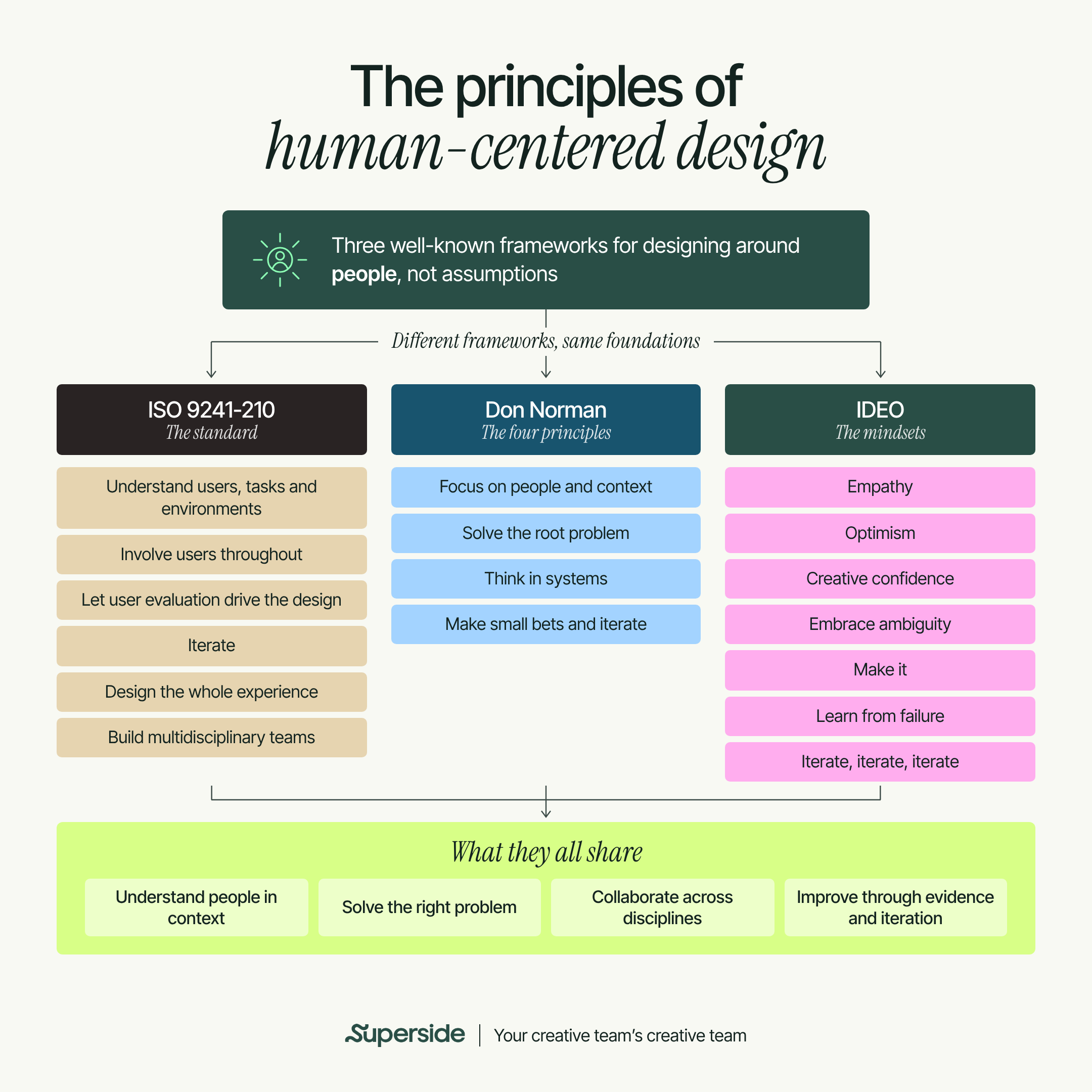
Different authorities organize the principles of human-centered design in different ways.
However, the best-known frameworks share the same foundations and underlying design principles: understand people in context, solve the right problem, collaborate across disciplines and improve the solution through evidence and iteration.
These are the three frameworks worth knowing.
The ISO 9241-210 principles
- Base the design on an explicit understanding of users, their tasks and their environments.
- Involve users throughout design and development.
- Let user-centered evaluation drive and refine the design.
- Treat the process as iterative.
- Address the whole user experience, not isolated interactions.
- Include multidisciplinary skills and perspectives on the design team.
Don Norman's four principles
As summarized by the Interaction Design Foundation, Norman frames HCD around four ideas.
- Focus on people and their context.
- Solve the root problem, not only the visible symptom.
- Recognize that every solution sits within a larger system.
- Use small, simple interventions and iterate instead of making one enormous bet.
IDEO's mindsets
IDEO frames HCD as both a process and a set of mindsets.
Its Field Guide to Human-Centered Design emphasizes empathy, optimism, creative confidence, embracing ambiguity, "make it," learning from failure and continuous iteration.
Designers can follow a process mechanically and still not design a good solution. For this reason, IDEO believes human-centered design also requires a healthy dose of curiosity, humility and a willingness to change direction.
The human-centered design process, step by step
The Stanford d.school's five-stage design thinking model is one of the best-known ways to apply HCD.
But while the stages provide structure, they're not meant to be used as a one-way, rigid sequence. The idea is to return to earlier stages when research or testing changes your understanding of the problem.
The steps are as follows.
1. Empathize
Make sure you deeply understand how people experience the problem.
Interview them, observe their behavior and look at the environment in which the product, service or system will be used. The goal is genuine insight into users' needs, motivations and frustrations, so you can think like them.
This is also a key principle of good UX design.
2. Define
Use the research from the empathize stage to define the problem clearly. Frame the challenge around a human need, not the feature your business wants to build.
A good problem statement identifies who needs help, what they need and why that need matters.
3. Ideate
Generate a broad range of possible design solutions before you narrow the field. Bring together people with different skills, backgrounds and experiences, then consider many options.
4. Prototype
Turn promising ideas into something tangible people can react to. A prototype might be a paper sketch, storyboard, service role-play or clickable mockup.
Prototyping early keeps you from over-investing in an idea that might not truly solve the user's problem.
5. Test
Give the prototype to real people and observe what they do. Use the opportunity to find points of friction and challenge assumptions.
Your results may reveal that you framed the problem incorrectly. When this happens, another research loop kicks off.
This iterative rhythm keeps HCD, and ultimately the final product, system or service, grounded in real evidence.
Human-centered design vs design thinking vs UCD vs UX
Human-centered design, design thinking, user-centered design (UCD) and user experience (UX) all sound fairly similar. But while there's overlap, they're not the same.
| Term | What it is | Typical scope |
|---|---|---|
| Human-centered design (HCD) | A broad philosophy and process that puts people affected by a solution at the center of design decisions | Products, services, systems and complex social or organizational challenges |
| Design thinking | A structured, iterative toolkit often used to put human-centered design into practice | Many types of innovation and problem-solving, typically through the empathize, define, ideate, prototype and test stages |
| User-centered design (UCD) | An approach focused on the needs, goals and usability of defined users | Usually a particular product, service or interface and its target users |
| User experience (UX) design | The design of a person's experience with a product or service, especially across digital interactions | Digital products and journeys, although UX can include connected physical and service touchpoints |
To summarize: HCD is the widest lens, design thinking is one way to practice it, UCD focuses on defined users and UX design applies the related principles to digital experiences and product design.
We cover the digital end of this spectrum in our guides to UX design and UI design services.
The best human-centered design examples
To understand human-centered design, it helps to look at a few standout examples.
All of the examples here started with a specific insight about how people behave. The companies behind them then turned that insight into a valuable solution.
1. Bank of America, "Keep the Change"
Bank of America and IDEO explored why saving money felt difficult for Americans, and noticed that some people rounded figures when managing household finances.
The team generated dozens of concepts before developing "Keep the Change," launched in 2005, which rounds debit-card purchases to the nearest dollar and transfers the difference to savings.
The service attracted 2 million customers in its first year and has since grown to more than 12 million, helping customers save around $2 billion. The idea worked because it fit existing behavior rather than fighting it.
2. OXO Good Grips

OXO, best known for its ergonomic kitchen tools, began after entrepreneur Sam Farber watched his wife, Betsey, struggle to use a traditional metal peeler because she had arthritis.
Betsey, an architect, became a co-designer rather than just the inspiration. Working with her and the firm Smart Design, Sam developed the original Good Grips range, launched in 1990. Its peeler featured a thick, soft, non-slip handle that was easier to hold and control. Although the design addressed the needs of people with limited grip strength, it proved more comfortable for everyone else too.
OXO's story illustrates a central lesson of human-centered design: addressing a specific need can lead to a better experience for everyone.
3. PillPack

PillPack reorganized the pharmacy experience for people who take several medications every day.
The company created pre-sorted medicine packets labeled with the date and time, replacing the need to manage multiple bottles and refill schedules. It also built a service combining packaging, delivery, digital account management and pharmacist support into one patient-centered system.
PillPack made a frustrating experience much easier, a human-centered approach that proved successful enough that Amazon acquired the company for $753 million in 2018.
4. American Express, "Pay It Plan It"

In 2015, American Express and IDEO studied how card members handled purchases and unexpected expenses.
The research shaped "Pay It Plan It," a feature that launched in 2017 and gave customers easier ways to pay smaller purchases immediately or split larger ones into fixed monthly plans.
By IDEO's account, the work generated nearly five million Plans and close to $4 billion in plan volume, with an average plan size of $789.
5. Nemours Children's Hospital

IDEO also helped Nemours design a new children's hospital around the needs of patients, families and care teams.
Research with these groups shaped everything from arrival and wayfinding to patient rooms and staff interactions. Greeters helped families navigate the hospital, children could personalize their rooms with colored lighting and family lounges gave relatives space to cook and eat together.
The result was a hospital experience designed to feel less confusing and intimidating, and to help families remain involved in their child's care.
6. Apple

Apple's best-known products illustrate several HCD principles: make important actions visible, give immediate feedback, reduce unnecessary complexity and design hardware, software and services as one coherent experience.
The company's approach isn't a perfect proxy for every HCD practice, but its focus on how people want to interact with technology helped move computing away from technical capability alone and toward usability, familiarity and delight.
Why human-centered design matters for business
Human-centered design isn't only the ethical way to build things. It's the profitable one, too. User research surfaces unmet needs before you invest too heavily, while prototypes make ideas testable while they're still inexpensive.
McKinsey's Business Value of Design study provides a textbook example of why HCD is good for business.
McKinsey tracked design practices at 300 companies over five years, then linked their financial performance to their design approach. The study didn't focus specifically on HCD, but its Design Index measured many HCD principles, including iteration based on user feedback and testing, a user-focused design approach and cross-functional design teams.
Over five years, the companies that followed those principles most closely saw 32 percentage points higher revenue growth and 56 percentage points higher total shareholder return growth than their industry peers. Tellingly, the same research found that more than 40% of companies still weren't talking to their end users during development, which is precisely the gap HCD closes.
The pattern also holds in data from IDEO's HCD-first projects. PillPack went from startup to a $753 million Amazon acquisition in five years. American Express built a payment-planning feature from customer research that drove close to $4 billion in plan volume.
It's also about reach and inclusion. The World Health Organization estimates that around 1.3 billion people, 16% of the world's population or one in six of us, experience significant disability. Designing for the full range of human ability is both a moral and a commercial imperative that HCD answers.
There's a longer-term benefit, too.
The World Economic Forum's Future of Jobs Report 2025 projects that 39% of workers' core skills will change or become outdated by 2030 as AI automates more routine work. Skills such as empathy, judgment and complex problem-solving become more valuable, precisely the capabilities HCD strengthens.
By teaching your design teams to understand people, question assumptions and solve complex problems, you improve what they create today and build the skills your workforce will need in years to come.
Common HCD challenges and how to avoid them
While HCD is fairly easy to describe, it can be difficult to sustain. These are the pitfalls teams typically encounter.
"We don't have time to talk to users"
Skipping user research can feel faster, but it pushes uncertainty downstream, where changes cost more.
The fix: start with the evidence you can gather now, such as a small set of interviews, observation sessions, support logs or usability tests. Then build a plan for deeper research around the highest-risk assumptions.
Weak stakeholder buy-in
Human-centered work can look slow to leaders who want output now.
The fix: tie the work to outcomes, showing that understanding people upfront reduces costly rework later.
"We already know our users"
Experience and knowledge of how your users think can create useful hypotheses, but it doesn't create certainty.
The fix: treat internal knowledge as a starting point and look for evidence that challenges it. Include people whose needs are often missed.
Testing to confirm, not to learn
If a test is designed to prove a preferred idea, it will generate false confidence.
The fix: be open to being wrong. Give participants realistic tasks and observe behavior without coaching them toward success.
Treating HCD as a workshop
A co-creation session can generate useful ideas, but HCD isn't a one-off event. It requires research, decisions, prototypes, testing and iteration across the product or service life cycle.
The fix: assign owners and build these activities into the delivery plan.
Human-centered design in the age of AI

At this point, you might wonder what happens to a human-centered design approach when AI can generate a thousand variations in seconds.
The answer is that AI makes human-centeredness even more important. AI is extraordinary at production, at generating options, variations and drafts at a speed no human can match. But it has no empathy, no lived experience and no taste. It doesn't understand your customers, feel their frustrations or know what will genuinely resonate. That gap is why so much AI-generated creative still feels off-brand.
HCD adds the deep empathy, judgment and systems thinking that direct AI toward work that actually serves people. Humans are best at understanding the problem and the user, while AI can speed up production.
In Superside's AI-first, human-led approach, the human half of the equation is what makes the AI worth using. Almost 100% of our creatives are AI-certified, so they can move fast and keep creative work grounded in human judgment, a balance explored in our guide to using AI for UX design.
It's also exactly what Brand Brain, our AI-first creative memory inside Superspace, is for. This custom, evolving intelligence layer captures the human understanding of our customers' brands, their guidelines, tone of voice, target customers and what's worked in the past. It then applies that understanding to every project that follows.
In other words, Brand Brain keeps AI-assisted work human-centered at scale. It carries forward the empathy and brand nuance our creative professionals put in, anchoring output in real human insight rather than letting it drift into generic sameness. That's the same principle behind maintaining brand consistency at scale.
Adopting AI well is itself a human-centered design problem. If you're still navigating that journey, our playbook for bringing AI to a creative team lays out a deliberately people-first approach.
How Superside brings human-centered design to enterprise creative
Human-centered design is the methodology behind Superside's product, web design and branding services. It's also what separates a strategic design partner from a commodity output vendor, which is worth weighing when you're finding a design partner or scoping product design consulting.
As the world's leading AI-first creative partner, we combine human-led design with an AI-first operating model that gives customers the human craft that makes work resonate, plus the scale and speed modern marketing demands. You can see how our team is built, and how we blend human creativity with AI, on our creative talent page.
That same thinking carries into how we scale design systems for brands, so human-centered decisions stay consistent across an entire organization rather than living in one team's heads.
Being AI-first means AI isn't just powering individual tools. It's embedded across the entire creative model, from how teams are trained to how brand knowledge compounds over time. That's the thinking behind our human-led, AI-powered approach: great creative still needs great creatives.
Our approach also delivers real, tangible benefits. A Total Economic Impact study commissioned by Superside and conducted by Forrester Consulting (April 2025) found that a composite organization achieved a 94% ROI over three years, with payback on a subscription in under six months. That's exactly the kind of return McKinsey uncovered in the design-led organizations it studied.
If you want a design partner that puts people at the center and has the scale to deliver, explore our enterprise creative services and let us become your creative team's creative team. Alternatively, simply book a call.
FAQs



See how top brands do it
Looking for extra inspiration?
Check out more of Superside's brand projects.


Give your internal teams the power to boost your brand
Publish once. Deliver everywhere. Our Creative Ops platform
puts your brand in front of the right people, everywhere.
Unlock seamless content distribution. Access your audience.


Ready to see it in action?
The best way to understand it is to experience it.
Because once your creative system has memory,
you won’t want to go back to starting from scratch.


Your creative team's creative team
Choose the world's leading AI-powered creative service
and get high-performing ads, videos, experiences and
more at scale, on your schedule and to your standards.