

The right design partner isn't just another vendor. The best partner complements your team, learns your brand deeply, helps you scale and gets better over time. This guide compares the main design partnership models, the criteria that matter in 2026 and the red flags to catch before you sign.
Finding a design partner can look deceptively simple. Find a team whose work you like, check that you can afford them and make sure they can meet your deadlines. But if you're looking for a partner who'll support your creative team for years to come, there's much more at stake.
The right partner plugs into how you work and gives you access to specialist skills and capacity when you need them most.
Crucially, the relationship improves over time: less rebriefing, fewer rounds of feedback and a deeper understanding of what great creative looks like for your brand.
In 2026, you have more options than ever. Traditional agencies, freelancers, in-house teams and creative subscription partners all solve different problems. AI adds another dimension to the decision.
This guide explains how to choose a creative partner before your procurement team turns the decision into a spreadsheet exercise. We compare the main partnership models, unpack the criteria that matter most for enterprise teams in 2026, highlight red flags to catch early and show you how to evaluate potential partners for the long haul.
What we mean by a "design partner"

In startup circles, a "design partner" refers to an early customer who helps shape a product. Here, the term means something different.
We're talking about an external creative team that handles your branding, campaign, product, content and other design work and functions like an extension of your company rather than a one-off supplier.
Yes, you can hire someone to knock out a batch of social graphics or ads, but that relationship is transactional and often ends when the project does. Instead, it makes sense to find a creative partner who learns your brand, plugs into your workflows and scales with your workload.
When you think about design partner versus vendor, another important difference is that the partner supports you over an extended period and becomes a true extension of your team. That makes finding a design partner an important, highly strategic decision.
Take note: our design partner checklist makes a solid companion to this more in-depth guide.
Pain points that signal when to find design partners
Tired of creative bottlenecks, inconsistent quality or the headache of managing too many suppliers? We hear you. That's quite likely what prompted the search that landed you on this page.
If several of the signs below sound familiar, your current creative setup may no longer be keeping pace with what the business needs. It's time to relook at how you operate.
- Your internal resources can't keep up. Creative requests keep climbing while capacity stays flat. That makes creative bottlenecks harder to avoid.
- You manage too many vendors. Four agencies and 12 freelancers mean 16 relationships to manage. That coordination takes time away from the creative work itself.
- Brand consistency is hard to maintain. Every new team member, freelancer or agency brings another interpretation of your brand. At scale, that increases the risk of off-brand work. If you're in a regulated industry, you also risk compliance issues.
- AI adoption is creating new risks. Your team may already be experimenting with AI. But without shared workflows and responsible AI guardrails, faster production can also mean inconsistent outputs, brand drift and greater risk.
- Marketing needs more formats, variations and specialist skills. Modern campaigns stretch across channels, markets and audiences. Your core team may simply not have the capacity or expertise to produce everything in-house.
- Growth is stretching your existing setup. A rebrand, product launch, new market or acquisition has created a surge in creative work your fixed in-house team can't absorb.
- External creative teams require too much work. Constant briefing, context-setting, regular feedback and follow-ups are signs you need a partner that operates as an extension of your team rather than another supplier to manage.
Why most of this decision happens before you contact anyone
If you haven't contacted a potential design partner yet but are already comparing options, you're right where most enterprise buyers start.
The modern buying journey is largely self-directed. Gartner's research on the B2B buying journey finds that 75% of B2B buyers prefer a rep-free sales experience, and most of the evaluation happens in the research buying teams do on their own, as they compare options, weigh models and work out what they actually need.
More importantly, those early impressions tend to stick. Analysis of around 10,000 B2B buyers by 6sense found that buying groups place four out of five vendors they will evaluate on the shortlist from day one, then buy from one of those four 95% of the time. In 2025, buyers reported not speaking with sellers until around 60% of the way through their journey.
Forrester's 2024 Buyers' Journey Survey points the same direction. 92% of buyers start with at least one vendor already in mind, and 41% already have a single preferred vendor before formal evaluation begins. As Forrester puts it, B2B buying has become a process of confirmation rather than selection.
All of this makes the research stage consequential. Finding a design partner starts with defining what you actually need from the relationship, before demos, pitches and procurement enter the picture.
Four ways to get design done

Before you choose a design partner, think about which partnership model best fits your needs. There are four main options.
1. Traditional creative or design agency
Agencies typically give you access to senior creative talent, specialist expertise and a valuable outside perspective. They're particularly well suited to major campaigns, rebrands and strategic projects where big-picture thinking matters.
The trade-offs are typically higher costs, longer timelines and fixed retainers that make it hard to scale work up or down as required.
Our roundup of creative agencies offers a good survey of the field.
2. Freelancers and freelance marketplaces
Freelancers give you flexible access to individual specialists, often quickly and at a lower cost than an agency. They're a good fit for specific projects, short-term gaps or skills your team doesn't have in-house.
The trade-off is management. You need to coordinate multiple people, constantly transfer brand knowledge and maintain consistency across projects.
Our guide to working with freelance designers covers how to manage these relationships effectively.
3. In-house team
An in-house team gives you dedicated creative talent with deep knowledge of your brand, business and internal stakeholders. It's a strong foundation for ongoing creative work and brand stewardship. In its most recent survey, the ANA found that 82% of its member companies had an in-house agency in 2023, up from 58% a decade earlier.
The trade-offs are fixed capacity and the time and cost of hiring specialist talent, which makes sudden demand spikes hard to absorb.
4. Creative subscription or CaaS partner
A Creative-as-a-Service (CaaS) partner gives you ongoing access to a multidisciplinary creative team through a flexible subscription. For teams looking for an agency alternative, enterprise creative subscriptions offer a more flexible way to access multidisciplinary talent and scale capacity with demand.
The model combines some of the breadth of an agency with the flexibility of external talent and the continuity of a longer-term partnership. The strongest CaaS partners also integrate into existing workflows, build deep brand knowledge and use AI to increase capacity.
Our guides to Creative-as-a-Service and CaaS vs. agencies vs. freelancers explore the model in more detail.
A combination might be the ideal solution: many enterprises combine an in-house core team that owns brand and strategy with external design partners that provide additional volume, specialist expertise and surge capacity. The better question, then, isn't simply "which model is best?" It's "which combination gives my team what it's currently missing?" Our comparisons of in-house versus agency and insourcing versus outsourcing both land on the same conclusion.
The real cost of the wrong partner
The least expensive design partner on your shortlist isn't necessarily the cheapest in the long run. Rate cards don't capture the time it takes to manage the relationship, rewrite briefs, correct off-brand work or go through endless review rounds.
The wrong partner can also create costs that are harder to quantify. Slow delivery holds up campaigns, inconsistent creative weakens brand equity and limited capacity forces you to find additional vendors when demand spikes.
There's an upside worth weighing too. Design isn't only a cost line. McKinsey's Business Value of Design research, published in 2018, found that top-quartile design performers achieved 32 percentage points higher revenue growth and 56 percentage points higher shareholder-return growth than their industry peers over five years, close to twice the rate. A partner that lifts the quality and consistency of your creative is compounding an advantage.
A strong long-term partner should reduce overhead, not add to it. That's why it's worth evaluating the total cost of the relationship alongside the quality of the creative itself.
The difference can be significant. You can see it in how Superside, the world's largest AI-native creative agency, helps enterprise teams scale up creative and cut operational costs. A Total Economic Impact study commissioned by Superside and conducted by Forrester Consulting (April 2025) found that a composite organization achieved a 94% ROI over three years, $4.16 million in total three-year benefits, a net present value of $2.01 million and payback in under six months. It also found that more than 60% of feedback rounds were avoided.
That last figure is particularly telling. The cost of creative isn't just what you pay your partner, but how much internal time it takes to get the work over the line. For a broader framework, read our guide to the ROI of design.
How to evaluate if a design partner is a good fit

Once you know which model fits your company, evaluate potential design partners against the criteria that predict a strong long-term relationship.
1. Evaluate creative quality and results
Look beyond attractive portfolios and ask what the work achieved for customers. Strong design partners should be able to share creative services examples and real results, ideally for companies in the same industry or with similar challenges.
2. Evaluate their range of services
Consider what you need today and what you might need a year from now. Can the partner handle ad creative and social as well as branding, video, web and presentations? A broad range of capabilities gives you room to grow without adding another vendor every time a new need emerges.
Our overview of types of design services can help you build your requirements list.
3. Evaluate their ability to scale
Ask what happens when your workload suddenly doubles. Can the partner increase capacity quickly without sacrificing quality or slowing down?
Adobe research found that 71% of more than 1,600 marketers surveyed expect content demand to grow fivefold or more by 2027, which makes the ability to scale creative production matter more than ever.
4. Evaluate their strategic contribution
A good design partner shouldn't simply take orders. Look for a team that asks smart questions, challenges weak briefs, contributes ideas and understands the business problem behind the creative request.
Look for a partner that will make your team better, not another production queue.
5. Evaluate their AI capabilities
Using AI is no longer a differentiator. How a partner uses it is.
Look for AI capabilities that improve speed and efficiency without affecting quality, brand consistency or responsible use. Ask whether they rely on generic AI tools or have systems that can actually learn and apply your brand context to current and future projects.
Superside's Brand Brain does this. It's our AI context engine, a custom, evolving intelligence layer inside our Superspace platform that captures your brand guidelines, past work and feedback so creative becomes more brand-aware over time.
Read more about how Superside approaches on-brand AI design for the companies we partner with.
6. Evaluate how well they collaborate
You'll work with this partner regularly, so communication and cultural fit matter.
Pay attention to how they respond to feedback, how quickly they understand your company and whether they're likely to behave like part of your team. A strong relationship should require less context-setting over time, not more.
7. Evaluate how they fit into your workflows
A long-term partner shouldn't create another layer of administration. Look at how they handle briefs, feedback, approvals and project management, and whether they can integrate with tools your team already uses, such as Slack, Asana and Figma.
The easier they are to work with day to day, the less operational overhead they add.
8. Evaluate their proof
Don't rely on the pitch. Ask for case studies with real results, references you can speak to, independent reviews and third-party validation. Ideally, look for evidence that the partner has solved problems similar to yours at a comparable scale.
The best creative services partners can prove the value they bring.
9. Evaluate the total cost
Look beyond the rate card to the total cost of the relationship. What's included? How easily can you scale capacity up or down? How much internal time will your team spend briefing, managing and reviewing the work? And how does the overall cost compare with building equivalent capabilities in-house?
Factor in labor savings too. These are the numbers your finance team will care about, and they're worth collecting early if you're the person who has to make the internal case. Forrester's commissioned study of Superside, for example, attributed $1.2 million in internal labor savings to the composite organization over three years, alongside the payback period in under six months.
Red flags to watch for in design partner agreements
Found a partner you like? Before you sign a contract, look closely at the terms behind the partnership. Red flags include:
- Unclear scope, deliverables or pricing. You should understand what's included, what isn't and what triggers additional fees. Ambiguity here can quickly turn into scope creep and unexpected costs.
- No clear account ownership. You need to know who leads the relationship and how you'll maintain continuity. Constantly changing teams mean you have to keep explaining your brand, priorities and ways of working.
- Vague IP and AI ownership terms. The agreement should clearly explain who owns the creative work, brand assets and any custom AI models or other systems built using your brand data, including what happens to them if the partnership ends.
- No clear approach to brand consistency. If you want to produce creative at scale, the partner should be able to explain how it will capture, share and apply your brand context across projects, teams and markets.
- No clear service expectations. Turnaround times, communication and feedback processes shouldn't be left to interpretation.
- Restrictive exit terms. Watch for long lock-in periods, excessive termination fees or other conditions that make it unnecessarily difficult or expensive to end the relationship.
Procurement will ask about compliance, security, IP ownership and ability to scale. A design partner with clear, documented answers in these areas usually gets their buy-in faster.
How to run the design partner evaluation

Once you know what you're looking for, turn those criteria into a structured evaluation process. The goal is to compare potential partners on the same terms and talk to the right internal stakeholders before you commit.
1. Set clear expectations. Document what you need, including volume, formats, turnaround times, specialist skills and the business outcomes you want to achieve. Our design requirements guide offers a useful template.
2. Research and build your shortlist. Use case studies, third-party reviews and independent validation to narrow the field to two or three strong contenders. Document what each option solves, how the costs compare and how well each aligns with your strategic needs.
3. Get buy-in from stakeholders early. A long-term design partnership can affect creative, marketing, brand, procurement, finance, IT and legal. Identify who needs a say and align on the most important selection criteria before you get too far into the process. Finance in particular will want payback period and cost comparison rather than creative quality arguments, so gather that evidence as you go.
4. Test the relationship, not just the pitch. Where possible, run a paid pilot or trial project before you commit. Pay attention to how the team communicates, interprets the brief, responds to feedback, solves problems and delivers. Use the same scorecard for every contender so you can compare them fairly.
5. Treat onboarding as part of the evaluation. A structured onboarding process is an early indication of how the relationship will work over time. Agree on roles, workflows, communication, feedback and expectations from the start, then establish regular check-ins to keep the partnership on track.
Our articles on onboarding best practices and building a strong design partner relationship can help once you've chosen your partner.
Why the right design partnership compounds over time
A vendor relationship often resets with each new project. Every time a project starts, you need to write a new brief, provide enough brand context and share insights from previous projects.
In contrast, a strong, long-term design partnership builds on what came before. Over time, the team develops a deep understanding of your brand, your preferences and what works, which makes each new project easier to execute.
The best partnerships have systems in place to capture that knowledge, so it doesn't live only in individual team members' heads. Brand guidelines, previous work, feedback and creative decisions become shared context that can inform every project that follows.
That's the thinking behind Superside's Brand Brain. It preserves context and captures new learnings from every project so they can inform the briefs and creative decisions that follow.
When you evaluate a partner, ask: what gets better the longer we work together? If the answer is "nothing," you may simply be hiring another vendor.
How Superside fits as your design partner
When you make Superside your AI-native creative agency, we'll become a true extension of your in-house team.
As an AI-native creative agency, we work with 400+ AI-forward brands like Intuit, Amazon, DoorDash, Figma and Reddit, covering the full range of creative from ad creative and video to brand and web, on a flexible plan that scales with demand.
Work flows through Superspace, where you brief, review and work with AI agents, which integrates into your existing workflows and tools. Brand Brain sits at the center, capturing and applying your brand context to every project so work stays consistent as volume grows.
Custom AI models trained on your brand keep output distinctive rather than generic, while 500+ AI-native experts in 67 countries let you scale up. More than 90% of our creatives are AI-certified, so you get both human craft and AI fluency, a combination the open market doesn't produce quickly.
Being AI-native means AI isn't just powering individual tools. It's embedded across the entire creative model, from how teams are trained to how brand knowledge compounds over time. That's why there are real creatives behind every output approach: great creative still needs great creatives.
It's the kind of compounding relationship that makes for a genuinely effective long-term partnership, which is why so many enterprise teams choose Superside over traditional agencies.
If you're building a shortlist of design partners, add Superside to it. Then book a call to see how our AI-native experts and AI systems can help your team scale great creative.
FAQs




Ready to unlock design maturity?
Ambitious creative teams often require creative support.
Learn how we act as an extension of your design team
and help you make the shift from service to strategy.
Stuck in AI testing mode?
Get a quick, practical checklist
for implementing AI across your team.


Inside Great Creative Partnerships
Tap into the minds of 22 top creative and
marketing leaders at brands like Wistia, Booking.com
and Twilio and see how they ship great work, together.

The data speaks for itself
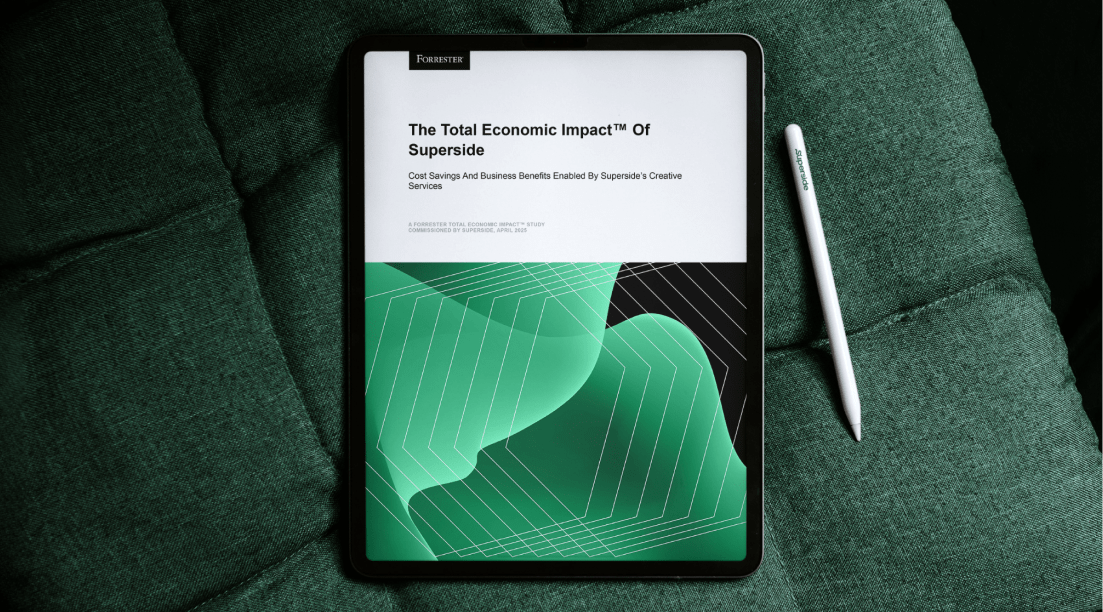
According to a Forrester Total Economic Impact™ study, Superside delivers a 94% ROI and pays for itself in six months.


Your creative team's creative team
Choose the world's leading AI-powered creative service
and get high-performing ads, videos, experiences and
more at scale, on your schedule and to your standards.