





Most enterprises carry creative debt: the gradual buildup of outdated, off-brand or poor creative that weakens the brand and drains the team. Like technical debt, it doesn't show up as a line item on the balance sheet, so nobody fixes it until real damage is done. Learn how to identify, measure and reduce creative debt before it compounds.
Software teams have a term for what builds up when teams keep choosing the fast fix over the right one: technical debt. It's a powerful metaphor that translates a fairly abstract problem into the financial language business leaders understand. All business leaders know that unmanaged debt eventually limits growth.
Marketing and creative teams have the same problem, at the exact same scale, yet almost no one has named it. Creative debt is the accumulated cost of every rushed, off-brand asset that's live, every campaign that outlived its relevance, every outdated template still used after a rebrand and every legacy logo that still lurks in sales decks.
Taken individually, these issues are easy to dismiss. Together, however, they become a liability that weakens brand consistency, drains team productivity and steadily slows the team's ability to get work to market.
The reason nobody talks about creative debt is the same reason technical debt went unmanaged for years: it's invisible on the balance sheet, and it accrues slowly enough to feel normal.
This article gives the problem a name and a shape. We define creative debt, show what it costs enterprises, explain why the AI era is raising the stakes and lay out practical ways to reduce it. We also use Superside's rebrand as a real-world example of how to eliminate creative debt at scale.
What is creative debt?

Creative debt is the accumulated liability an enterprise takes on when speed, volume or convenience repeatedly win out over consistency, quality and maintenance in its creative output.
Like technical debt, some creative debt is normal and even rational. Every now and then, the creative team has to deliver the quick version to hit that deadline. The danger is when those shortcuts compound and no one ever goes back to fix the work. What began as a temporary compromise becomes the new normal.
The technical debt analogy is powerful because it demonstrates how seemingly small compromises can compound into costs the business simply can't ignore.
According to McKinsey, CIOs divert 10 to 20% of their technology budget earmarked for new products to resolving technical debt. McKinsey also estimates that technical debt represents 20 to 40% of the value of an organization's technology estate before depreciation. In large enterprises, that debt often accumulates to millions of dollars.
McKinsey argues that organizations that actively measure and manage technical debt can free up engineering capacity, speed up innovation and create greater business value. Another source, Stripe, notes that developers lose around 13.5 hours a week to technical debt.
In most enterprises, there's no budget line called "technical debt," and no invoice arrives for it. Instead, the cost shows up in slow, hard work, repeated fixes, delayed creative projects and missed opportunities.
Just like technical debt, creative debt builds up over time. It generally manifests in five ways:
- Legacy debt: outdated assets still in circulation, like the pre-rebrand logo in a sales deck or the old brand colors on a regional banner.
- Inconsistency debt: off-brand work produced by distributed teams, freelancers, agencies and tools that didn't pull brand guidelines from a single source of truth.
- Backlog debt: the creative you needed but never made, the channels you under-serve and the tests you never run because the team is at capacity.
- Staleness debt: campaigns and assets that weren't refreshed often enough, causing audiences to tune them out and creative performance to decline.
- Marketing operations debt: the absence of design systems, brand guidelines, custom AI image models and the marketing design ops that would have prevented all of the above. Instead, teams reinvent the wheel every time, increasing effort and the risk of burnout.
Creative debt is easy to overlook because it compounds in small increments. Over time, however, slower execution, weaker brand consistency and talented teams spending more time fixing problems than shipping new work become impossible to ignore. Unfortunately, you can't manage a problem you haven't named, which is why recognizing creative debt is the first step to reducing it.
The difference between brand debt, design debt and narrative debt
It's also worth distinguishing creative debt from a few related terms:
- Brand debt in enterprise organizations describes the gradual erosion of brand consistency as outdated logos, messaging and visual assets continue to circulate.
- Design debt in enterprises typically refers to UX and product design compromises that accumulate over time.
- Narrative debt describes brand messages that no longer reflect the company's strategy or market position.
Enterprises rarely experience these types of debt in isolation. They deal with all of them at once. Creative debt is the broader enterprise frame that captures the accumulated cost of all these compromises together.
Why creative debt compounds in the AI era
In 2026, two forces make creative debt accumulate faster than ever, and enterprises are squarely in the blast radius.
Creative demand outpaces capacity
Enterprise creative teams are under pressure to produce more assets across more channels, formats and markets than ever before. Our "Breakpoint" research shows that four in five teams are at or over capacity, while seven in ten leaders report burnout.
When workloads outpace capacity, shortcuts become inevitable. That's how creative debt accumulates. Bottlenecks multiply, quality slips and brand consistency is often the first casualty.
AI is a double-edged sword
AI promises a way out of creative debt and, when used strategically, delivers. But without the right systems in place, AI can just as easily make the debt problem worse. As we explain in our article on creative content velocity, anyone can click "generate" and flood the pipeline with AI content. But without clear brand guardrails and senior human oversight, the output can quickly become AI slop.
The cost of creative debt
The cost of creative debt isn't abstract. Every inconsistent, outdated asset chips away at the brand recognition that drives revenue and business growth.
Participants in a Marq research study estimated that maintaining a consistent brand would increase overall growth by 10 to 20%. That additional revenue could then be reinvested in hiring, technology or software that might otherwise be out of reach.
Creative debt also shows up as:
- Senior creative time wasted on rework instead of high-value creative work.
- Slower workflows and launches as teams recreate assets that should already exist.
- Poor campaign performance as audiences tire of stale creative.
It's the same compounding tax McKinsey observed in engineering teams. Here, however, your marketing and creative teams pay the price.
How to pay down creative debt (and stop borrowing against your brand)
Paying down your creative debt takes focus and discipline, much like debt-conscious software teams build paydown into their operations. The six-step framework below will help you pay down your current debt and replace short-term fixes with sustainable creative operations.
Step 1: Audit your creative to find the debt
You can't pay down a debt you haven't measured. The first step is, therefore, to start with a creative audit:
- Take stock of what's live across channels and markets.
- Identify and flag what's off-brand or outdated.
- Determine where the same asset has been recreated several times.
This exercise is the equivalent of going through your balance sheet. Most enterprises are shocked by how much creative debt surfaces.
Step 2: Build a single source of truth
A single source of truth is your best defense against recurring creative debt. An up-to-date, centralized design system, with tokens, components, templates, brand guidelines and approved assets, helps ensure creative debt doesn't start creeping back in. When the source of truth is genuinely central, teams no longer recreate assets or deviate from brand standards, and consistency becomes the default. Without this system, any paydown is temporary.
Step 3: Build creative velocity
Paying down creative debt requires capacity. But without purpose, extra capacity simply creates new debt. That's why Superside focuses on what we call creative velocity: not just moving faster, but moving faster in the right direction. Creative velocity helps your team clear the enterprise creative backlog while delivering high-quality, on-brand creative at scale.
Step 4: Set a refresh cadence to keep creative effective
Staleness debt is the easiest to ignore. It's also the easiest to prevent. Simply decide upfront how often key assets and campaigns should be refreshed, and stick to it. A refresh cadence fights audience fatigue and turns one-time campaigns into living systems you update rather than rebuild.
Step 5: Use AI to pay debt down
This is one of the most important shifts of the AI era. Generic AI tools can increase creative debt. When they don't know your brand, they can generate high volumes of off-brand work fast. On the flip side, you can quickly pay down your creative debt with AI systems that truly understand your brand.
Custom AI image models trained on your assets, paired with a living brand intelligence layer, mean that every new asset starts closer to on-brand. We'll come back to how Superside's Brand Brain, the AI layer inside our Superspace creative management platform, makes this systematic. The principle: point AI at consistency and maintenance, not just content generation. That's how it helps you pay down creative debt.
Step 6: Keep humans in the loop
Don't fall into the trap of thinking all of this can run on autopilot. AI can handle much of the execution, but human judgment remains essential. Experienced creatives still need to be pulled in at specific points to protect brand consistency and quality.
This is the AI creative quality control layer that separates a creative system that compounds value from one that spits out AI slop. With senior human oversight, AI-powered workflows can deliver speed and consistency together, not one at the expense of the other.
How Superside paid down its own creative debt

Superside's new visual identity
The concept clicks when you see a brand pay down years of accumulated creative debt. Superside did exactly this during our own rebrand, which makes it the perfect lived example of how the six-step framework works in practice.
By 2024, we'd built up years of creative debt. Over time, Superside had evolved into the world's leading AI-first creative partner, but our visual identity didn't reflect this new positioning.
The old visual identity didn't reflect the brand it truly is, which is a company full of people that are really senior, really experienced and come from some of the top companies in the world.

Rather than service our debt slowly, we paid it down comprehensively. We started refreshing the brand top to bottom with the same AI-first, human-led approach we use for our customers. Three steps in particular stand out.
1. We built a company-wide GPT
First, our team rewrote our brand voice so AI tools could interpret it correctly. Then we built a company-wide GPT around it. That made brand consistency the default, not something our team members had to remember.
The whole brand voice was written in a very AI-friendly way. We created a GPT that wasn't just for our copywriters but actually for all Supersiders, so that everyone can talk in an on-brand way.

2. We did one foundational photoshoot
Second, instead of compiling a spec sheet that would slowly age, our team ran a single foundational photoshoot in Cape Town, South Africa. Importantly, we then trained a custom AI image model on the results, producing enough imagery for a year from one shoot.
We now have photos for 12 months that are totally on-brand, trained on our imagery. It unlocks creative capacity that would’ve been too expensive before.

3. Human creatives stayed in control
Finally, we made sure humans led every decision, while AI dramatically compressed the timeline.
This was in line with our responsible AI approach. The result was a full rebrand delivered in six months, with the systems in place to keep new debt from accruing. The rebrand also drove Superside's best-ever sales quarter.
How Superside helps enterprises pay down and prevent creative debt
Superside is the world's leading AI-first creative partner. We help in-house marketing and creative teams at brands like Intuit, Amazon, DoorDash, Figma and Reddit scale high-quality, on-brand creative that performs. We're a human-led, AI-native creative partner, and paying down creative debt, then keeping it paid down, is one of the most valuable things that partnership delivers.
Being AI-first means AI isn't just powering individual tools. It's embedded across the entire creative model, from how teams are trained to how brand knowledge compounds over time.
We bring both capacity and creative velocity to our partnerships. With 40+ AI workflows, 20+ specialized creative services and almost 100% of our creatives AI-certified, Superside can support every channel, cut design timelines and improve delivery efficiency by around 35%. This velocity is how we help teams pay off their creative debt without sacrificing quality or consistency. We've proven how this approach pays off across 5,000+ AI-powered projects. In 2025 alone, we saved our customers over 31,000 hours. And the independent Total Economic Impact study of Superside showed that Superside delivers a 94% ROI and over $4 million in business benefits in three years.
How do we do this? We mastered how to scale creative production with an integrated approach that includes a workflow audit, a solid brand foundation, custom AI models, creative automation, human-led checkpoints and feedback loops, delivered through Superspace, our AI-powered creative management platform.

Brand Brain, the AI intelligence layer inside Superspace, is the single most effective anti-debt mechanism we've created for ourselves and for our customers. It captures brand guidelines, tone, past work, feedback and performance, then uses that context to keep every new asset on-brand from the first draft. Generic AI tools increase creative debt. Brand Brain does the opposite: it learns your brand and gets smarter over time, so every project reinforces consistency instead of creating more creative debt. Best of all, it's included with every Superside subscription and supported by world-class creatives who own the taste, judgment and decision-making AI can't.
Ready to find out how much creative debt your brand is carrying, and start paying it down? Book a demo and let's build the system that keeps your brand consistent at scale.
If you can name it, you can fix it
Giving technical debt a name turned an invisible problem into something business leaders could measure, prioritize and fix. Creative debt is at that same moment now. It's been sitting on every enterprise's books for years, unnamed and invisible, costing brand equity, senior time and speed to market.
In the next few years, the successful enterprises will be the ones that see it clearly, measure it accurately, pay it down purposefully and prevent it from accumulating in the first place.
The playbook isn't complicated: audit your creative debt, build a single source of truth, create real content velocity, routinely refresh your creative, point AI at consistency rather than raw volume and keep humans in the loop.
Superside proved this approach works by paying down our own creative debt when we rebranded. We now help other enterprise teams do the same with an AI-first, human-led model built on Brand Brain, our ultimate anti-debt mechanism. Imagine finally being able to pay off your debt. If you're ready for this step, it's the perfect time to make Superside your creative team's creative team. Book a call.
FAQs



Creative teams are at a breaking point
The pressure is real, the opportunity is too.
Get insights from 300+ leaders on
beating burnout, using AI wisely
and navigating 2026’s inflection point.

The data speaks for itself
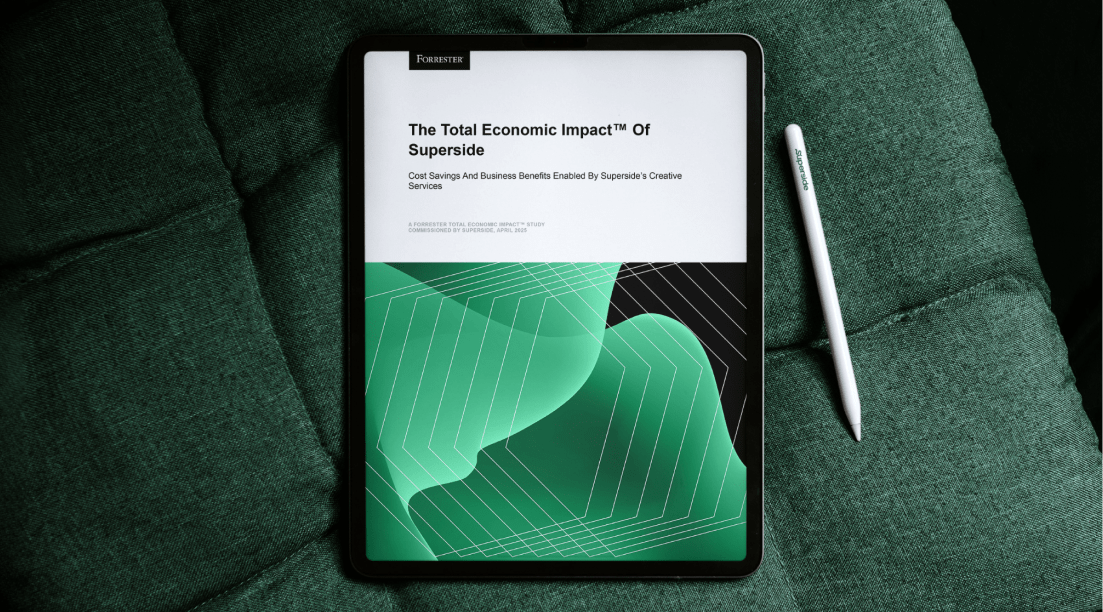
According to a Forrester Total Economic Impact™ study, Superside delivers a 94% ROI and pays for itself in six months.


Stuck in AI testing mode?
It’s time to move from experiments
to real impact.
Explore AI Reset—a 5-step framework
to embed AI into your creative workflows.


Ready to see it in action?
The best way to understand it is to experience it.
Because once your creative system has memory,
you won’t want to go back to starting from scratch.


Increase your creative capacity
Let your in-house team reach for the stars,
while Superside keeps your day-to-day creative needs
at an industry-leading level. Ready to scale?


