

AI brand design has moved from experiment to proven practice. Across nine examples, from Superside customers like Johnson Controls and Pixlmob to global brands like Heinz, Nutella and Coca-Cola, you'll see AI generate hundreds of on-brand assets in hours and cut production time by up to 90%. The winners all share four traits, and Brand Brain is what makes the pattern repeatable.
Everyone has seen the bad version of AI design. The slightly off visuals that look like they're from a 1990s stock library, and the "technically fine, totally forgettable" ad creative that's about as memorable as your privacy policy.
It's no wonder many marketing and creative leaders are skeptical that AI can produce standout, on-brand creative at the speed it promises.
Today's AI tools are incredibly powerful. The problem is that many enterprises still use generic tools that pull from the internet rather than their own brands, and fail to implement strong AI-powered workflows.
But when you train AI on your brand and implement human-led processes, the technology opens up a mind-blowing way to scale creative production.
That's exactly what the nine examples in this article demonstrate. Five come from Superside customers and four from brands you already know. Together, they show how AI design can cut production time by up to 90%, generate hundreds of high-quality, on-brand assets in hours and even help reinforce what makes your brand recognizable.
Why AI brand design is suddenly everywhere
As enterprises grow, their marketing teams support more launches, campaigns, regions and channels. Many teams have embraced AI, viewing it as a way to do more with fewer resources.
Yet adopting AI isn't the same as using it well. Only 2% of in-house marketing and creative teams have fully integrated AI into their workflows, according to Superside's "No-Hype AI" report. Most realize the tools have potential but don't quite know how or where to integrate them.
Part of the frustration is that generic AI tools don't understand their brands. Team members share prompts with a general-purpose model, get content that could belong to almost any company and lose faith in the technology.
But here's the part many marketing teams haven't fully embraced yet. When AI is grounded in your brand and paired with the right strategy, workflows and human expertise, the same technology that can produce AI slop can become a force multiplier.
We've seen this first-hand. Across our first 200 AI-enhanced projects, we delivered creative 30-60% faster and saved our customers more than $300,000. Just as importantly, we maintained a near-perfect satisfaction rating.
The examples that follow illustrate an approach we've operationalized: AI-powered processes that drive speed and scale, senior creative talent who provide strategic judgment and the final approval layer, plus a strong brand foundation that keeps every asset on-brand. Together, these three layers make it possible to produce more creative without compromising brand consistency or quality.
9 AI brand design examples from brands using AI for design
The examples below show how top brands use AI to produce distinctive, on-brand work faster, more consistently and at a scale traditional workflows struggle to match.
1. Johnson Controls delivers a claymation-style ad 85% faster
When Johnson Controls, a building technology and software company, wanted to break away from the predictable, photorealistic approach of most B2B industry videos, Superside proposed something completely different: a claymation-inspired animated campaign built around a memorable character named Bob.
AI supported the storyboarding, visual exploration and production. Human creatives directed the narrative and tone, and helped conceptualize the now-recognizable character at the center of the campaign.
The "Don't Surprise Bob" video was delivered 85% faster than traditional methods, saving Johnson Controls $47,000 in production costs. More importantly, our team didn't compromise on quality, which led Johnson Controls to engage us for other work as well. This example perfectly illustrates how AI can compress a months-long animation timeline into weeks without sanding off the creative edges.
2. Independence Pet Group creates 750+ illustrations in 11.5 hours

Independence Pet Group (IPG), one of North America's largest pet insurance providers, wanted a playful, distinctive illustration style to bring its internal communications and merchandise to life. Like many in-house teams, however, it faced familiar constraints: limited creative capacity, tight timelines and a fixed budget.
With an AI-enhanced workflow, a single team of Superside illustrators, designers and copywriters produced 750+ unique images, including 14 brand illustrations, a series of stickers and virtual backgrounds, in just 11.5 hours of work.
This represented roughly 90% in design hours saved and $15,000 to $20,000 in cost savings for our customer. Better yet, IPG approved the work with zero revisions. It's a strong example of what happens when experienced creatives use AI to speed up production. Projects that once felt like "someday, maybe" become polished, on-brand deliverables in a day or two.
3. Density builds a 70+ piece illustration library 83% faster

Sensor technology brand Density needed a visual identity as innovative as its product, without resorting to generic stock imagery. Using AI tools, our designers quickly explored ideas, visualized concepts and built mood boards, which sped up the creative process and helped us develop a distinctive visual identity.
Subsequently, we built a scalable illustration library of 70+ custom visuals and an AI-generated brand identity. The library helped the team produce cohesive visual concepts that balanced advanced technology with human-centered workplace solutions.
Thanks to robust design systems, the transformation was completed 83% faster than traditional production would have allowed. Because the library was modular, Density could generate new environments and product-adjacent visuals without fresh photo shoots. AI brand design as infrastructure ultimately made Density stand out on the playing field.
4. Pixlmob delivers a full rebrand at 2x speed with 100% consistency

Pixlmob, an online marketplace for real estate photographers and editors, came to Superside for a full brand transformation. Combining human creativity with AI, our team developed a bold new visual identity, including color palettes, logo design, typography and custom elements. We then built a tailored library of 400+ assets that merged AI-generated visuals with expert design.
The results directly addressed one of the biggest concerns about AI design: how to ensure AI outputs are consistently on-brand. We delivered a premium brand identity twice as fast as traditional methods while maintaining consistency. Every asset stayed true to the brand voice and identity.
This example proves that large volumes of AI content don't have to threaten brand integrity. With a well-trained AI system, clear creative guardrails and human oversight, brands can achieve both speed and consistency.
5. D2L Brightspace produces 114 on-brand ads 70% faster

When edtech company D2L Brightspace turned to Superside for a fresh, playful ad campaign, our team used Midjourney to explore prompts and styles. In the end, we landed on a bright, stylized orange aesthetic, which we refined in Photoshop.
The output was 114 unique ads produced in 70% less time than conventional ad design would have taken. Each of these variations maintained 100% brand consistency, which gave D2L greater capacity to focus on other aspects of the campaign.
The project once again showed what's possible when AI is trained to work within a brand system. Instead of investing weeks in just a handful of concepts, our team could quickly generate dozens of on-brand creative variations, test them across channels and learn which creative resonates without sacrificing consistency.
6. Heinz "A.I. Ketchup" proves a brand owns a category

In 2022, Heinz launched one of the smartest early AI brand campaigns. The brand asked OpenAI's DALL-E 2 to generate images of "ketchup," then experimented with increasingly unusual prompts, from Renaissance paintings to fantastical scenes. Time and again, the AI produced images that looked unmistakably like Heinz bottles.
The campaign proved the brand's leading role in the industry. Even an AI model trained on the whole internet thinks "ketchup" looks like Heinz. The brand then turned this finding into a fully fledged marketing campaign of AI-generated visuals paired with real customer prompts.
The highly successful campaign reportedly drove more than 1.15 billion earned impressions and a 2,500% return in earned media. Rather than using AI simply to produce assets, Heinz used the model's bias as the message. It let the AI itself prove that, for most people and machines, ketchup is Heinz.
7. Nutella Unica uses an algorithm to design 7 million jars

Before generative AI became mainstream, Nutella demonstrated the power of computational brand design. For the 2017 Nutella Unica campaign in Italy, an algorithm combined dozens of patterns, colors and graphic elements to generate seven million one-of-a-kind jar labels. All the jars sold out in Italian supermarkets within a month.
In many ways, it foreshadowed today's brand-trained generative AI systems. While the technology was different, the principle was the same. Define the creative rules once, then let technology generate countless on-brand variations within those guardrails.
8. Coca-Cola "Create Real Magic" turns brand assets into a creative sandbox

Coca-Cola's 2023 "Create Real Magic" platform combined GPT-4 and DALL-E and did something unusual. It gave the public controlled access to its most iconic brand assets, inviting people to create AI-generated artwork using official Coca-Cola imagery.
Fans could remix the contour bottle, the Spencerian script logo and famous Coca-Cola imagery into original AI artwork. The best pieces were featured on digital billboards in New York City and London, and 30 creators were invited to Atlanta for a creative academy.
The platform's success stemmed from its design. Coca-Cola didn't invite people to create anything in its name. It invited them to create within a carefully designed system. It shared a curated set of instantly recognizable brand assets, then gave people creative freedom to play. That's the model many enterprises now aim for: broad creativity inside clear brand guardrails.
9. Mango launches the first fully AI-generated fashion campaign

In 2024, fashion retailer Mango launched its first campaign featuring AI-generated imagery for the Sunset Dream collection from its Mango Teen line.
The creative team first photographed the real garments, then used generative AI to place those exact products on AI-generated models in digitally created settings. The result was editorial-quality imagery that accurately preserved the design, fit and details of each piece. Human creatives curated the outputs, retouched the images and finalized the campaign.
What stands out is what happened next. Mango immediately began integrating generative AI into its broader content production workflows. For a brand whose business depends on compelling visual storytelling, embracing AI-generated campaign imagery was a significant move. It also points to where retail brand design is headed: real products, AI-created worlds around them and human creatives shaping the final result.
What the best AI brand design examples have in common
Nine very different case studies, one repeated pattern. Pull them apart, and the same four traits show up every time.
1. AI is anchored to the brand, not the internet
The Density and Pixlmob projects succeeded because the AI models and workflows were built strictly around the brand identities. The Coca-Cola campaign was a roaring success because the sandbox environment contained only approved brand elements. And the Heinz campaign landed because the brand identity was so strong that the AI had already absorbed it. The lesson is that generic AI tools produce generic outputs. The teams that nail on-brand AI design train their systems on their brands.
2. Human creatives continue to lead the charge
In every Superside case, human creatives set the direction and approved the outputs. In the Mango example, the brand's team retouched and finalized all the creative assets in-studio. The key is to let AI handle volume, variation and speed, but to leave judgment, taste and brand governance firmly in human hands. The result is strong AI creative quality control.
3. Design systems, not one-offs, are the default
The brands that executed the strong AI design examples in this article all used design systems and asset libraries. Density's modular illustration library, IPG's collection of 750+ assets and Pixlmob's library of 400+ branded elements all laid the foundation for internal and external teams to keep building on long after the initial project. When both AI and human creatives work within an established brand design system, it becomes much easier to produce consistent, scalable creative. The result is faster production, lower costs and a brand that becomes more recognizable, not less, as content volume grows.
4. Speed expands what's possible
Dramatically cutting production time freed up the creative teams involved in all these campaigns to explore more creative directions, test more ad variants and take on projects that were previously off the table. The lesson is that, when AI is used well in creative workflows, it expands what's possible. The key, however, is a system that remembers your brand and gets smarter over time. At Superside, that system is called Brand Brain.
How Brand Brain makes on-brand AI design repeatable
Superside helps in-house marketing and creative teams at brands like Intuit, Amazon, DoorDash, Figma and Reddit scale high-quality, on-brand creative fast. We're a human-led, AI-native creative partner that becomes your creative team's creative team.
Being AI-first means AI isn't just powering individual tools. It's embedded across the entire creative model, from how teams are trained to how brand knowledge compounds over time.
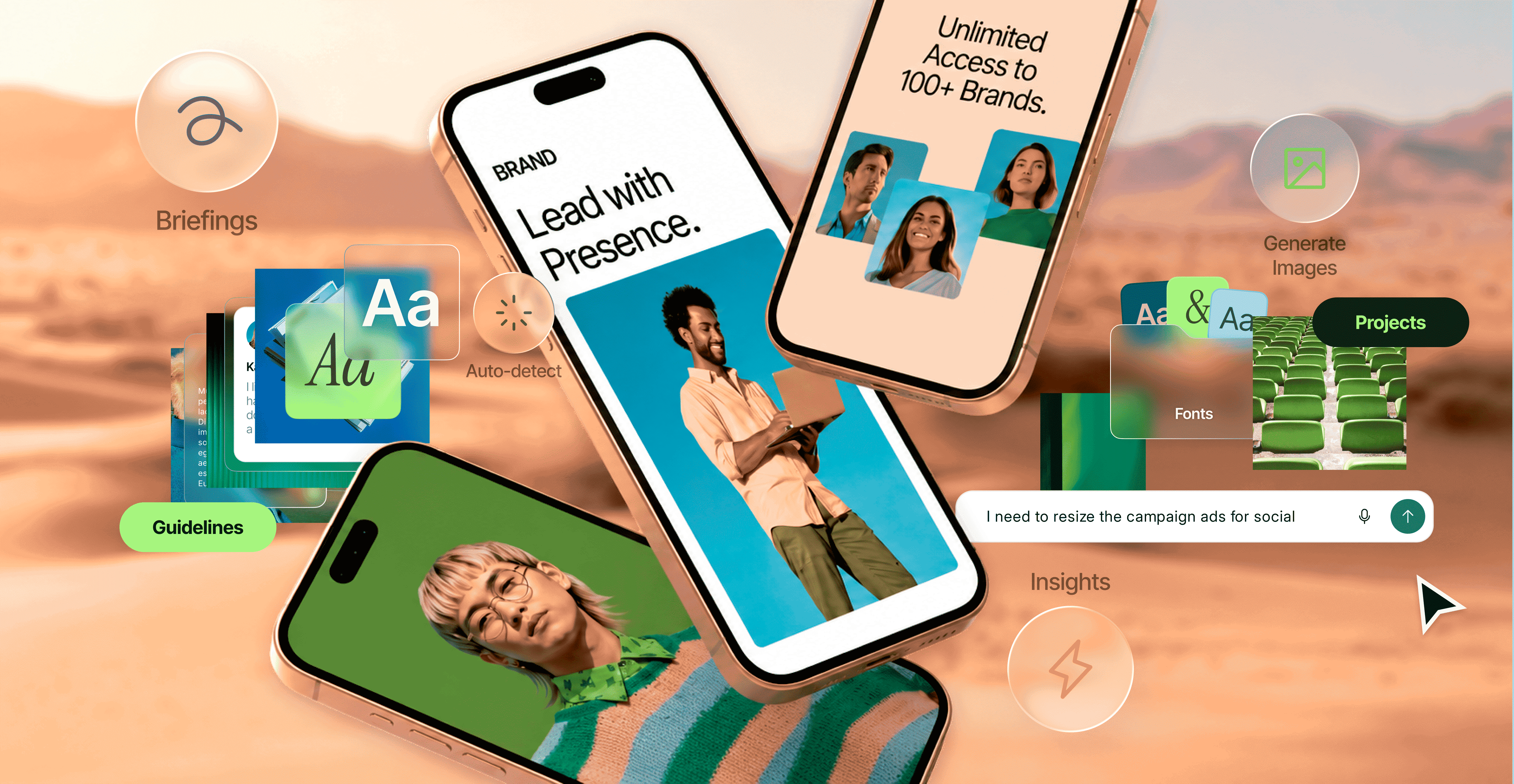
Within our Superspace creative management platform, Brand Brain provides persistent brand memory for your projects. It captures your brand context and applies it from the very first brief, so work starts on-brand every time. And with every project, Brand Brain learns what works and carries those insights into the next one.
The system also holds the context that generic AI tools forget:
- Brand guidelines, tone, messaging and compliance standards.
- Past work, feedback and performance.
- Roles, preferences, workflows and approvals.
This persistent memory makes on-brand creative the default, not something you have to prompt for. In practice, this memory layer shows up exactly where you need it most:
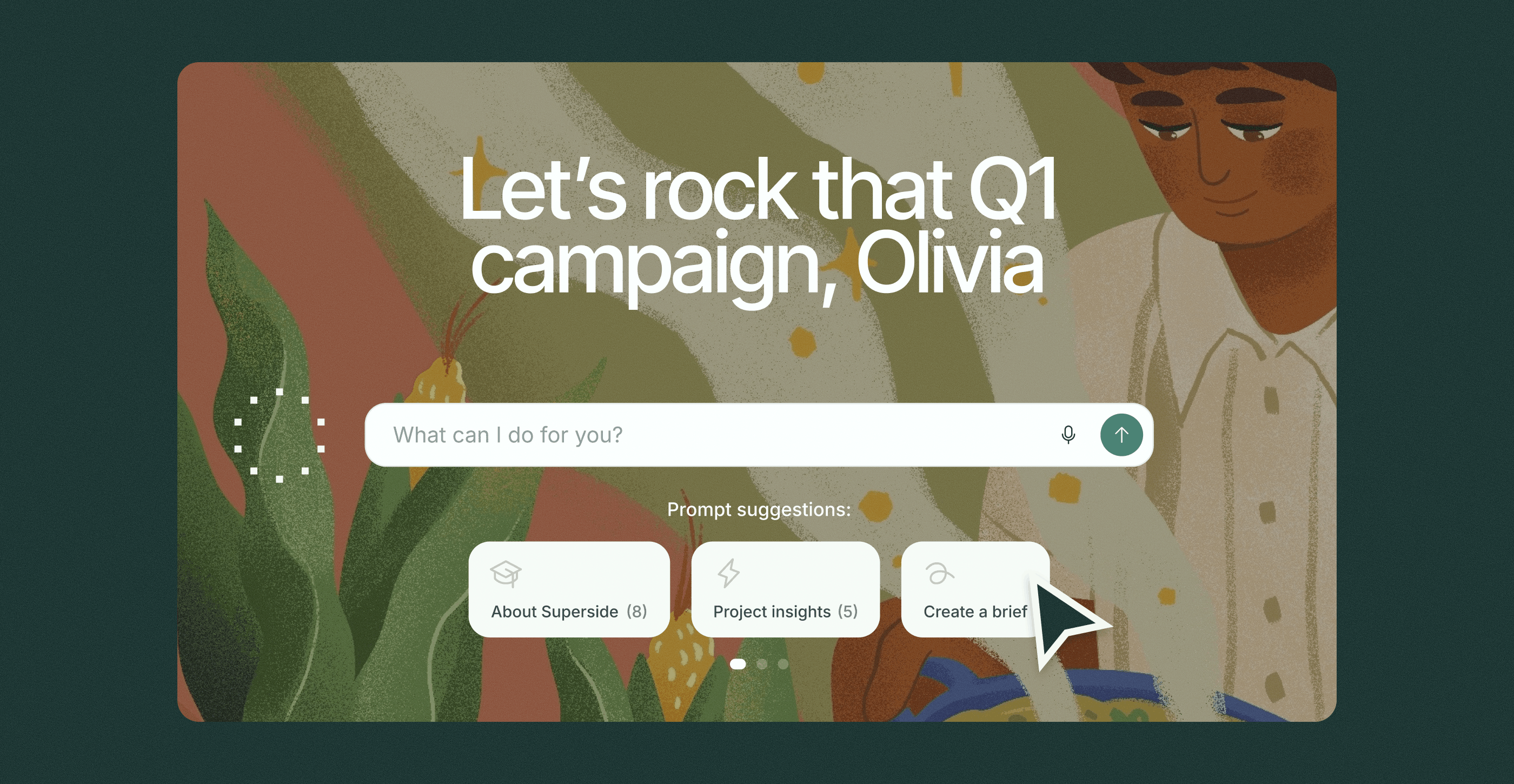
- An AI Insights Agent lets you "pick your brand's brain" on demand and surfaces patterns, gaps and opportunities across all campaign activity, content and decisions stored in Superspace.
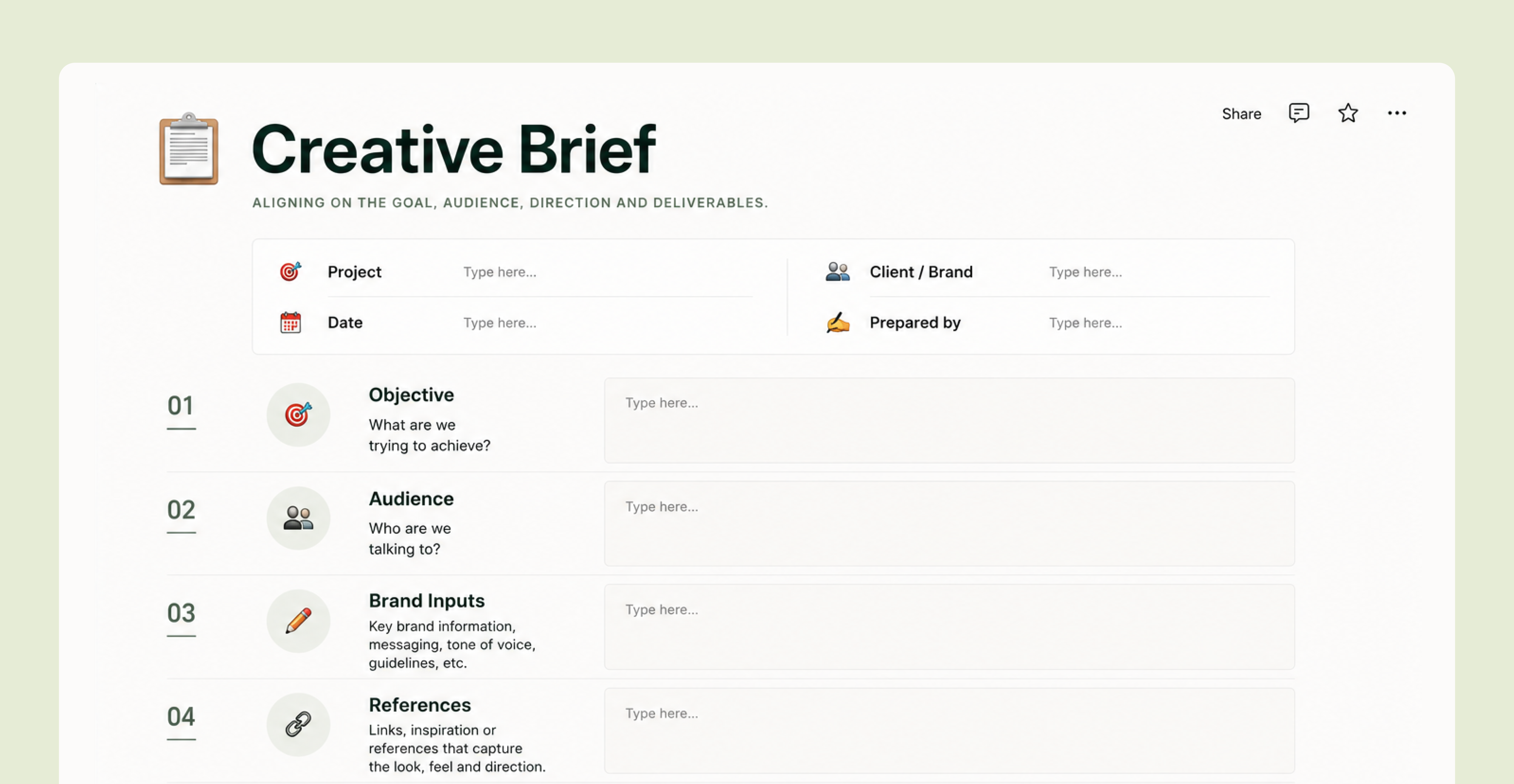
- The AI Briefing Agent helps you translate rough requests into clear, actionable briefs that draw from your Brand Brain to add specs, references and context.
- Custom Brand Models, custom-trained on your visual style, generate fresh imagery to use in any circumstance in seconds.
- Custom Automation Workflows handle asset resizing, headshot editing, product shots, motion and campaign visuals.
None of this runs on autopilot. Almost 100% of our creatives are AI-certified and stay involved throughout the process. We maintain 50+ production-ready AI workflows, and every deliverable is reviewed and approved by experienced creatives before it reaches your team.
The results speak for themselves. We've delivered 12,000+ AI-powered projects, achieving roughly 40% efficiency gains and saving our customers more than $4.5 million in creative costs. Our AI-first approach has also helped customers save more than 31,000 hours in a single year while reducing production friction across creative workflows.
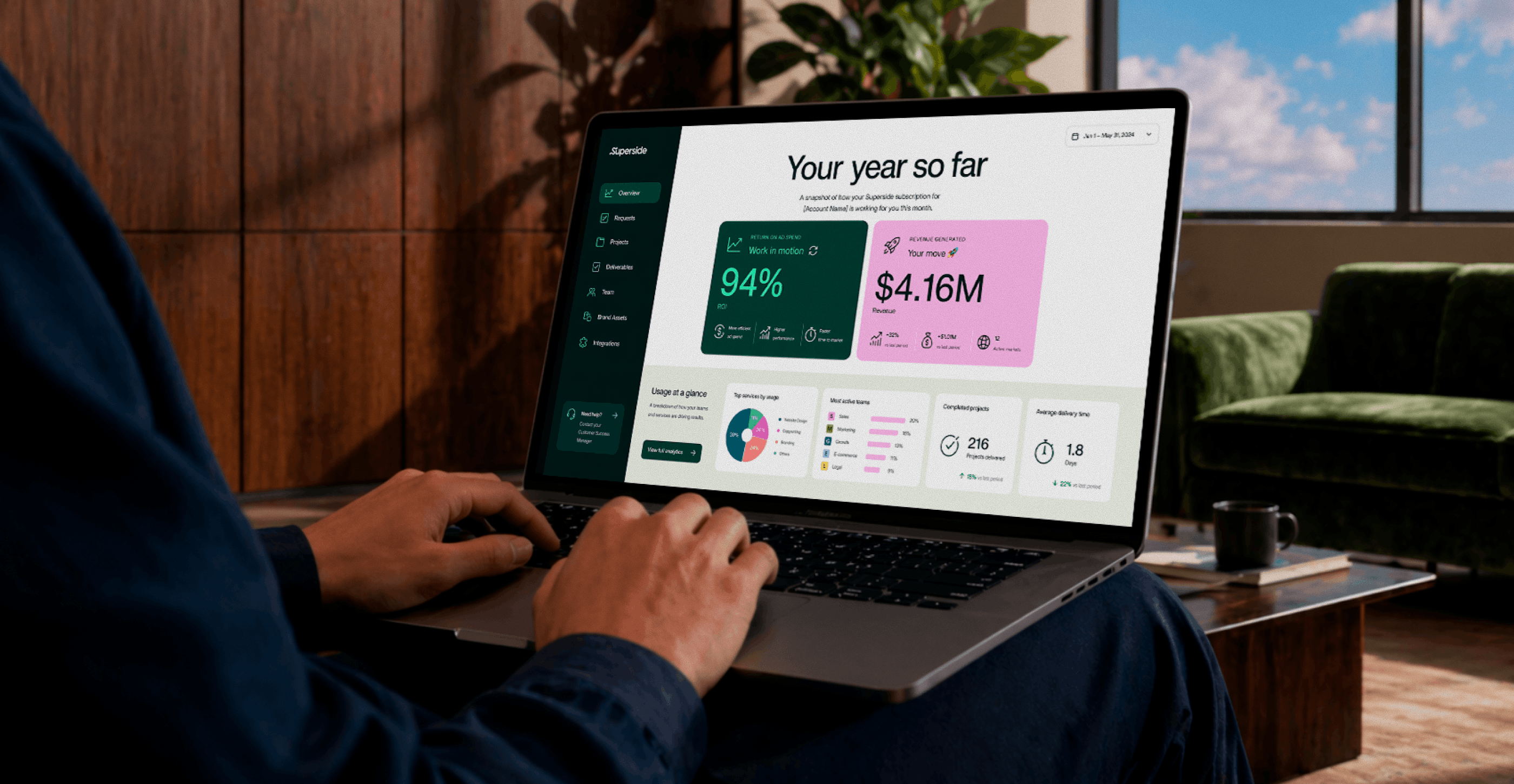
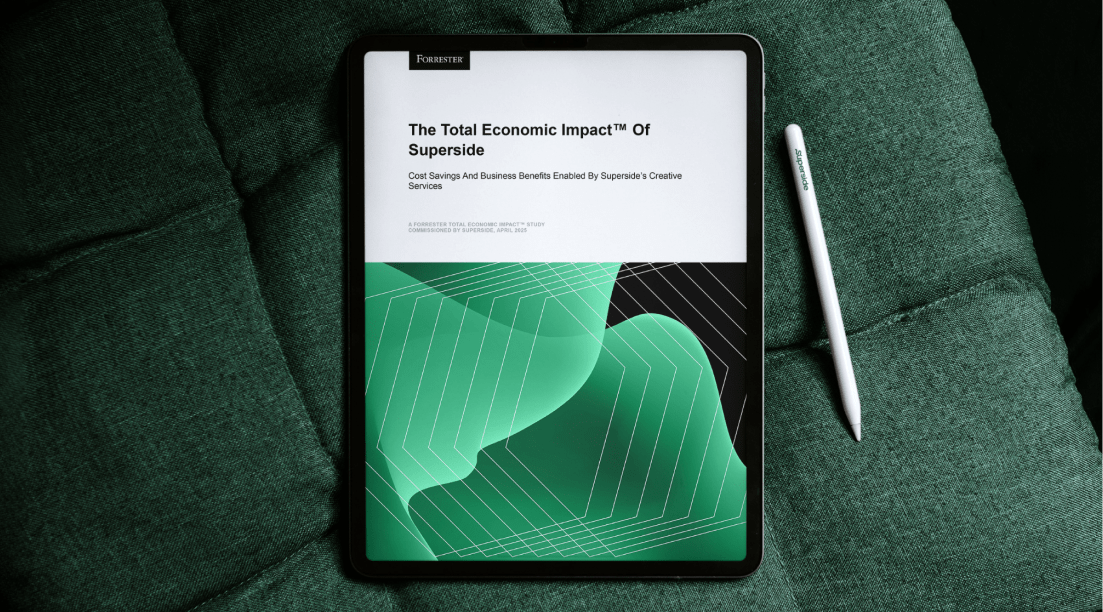
What's more, a commissioned Forrester Total Economic Impact study found that a Superside subscription delivers a 94% ROI and pays for itself in under six months.
And we don't just offer a wide range of creative services. We also offer AI consulting for enterprise teams that are ready to scale and succeed with generative AI, but don't quite know where to start.
On-brand AI design is a choice, and the examples prove it
If you're worried AI will make your brand look and sound like everyone else's, the AI design examples in this article show it doesn't have to. In fact, AI-powered workflows can truly set you apart.
None of the work produced for brands like Johnson Controls, IPG, Heinz, Coca-Cola, Pixlmob, Mango, Nutella and Density looked like AI slop, because none of it was built like AI slop.
The reality is simple. Generic AI tools produce generic work. Brand-trained AI, guided by human creatives and powered by an AI memory layer, speeds up creative production and keeps every asset perfectly on-brand.
If you want your own entry on a list like this, the path is a system that knows your brand. That's what Brand Brain inside Superspace gives every Superside customer. Book a demo to see what Brand Brain can do with your brand.
FAQs


$4.5M+ saved in creative costs in two years
Get real-world examples, results and insights
from over 5,000 GenAI-powered projects.
Make your creative team future-proof
97% of creative leaders say the role of the creative
professional will look fundamentally different in 5 years.
This report is our prediction for what’s coming
and how to be ready for it.

Ready to see it in action?
The best way to understand it is to experience it.
Because once your creative system has memory,
you won’t want to go back to starting from scratch.

The data speaks for itself
According to a Forrester Total Economic Impact™ study, Superside delivers a 94% ROI and pays for itself in six months.


Increase your creative capacity
Let your in-house team reach for the stars,
while Superside keeps your day-to-day creative needs
at an industry-leading level. Ready to scale?