


As targeting has become more automated, creative has become the main driver of ad performance. Learn what separates effective ad creative from the rest, why testing and iteration matter, and how AI-first production can help you create ads at the speed the market now demands.
There’s a shift happening in digital advertising that many marketing teams haven’t yet fully absorbed.
As platforms like Meta and TikTok automate targeting, bidding and placement, algorithms increasingly handle the targeting variables that human teams once controlled. What that leaves on the table, as the primary lever marketers can still pull, is creative quality.
Creative has always mattered. What’s changed is how much it now carries.
Yet, while more than 83% of marketers say creative is a powerful performance driver, many still struggle to deliver the volume required. Over half cite limited asset updates and insufficient creative variations for testing as key reasons for campaign underperformance.
As targeting and delivery become more automated, ad creative now bears more responsibility for attention and results.
We break down what it takes to design high-performing ad creatives, and how an AI-first creative partner can help you create impactful ads consistently and at scale.
Why most ads underperform (it’s not the targeting)
When ad campaigns underperform, teams tend to think that audience targeting was off, segmentation was too broad or ad spend was misaligned.
These factors matter, but as platforms improve their automated targeting, creative quality has become more important. If the visual doesn’t grab attention, the headline misses the mark or the ad isn’t built for how people view ad content on a specific platform, it’ll simply get ignored.
Behind the scenes, there’s usually another issue: Many enterprises struggle with capacity, which means they simply don’t produce enough creative assets to test effectively.
The creative agencies and brands that perform best produce high-quality ad creatives quickly, learn from the performance data and test in near-real time.
The fundamentals of high-performing ad creative
Before we get into the design process involved, let’s quickly pause to look at the ad creative best practices that drive performance.
A common mistake is to treat visual appeal as a proxy for performance. They’re not the same thing. In fact, many top-performing ads lean into a rough, user-generated feel or intentionally break traditional design rules. What really matters is whether the creative achieves the ad’s objective.
Enterprise teams that create ads should always first check that they’ve covered a few fundamentals.
Think of the “first three seconds”
The first three seconds of a video or motion ad determine whether the rest gets seen. A strong hook and visual capture attention, establish context, create curiosity and give the viewer a reason to watch or read what follows.
A common mistake is to save the main point for too late. A 30-second video that saves its most compelling claim for the 20-second mark will lose most of its target audience before they reach it.
Match the format to the platform and moment
Platform-native ad creative tends to outperform polished, traditional broadcast-style production. Target customers instantly sense what fits in their feeds, and ad creatives that feel out of place are quickly dismissed.
With mobile accounting for roughly 75% of global digital ad spend, vertical formats are also no longer optional.
Specificity beats cleverness
Specific, compelling ad copy consistently outperforms clever, abstract text. A headline that reads “Cut working time by 70%” works better than “Work better, faster.” Specificity shows the claim is real, testable and not generic marketing language.
This applies to visual creative as much as to ad copy. Ad creatives that show a product in a clear, familiar context outperform generic lifestyle imagery.
Emotion drives attention; reason drives action
The most durable principle in advertising is that emotion creates engagement while rational justification closes the loop. An ad that makes someone feel something is more likely to hold attention long enough for the value proposition to land.
This plays out differently at various funnel stages. Upper-funnel creative should lean on emotional resonance and brand building. Direct-response creative needs a clear, believable offer to capture attention and deliver a smooth path to action.
The strongest ad campaigns align emotion and logic to the objective. Weak campaigns either mismatch them or fail to integrate both.
Brand consistency is a performance variable
Brand consistency, which builds recognition over time, is the last fundamental to prioritize. A target customer who’s seen your brand three times in different formats is more likely to engage than one who feels like they’ve seen it for the first time.
Unfortunately, when creative teams are rushed and lack proper design systems, brand consistency often slips. Brands then end up with incoherent advertising campaigns and a reduction in the recognition effect that ad frequency was supposed to build.
The creative performance approach: How to connect creative to outcomes
A creative performance approach treats ads as assets that are measured, tested and optimized for results. It connects creative production to business outcomes and allows data from one campaign to inform the next.
In many teams, these functions are still disconnected. Designers produce ad creatives, performance teams run them and team leads report results. Sadly, this often means the next campaign starts with little reference to what worked in the past.
With a creative performance approach, like the one outlined below, teams develop clear hypotheses, design multiple ad variations from the start and use performance data to guide each iteration.
Design for testing from the start
High-performing ad creatives and campaigns are built on structured testing and continuous learning.
The teams that get this right develop each concept as a set of variations, with changes to the hook, visual, headline or CTA. This creates enough contrast to learn what drives performance, without having to rebuild each ad set from scratch every time.
A modular creative system is key. When creative components can be adapted and recombined, teams can produce new variations quickly and refine them based on real results.
Use AI to accelerate iteration, not replace direction
AI, embedded throughout the ad creation process, changes what’s possible.
Teams can generate concepts fast, adapt creative across ad formats in a flash and thoroughly test ideas before they commit to full production.
Those who use AI effectively understand that strong results depend on clear creative direction and human oversight throughout the ad-creation process. They think “direction first, tools second.”
The most important part of the creative process is why? Why are we doing this? Most people jump into how to do something. But why? What is the story of this? How does this [asset] fit into the solution? AI-generated images can never replace that. It can generate assets. Someone has to assemble those pieces into a narrative

Feed performance data back into creative decisions
Past campaign data should always inform the next round of creative production. However, all too often, this data sits in reports nobody checks again.
Clear visibility into which creative elements drove results and the incorporation of these insights into future advertising campaigns are the only way to go.
A tool like Superads identifies patterns across creative elements and surfaces the variables that correlate with performance. This type of information, in the hands of a team that knows how to act on it, turns a single good campaign into a compounding learning system.
How to build an ad production system that keeps up
A deep understanding of what makes ads perform is one thing. Putting this knowledge into practice consistently is where many enterprise teams get stuck.
The key is to build systems that make it easy to create, test and refine ad creative continuously. Here’s what this looks like in practice.
1. Remove production bottlenecks early
Many teams still use a linear workflow: Brief, concept, approval, then production. However, this often creates bottlenecks that slow creative iteration and limit performance.
To move faster, it helps to reduce approval layers (especially for test assets), move decisions closer to the team doing the work and get variations live earlier, rather than perfecting a single version.
The goal is to get work into the market sooner and then improve based on what performs.
2. Build for variation from the start
High-performing ad programs don’t rely on a single asset. They use multiple variations to test specific concepts.
Build this step in from the start and think in “creative families”: One core concept, multiple hooks that speak to different customer pain points, different visual elements and variations in headlines and CTAs.
3. Plan for continuous refresh, not campaign cycles
Creative fatigue usually shows up in the data first, e.g., CTR drops and/or CPR rises.
While the default response is to adjust targeting or ad spend, the reality is that, in many cases, the creative has already stopped working.
High-performing teams circumvent this problem. New variations go live regularly across different ad formats, underperforming assets get replaced early, and more tests are done on strong concepts while they’re still effective.
4. Align ads and landing pages as one system
Ad performance doesn’t stop when the target customer clicks the CTA button. A strong ad sets a clear expectation, and then takes the user to a landing page that delivers.
When the message isn’t 100% aligned, conversion typically drops.
Keep things simple: Carry the exact same message through to the landing page, keep visual cues consistent, and reduce friction between the click and action.
5. Standardize briefs to reduce rework
Brief quality is one of the biggest hidden bottlenecks in ad production. When briefs are vague, creative often goes through multiple revision rounds before it becomes usable. Each round costs valuable time.
Clear briefs shaped by a broader creative strategy are key. The objective, target audience, message, required ad formats and what’s being tested should be crystal clear. The better the input, the better the output, and the more time saved.
6. Build design systems for scale
As production volume increases, consistency typically becomes harder to maintain. Teams that scale effectively invest in design systems grounded in a strong brand identity and built for creative iteration.
These systems include design tokens, patterns, templates, visual identity rules and clear production and accessibility rules. With a design system, brand elements stay consistent as other key elements (e.g., the ad message, product or format) change.
Design systems allow teams to quickly produce large volumes of creative assets, including high-quality ads, without reworking the same foundations each time.
7. Connect campaign performance data back into production
This is where most teams fall short. Campaign performance data is collected and reported across marketing channels, but it doesn’t shape what gets produced next.
It’s critical to close this loop, track what drives results, feed that back into the next brief, and build on what’s worked. Why? Because this approach turns creative production into a system that improves with each campaign and drives long-term digital marketing performance and business success.
Top 6 high-performing ad creative examples
The theory makes more sense when you see how successful creative strategies come to life. The AI advertising campaign examples below show how Superside helped top enterprises create successful ad campaigns.
1. D2L Brightspace: Finding a distinctive visual voice


When D2L Brightspace needed a visual direction that stood apart from generic edtech creative, Superside developed a bold, text-led style inspired by The Economist and used AI to scale it across multiple concepts.
This approach helped us to produce consistent, high-quality visuals fast without relying on stock imagery. We delivered 114 ad variations with full brand consistency and reduced image-sourcing time by 70%, turning a one-off idea into a repeatable system.
What made it work: A clear visual system that could scale, rather than a single creative idea.
2. PointCard: From concept to measurable growth
When PointCard (now Atlas Card) needed to scale its advertising and move beyond standard fintech visuals, Superside developed new testing frameworks and produced more than 440 assets across nearly 30 concepts.
This approach gave the PointCard team enough variation to test messaging and formats across target audience segments. Through continuous iteration, they achieved a 240% increase in CTR and a 275% increase in conversion rate.
What made it work: Structured testing and iteration, not a one-off campaign.
3. Syngenta: AI-assisted campaign built in days


When agricultural company Syngenta needed to communicate its sustainability story within a tight production window, Superside used AI-assisted workflows to develop concepts and produce campaign visuals in just a few days.
The creative translated themes such as pollination and soil conservation into distinctive, nature-led imagery without relying on stock imagery.
The result: A faster production cycle and a scalable approach to creative development for future campaigns.
What made it work: Fast concept development paired with a clear creative direction.
4. Boomi: Tripling creative output for lead generation


When Boomi needed to rebrand and refresh its lead-generation creative ads, the software company turned to Superside for help.
Not only did we help keep costs down, speed up work and nail creative testing and iteration with our AI-assisted workflows. We also helped them to achieve remarkable outcomes.
Boomi received 3x as many creative options as before and 75 unique images in record time. Plus, we delivered strong creative that drove a 24% engagement rate on LinkedIn (the average is between 1% and 3.5%).
What made it work: High-volume variation supported by meaningful testing.
5. Johnson Controls: Using a strong creative concept to stand out
When Johnson Controls needed to make a technical B2B offering more memorable across channels, Superside helped them to think outside the box.
Our team transformed a complex HVAC product campaign into the engaging “Don’t Surprise Bob” animation. The puppetry-style AI-generated creative introduced personality to a traditionally functional category.
We quickly scaled the concept across formats and channels, delivering the work 85% faster than traditional production would have. Plus, we dramatically reduced costs.
What made it work: A distinctive concept paired with a scalable production approach.
6. Sailun Tires: Replacing stock with scalable visual production
Sailun Tire Americas wanted to move beyond generic stock imagery and develop a more distinctive visual identity for its campaigns.
A partnership with Superside introduced an AI-assisted workflow and a custom AI image model. As a result, we could easily produce consistent brand messaging and on-brand visuals without costly, time-consuming traditional photo shoots.
The shift reduced production time by up to 75% and cut costs by up to 85%, while giving the team greater control over consistency, quality and scale.
What made it work: A production system that enabled consistent, on-brand output at scale.
How Brand Brain by Superside changes the ad creative loop
A new brief arrives, some team members know the brand deeply, others have to relearn it, revisions pile up and past insights get lost. Sound familiar?
Brand Brain, the AI intelligence layer inside our Superspace creative management platform, changes this common scenario. It captures what’s been approved, what performs, what gets rejected and why.
Instead of starting from zero, every new brief builds on proven learnings, with visual styles, ad copy wins and placement preferences carried forward.
Over time, the advantages compound: Each campaign makes the next one smarter, briefs get sharper, first drafts land closer and revision cycles shrink. Instead of losing knowledge between projects, Brand Brain continuously builds on it, helping us to deliver highly successful ad campaigns.
Turn creative into a growth engine with Superside
Targeting and bidding are becoming more automated, which means a different approach is required to design high-performing ads in 2026.
The teams that run successful ad campaigns create different variations at speed, run structured experiments and feed what they’ve learned straight back into the next campaign round.
AI has shifted this process. Work that once took days to complete now takes hours. And production that used to require full shoots and big budgets can now start with a well-trained AI model and a clear brief.
If your enterprise wants to scale its ad campaigns, the best investment is infrastructure that improves creative quality and iteration speed. Think strong design systems, clear briefs grounded in brand knowledge, a production partner that offers both senior creative expertise and AI excellence, and feedback loops that connect each campaign’s outcomes to the next.
That combination is what Superside’s ad creative services are built to deliver. The result is more impactful work, delivered on time and always on brand.
Ready to create ads that set you apart? Book a call today and learn how we can support your enterprise campaigns at the next level.
FAQs

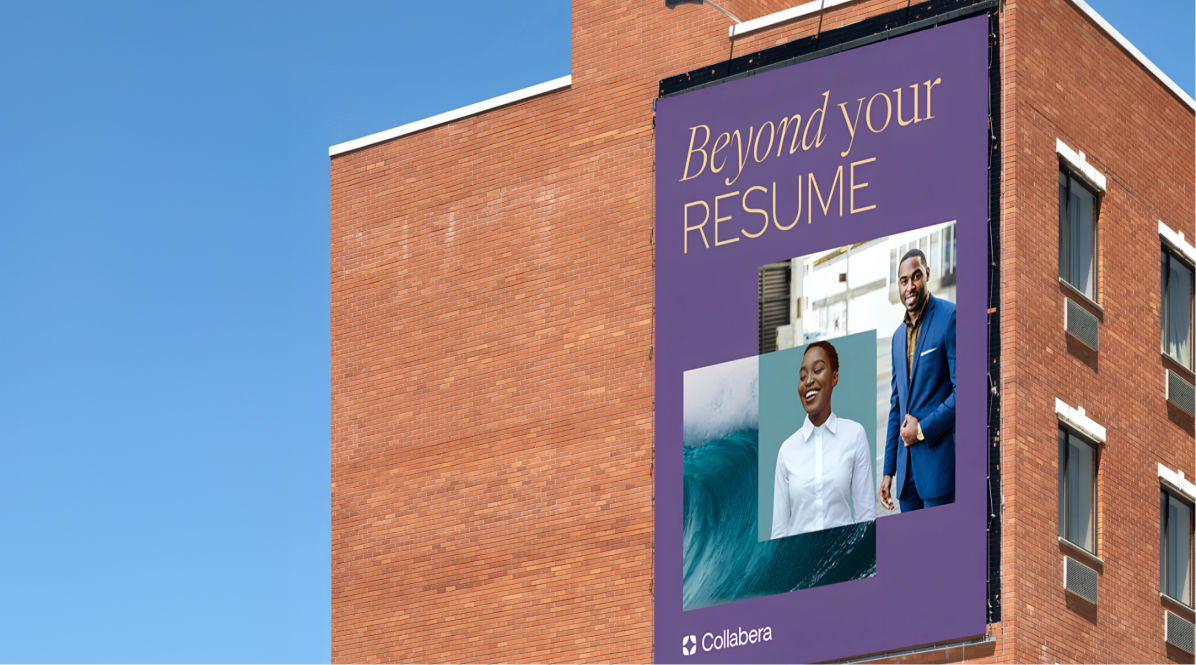
Produce ad creative that converts
Explore our ad design services
and get support to scale all from
static and motion ads to out-of-home
and social media campaigns.


This is the quality you can create with Superside
Discover how Supersiders help global brands
launch high-impact campaigns at scale with top design.
We're your creative team's creative team.


Build once. Scale everywhere.
Launch faster, cut rework and double
design-to-dev alignment with
smart systems built for scale.