



At enterprise volume, hourly rates and retainers hide more than they reveal, so this guide shows how to calculate cost per approved asset and runs all three models through it. An in-house senior designer works out at $427 to $533 per asset once you load in benefits and lost capacity, agency costs climb with every resize and a subscription spreads a fixed fee across more output. We also walk a 200-assets-a-month scenario end to end and publish Superside's actual pricing.
When it comes to creative cost benchmarks, only one question matters at enterprise scale. What's the total cost of each finished, on-brand asset?
It's tempting to assume the model with the lowest hourly rate is best for your budget. But hourly rates, retainers and salaries rarely show the full picture.
Cost per asset does.
This guide explains what cost per asset means, how to calculate it for a fair comparison and how the numbers stack up across in-house teams, traditional agencies and creative subscriptions. It also explains why the subscription model is built to reduce cost per asset as volume rises.
What cost per asset actually means
Cost per asset, also called cost per approved asset, is your total fully loaded creative spend divided by the number of finished, production-ready assets delivered in a given period.
The calculation creates a common basis for comparing models that price work completely differently. Freelancers charge by the hour. Agencies use project fees or retainers. In-house teams are salary-based. Creative subscriptions run on recurring monthly budgets. Cost per asset flattens all four into one number you can actually compare.
How to calculate cost per asset
The formula is simple, but can vary depending on how you are getting the assets. The inputs are where people go wrong.
For an in-house team member, the calculation has to include benefits, software, hardware, recruitment and management time, not just salary.
For an agency, the headline fee often excludes strategy, extra revision rounds, resizing and versioning.
For a freelancer, the hourly rate says nothing about the hours your own team spends briefing and managing them.
So start by understanding what each model actually covers. Then make sure you're comparing the same mix and complexity of work. And use one shared definition of "finished" across every model, something like approved, on-brand, production-ready and delivered in every format intended for use.
Without that definition, every comparison you run is measuring different things.
Let's take the models one at a time.
Model 1: The in-house team
At first glance, an in-house designer looks like the most cost-effective option. Salary alone doesn't reveal the true cost per asset.
The US Bureau of Labor Statistics put a graphic designer's median annual pay at $62,960 as of May 2025. Senior talent costs considerably more. Indeed reports an average of roughly $82,000 for a senior graphic designer as of September 2026, with the top of its range reaching into the $120,000s.
Now load it properly. The BLS Employer Costs for Employee Compensation release puts benefits at 30.0% of total compensation for private industry workers as of June 2026. An $82,000 base therefore costs about $117,000 in total compensation. Add software, equipment, recruitment and a share of management time and roughly $128,000 a year is a realistic all-in figure for one senior designer.
Then there's the capacity question nobody puts in the budget. No designer spends 100% of their time producing assets. Meetings, briefings, revisions, administration, training and paid time off all eat into it. Asana's Anatomy of Work Index, based on a survey of over 13,000 knowledge workers, found that people spend close to two-thirds of their time on "work about work" rather than the skilled work they were hired for.
In our experience, a realistic output is 20 to 25 production-ready assets a month, or 240 to 300 a year. At $128,000 fully loaded, that's $427 to $533 per asset.
Compare that with the salary-only version. Divide an $82,000 salary by 300 assets and you get $273 per asset, roughly a third below the real number at the same output and barely half of it once capacity dips. The gap is everything the salary line leaves out. These are the costs and constraints most teams miss when they assess what enterprise creative really costs.
Model 2: The traditional creative agency
Traditional agencies deliver real strategic value. Their economics just get hard to justify once production volume climbs.
Clutch puts the average US design agency rate at $100 to $149 per hour. It also reports an average design project cost of $56,303 across a typical 11-month engagement, or roughly $5,100 a month. Additional deliverables and iterations push that up.
That hourly rate covers much more than a designer's time. It also carries benefits, admin, equipment, nonbillable hours, overhead and profit. Which is why agencies commonly set rates by multiplying an employee's hourly cost by two to four, with three as a typical benchmark.
At low volumes, that works fine. At enterprise scale, every revision, resize and adaptation consumes more billable time. One approved concept becomes multiple separately priced deliverables. More output means more hours, a larger retainer or a renegotiated scope. The cost rises with output. It doesn't get more efficient with it.
Our scorecard of where the agency model fails covers this in more depth.

Model 3: The creative subscription
The creative subscription model is designed to make production more efficient as volume grows, which is the opposite of how the other two behave.
Customers commit to a monthly budget for ongoing access to creative talent. Instead of sourcing freelancers or onboarding a new agency every time demand spikes, you draw on a broader team and adjust capacity.
Reusable templates, established workflows and a team that already knows the brand maintain consistency while cutting the setup, briefing and revision work behind each deliverable. As those efficiencies spread across more assets, the effective cost of production falls.
Format, complexity and work mix all affect the exact number. But for enterprises with steady, high-volume demand, a subscription typically beats repeatedly sourcing freelancers, working with agencies or adding headcount. Our take on high-volume graphic design output shows what that looks like in practice.
Demand isn't easing, either. In our Breakpoint Report, 92% of creative and marketing leaders said executives now expect higher quality and 94% said they expect it faster, while 86% said their team is already at or over capacity. Efficient production isn't a nice-to-have at that point.
Superside's model pairs predictable monthly capacity with dedicated creative talent and AI-powered systems.
Pricing starts at a $15,000 monthly minimum on an annual term, and the plan with a dedicated AI-native team starts at $30,000 a month on a 12-month term.
Because the same team stays close to your brand, we're not relearning your guidelines, preferences and processes with every project. Brand Brain, the custom, evolving intelligence layer at the center of our Superspace platform, holds that knowledge and applies it to future briefs and reviews, which cuts setup time, off-brand work, rework and feedback cycles.
AI-powered workflows handle labor-intensive tasks like resizing and versioning, with human creatives providing direction and quality control. The result is more approved assets from the same budget and a lower effective cost per asset as the partnership scales.
In-house vs agency vs creative subscription, side by side
All three models look affordable at first. Compare total cost against approved assets delivered and the differences get hard to miss.
| Model | Cost basis | Approximate cost per asset | Do you pay for idle time? | What happens as volume grows? |
|---|---|---|---|---|
| In-house team | About $128,000 fully loaded per senior designer per year | $427 to $533, based on 240 to 300 approved assets a year | Yes, you pay for nonproductive hours | Capacity is capped without additional support |
| Agency | Typically $100 to $149 per hour. Clutch reports an average project cost of $56,303 | Depends on scope, output and what counts as finished | No, but you pay markup and per-resize fees | Costs rise with the hours, deliverables and capacity required |
| Creative subscription | Superside starts at a $15,000 monthly minimum on an annual term | Illustrative $100 to $250, falling as volume rises | No, you buy output rather than hours | Reusable systems, dedicated talent and AI workflows lower unit costs |
A note on that last figure, because it matters. The $100 to $250 range is illustrative arithmetic, not a price list.
Your actual number depends on the mix and complexity of the work, and we quote every project transparently rather than selling by the asset.
The pattern holds regardless. In-house teams carry employment costs and capped capacity. Agencies charge for the additional time and scope that more assets require. A subscription spreads a fixed fee across more output.
A practical example, producing 200 assets a month

Picture an enterprise marketing team that needs 200 creative assets a month across paid media, social, sales and lifecycle. What does each model cost at that volume?
In-house would need roughly eight to ten designers. At about $128,000 fully loaded each, that's $1.02 to $1.28 million a year, or $427 to $533 per asset, before you add a manager to oversee the work. Capacity is fixed, so when demand rises you hire or outsource, and when it falls you still carry the payroll.
An agency's cost depends on the complexity and mix of those 200 assets, but at typical rates it runs into tens of thousands of dollars a month. Resizing, extra revision rounds, strategy and rush work add more. Retainers cover a set capacity, so overflow means extra charges or a bigger scope.
A creative subscription gives you a predictable monthly budget and flexible capacity. Spread across 200 assets, the effective cost per asset falls into the low hundreds and keeps falling as volume climbs.
The exact numbers vary. The pattern doesn't.
At 200 assets a month, in-house is expensive and rigid, agency is expensive and capped and the subscription model is the only one of the three built to absorb that volume.
Worth being precise about the claim here, though. This isn't an argument for buying the cheapest creative available. It's an argument that at real enterprise volume, a subscription delivers the lowest true cost per asset for the speed, quality, scale and low management overhead an enterprise actually needs. Those are different things, and the second one is what shows up in your results.
Our comparison of Superside vs. the alternatives unpacks all three models in more detail.
Cost per asset isn't the only number that matters
It's a useful way to compare models, but it doesn't tell the whole story. Four things to weigh alongside it:
- Speed. A low cost per asset means nothing if the work lands after the campaign. Look for a model that balances cost with reliable turnaround.
- Scale and flexibility. Can the model absorb a sudden spike without a hiring process or a contract renegotiation?
- Quality and brand consistency. Off-brand work creates extra review loops and rework, which quietly inflates the real cost. The model has to hold brand consistency at scale, which is exactly where a system like Brand Brain earns its keep.
- Management overhead. Count the hours your team spends finding providers, writing briefs, giving feedback and chasing work. Those internal hours are part of the total cost, even though they never appear on an invoice.
How to lower your cost per asset
Whatever model you choose, a few moves reliably cut the time and money behind each asset.
- Consolidate where it makes sense. Fewer suppliers means less repeated onboarding, briefing and management. A good partner also reuses brand knowledge and production systems across projects, which lowers unit costs and improves consistency at the same time.
- Build reusable systems. Templates, design systems and custom AI models reduce the work behind standard, recurring assets. They won't make production free. They will make it meaningfully more efficient.
- Reduce unnecessary revisions. Clear briefs, early alignment and a strong creative operations process prevent avoidable rework. This is usually the single biggest lever.
- Apply AI to the right tasks. Scaling creative production with AI cuts time on resizing, versioning and first-pass adaptations. Human direction and creative quality control stay essential.
- Track the full cost. Calculate cost per approved asset for each model, including internal management time and rework, then assess it alongside quality, speed and performance.
How Superside prices and why the math favors our model at scale
To understand what creative really costs, look past salaries, hourly rates and retainers. If your demand is steady and high-volume, the most efficient model is the one that reduces repeated setup, makes better use of existing brand context and increases output without adding cost at the same rate.
That's what Superside, the world's leading AI-first creative partner, is built to do. We're also unusually transparent about how we price it.
Flexible subscription plans start at a $15,000 monthly minimum on an annual term, while plans with a dedicated AI-native team start at $30,000 a month on a 12-month term. When you make us your creative team's creative team, you also get Superspace with Brand Brain at its core, plus a bench of elite designers, project managers, animators, copywriters and AI technologists.
We're a premium service. Generally less expensive than traditional agencies and more expensive than an individual freelancer, but built so the model gets more efficient as the partnership grows, because the team, the workflows and the technology are already in place.
Being AI-first means AI isn't just powering individual tools. It's embedded across the entire creative model, from how teams are trained to how brand knowledge compounds over time. That compounding is the whole reason unit costs fall instead of holding flat, and it's the thinking behind our human-led, AI-powered approach.
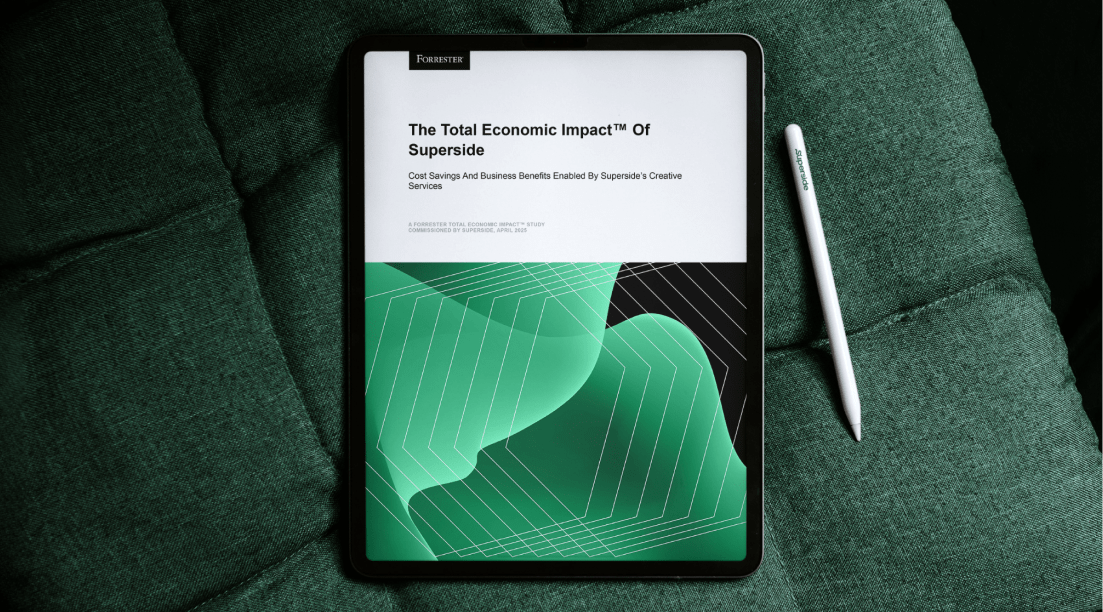
The numbers back it up. Amazon saved 345 hours in three months with Superside across 1,092 delivered assets. And a Forrester Total Economic Impact study commissioned by Superside found a composite enterprise organization achieved a 94% ROI and $4.16 million in total benefits, with payback in under six months. Those are three-year, risk-adjusted present value figures.
No model delivers the same cost per asset for every type of work. But if your enterprise needs high-quality creative on an ongoing basis, a Superside subscription gives you more predictable spend, flexible capacity and better efficiency as volume grows.
Ready to make your creative budget stretch further? Explore our pricing page or book a demo to see what the model looks like against your own numbers.
FAQs





See how top brands do it
Looking for extra inspiration?
Check out more of Superside's brand projects.


Ready to see it in action?
The best way to understand it is to experience it.
Because once your creative system has memory,
you won’t want to go back to starting from scratch.

The data speaks for itself
According to a Forrester Total Economic Impact™ study, Superside delivers a 94% ROI and pays for itself in six months.


Your creative team's creative team
Choose the world's leading AI-powered creative service
and get high-performing ads, videos, experiences and
more at scale, on your schedule and to your standards.