

AI-powered web design services can help brands quickly test ideas and build websites. But at the enterprise level, web design still requires strong human leadership. Superside pairs the latest AI technology with top talent to deliver standout websites that scale easily without sacrificing quality or brand consistency.
Enterprise websites carry a heavy workload. To deliver for their brands, they must be well-designed, easy to access, on-brand, localized and optimized to drive conversions.
AI has become a key part of how busy teams keep up, and a new wave of AI web design tools now supports faster layout creation, testing and iteration. Website builders, layout generators, automated UX engines and AI image creators make experimentation feel easier and more accessible than ever.
That momentum solves one problem, but it creates a few new ones. While today’s AI web design tools make it possible to produce a website in just a few clicks, the technology still can’t replace good human judgment.
AI doesn’t understand finer brand nuances, business goals, accessibility requirements or complex user journeys. Without strong human creative direction and UX expertise, teams risk creating AI-generated websites that appear polished on the surface but are generic, inconsistent or downright difficult to use.
This article breaks down where AI web design services create real value, where automation hits its limits, which AI website design companies and AI website creators lead the market.
What AI web design services actually do
At a basic level, these services use artificial intelligence to speed up how websites are planned, designed, built, tested and iterated.
Their biggest advantage is rapid experimentation: AI can generate many viable options quickly, making iteration faster and cheaper.
In practice, AI web design can refer to anything from AI website generators that produce entire sites from prompts to AI-assisted workflows that help designers and developers improve usability, responsiveness, load performance, accessibility and SEO.
Today’s AI website builders and design tools can:
- Generate layouts and wireframe options in just a few minutes.
- Suggest UX patterns based on data and common best practices.
- Auto-optimize spacing, typography and visual hierarchy to save time.
- Generate imagery, illustrations or UI assets for a custom site.
- Produce responsive variations for different breakpoints and devices with just a few prompts.
- Analyze performance metrics to suggest UX improvements.
- Automate repetitive production tasks like resizing, exporting, formatting and templating.
Many tools also include a drag-and-drop editor, custom domain setup and an SSL certificate to help brands launch fully functional, launch-ready websites quickly.
Where AI reaches its limits:
- AI doesn’t understand the finer nuances of brand voice or long-term brand goals.
- It can’t create strategic UX flows for complex SaaS (or other) products.
- An AI website creator doesn’t make decisions based on company goals, competitive landscape or differentiated value propositions.
- It creates “correct” but generic UX patterns that fail to set brands apart.
- It struggles with accessibility and compliance at enterprise scale.
AI can flag issues and surface suggestions, and some tools promise to generate SEO-friendly copy. But, unguided, AI-powered technology typically struggles to meet brand standards across large, evolving web environments.
The role AI actually plays:
There’s no question: AI can certainly help brands to produce high volumes of web assets fast. It can also help creative teams move faster and explore more options with less effort.
But meaning, direction and cohesion should still come from experienced human professionals.
The question, therefore, is not whether to use AI in web design. It’s about finding the right partners who can harness AI to create thoughtful, strategic web experiences that deliver real results.
Why AI alone isn’t enough for enterprise web design
Enterprise websites work best when everything connects: Strategy, design, content and creative performance. While AI can support this work, human leadership is what keeps the system working as a whole.
Here’s where people matter most:
1. Brand coherence requires human judgment
Enterprises operate across markets, channels and teams. Tone, accessibility standards and brand rules need to hold together across hundreds, sometimes thousands, of web pages.
While AI can follow instructions and repeat patterns, it can’t read nuance or decide when it’s safe to bend a few rules. Those decisions shape how a brand shows up in the real world.
Human judgment is required to ensure brand consistency (and to be creative within defined constraints).
2. UX strategy isn’t algorithmic
Enterprise websites often support complex products, long user journeys, complicated onboarding flows and industry-specific behavior.
AI can suggest layouts and patterns based on best practices, but it can’t decide which journeys matter most or how those journeys support business goals. It also can’t tell when to reduce friction and when to introduce it intentionally.
UX strategy starts with intent, which can only be set (and checked) by experienced creative professionals.
3. Accessibility and compliance must be deliberate
Accessibility and compliance aren’t optional at enterprise scale. Standards such as WCAG, legal requirements and performance benchmarks must be applied consistently. These standards must also be verified.
AI can surface issues and flag risks, but it doesn’t own the outcome. Without expert oversight, accessibility and compliance are often addressed only when problems arise, rather than being built into the design system from the start.
Meeting the required standards requires deliberate design decisions and ongoing review. That responsibility should ultimately sit with human professionals.
4. Design systems require ongoing coordination
At the enterprise level, design systems enable teams to quickly create new web pages without reinventing the wheel. These systems include tokens, components, reusable patterns, documentation and shared governance across teams.
AI can help creative professionals generate these components quickly, but it can’t help teams manage how the system should change as the business evolves. For this, human input is required.
AI opens up endless possibilities and speeds up certain tasks, but human-led design systems ultimately deliver the quality and consistency enterprises need to see results.
The 7 best AI web design services
Today’s AI web design services span a wide spectrum, from self-serve tools that generate layouts in minutes to full-service partners that integrate AI into enterprise-scale creative operations.
To evaluate this landscape fairly, it’s important to distinguish between tools that accelerate tasks and partners that deliver outcomes.
This list of AI web design services below prioritizes companies based on:
- Enterprise readiness
- AI integration
- Quality of output
- Design system maturity
- Scalability
1. Superside
Web design services offered:
- Full UX/UI design
- Responsive and mobile-first web design
- Web rebrands and redesigns
- Landing page systems
- Component- and token-based design systems
- Motion and micro-interactions
- Global-scale asset production
- High-volume UI updates and A/B test variants
Overall design services offered:
- Conceptual design creation
- Campaign strategy services
- Graphic design services
- Brand design
- AI creative and AI consulting services
- Presentation design
- Video production and motion design services
- Illustration design
- Web design and Webflow development
- Social media and ad creative
- Email design
- Print design services
- Packaging and merch design
- Digital marketing strategy & consulting
- Design systems and product design services
- Immersive design services for AR / 3D solutions
- eBook and digital report design and copywriting services
- Creative automation services
Superside is built to be your creative team’s creative team. We plug directly into your marketing, product and design operations to support everything from one-off web launches to design systems that evolve over time.
Behind the scenes, AI accelerates key parts of our web design workflow (from ideation and wireframing to asset generation and QA) so teams can move faster and test more ideas. But unlike tool-first platforms, Superside never leaves those decisions to automation alone.
Our creatives stay accountable for brand direction, UX quality, accessibility and visual consistency across every page and every market. That means you get the speed of AI without losing the strategic thinking and creative leadership that enterprise websites depend on.
Why enterprises choose Superside:
Large websites involve many people working across markets, products and channels. That only works when there’s a clear way to manage quality, consistency and speed simultaneously.
Superside provides that structure.
Instead of juggling freelancers, agencies and internal bottlenecks, teams get an always-on creative partner that scales with demand.
Dedicated creative teams and project managers work alongside your in-house teams, so design stays connected to what the business needs, whether that’s a global rebrand or hundreds of new landing pages.
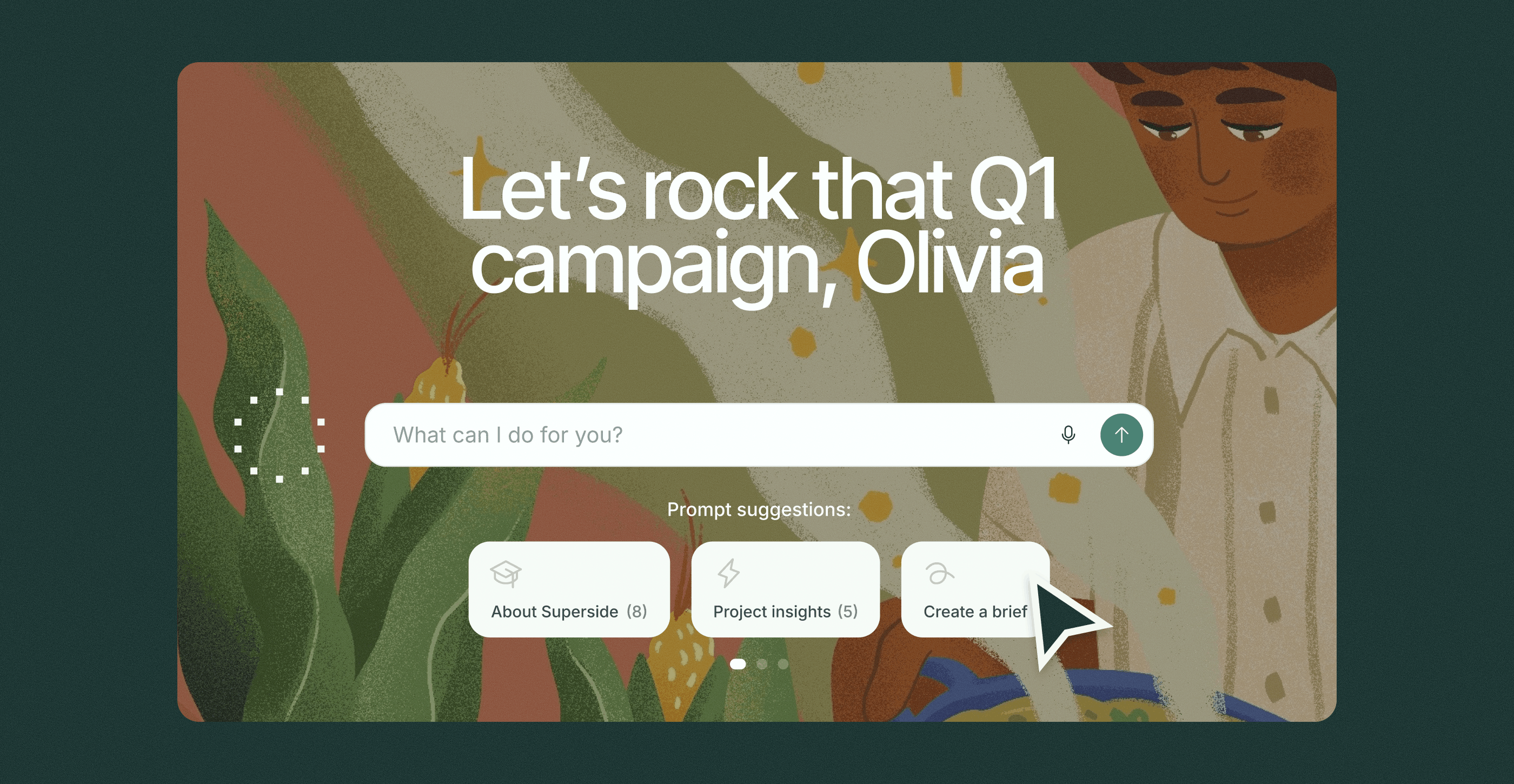
And because all work flows through Superspace (Superside’s platform for briefs, approvals and brand governance), visibility and control are consistent across every market and page.
We offer a range of creative design and production services, from ad creative and branding to video production, product design and copywriting.
What differentiates Superside:
At Superside, we combine a global bench of experienced creatives with a flexible subscription model, AI-accelerated workflows and enterprise-grade operations.
The result is an enterprise web design partner purpose-built for scalable web design.
In fact, Superside is the only AI-first creative partner built to help teams scale web design globally without sacrificing quality or brand integrity.
2. Webflow (with AI)

(Source: Webflow)
Webflow sits at the intersection of design and development. The web development platform gives teams visual control over production-ready websites, with CMS and hosting built in.
Its new AI features accelerate layout, content and page setup, helping designers publish websites without waiting on development teams.
- Strengths: Visual development, CMS flexibility, AI-assisted layout and content generation.
- Limitations: This is a tool-first platform. Strategy, UX leadership and governance remain the customer’s responsibility.
- Best for: Design-forward teams with in-house Webflow expertise.
3. Figma AI

(Source: Figma)
Figma AI is a set of AI-powered features integrated directly into Figma. The AI tools live inside the design workflow, helping teams generate copy, explore layouts and move faster through early-stage UX and UI work.
It offers a powerful way to accelerate ideation and production, especially for teams that run large, complex design systems.
- Strengths: AI-assisted ideation, content generation and design productivity.
- Limitations: Figma AI isn’t a web design service or execution partner.
- Best for: Enterprise design teams that want to enhance their existing UX/UI workflows.
4. Framer AI

(Source: Framer)
Framer AI is an integrated suite of artificial intelligence tools that brings AI directly into page creation. It can generate modern, responsive landing pages from prompts, complete with layout, styling and basic interactions.
For enterprise teams, this makes it easy to create campaign pages or product microsites without requiring technical support.
- Strengths: AI-assisted page generation, modern UI patterns and rapid prototyping with interactivity.
- Limitations: This is a tool-first platform. The responsibility for governance and enterprise-scale UX strategy remains with the customer.
- Best for: Marketing and design teams who want to launch fast, design-led pages and prototypes.
5. Wix Studio AI

(Source: Wix Studio)
Wix Studio AI is an end-to-end web creation platform built for fast site creation with the help of AI. It combines layout generation, content tools, and hosting on a single platform, making it quick and easy to launch a website.
For smaller teams and short-term projects, this all-in-one setup is especially appealing.
- Strengths: AI-driven site creation, integrated hosting and rapid setup.
- Limitations: The platform isn’t built for complex enterprise UX, design systems or long-term brand governance.
- Best for: Small teams or fast-turn campaign sites.
6. Uizard

(Source: Uizard)
This AI-powered design tool focuses on the earliest stages of UX. Uizard turns prompts, wireframes or sketches into clickable prototypes, which helps teams test ideas before real design work begins.
It offers a fast way to explore user flows and validate concepts with stakeholders.
- Strengths: AI-powered UX prototyping from prompts or sketches.
- Limitations: Output quality and scalability are limited for production use.
- Best for: Early-stage ideation and UX validation.
7. 10Web AI

(Source: 10Web)
This AI-powered platform automatically creates WordPress websites and pairs site creation with hosting and performance tools.
It cuts technical friction and helps teams launch fully functional sites with minimal effort.
- Strengths: Fast AI-generated WordPress websites with hosting and optimization built in.
- Limitations: Optimized for small to mid-size projects, not enterprise-scale UX strategy, governance or scalable design systems for web.
- Best for: Teams who prioritize rapid setup and automation over bespoke UX.
These tools demonstrate how AI can speed up web design, but they also highlight a key reality: At enterprise scale, AI-only platforms alone fall short. Strategy, UX leadership, accessibility, governance and standout design still require experienced human teams.
How enterprises should evaluate AI web design partners
With so many AI web design tools and platforms on the market, it can be hard to determine which partner, tool or service to trust with your web design.
62% of businesses now prefer partners that actively use AI website builder technologies, which changes how agencies are shortlisted, compared and selected. The reality is that enterprise teams now expect speed, automation and modern workflows as standard.
The strongest partners bring structure, strong creative and strategic skills and governance. They also bring experience using AI tools for web design to deliver consistent, high-quality digital experiences at scale. While agencies provide immediate scale, many enterprises eventually seek to build internal technical capabilities. For those transitioning to an in-house model, learning how to manage remote devs and hire software developers who can manage these AI-driven workflows is a critical organizational milestone.
Here’s how to evaluate them:
1. Ability to scale across global teams
Enterprise websites aren’t one-and-done projects. They’re living systems that require robust operations to remain stable at scale.
Ask:
- Can this partner deliver hundreds of pages across channels, products and regions?
- Can they support localization, multilingual rollouts and parallel workstreams?
- Does quality stay consistent as volume increases?
2. Strength of UX and brand strategy
AI can surface patterns, but it can’t set a direction. Enterprise UX depends on judgment that prompts alone can’t provide.
Look for partners who:
- Understand complex user journeys and product ecosystems.
- Design with conversion, retention and usability in mind.
- Make design decisions based on business goals.
- Treat brand systems as powerful strategic assets.
3. Maturity of AI workflows
Not all “AI-powered” claims mean the same thing. If AI feels like an add-on, it probably is.
Strong partners:
- Use AI across ideation, production and optimization.
- Don’t just treat AI as a feature. They integrate it into their everyday workflows.
- Pair automation with human review and accountability.
- Use AI to reduce friction, not introduce risk.
4. Quality and depth of design talent
Enterprise web design isn’t a generalist skill.
It’s therefore important to evaluate:
- Specialist skills across UX, UI, motion and systems design.
- Experience working with complex products and enterprise-level brands.
- A proven ability to collaborate with product and engineering teams.
- A track record of producing work for large-scale digital environments.
5. Design system competence
Design systems are what keep enterprise websites consistent as they scale.
Your partner should demonstrate:
- A strong grasp of tokens, components and reuse.
- Experience in maintaining design systems over time.
- Clear governance that prevents brand inconsistencies and fragmentation.
- Straightforward alignment across marketing, product and engineering teams.
6. Operational reliability
Speed only matters if delivery holds up.
Look for:
- Clear ownership and repeatable design processes.
- Flexible resourcing for launches, events and peak campaign periods.
- Strong project management and communication methods and tools.
- Predictable timelines and a strong focus on quality standards.
7. Ability to integrate with internal teams
The best partners plug into your organization.
Prioritize partners who will:
- Work seamlessly with in-house teams.
- Easily slot into existing workflows.
- Respect internal brand and governance structures.
- Act as a true extension of your creative team.
This is where Superside consistently excels. We provide in-house teams at major enterprise brands with a scalable, flexible and efficient way to bring high-performing web experiences to market.
The future of AI in enterprise web design
Over the next few years, AI will become less visible as a standalone technology and more embedded across the entire enterprise web design lifecycle, from ideation and content production to QA, optimization and iteration.
More than 90% of designers and developers already use AI tools, and nearly 60% of designers use AI to generate imagery and media assets. The impact on productivity is also measurable, with approximately 33% of web designers reporting gains from AI.
Let’s take a closer look at what the future of AI in enterprise web design looks like:
AI-generated components, not just pages
AI will move beyond page generation and support component-level design. Teams will use it to expand UI libraries, recommend patterns within existing design systems and scale components without compromising consistency.
Automated responsive and variant design
AI will reduce the manual work required for responsive layouts, A/B test variants and localization.
Instead of redesigning from scratch, teams will create controlled variations inside approved frameworks. That means faster experimentation without losing governance.
Predictive UX personalization
As AI improves at interpreting customer behavior and performance data, it will enable smarter UX adjustments, personalized layouts and clearer user paths.
At enterprise scale, this only works with strong human oversight. Personalization must align with brand intent, accessibility standards and ethical data use.
AI-driven QA and accessibility support
Automated QA is one of the most practical gains. AI already flags accessibility issues earlier, surfaces performance risks before launch and spots inconsistencies across large websites.
Human review still matters, but AI will speed up the design process and reduce brand risk at scale.
Continuous experimentation loops
Enterprise web design is shifting from fixed projects to ongoing systems. AI enables faster feedback cycles between design, performance and optimization, with ongoing insights from real user behavior.
The constant: Human leadership
AI increases speed, scale and efficiency. Humans define brand expression, UX intent, accessibility standards and strategic priorities.
The future of enterprise web design will, therefore, be marked by close human and AI design collaboration.
In fact, at Superside, this is already how we approach creative execution: AI-powered workflows streamline project management and creative iterations to minimize delays, maximize efficiency and reduce project costs. Human creatives bring the creative and strategic thinking, judgment and direction.
AI is powerful; Human-led web design is irreplaceable
In many ways, AI has made web design faster, more efficient and easier to scale. Teams can generate page layouts, test more ideas and produce more assets faster than ever before.
But enterprise websites still need a human-led strategy, consistency and UX design. Without human direction, AI builders can produce work that looks correct but fails to perform at scale.
The teams that win use AI to scale output, while strong creative professionals remain firmly at the helm. That’s where Superside truly stands out.
As the world’s leading AI-first creative service built for enterprises, Superside combines human expertise with AI efficiency to help teams scale web design without sacrificing quality or consistency.
If you want to explore what a hybrid creative model can unlock for your next web design project, Superside web design should be your starting point.
FAQs
Stuck in AI testing mode?
Get a quick, practical checklist
for implementing AI across your team.
Build once. Scale everywhere.
Launch faster, cut rework and double
design-to-dev alignment with
smart systems built for scale.


This is the quality you can create with Superside
Discover how Supersiders help global brands
launch high-impact campaigns at scale with top design.
We're your creative team's creative team.


Go global without headaches
Streamline the way you localize content and creative.
Partner with Superside to amp up your processes,
production and creative performance.