


Spreading content across multiple social platforms isn’t optional anymore. It’s how you reduce risk, reach a wider audience and keep results steady. But most teams don’t have the bandwidth to create native content for every channel. The fix is a depth-first, breadth-second approach: build one exceptional pillar asset, then use AI to adapt it into platform-native variations. We break down a six-step framework for doing this at scale, with insights from brainchild’s Drew Brucker and Superside’s own method.
Thanks to AI, what used to take days to produce now takes minutes, and what used to require a full creative team can now be generated in a few clicks. The result is an internet flooded with content and brands competing harder than ever for the same slice of customer attention.
In this environment, your brand can’t afford to stay in one lane. Audiences move fluidly between social channels. If you don’t show up on LinkedIn, X, Instagram or the next big platform, someone else will. A HubSpot study found that marketers use an average of four social platforms, and those who diversify consistently outperform those who don’t.
This means that, for marketing and creative teams, the pressure is on. The mandate? Diversify, experiment and expand.
The reality: most teams simply can’t keep up with demand.
Those who cross-post content, hoping that volume will make up for a lack of customization, quickly learn this approach rarely works. Unfortunately, neither does taking hours to create a post for every platform. There simply isn’t time.
Today’s top teams use AI to turn strong pillar assets into multiple platform-native social variations that actually perform. They learn to turn everything from video interviews and podcasts to white papers and blog posts into social posts with AI.
Keen to unlock this type of creative content velocity for your brand? This practical AI content repurposing framework, with insights from our “Shift Happens” guide and brainchild’s Drew Brucker, will be a lifeline.
What strategic AI content repurposing for social media actually means
First, it’s important to distinguish between two concepts: cross-posting and true AI content repurposing.
When you cross-post, you publish identical content across various social media platforms. Unfortunately, this rarely delivers results, because every platform has its own culture, formatting requirements and audience expectations.

For example, on LinkedIn, it’s best to share professional insights, data-driven narratives and thought-leadership-style content.
On Instagram, visual storytelling and concise captions with emotional hooks work well. On TikTok and YouTube Shorts, entertaining content that quickly captures attention is best practice. According to Sprout Social’s research, audiences on each platform have fundamentally different expectations for the content they consume.
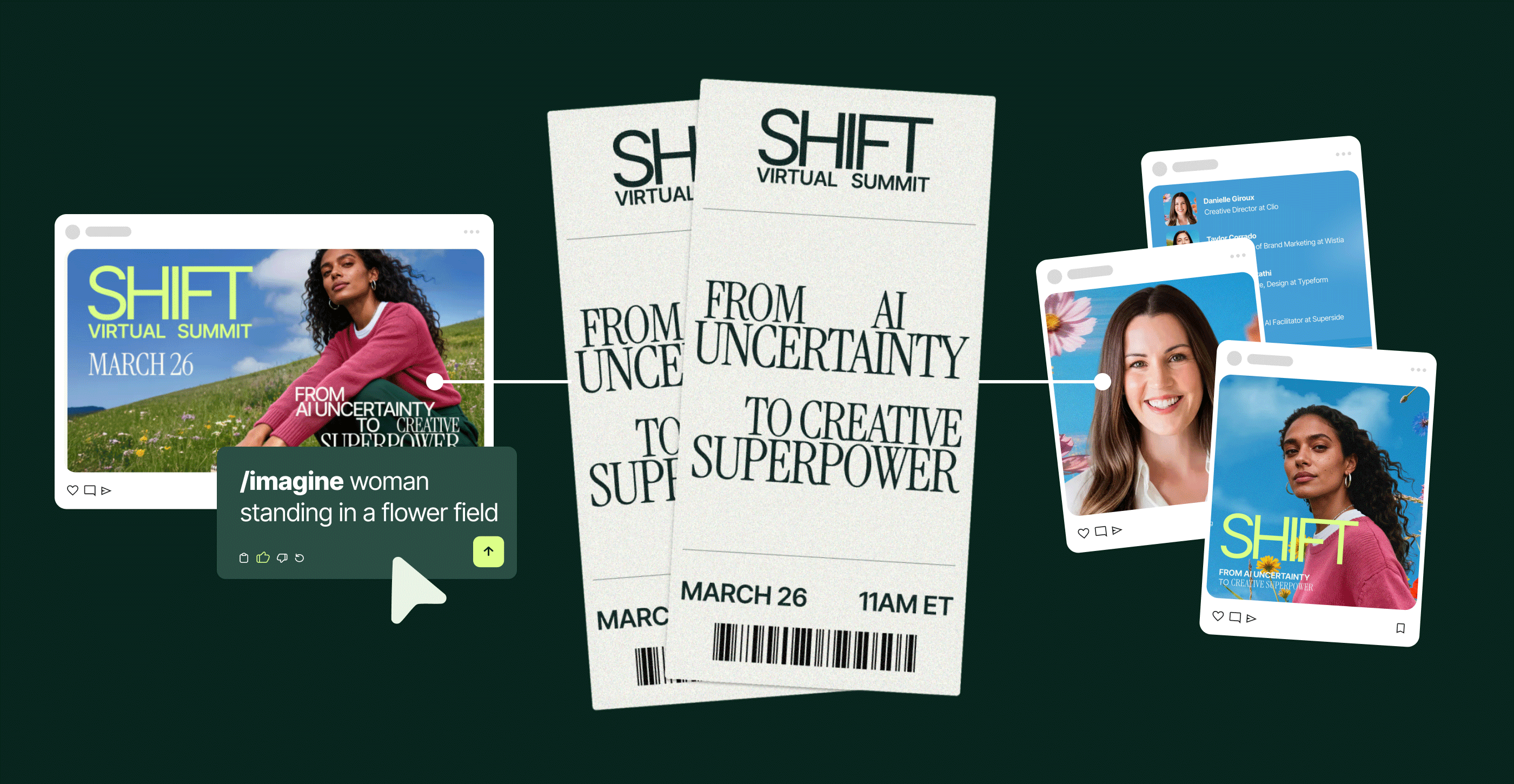
True, strategic AI content repurposing for social media is where you take one highly valuable asset and use AI to transform it into platform-specific, on-brand variations that honor each channel’s native environment.
You wouldn’t speak the same way in a board meeting as with a friend over coffee. Social platforms are the same. Each has its own culture, language and audience.

Thanks to AI, it’s now possible to quickly turn a blog post, podcast episode or white paper about quarterly marketing trends into:
- A LinkedIn post and carousel that breaks down the top trends with data visualizations and takeaways for marketing leaders (an AI LinkedIn carousel generator can speed up production dramatically).
- An Instagram post with a strong image, a short caption that highlights the most surprising trend and a question that encourages engagement (see our design tips here).
- Three X posts. One shares a contrarian take from the blog, another highlights a specific statistic with context and a third poses a provocative question.
- A 60-second video for TikTok or YouTube Shorts that features the most compelling insights (see our short-form video scaling tips).

Of course, today’s AI tools don’t magically understand your branding strategy or audience data. However, when applied thoughtfully and in line with your strategy and brand identity guidelines, these tools can significantly speed up social media content production.
The key is to use AI to quickly reformat, condense and restructure your core pillar piece into social media snippets, while keeping humans in the loop to provide strategic direction and oversight.
The real value of AI is leverage. It lets you do more with what you already have.
The depth-first, breadth-second model. How to build your pillar content strategy
The temptation with time-saving AI tools is obvious: create hundreds of social posts, flood every channel and hope something sticks. But as marketing leaders repeatedly warn in our “Shift Happens” guide, volume rarely delivers better results.

When AI outputs are not overseen by senior creatives who understand your brand, you risk publishing content that feels generic, off-brand or inconsistent.
AI is an excellent way to move through ideation and research faster, freeing up time for deep work. But it’s a double-edged sword. Junior members might look at the output and say, ‘Seems good enough to me!

Depth first. Start with exceptional pillar content
The better approach is to think “depth first” and channel most of your creative energy, strategic thinking and brand expertise toward exceptional pillar content.
The content can take many forms, from comprehensive blog posts and in-depth video interviews to detailed case studies, research reports, podcast episodes, white papers and more.
The format matters less than the quality and strategic foundation. If the foundation is weak, every repurposed piece built on it will be weak too.
Without doing the strategic work of understanding your audience and getting out of your echo chamber, you’ll inevitably end up creating more of the same.

Breadth second. AI as creative multiplier
Once you’ve created your pillar content, AI becomes the force multiplier that helps you achieve breadth while saving time and resources.
In 2026, your team doesn’t have to manually create native content for each social platform from scratch. With the right AI content repurposing prompts, brand guidelines and background information, AI systems can help you extract the most relevant insights and create posts that align with each platform’s format and culture.
Build depth first, then breadth second, with AI as your multiplier. Focus on doing a few things exceptionally well, then use AI to extend that work without sacrificing quality.
The efficiency gains are dramatic. One pillar asset can be repurposed into multiple formats, from audio content, carousels and blogs to short video clips and marketing emails, with minimal effort.
The best part: once you’ve nailed the use of AI for social content production, you’ll give bandwidth back to your team. They’ll still need to prompt and check things, but they’ll deliver high-quality, on-brand assets faster than ever before.
That said, a key part of the depth-first, breadth-second model is knowing what not to repurpose. Just because AI makes it easy to create a gazillion posts doesn’t mean you should. Not every idea has the strength, relevance or audience fit to perform across every channel.
As much as we talk about speed and scale with AI, it’s arguably more important to have the discipline to know when to say no.
Before you decide to repurpose content with AI, pause to ask whether your audience actually spends time on the platform, whether you have the resources to engage with responses there and whether the content will add genuine value.

How to turn one asset into platform-native social content with AI (the Superside method)
Superside has mastered how to use AI to repurpose social content in a smart, scalable way that fits each platform. It’s a framework that could also work for your brand, now with Brand Brain.
Here’s what it involves.
Step 1. Develop your pillar content
Our AI content repurposing for social media approach always begins with a strong creative brief and high-quality pillar content that’s strategically sound, on-brand and packed with insights.
This could be anything from a white paper based on survey results to a video interview in which company leaders unpack annual results.
If we become your creative team’s creative team, our experienced strategists, writers and designers can help develop this pillar content, working closely with your in-house creatives and subject-matter experts.
Step 2. Identify AI content repurposing opportunities
The next step is to determine what should be repurposed for which social platform. Here, we typically explore:
- Platforms the target audience actively uses.
- The different formats that perform best on each platform for the brand.
- Key moments or messages from the pillar content to emphasize for each platform.
- Tone and style adjustments needed to match each platform’s culture.
This step prevents the “spray-and-pray” approach that wastes resources on platforms where your brand’s audience doesn’t exist or content types that don’t align with your brand personality.
Step 3. Use AI to generate platform-specific adaptations
Next, we use AI to strategically adapt pillar content into platform-native variations.

We use simple, copyable prompt templates like the following:
LinkedIn: Extract the 5 most important strategic insights from this [blog post/video/report] and structure them as a LinkedIn carousel with: (1) attention-grabbing title slide, (2) one insight per slide with supporting data, (3) visual elements that enhance comprehension, (4) conclusion slide with clear CTA. Maintain a professional yet approachable tone that resonates with [target audience].
Instagram: Create an Instagram caption (150 words max) from this content that: (1) opens with an attention-grabbing hook, (2) highlights the most surprising/valuable insight, (3) connects to the audience’s emotional needs and (4) ends with a question or CTA that encourages comments. Include 5–8 relevant hashtags. Tone: [brand voice descriptor].
X: Create 3 posts from this content: (1) a contrarian or surprising perspective in 280 characters, (2) the most compelling statistic with brief context, (3) a provocative question that invites replies. Each should work as a standalone post. Tone: [brand voice].
Shorts: Create a 60-second TikTok or YouTube video script from this content that: (1) opens with a hook in the first 3 seconds, (2) clearly delivers the main insight, (3) includes 2–3 visual moments or examples and (4) ends with a clear CTA. Format as: Hook, Setup, Insight, Example and Conclusion.
Have a look at how Oyster automates their social campaigns.
Step 4. Apply brand voice and do QA
As we note in our “Shift Happens” guide, AI outputs should be treated as raw material. They’re conversation starters that an experienced creative team should refine.
Our creative talent will check the AI-generated content for:
- Brand voice consistency. Does it sound like your brand? Is the tone, word choice and style aligned with your brand guidelines?
- Platform appropriateness. Does the content respect the cultural norms and format requirements of the specific platform?
- Strategic alignment. Does the content emphasize the right messages and support the brand’s marketing and campaign objectives?
- Quality standards. Is the content actually good? Would it grab attention in busy social feeds? Does it add value or just more noise?
It’s this human-driven quality control that differentiates truly professional AI content repurposing from the work churned out by content mills.
Step 5. Create visual assets to match each platform
During this step, we create platform-specific visual assets that enhance each piece of content. For example, we develop LinkedIn carousels with data visualizations and branded design elements or high-performing Instagram graphics that grab attention.
Many brands use AI design tools to generate custom visuals. Superside takes this a step further. We combine AI-powered creative with human brilliance to ensure every visual is on-brand and platform-optimized.
Step 6. Implement feedback loops and continuous optimization
The last step is to learn what works. At Superside, we track creative performance across different platforms and use these insights to refine the content creation process over time.
Drew Brucker’s favorite AI social media repurposing workflow, executed the Superside way
For our “Shift Happens” guide, we asked brainchild’s Drew Brucker to share his favorite AI social media repurposing workflow.
Below, we’ve adapted it to show how Superside can help you execute each step to deliver on-brand, high-quality social content at speed and scale.

Step 1. Record a long-form video conversation or podcast with our AI-powered video production team (here’s why video is a good place to start).
Step 2. Tap into Superside’s AI-powered, human-crafted model to extract strong hooks, engaging soundbites, timestamps, titles, descriptions and themes from the transcript.
Step 3. Use AI to auto-generate short clips with captions for social, drafts for long-form articles or social posts and key pull quotes and main points to share in email campaigns.
Step 4. Use Midjourney, a custom AI image model and/or your dedicated Superside team to generate custom visuals. These images ensure everything feels on-brand and fresh (explore our AI in graphic design article for tips and tricks).
Step 5. Combine clips, captions and videos to generate an entire week’s worth of social content, tuned for each platform. If you decide to Superside it, we’ll ensure every asset is 100% on-brand, on-message and on-point.
AI lets me focus on creativity, messaging and resonance while it handles the first-principles thinking, repurposing and admin work. I keep final decisions and high-impact creative moments human.
This AI-powered method works because it combines three essential elements:
- A strong strategic foundation. Each project starts with clear audience insights, defined objectives and quality pillar content (the depth-first principle that makes everything else work).
- AI-powered efficiency. AI handles the mechanical adaptation work. This allows you to produce 10x more platform-native content without 10x more manual effort.
- Human-led quality control. Expert creatives review, refine and elevate every AI-generated variation to ensure they’re on-brand and effective.

Turn one asset into many with Superside
To get your target customers’ attention, you simply have to diversify and spread your messages across different channels. But creating truly native content for every platform is a massive undertaking.
To keep up, it makes sense to strategically repurpose content with AI. Our approach is to build depth first with exceptional pillar content, then use AI tools to achieve breadth. This is the only sustainable way to meet today’s content demands and ease the pressure on overcommitted creative teams.

Superside is an AI-first creative partner perfectly positioned to help you produce high-performing social media creative fast, on-brand and at scale. By combining world-class creative talent with AI expertise, automated workflows and sharp strategic insight, we deliver everything from ad hoc posts to full social campaigns, without the cost, complexity or delays of traditional agencies.
Our AI-first approach goes beyond using AI in standalone tools — it's woven into every layer of the creative process, from team development to the way brand intelligence builds and deepens over time.
With more than 500 completed AI design projects in our portfolio, we’ve truly seen what it takes to produce high-performing content in today’s dynamic content landscape. Learn more about our human-led, AI-powered approach.
Ready to thrive in the content jungle with a strong AI content repurposing approach for social media? Superside it.
FAQs


How 400+ brands get more work done, without doing more
They Superside it. Fast, high-quality creative from the
AI-powered creative service that handles it all.


Give your internal teams the power to boost your brand
Publish once. Deliver everywhere. Our Creative Ops platform
puts your brand in front of the right people, everywhere.
Unlock seamless content distribution. Access your audience.


Increase your creative capacity
Let your in-house team reach for the stars,
while Superside keeps your day-to-day creative needs
at an industry-leading level. Ready to scale?