

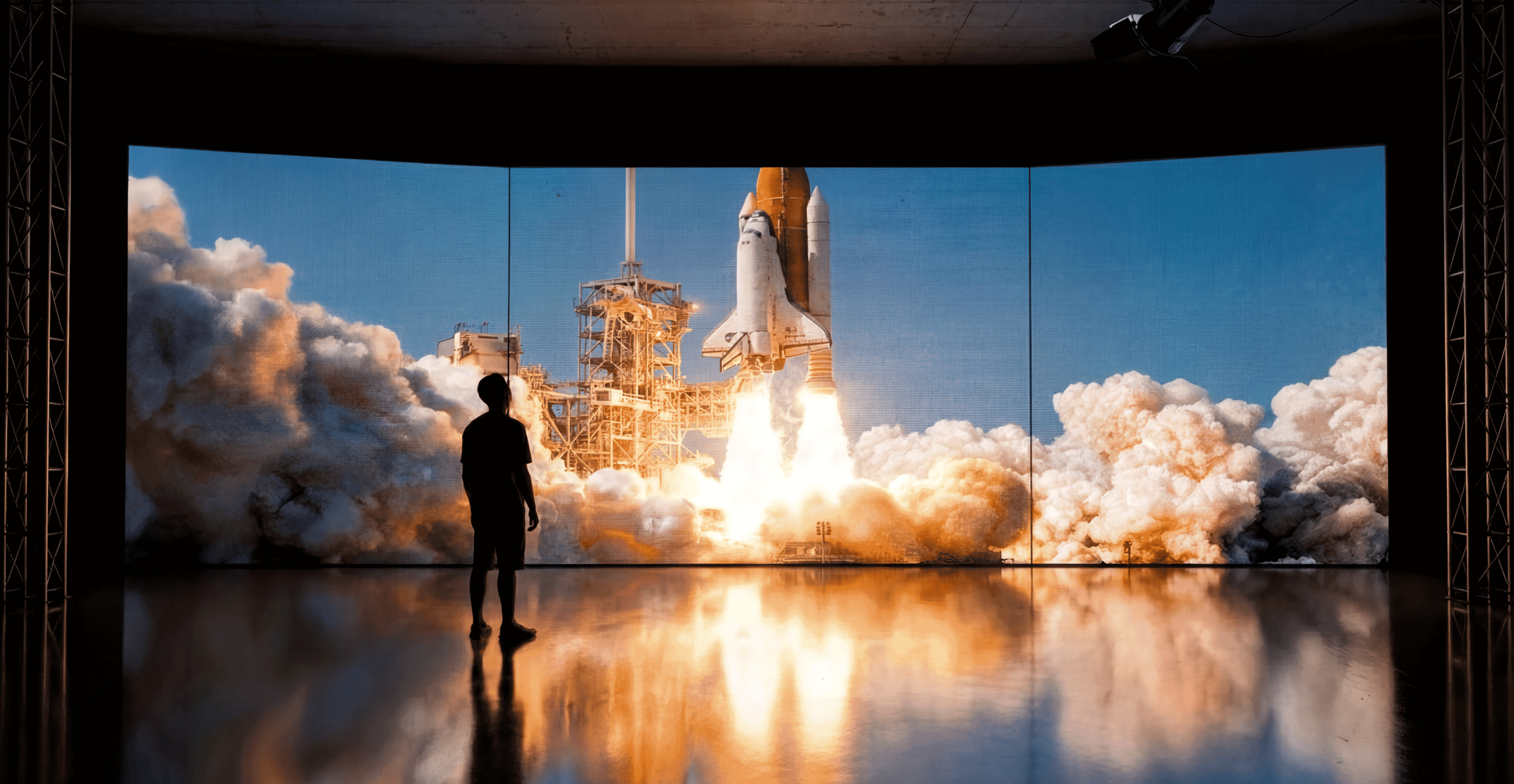
The best digital brand experiences don’t just look good, they make people feel something specific. This article breaks down six standout examples, from Spotify Wrapped to immersive live activations, and the five principles behind them: a strong concept, specificity, connected physical and digital touchpoints, designed-for-moments thinking and clear scope. We also go behind the scenes on how Superside helped Forter deliver a 30,000-square-foot experience in under three weeks.
The most effective digital brand experiences don’t feel like marketing. They create meaningful moments grounded in a deep understanding of the audience and what the brand wants them to think and feel.
There are many great digital brand experience examples out there. But the thinking, strategy and creative choices behind the ones that truly connect are rarely shared.
This article lifts the lid on what makes these digital experiences work. We unpack what defines successful digital brand experiences, the qualities they share, the recurring patterns and why Forter’s IMPACT 2024 conference is the gold standard for immersive digital experiences. You’ll also see practical steps to take, inspired by how Forter’s event was brought to life with Superside’s support.
What makes a digital brand experience actually work
The term “brand experience” is used so often and so loosely that it’s worth slowing down to define what it really means. Here’s what separates truly effective websites, campaigns and real-life interactive experiences from those that simply look good in a presentation.
Emotion, not just aesthetics
A common mistake many brands make is to prioritize aesthetics over connection, perhaps not realizing that 94% of consumers will recommend brands they feel an emotional connection to.
A clear point of view
Great brand experiences are bold and uncompromising. The brands that stand out treat a strong point of view as a signal of confidence and respect for their audience.
Brand values become tangible moments
Good brand experiences build trust by turning what a company says it stands for into something audiences can see and feel.
The relationship between brand design and trust is especially important in technology and enterprise contexts, where products are often hard to explain, and audiences are quick to see through surface-level polish.
Multiple levels of engagement
Good brand experiences work just as well for someone who spends 30 seconds in a physical space or on a website as they do for someone who lingers longer. Every element, from typography to visual hierarchy, works together to ensure a memorable message lands, even in the briefest interaction.
Context, audience, occasion and environment
What works for a B2C festival won’t necessarily work for a B2B conference. The best brand experience designers understand that context, target audience, occasion and competitive environment all shape what the experience should look and feel like.
5 principles of strong digital brand experiences
The most effective brand experience campaigns share common principles worth mirroring in your own.
Principle 1. A strong central idea
Too often, teams try to shape an idea around visual assets or multiple concepts. The best digital brand experiences start with a single strong concept that carries through every touchpoint to create a unified, consistent experience.
Principle 2. Specificity over generality
A clear concept is important, but so is a clear understanding of the target audience. The strongest brand experiences feel deeply personal, from the big ideas to the small details.
Principle 3. The physical and digital layers reinforce each other
Today’s consumers constantly move between physical and digital spaces. Much of the impact of a live event comes from the content people create and share in real time.
The brands that understand how physical and digital layers reinforce each other tend to successfully extend the life of their experiences.
Principle 4. The experience is designed to generate moments
Great enterprise brand experiences are built around memorable moments. Successful brands design immersive, interactive experiences that can be photographed, shared, talked about or simply felt more deeply.
Principle 5. Restraint in scope, ambition in execution
The idea of “less is more” also counts here. One strong visual idea carried through every part of an experience will always outperform a handful of ideas that fight for attention.
Across these principles, clear brand experience design rules matter. When a strong design system is in place, teams can deliver exceptional, on-brand work that’s hard to forget.
6 best digital brand experience examples
Ready to learn from brands that lead the way in digital brand experiences? The list below shows how the principles above work in practice.
1. Forter’s IMPACT 2024 event
In 2024, Forter’s annual IMPACT event for digital commerce leaders was scheduled to take place at Center415 in Midtown Manhattan, New York City.
To transform this 30,000-square-foot space on Fifth Avenue into an experience distinct from other enterprise tech conferences required serious creative muscle.
With less than three weeks to deliver, a tight budget and an overstretched internal team, Forter turned to Superside for support.
Bringing NYC indoors
Every strong enterprise brand experience starts with a clear creative brief. In this instance, the brief was to transform Center415 into a living microcosm of New York City.
Given that the setting was home to Forter’s headquarters, it made perfect sense. The city’s energy also reflected the dynamic brand and would connect with the commercial and technology leaders invited to attend.
And so, every creative decision, from the entrance murals to the coffee cup designs, was tested against this one concept.
Execution built on the details
A strong first impression. The best brand experiences begin before customers even set foot in a space, whether physical or digital. This project was a shining example of how that works in practice.
Center415’s exterior was transformed into a reimagined, character-filled New York cityscape in the brand’s signature blue, with illustrated cartoon characters peeking out of the windows above. Even passers-by stopped to take a look.
Our designers knew that the entrance should feel separate from what comes next, but also set the scene for the rest of the experience.

Visual consistency as a trust signal. The theme continued on the inside. The brand’s blue appeared on every surface and piece of collateral, while the logo was subtly placed throughout.
We built on the power of consistency and repetition, knowing that if we gave the audience the sense that every element belonged to the same world, the environment would go beyond a collection of branded assets and become highly memorable.
Consistency in illustration, motion and animation. Illustration is a powerful branding tool, and it was one of IMPACT 2024’s most distinctive elements.
Playful, detailed and true to Forter’s personality, the murals, 2D cutouts and illustrated environments reflected the brand’s visual identity.
Motion graphics also offered real value. At the venue, generic product slides were replaced with animated intro screens and video content that showcased real innovation.
Creating a link between the physical and digital experience meant that attendees who knew the brand digitally could immediately recognize it in the physical space, too.
Small details as brand amplifiers. It’s easy to get distracted by the big moments, but what makes event branding truly successful is attention to the small details.
At IMPACT 2024, menu descriptions carried the same design as the murals. Attendee pins featured the illustrated characters, and even the event swag had the same level of visual craft.
Most attendees probably never consciously registered this level of intentional brand experience design, but they felt it. We knew, of course, that this is where trust is built.
We turned the entire space into a microcosm of NYC. Superside created murals, 2D cutouts and even illustrations I still wear on my sweatshirt. It looked incredible—and was executed super fast and on budget.

An unforgettable brand moment
The illustrated environments at IMPACT 2024 were designed as moments to be shared on digital channels. Photography, video content and social coverage were all used to extend the event’s reach and deliver value for weeks. This is called the “multiplier effect,” and it’s what the best brand experience examples deliver.
What you can learn from the Forter example
- One clear concept executed across every touchpoint signals a strong brand identity.
- Consistency builds trust.
- The small details are as important as the big ones.
- The physical and digital experiences must reinforce each other.
- The key is to create moments that can be shared beyond the room.
Superside allows us to say yes to more things. It makes our marketing team and our creative team look amazing.
2. Spotify Wrapped 2024

(Source: Medium)
Every year, the Spotify Wrapped marketing campaign celebrates the audio that defined each user’s experience during the past 12 months. It’s aided by artificial intelligence and has become a cultural phenomenon.
In 2024, Spotify took the online experience to the next level. Moving from an in-app personalized recap, the brand designed large-scale projections across New York and Los Angeles, each created to celebrate streaming trends specific to that city.
By presenting mobile app data as a visually engaging experience, the brand kept the audience connected to the platform. It also turned many of them into brand advocates.
Spotify encouraged users to give the world a glimpse into their everyday lives by sharing their yearly recap. This instantly turned the campaign from a marketing plan into social currency. By sharing music preferences and engaging with others’ listening habits, users developed a sense of belonging to a larger community.
An incredible 2.2 million listeners shared their experiences on X.
The lesson. The most shareable enterprise brand experiences make the target audience feel seen. When the content is about them, sharing it feels natural.
3. Delta at Sphere Las Vegas
(Source: YouTube)
For his centennial keynote at CES 2025, the CEO of Delta Air Lines swapped the traditional conference stage for Sphere Las Vegas.
The 17,500-seat venue, with a fully immersive LED interior, set the scene for a multisensory journey through Delta’s past and future. Installations included a holographic display of Delta aircraft through the decades, a fuselage-shaped activation and a flight simulator.
These creative moments matched the scale of the announcements, which included new high-profile partnerships, an AI concierge service and an exclusive in-flight entertainment deal.
The brand experience generated 26 billion impressions, and coverage extended well beyond Delta’s immediate audience.
The lesson. The moment matters as much as the message. Delivering a standard keynote in an extraordinary setting signals confidence, ambition and investment in the audience experience.
4. Louis Vuitton x Yayoi Kusama brings AR to life
(Source: YouTube)
The launch of the LVMH collaboration with artist Yayoi Kusama went beyond a traditional marketing campaign and in-store shopping experience. In fact, it became one of the biggest global augmented reality (AR) experiences ever executed.
Outside flagship stores, passers-by could scan a QR code and watch 3D pumpkins, dots and mirrored elements (all core to Kusama’s visual universe) come to life, layered over the physical storefronts.
For a brand whose identity is built on craftsmanship and artistry, this choice to use AR was as much a brand statement as it was a marketing tactic.
The lesson. AR experiences are most effective when several digital and physical layers are integrated. AR should reveal something that couldn’t exist without it, rather than decorate a space that already exists.
5. Corona “Golden Bottle” at Paris 2024 Olympics

(Source: Olympics)
The 2024 Paris Olympics were the first to include a beer sponsor. But French law prohibited conventional alcohol advertising, which meant Corona and its agency Wink needed to think outside the box.
Enter the “Golden Bottle” concept. A limited-edition glass object that athletes could engrave with personal “golden moments,” while fans collected their own versions at locations across Paris.
4.1 billion impressions, 10,000 athlete engagements, a 38% share of voice (the highest among Olympic sponsors) and a 122% year-over-year sales lift all reflect the campaign’s success.
The lesson. Constraints present creative opportunities. The brands that respond to limitations by creating a more interesting customer journey often end up with something more memorable.
6. HBO’s Dune: Prophecy “Obey the Order” at New York Comic Con
(Source: YouTube)
In the run-up to the premiere of HBO’s Dune: Prophecy, agency Droga5 created “Obey the Order,” a four-day immersive experience at New York Comic Con.
In near-total darkness, participants followed commands delivered by “The Voice,” triggered by 100 in-room performers. There was no conventional marketing of any kind. Instead, the brand created an interactive experience that demanded their engagement.
The event sold out in under two hours and generated 224 million earned media impressions before the series premiered.
The lesson. We value things more when they seem rare. An experience that can accommodate only 500 people generates more interest than one open to 50,000. Plus, when participants are asked to actively engage, it brings the experience to a human level, creating visceral personal memory that no ad budget can buy.
How Superside helps enterprise brands create experiences like this

Like many enterprise brands, Forter’s challenge wasn’t a lack of creative vision. The team simply didn’t have enough bandwidth to create the experience.
The Forter IMPACT 2024 project had a three-week deadline, a tight budget and a creative scope that required multidisciplinary execution at scale. That’s what creative services like Superside are designed for.
As an AI-first creative partner, Superside is your creative team’s creative team. We give in-house teams at brands like Intuit, Amazon, DoorDash, Figma and Reddit the ability to scale high-quality, on-brand creative without the usual trade-offs between speed, cost and craft.
Superside as a creative extension, not a vendor
Both production capacity and depth of creative integration made the Forter partnership work. Our team of superb creatives was involved in every step of the creative process, from concept through to execution.
Superside is my creative team’s creative team and one of the best I’ve ever worked with.
This type of collaborative approach is what sets creative outsourcing up for success.
Multidisciplinary execution at scale
Forter’s brand relies heavily on motion. Even relatively simple brand applications require expertise in animation and motion design.
Superside’s multidisciplinary team means enterprise brands have access to specialized skills when they need them. Our ability to handle motion design alongside illustration, environmental graphics and digital assets helped Forter bring the full range of their visual language to the event.
Speed without the usual trade-offs
Three weeks is very little time to design and deliver the creative for a major enterprise event. Superside’s production model is built for this pressure.
- Our dedicated creative teams plug into existing workflows to help scale production.
- Our collaborative Superspace platform simplifies the briefing process, reducing revisions.
- Our flexible subscription model offers flexibility as needs and budgets change.
AI-powered creativity for experiences at the edge of budget
AI offers a creative advantage for brand teams working with limited budgets.
For Forter’s internal “All Systems Go” sales kickoff, Superside used AI-powered tools to quickly and cost-effectively create sci-fi-themed animations.
We delivered an immersive, planetarium-like event experience that would have been prohibitively expensive to produce with traditional methods. It’s an example of what can be achieved when AI is integrated thoughtfully into the creative process.
It literally looked like a sci-fi movie, and it was done fast, with AI.
A partnership built to scale
Perhaps the strongest testament to the Forter story is the partnership’s evolution. Where Superside once offered project-by-project support, we’re now an integrated part of the creative team. This kind of partnership takes time and creative investment. But once it’s established, turnaround times drop, revisions diminish and quality skyrockets.
Whenever a request comes in that we don’t know how to handle, we just ‘Superside it!’
What the best digital brand experiences teach you
The brands that create memorable, immersive digital experiences aren’t always the ones with the biggest budgets or creative teams. They’re the ones who understand the value of carefully planned moments.
Forter’s IMPACT 2024 clearly shows this. Its success came from knowing what it wanted to achieve and working with Superside to make it happen.
The gap between brands that create effective experiences and those that merely produce branded content isn’t talent. It’s commitment to the concept, the details and the creative partnership that makes it all possible.
Being AI-first means AI isn’t just powering individual tools. It’s embedded across the entire creative model, from how teams are trained to how brand knowledge compounds over time. That’s the idea behind our Human-Led, AI-Powered approach. Great creative still needs great creatives. AI is the multiplier.
Superside can give your in-house team a creative edge that’s incredibly hard to build on your own.
Think world-class talent, AI-powered systems and brand knowledge that compounds over time. No bloated processes. No missed nuance. Just great brand experiences, done right and done on time.
FAQs
AI-powered Creative Services for Enterprises
Discover why the world’s biggest brands choose us







Meet Customers Who’ve Experienced Exceptional ROI
Discover how Shopify got 4,375 assets in 12-24 hours or how Amazon saved 345 hours in three months.


The creative partner of the future
82% of in-house teams can't keep up with creative requests.
100% have found relief with Superside.
With AI-powered workflows, certified creatives and 5x faster turnaround times, your enterprise teams can be next.