




Most writing on AI transformation is theory, so I gathered 12 documented cases from Unilever, Nestlé, Duolingo, WPP, Procter & Gamble and Superside customers like Mekanism and Vimeo, each with a real outcome attached. They fall into four types: custom model builds, diagnostic-led rollouts, upskilling and systems-led scaling. The pattern across all 12 is the same: build the brand knowledge layer first, diagnose before you deploy and invest in skills before you scale.
AI transformation is easy to talk about and hard to prove. Search for "AI transformation strategy," and you'll find plenty of advice on what organizations should do, with few documented examples of what actually worked.
That's a problem when you're building a business case. Your leadership team wants proof that AI solves real problems for teams like yours.
So I gathered 12 AI transformation examples from creative, marketing and related teams. Each one shows what changed, how it changed and what it delivered. Use them to find the approach that fits your team and build a business case your leadership will back.
I also asked Guilla Yby, AI Associate Creative Director at Spark Studio, what it takes for creatives to adopt AI for real. She has spent 15 years working across fine arts, design, fashion and technology at agencies and brands like AKQA, Publicis, Dentsu and Google.
Why almost every AI transformation article is theoretical
Plenty of opinions exist on what successful AI transformation should look like. Documented transformations, however, are rare. Many organizations either can't share their numbers or don't have any. Others are still stuck in the pilot stage or lack clear plans for integrating AI.
McKinsey's 2026 State of AI research found that nearly nine in ten organizations use AI in at least one business function. Yet only 6% qualify as "AI high performers" that see a significant business impact. The World Economic Forum paints a similar picture, flagging a significant gap between AI experimentation and scaled success.
Talent is one of the biggest obstacles. A BearingPoint survey of C-suite executives, published by the World Economic Forum, found that 94% of leaders face AI-critical skill shortages today.
However, those that get AI transformation right reap the rewards. Accenture research from 2024 found that organizations with fully modernized, AI-led processes achieve 2.5x higher revenue growth than their peers.
12 AI transformation examples across four approaches
This article brings you the practical examples you've been searching for. Before we go any further, note that I've grouped them into four approaches:
- Technical: Custom model and pipeline builds
- Organizational: Diagnostic-led rollouts
- Capability: Upskilling programs
- Operational: Systems-led scaling
This will help you identify the approach that best fits your team and workflow.
The full set of examples at a glance:
| Organization | Type | Outcome | Source |
|---|---|---|---|
| Unilever | Custom model and pipeline build | Assets up to 30% faster, 100+ assets in three days | Unilever |
| Nestlé | Custom model and pipeline build | Over 70% less time and cost to scale digital twins | Nestlé |
| Global SaaS company | Custom model and pipeline build | 70% productivity gains identified in content production | Superside |
| Fortune 500 (anonymized) | Diagnostic-led rollout | Nearly 80% of 15,000+ employees actively using AI | Superside |
| Fortune 500 (anonymized) | Diagnostic-led rollout | 25% efficiency gains identified in creative workflows | Superside |
| Palo Alto Networks | Diagnostic-led rollout | AI readiness score up from 79 to 91 | Content Workshop |
| Mekanism | Upskilling | 85 to 90% AI adoption in under eight months | Superside |
| Procter & Gamble | Upskilling | Individuals with AI matched teams without it | NBER |
| Superside | Upskilling | 90%+ AI-certified creatives, 21,000+ AI projects delivered | Superside |
| Duolingo | Systems-led scaling | 148 new courses in under a year | Duolingo |
| WPP | Systems-led scaling | On track for £100m in-year savings in 2026 | WPP |
| Vimeo | Systems-led scaling | 20%+ efficiency gains in selected creative workflows | Superside |
Type 1: Custom model and pipeline builds
This is the most technical category. These organizations didn't simply adopt generic AI tools. They built brand-specific AI solutions.
1. Unilever

(Source: Unilever)
Unilever is the most thoroughly documented creative AI transformation example in the market.
Its Beauty AI Studio helps teams produce assets up to 30% faster, while its toothpaste brand Closeup used its SuperShoots AI production system to launch White Now toothpaste. That system created 100+ assets in just three days.
The detail most cited is Brand DNAi, Unilever's AI training repository, which is built to keep AI outputs brand-safe. That brand knowledge becomes part of the production process, giving the brand's creative teams a consistent foundation to generate and adapt content at scale.
Separately, Marketing Dive reported in July 2025 that Unilever's Sketch Pro unit with IPG Studios can turn a concept into material ready for consumer testing within two hours. The service went live in four cities and is set to expand into 21 markets.
The goal is to "wean brands off" a traditional TV-first production model and shift creative operations to a social-first approach, where brands need to produce and iterate content faster than ever.
Transferable lesson: Turn brand knowledge into infrastructure. Brand DNAi makes Unilever's brand knowledge usable inside its AI production systems instead of leaving it locked in PDF guidelines and training documents.
2. Nestlé

(Source: Nestlé)
In June 2025, Nestlé reported that its new content service reduces the time and cost of scaling its digital twins by over 70%. These twins are 3D virtual replicas of physical products.
Built on NVIDIA Omniverse and OpenUSD, the system starts from a baseline of 4,000 3D digital master products. It lets Nestlé adapt product packaging and visuals for different markets, campaigns and formats without repeated photo shoots.
"This roll-out scales up the technology in-house at Nestlé," the company said, "putting it at the fingertips of content creators across the company."
Transferable lesson: For product-led categories, AI can create significant efficiencies by turning product imagery into scalable creative assets.
3. Our work for a global SaaS company

Our own custom AI solutions follow the same pattern.
For one global SaaS company, we identified 70% productivity gains in content production with AI and template automation. Custom AI image models like the ones we build typically deliver imagery up to 10x faster and cut per-image costs by up to 85%.
Transferable lesson: Generic AI models produce generic output. Real transformation happens when the model knows your brand.
Type 2: Diagnostic-led rollouts
In the examples below, the AI transformations started with an assessment, using the findings to identify inefficiencies and decide where AI could have the greatest impact.
4. Our work for a Fortune 500 company

Our Fortune 500 adoption work is one of the most instructive examples of enterprise AI transformation on this page. It covers an AI program for more than 15,000 employees.
The process started with a diagnostic phase that identified adoption blockers, followed by a program to build AI use into the company's culture. The initial goal was to increase AI adoption by 20% within a few months of launch.
The result far exceeded expectations. The program reached 85%+ training completion, and nearly 80% of employees actively used AI to speed up their workflows.
5. Our work for a second Fortune 500 company

A second Fortune 500 engagement, covered in our Fortune 500 AI strategy case study, identified 25% efficiency gains across the company's creative workflows through a similar approach.
We turned our diagnostic insights into role-specific workshops, defined the company's AI adoption strategy and recommended the right AI tools.
Transferable lesson: Diagnose adoption problems before deploying tools. That way, you target the right interventions and avoid rolling out AI technologies people aren't ready to use.
6. Content Workshop for Palo Alto Networks
Content Workshop began its work with Palo Alto Networks' marketing teams with an AI readiness assessment. It explored who was already experimenting with AI, where people felt stuck and which knowledge gaps were holding back adoption.
The findings informed a 12-week training program designed to move the team from AI fundamentals to confident, practical use. The team's AI readiness score rose from 79 to 91. Trainees also reported weekly time savings: 30% saved three to four hours, 45% saved five to eight hours and 15% saved more than nine hours.
Transferable lesson: Good diagnosis leads to AI training that teams can carry straight back into their everyday workflows.
Type 3: Upskilling
The examples in this section focused on building capability through upskilling and continuous learning.
Upskilling only works when it deals with why people hold back. Guilla says the barrier is rarely the technology itself:
It's rarely about tech-phobia. It's about creative ego and existential anxiety. When you've spent years mastering a specific craft, watching an algorithm spit out a visual in seconds can feel threatening.

That's why the strongest programs show creatives that AI takes on the grunt work, so they can spend more time on high-level creative thinking.
7. Our work for Mekanism
Our work with Mekanism shows how upskilling supports wider AI adoption. With Superside's help, the creative agency reached 85 to 90% AI adoption in under eight months.
Our first step was to survey employees and review their existing workflows to understand how Mekanism's teams used AI and where it could help most. This phase identified opportunities in tasks such as idea generation, copywriting and proof-of-concept development.
The findings informed our tool recommendations, rollout planning and employee upskilling. We also helped Mekanism set rules for responsible AI use. Now, people stay in charge of ideas, strategy and execution, while AI supports the team's day-to-day work.
So how do you know the training has landed? Guilla looks for a change in how creatives treat the tool:
You know a creative truly gets AI when they stop treating it like a vending machine for ideas or a magic 'make pretty' button. The moment the lightbulb goes off, they realize AI isn't here to replace the craft. It's an insanely flexible, interdisciplinary sparring partner.
Transferable lesson: Lasting AI success means people keep using the technology because it helps them do their work. Building their skills and confidence is what gets you there.
8. Procter & Gamble
The strongest peer-reviewed evidence on what AI does for creative teams comes from a field experiment at Procter & Gamble, published as an NBER working paper in April 2025 and later in Organization Science.
Two findings matter for anyone planning an AI transformation:
- Individuals who worked with AI matched the performance of teams that didn't.
- AI helped break up silos, with professionals producing work that crossed traditional disciplinary boundaries.
AI transformation often requires team restructures, which is exactly why tool-only rollouts underdeliver. Paper co-author Karim Lakhani made the point in an interview with Microsoft WorkLab:
You need to drive as much organizational transformation as technical transformation. We often say it's 30% tech, 70% organization.
Transferable lesson: Plan for the output gains and for the consequences for organizational design.
9. Superside's own team: We walk the talk
At Superside, AI is built into how we work from the start. More than 90% of our creatives are AI-certified, and we've delivered 21,000+ AI projects.
We pair AI-native experts with AI systems to produce standout creative that stays consistent at scale. Our AI creatives and creative technologists bring creative direction, craft and judgment, while our AI systems handle briefing support, first drafts and creative quality control. There are real creatives behind every output.
Guilla sees the gap between trained creatives and casual tool users in practice:
Someone who just uses AI tools usually expects the tech to do the heavy lifting from scratch, and it shows. An AI-trained designer, on the other hand, never abandons their human creative instinct. They still sketch, hunt for sharp insights and define the core problem first, using AI to amplify that initial spark rather than replace it.
Our article on building and training an AI-powered creative team documents how we built that capability, while our Gen AI training for creative teams guide explores how to structure your own training.
Transferable lesson: Measure AI capability by how well teams apply their skills in real workflows and the quality of the work they deliver. Don't just count the AI tools they have access to.
Type 4: Systems-led scaling
In the examples below, teams changed the underlying operating system to make the most of AI and deliver real scale.
10. Duolingo

(Source: Duolingo)
Duolingo took about 12 years to build its first 100 language courses. Then, using generative AI, shared content systems and internal tools, it created and launched 148 new courses in under a year.
The breakthrough was a repeatable production process. Teams could build a base course and adapt it for speakers of different languages, using AI to create and validate content. This made Duolingo's seven most popular non-English languages available to speakers of all 28 languages its interface supports, a concrete expansion in who the product could serve.
Luis von Ahn, co-founder and CEO, has spoken publicly and at times controversially about the company's AI-first operating decisions. In an April 2025 all-hands email, he wrote:
Being AI-first means we will need to rethink much of how we work. Making minor tweaks to systems designed for humans won't get us there.
Transferable lesson: The largest returns usually come from work you previously couldn't do at all, not from work you already do slightly faster.
11. WPP Open

(Source: WPP)
WPP is making its agentic marketing platform, WPP Open, the shared system its teams use to deliver client work.
In its August 2026 interim results, the company reported that WPP Open increasingly supports everyday workflows and automates high-volume tasks across creative development, production and campaign delivery. WPP also said it's on track to deliver £100m of in-year savings in 2026.
WPP now organizes client delivery across four operating units, with shared incentives that encourage teams to work together. The platform connects those units, making AI part of a broader shift in how the company organizes and delivers work.
Transferable lesson: Automate the repeatable layer deliberately and protect the layer where human judgment is essential.
12. Our work for Vimeo

Superside helped Vimeo understand how prepared its creative teams were for AI, choose suitable tools and build a practical adoption plan.
The team was already experimenting with AI at the start of the project, but those efforts lacked coordination. Questions about legal and compliance requirements remained, and some designers were unsure about AI's role in their work.
The assessment identified efficiency gains of more than 20% in selected creative workflows and helped the team put a plan in place for sustained AI adoption. Leif Huron, Lead Production Manager at Vimeo, described what changed inside the team:
We now have an in-house tiger team assembled to define our AI governance, establish our best practices and articulate our mission statement. That has been both very grounding and eye-opening.
Transferable lesson: When demand outgrows the way creative work is organized, hiring isn't the only answer. A better workflow helps your existing team spend more time on its best work.
For more examples of how we've helped brands with AI and creative operations, read how we worked with Sherweb, how Typeform built a sustainable creative model, how Twilio approached its creative storytelling model and how we ran our own rebrand. Or browse all our customer stories.
What all 12 AI strategies have in common
| Transformation type | What changed | Typical proof metric |
|---|---|---|
| Custom model and pipeline builds | The brand knowledge layer | Cost and time per asset |
| Diagnostic-led rollouts | Assessment before tool deployment or upskilling | Adoption rate |
| Upskilling | Team capability | Voluntary sustained usage |
| Systems-led scaling | The operating model | Output volume and cycle time |
Four elements recurred across the cases above:
- The brand knowledge layer came first: Unilever built Brand DNAi, Nestlé built digital twins and we build custom AI image models alongside Brand Brain, your brand-trained AI. The organizations producing consistent AI output at scale built a brand knowledge system before they scaled output. Without this layer, brand consistency and reputation are at risk.
- Diagnosis beats quick deployment: One Fortune 500 organization set a goal of increasing AI adoption by 20% across 15,000+ employees. After identifying the barriers and tailoring a program around them, nearly 80% of employees were actively using AI within months.
- Skills mattered more than specific tools: Teams needed to give AI clear instructions, judge its output and decide where it could help. Those skills stay useful as AI tools change, which makes it easier to adapt to new technology. Training is critical, and human expertise needs to stay in the workflow.
- The organization changed, planned or not: The Procter & Gamble research showed how AI breaks down functional silos. You can design for organizational change or be caught off guard.
Guilla says that kind of capability comes from real work, not training sessions alone:
Real confidence isn't built in a sanitized training session. It's forged by getting thrown into the creative fire. Creatives need hands-on, real-world challenges where AI is the key to solving a complex problem under pressure.
Against all this, one number from our No-Hype AI report keeps the ambition honest: only 2% of in-house teams have cracked the code on total AI integration. Most teams are earlier in the process than the case studies in this article.
Our research with 190 creative leaders and our Breakpoint report give the fuller picture of where teams actually are, while our articles on barriers to AI adoption and how teams navigate AI today cover what typically stalls.
Which AI transformation strategy applies to you?
The case studies only help if you can locate your organization among them. Use the problem you're trying to solve, not your ambition, to guide you:
| Symptom | Transformation type | First step |
|---|---|---|
| AI output looks generic and off-brand | Custom model and pipeline | Build the brand knowledge layer |
| Tools have been rolled out, but nobody uses them | Diagnostic-led | Identify barriers to adoption |
| Only a few team members use AI really well | Upskilling | Build capability with training |
| People are faster, but output isn't better | Systems-led scaling | Fix the workflow first |
Most organizations will need to combine these approaches, and the order matters. Before you scale production, give your AI systems the brand knowledge they need. Otherwise, you risk producing more content that drifts from your brand.
The sequence that recurs across the successful cases:
Knowledge layer, then capability, then systems, then scale.
Skipping straight to scale is the most common and expensive error, because you'll have to review, correct or quietly retire everything you produce during that period.
The Superside approach to AI adoption
The examples above put hard numbers behind AI transformation. They also reflect how we work as the world's largest AI-native creative agency. Unlike traditional agencies, we build tools and systems that help brands scale. Unlike tech platforms, we put real creatives behind every output.
Our approach has four layers:
- The diagnostic layer: AI consulting starts by finding where adoption is actually blocked.
- The capability layer: AI Excellence is the upskilling program behind the results we achieved for Mekanism, as well as the 90%+ AI certification rate across our own creatives.
- The systems layer: Customer work runs through our platform, where teams brief, review and work with AI agents. Brand Brain, your brand-trained AI, carries your guidelines, feedback and past work into every brief, checks deliverables and evolves with performance data. Every brief starts smarter than the last.
- The production layer: Custom AI image models help scale on-brand creative output, so campaigns never have to start from scratch.
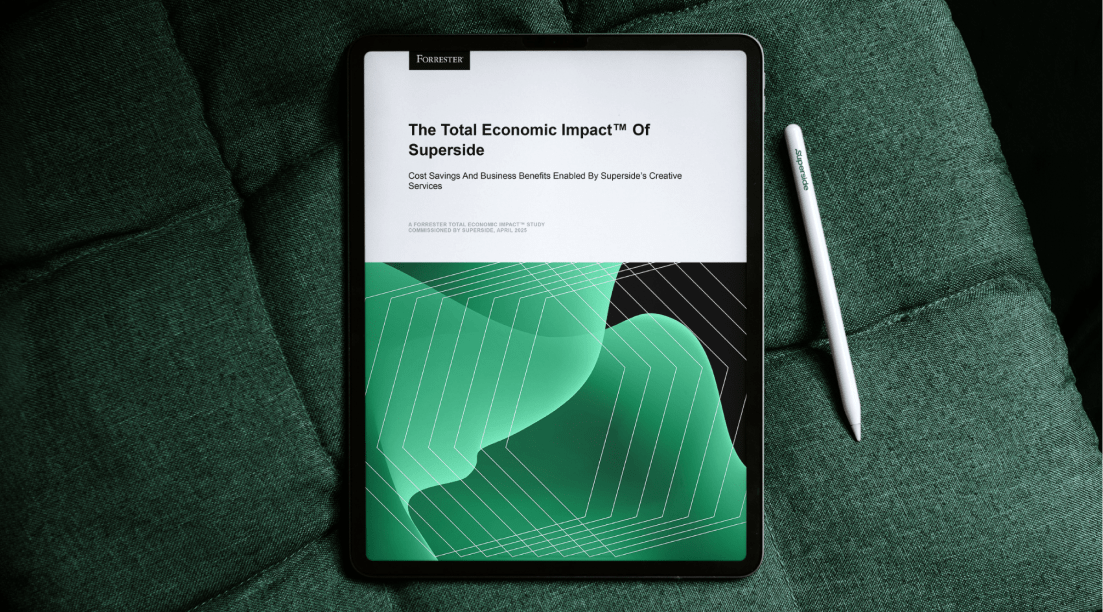
There's a real return on investment, too. Forrester's Total Economic Impact™ study, commissioned by Superside, found that the composite organization achieved a 94% ROI and $4.16 million in total benefits over three years (risk-adjusted present value). It also found payback in under six months and more than 60% of feedback rounds avoided.
If you'd like to measure your own progress, our guides to AI adoption metrics and measuring AI ROI are good next reads.
Successful AI transformation: The pattern is clear
The success stories in this article all started with solid groundwork. The teams built brand knowledge into their systems, identified what held them back and developed the skills and workflows they needed to scale.
The ones that started with an AI tool rollout are the ones with no numbers to publish.
If you're early in your adoption process, you're not alone. Most creative teams are in the same boat. Start with a diagnosis, protect the layer where human judgment lives and measure adoption depth, not license counts.
If you need help along the way, our AI creative services pair AI-native experts with AI systems to deliver creative that measurably performs. Browse our customer stories, see how we support enterprise teams or book a call to talk about your AI transformation.
FAQs




How top brands get more work done, without doing more
They Superside it. Fast, high-quality creative from the
AI-powered creative service that handles it all.


Meet Customers Who’ve Experienced Exceptional ROI
Discover how Shopify got 4,375 assets in 12-24 hours or how Amazon saved 345 hours in three months.


The real story behind GenAI’s impact on creative
You've heard the hype. But what does the data say?

The data speaks for itself
According to a Forrester Total Economic Impact™ study, Superside delivers a 94% ROI and pays for itself in six months.


Say yes to bigger campaigns
Our AI-native creative agency helps your team
take on more formats and markets with no new headcount.