


Artificial Intelligence (AI) is adding a powerful edge to every aspect of marketing—and ad creative is no exception. With the proliferation of AI ad creative generators, all promising to squash turnaround times and maximize impact on advertising efforts, how do you even begin to find a tool that’s right for you? Right here, with Superside’s list of the top 10 generators.
AI ad generators are becoming indispensable artillery in the high-stakes battle for consumer attention.
These cutting-edge tools are like nuclear energy for creativity, enabling brands to conceptualize, test and optimize ad accounts with distinctive visual assets and compelling ad copy variations at a pace that leaves traditional methods eating their dust.
2026 brings scalability in AI technologies for companies & marketing departments, and you don’t want your brand to fall behind.
Superside’s AI design services are your direct line to future possibilities. Combining the top 1% of global ad design expertise with powerhouse AI tools, Superside has completed 4000+ AI-powered projects, saving our customers over $1.4 million and cutting delivery time in half.
Of course, not all AI ad production capabilities are created equal. Read on to discover the right AI ad creative builder for your business.
How do AI ad generators work?
Generative AI works by training large neural networks on massive datasets to discover patterns and extract insights that allow them to generate new content. You’re no doubt already familiar with copy-generating AI such as ChatGPT. This tool is a large language model (LLM) trained on vast amounts of text, allowing it to produce increasingly sophisticated content in response to prompts.
You’ve probably also heard of the image-generating AI tool Midjourney, which (if you’ll forgive me for nerding out for a moment) uses a fascinating framework called a generative adversarial network (GAN). This network, in turn, consists of two neural networks: A generator and a discriminator.
The generator makes “fake” data, like images, while the discriminator checks how real the outputs look by comparing them to genuine images. This helps the generator get better at creating realistic pictures.
AI ad generators are trained on—you guessed it—huge datasets of existing high-conversion advertising creative, and their applications are virtually limitless. Before generating new ad creatives, marketers often use an image background remover to isolate products, create clean brand assets, and prepare visuals that AI tools can seamlessly incorporate into high-converting ad designs.
In a world where the lifespan of paid ads is shrinking in direct proportion to the demand for high-impact creative, this technology is already indispensable.
Best practices for creating effective AI-generated ads
AI isn't a silver bullet. While AI can be used to create great ad content, the truth is that humans are the ones steering the ship. Before using any AI ad creative tool, ensure you take the following tips into account.
1. AI + human talent = results
By now, you might be asking the million-dollar question: Can quality ad creative be left entirely to AI?
It cannot (at least, not yet). While this technology is revolutionizing digital marketing, it’s still only as good as the skill of the humans who wield it.
AI can automate a heck of a lot of repetitive human work. At Superside, for example, generative AI enhances design projects by helping customers explore a greater range of concepts more quickly, streamlining resource allocation and cutting production times.
But, it can’t replace decades of professional experience or human creativity. It also can’t understand cultural nuance or emotional resonance quite like we can.
Almost 100% of Superside creatives are AI-certified, so they can move faster while ensuring alignment with brand and brief. And we continually train about 40 new creatives each month to effectively tap into our AI toolkit.
2. Make branding matter
Consistency builds brands, which is why it’s crucial to give AI clear instructions and parameters for generating content. Short prompts rely too heavily on the AI generator’s default style, so it’s important to communicate your brand's distinctive personality, core values, visual aesthetic and the details around your product or service.
Word choices also matter, so the more specific the instructions, the better (but too much information can negatively impact results, too, so it’s a balancing act).
Visually, AI may require instructions for a color palette, product images and theme (“FinTech,” for example). Good text prompts will include tone of voice (informal, friendly, formal), your USP, information about the product and the ad’s intended audience.
Superside creative experts work with AI generators through a few iterations before hitting the perfect on-brand results, which can then be scaled to produce a high volume of consistently branded ad creative variations for testing and optimization across platforms.
3. Monitor and tweak
While AI excels at rapidly generating a wealth of creative ad variations, the true power lies in continuously optimizing these ads based on real-world performance data. This analytics-driven approach allows designers and marketers to identify the highest-performing creative elements and tweak AI prompts and parameters to double down on what's resonating with target audiences.
By feeding insights back into the content generation process, companies can fine-tune their way to ad creative that doesn't just catch eyes but compels action. Dynamically adapting ad creative generation through machine learning fueled by continuous performance data is the future of advertising.
10 best AI ad creative generators in 2026
From AI logo generators to tools that help us brainstorm and streamline creative processes, it's time to take advantage of artificial intelligence. Here are the best 10 AI ad creative tools available this year.
We used our scorecard to classify these tools and companies based on their performance, online reviews, pricing and more. Watch the summary in our table or scroll down to read about each in specific.
| Rank | Provider | Total /100 | Band | Best for |
|---|---|---|---|---|
| 1 | Superside | 96 | Fully documented | Enterprise teams wanting AI-assisted ad creative inside a full creative stack (video, motion, design). |
| 2 | Pencil | 95 | Fully documented | Global brands needing enterprise-governed GenAI ad production across many markets and models. |
| 3 | Admiral Media | 92 | Fully documented | App/game/e-commerce brands wanting AI ad creative as a managed performance service. |
| 4 | AdCreative.ai | 84 | Well documented | SMBs/agencies producing conversion-focused static ads and copy fast. |
| 5 | Creatify | 83 | Well documented | Performance marketers making UGC-style AI video ads from a product URL at volume. |
| 6 | Smartly.io | 81 | Well documented | Enterprises unifying AI creative production with media buying across channels/CTV. |
| 7 | Omneky | 72 | Well documented | Performance brands wanting AI creative tied to cross-channel optimization + enterprise security. |
| 8 | Predis.ai | 65 | Partially documented | Solopreneurs/small social teams needing bulk on-brand social + ad content. |
| 9 | The Brief AI | 62 | Partially documented | In-house teams producing and resizing display/banner variations at scale. |
| 10 | QuickAds | 57 | Partially documented | Startups turning product links into ready-to-run ads on a budget. |
1. Superside: AI-first creative services that outperform standard gen tools
AI ad creative services offered:
- AI-powered ad design
- Social media ad creative
- Custom AI-generated image banks
- AI-powered brand library expansion
- AI creative at scale (from 3D images, micro animations, photo-realistic characters, 2D and 3D illustrations, voiceovers, rapid branding, copy concept and development, short-form video, and more)
- AI consulting and implementation
Other AI-powered services offered:
- Graphic design services
- Brand design
- Video production and motion design services
- Illustration design
- Web design
- Email design
- Print design services
- Packaging and merch design
- Presentation design and concept creation
- Design systems and product design services
- Immersive design services
- eBook and digital report design and copywriting services
The first thing to understand about Superside is that we’re not an AI ad generator—we’re way better than that.
AI ad generation works best in the hands of humans with in-depth knowledge and experience in producing marketing creative, and that’s us. Our AI expertise and guidance let you generate and experiment with ideas up to 45% more efficiently, saving thousands in design costs and freeing up time for other tasks.
Unlike AI ad-generating platforms, choosing Superside means you won’t have to waste precious time and money familiarizing yourself with new technology through trial and error.
We come into your enterprise structure to take your creative needs to the next level. That includes digital ad production with much more than just AI—our creative strategists are ready to help you deliver not only beautiful assets but ones that perform well too.
But don’t take our word for it, read how our AI-powered creative work for learning platform D2L Brightspace became one of their best-performing online ad campaigns ever.


One more thing: We already mentioned we’re not an AI ad-generating platform, but we’re not a design agency, either.
We follow a creative subscription model, which gives you access to our AI-enhanced creative services and a lot more for a set monthly fee. Unlike traditional agencies, where pricing lacks transparency, our subscription plans feature clearly listed pricing to provide cost visibility right from the start.
Top-notch ad creative is just the cherry on the AI cupcake, though. If your marketing or creative team is fired up about integrating AI into your workflows but hasn’t quite cracked it, your Superside subscription can also give you access to our comprehensive upskilling programs and expertise in embedding generative AI into your systems.
- Pricing: Custom pricing. Scalable and flexible for enterprises.
- Based in: Globally distributed across the Americas, Europe, Africa and Asia.
- Best for: Larger companies that have a continual, high-volume need for ad creative.
2. Pencil
 (Source: Pencil)
Services offered:
- AI image and video ad generation
- Predictive creative scoring against ad performance data
- Brand guardrails and governance controls
- Purpose-built agents for ideation, personas, beauty shots and media planning
- Direct integrations with Meta, Google, TikTok, YouTube and Amazon Ads
Pencil has been running AI in enterprise marketing production since 2018 and was acquired by The Brandtech Group in 2023. It is the most enterprise-serious pure platform on this list. Its predictive scoring is trained on a large corpus of real ad spend, and its "Open Garden" approach routes generation across OpenAI, Google, Adobe Firefly, Bria and Runway rather than locking you to one model.
The enterprise tier, Pencil Pro, sits alongside Brandtech’s wider stack of embedded teams and serviced delivery, which is why it shows up in procurement comparisons at global brands. Every deliverable is tracked from brief to result with cost-per-asset visibility, which is unusual and genuinely useful for CFO conversations.
- Pricing: Core from $14/mo (50 generations), Growth $55/mo (250 generations), Enterprise plan on request with committed consumption pricing.
- Best for: In-house marketing teams, agencies, SMBs and startups looking to create lead generation ads, customer engagement creatives, e-commerce ads and more.
Pros
- Predictive scoring grounded in real media spend, not just aesthetic preference.
- Model-agnostic generation avoids single-vendor quality ceilings.
- Strong enterprise governance, brand guardrails and cost-per-asset reporting.
- Genuinely low self-serve entry price for a platform of this depth.
Cons
- Self-serve tiers cap monthly generations tightly, which high-volume teams hit fast.
- Limited fine-grained editing control over layout and copy placement.
- Roadmap has shifted toward enterprise since the acquisition, making the self-serve experience less predictable.
- Scores creatives against each other rather than forecasting post-launch performance.
3. Admiral Media
 (Source: Admiral Media)
Services offered:
- AI creative production across UGC video, static and carousel
- Paid social management on Meta, TikTok and Snapchat
- Paid search and Apple Search Ads management
- App store optimization
- Creative strategy, performance reporting and monthly iteration
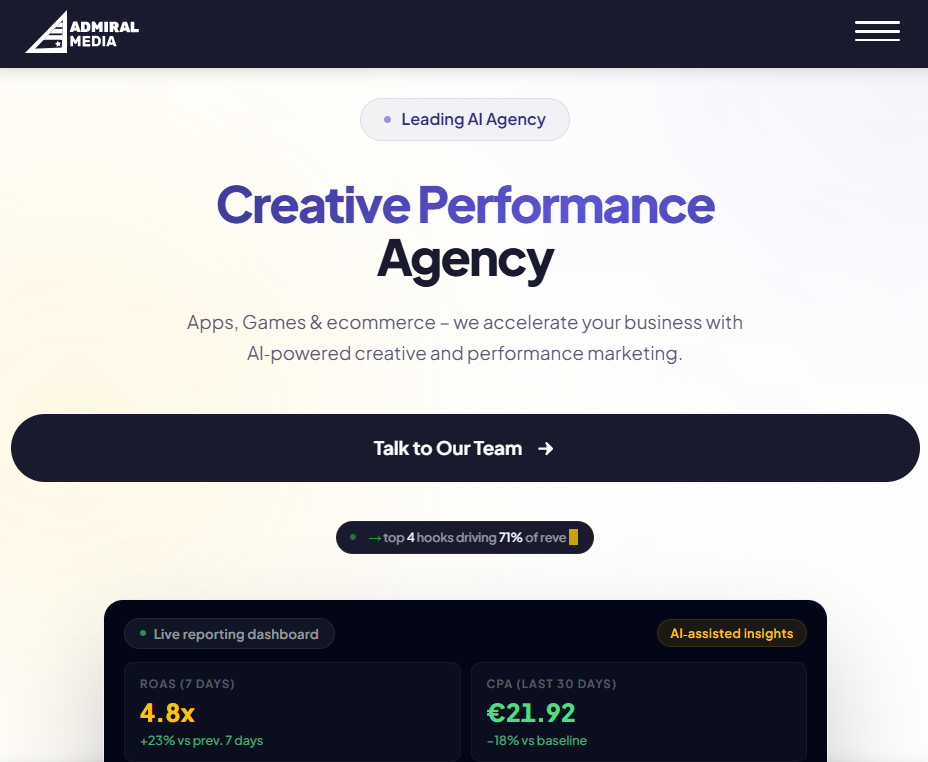
Admiral Media is the one entry here that is not software. It is a Barcelona-based performance marketing and AI creative agency that has managed more than EUR 500M in ad spend for 150+ brands across 35+ markets since 2019, with a 5.0 rating on Clutch.
It earns a place on a tools list because the buying decision is genuinely comparable: you are choosing between paying for software plus internal labour, or paying for output with the labour included.
Admiral packages AI creative as a managed retainer with strategy, human QA, platform-specific formatting and iteration built in. For teams without an in-house operator to run a generation tool properly, that is often the cheaper path in practice.
- Pricing: AI creative packages from EUR 4,000/mo (20 videos), EUR 9,600/mo (40 videos) and EUR 21,500/mo (80 videos). Media management typically adds 15% to 20% of managed spend.
- Best for: App, game and ecommerce brands wanting AI ad creative delivered as a managed performance service.
Pros
- Fully managed, so no internal capacity needed to run the tooling.
- Transparent published retainer tiers, which is rare for an agency.
- Deep performance marketing expertise means creative is built for the auction, not just for looks.
- Official partner status with Meta, Google, TikTok, Snapchat and Apple Search Ads.
Cons
- Retainer commitment rather than a tool you can trial.
- Specialised in apps, games and ecommerce, so less proven for B2B or brand-led work.
- Media management is charged separately, typically as a percentage of managed spend.
- Video-weighted output, less suited to display and banner programmes.
4. AdCreative.ai
 (Source: AdCreative.ai)
Features:
- AI ad and social creative generation
- AI copy and headline generation
- AI video ads and product photoshoots
- Creative scoring and compliance checking
- Competitor ad analysis and ad library
AdCreative.ai remains the most widely adopted self-serve tool in the category, and it is still the fastest route from brand kit to a batch of conversion-oriented static ads. The proprietary model learns your fonts and palette, and creative scoring gives non-designers a rough signal on which output to run.
The catch is packaging. Video ads, storytelling ads and product videos are locked behind the Professional tier, which is a steep jump from the entry plan. Credits are consumed on download rather than generation, so the effective cost depends heavily on how much you discard.
- Pricing: Starter from $39/mo billed monthly (around $20/mo billed annually), Professional $249/mo unlocking video, higher agency tiers up to roughly $999/mo. Seven-day free trial.
- Best for: SMBs and agencies producing conversion-focused static ads and copy at speed.
Pros
- Fast, genuinely easy for non-designers, with a very low learning curve.
- Unlimited generations, with credits only spent on downloads.
- Creative scoring and compliance checking are useful guardrails for small teams.
- Large user base and a mature G2 review footprint at 4.3 across nearly 800 reviews.
Cons
- Output can feel templated, which is a real problem as platforms down-rank obvious AI creative.
- Video capability requires a roughly six-fold price jump to the Professional tier.
- Credit costs for video are not clearly published, making budgeting hard before you commit.
- Limited fine control over layout for brand-sensitive work.
5. Creatify

(Source: Creatify)
- Services offered:
- URL to video ad generation
- AI avatars and AI influencers
- AI script writer and text-to-speech
- Batch Mode for simultaneous variant generation
- Ad launcher and competitor ad tracking
Creatify is the strongest pure UGC video generator here for paid social hook testing. Paste a product URL and it produces an avatar-led short video with script, voiceover and captions. Batch Mode is the real differentiator: generate 10 or more variations at once and let the platform algorithm find the winner.
It carries the highest review rating in this list at 4.8 on G2 across more than 1,500 reviews. Practitioners are consistent about the trade-off, though. Raw output is competent and formulaic, lip-sync can drift, and there is a recognisable house look that undercuts the authenticity UGC ads depend on. Budget for editing.
- Pricing: Free tier with 10 credits, Starter $39/mo (100 credits), Pro $99/mo (300 credits, ad launcher, competitor tracker, team seats), Enterprise custom.
- Best for: Performance marketers producing UGC-style AI video ads from product URLs at volume.
Pros
- Fastest path from product URL to a testable video ad.
- Batch Mode is purpose-built for high-volume hook and angle testing.
- Very large avatar library and multilingual voiceover.
- Free tier makes it genuinely low-risk to evaluate.
Cons
- Avatar quality varies noticeably and lip-sync issues are a recurring complaint.
- Credit consumption per video is unpredictable, ranging widely by length and model.
- Credits do not roll over, so under-use is wasted spend.
- Optimised for speed over polish, so heavy brand governance needs will outgrow it.
6. Smartly.io
 (Source: Smartly.io)
Services offered:
- Creative Suite for AI-powered creative production and dynamic formats
- Media Suite for automated cross-channel buying
- Intelligence Suite for unified creative and media analytics
- Coverage across Meta, Google, TikTok, Pinterest, Snapchat, Amazon, Reddit, Spotify and YouTube
- Connected TV delivery across a large streaming footprint
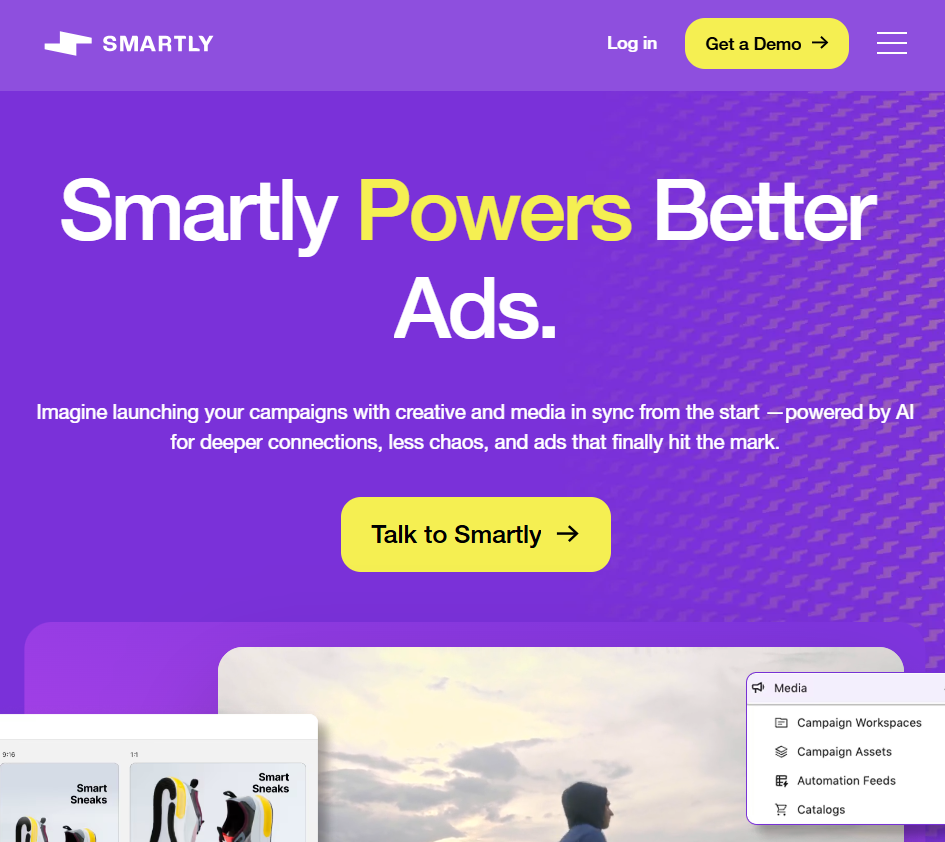
Smartly.io is the most complete enterprise system here, and the only one that treats creative and media as a single loop rather than two handoffs.
Creative insight from analytics informs what gets produced, production feeds the buying engine and performance attribution flows back automatically. For a team running eight-figure annual spend across many channels, that closed loop is the whole value proposition.
It holds a 4.4 rating on G2 across more than 450 reviews, with automation and cross-channel management as the consistent strengths and the pricing model as the consistent complaint.
- Pricing: Custom enterprise pricing only, quoted on managed spend, channel scope and service level. No published rate card and no free trial.
- Best for: Enterprises unifying AI-powered creative production with media buying across many channels and CTV.
Pros
- Genuinely unifies creative production, media buying and analytics in one platform.
- Exceptionally wide channel coverage including Connected TV.
- Built for the operational complexity of multi-market enterprise campaigns.
- Strong documented integration depth with Meta and TikTok.
Cons
- No public pricing and no self-serve tier, so evaluation starts with a sales conversation.
- Percentage-of-spend pricing draws consistent criticism as spend scales.
- Steep learning curve and a UI that smaller teams find unwieldy.
- Not viable below meaningful enterprise spend levels.
7. Omneky
 (Source: Omneky)
Features:
- AI image and video ad generation from a brand URL
- Creative performance insights and forecasting
- Product image generation without photography
- Direct publishing to Meta, Google, TikTok, LinkedIn and Reddit
- Omnichannel analytics and enterprise brand controls
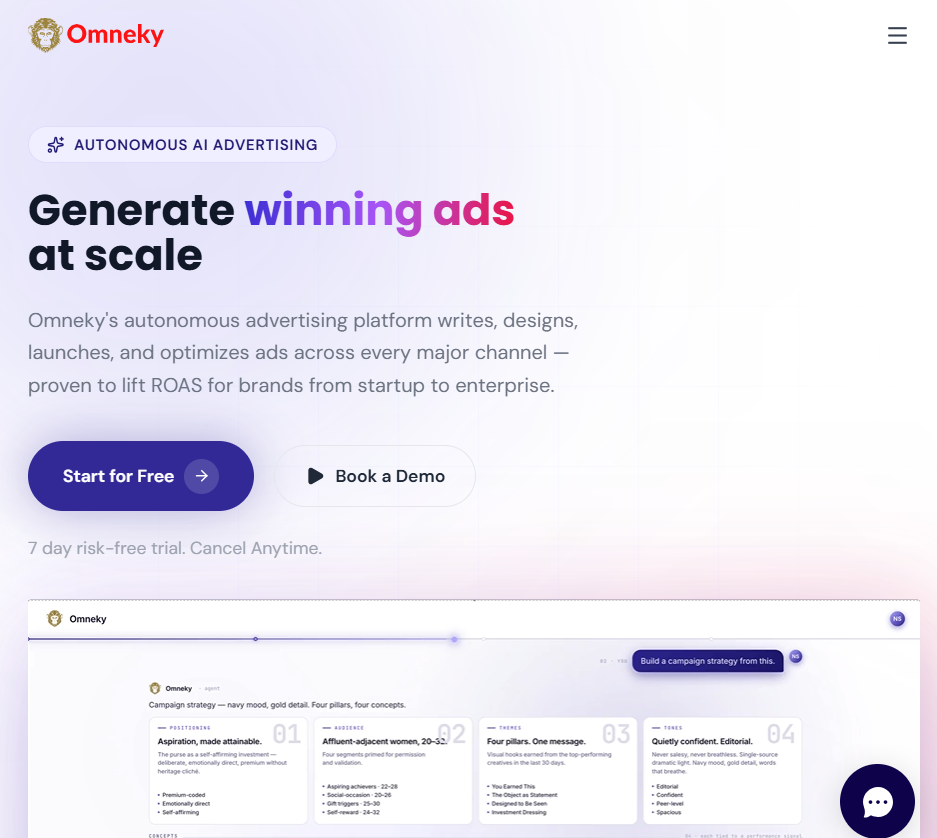
Omneky’s pitch is that generation and optimization should be one system: it analyses which designs and messages resonate, then generates the next round accordingly.
Paste a URL, it extracts brand elements, generates ads, launches campaigns and reports back. The enterprise tier adds committed consumption pricing and brand governance.
It is a capable platform with a real enterprise story. The evidence picture is the weak point, and buyers should go in with eyes open on that.
- Pricing: Credit-based self-serve tiers starting in the region of $29/mo, scaling to roughly $199 to $249/mo, plus custom enterprise pricing. Seven-day free trial. Verify current tiers directly, as published figures differ widely by source.
- Best for: Performance brands wanting AI creative generation tied to cross-channel optimization and enterprise security.
Pros
- Generation, publishing and cross-channel analytics in a single workflow.
- Product image generation removes a genuine photography cost line.
- Enterprise tier includes brand controls and committed consumption pricing.
- Free trial available before commitment.
Cons
- Published pricing varies substantially between sources, so verify directly.
- Third-party review signals conflict sharply, with a strong G2 profile and a poor Trustpilot one.
- Enterprise-oriented feature depth means a steep learning curve for small teams.
- Batch generation speed is a recurring user complaint.
8. Predis.ai

(Source: Predis)
Services offered:
- AI reels, shorts and video ads
- AI ad images, copy and social creative
- AI product videos and product photoshoots
- Competitor analysis and content scheduling
- Multi-channel publishing across major social platforms
Predis.ai sits at the intersection of ad generation and social media management, which is exactly why small teams like it. One subscription covers creative generation, scheduling, publishing and competitor analysis, so there is no tool-switching between making the asset and getting it live.
It holds a 4.7 on G2, though across a relatively small review base of around 90. Users consistently praise the time saved and consistently want more credits for the money.
- Pricing: Free tier available, paid plans from approximately $32/mo, mid tier around $79/mo and agency tier around $249/mo. Annual billing discounts apply. Verify current tiers directly.
- Best for: Solopreneurs and small social teams needing bulk on-brand social and ad content.
Pros
- Generation, scheduling and publishing in one place, which removes real workflow friction.
- Built-in competitor analysis is unusual at this price point.
- Free tier and low entry pricing make evaluation easy.
- Broad social channel coverage.
Cons
- Credit limits bite quickly once you iterate seriously on creative.
- AI output usually needs manual refinement before it is campaign-ready.
- Interface feels dated and support response times draw criticism.
- Light on enterprise depth, governance and large custom campaigns.
9. The Brief (Creatopy)
 (Source: Brief AI)
Services offered:
- Ad Studio for design, animation and multi-format resizing
- Discover agent for market and competitor research
- Create agent for on-brand ad variations
- Launch agent for publishing across social, display and programmatic
- Optimize agent for performance tracking and feedback
- PSD and Figma import
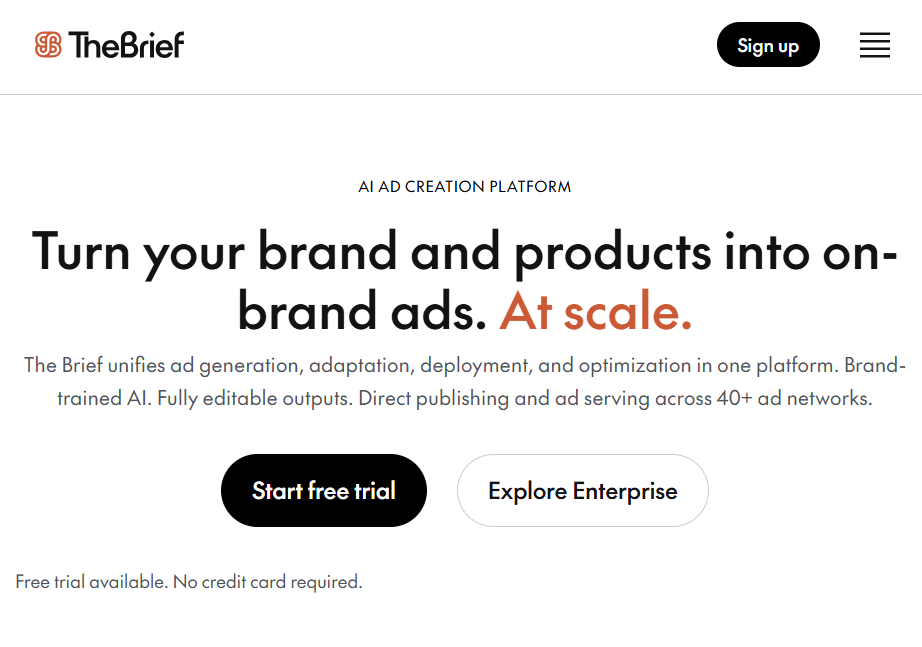
Creatopy rebranded as The Brief in October 2025, repositioning from an ad design tool to what it calls an end-to-end AI agency, built around four agents that run discovery, creation, launch and optimization as a continuous loop.
Underneath the repositioning, the core strength is unchanged and still genuinely good: multi-size automation. Build one ad, get hundreds of correctly sized variants. For display and banner programmes at scale, nothing else here matches that depth. The company reports customers seeing up to 10x more content, 35% lower costs and 50% faster production, though those figures are vendor-reported and unaudited.
- Pricing: Pro $29/mo for individuals, Ultra $79/mo for high volume, Team $49/seat/mo for 2 to 10 people, Enterprise custom. Seven-day free trial.
- Best for: In-house teams producing and resizing display and banner variations at scale.
Pros
- Best-in-class multi-size and multi-format automation for display.
- Brand element extraction straight from a URL saves significant setup time.
- PSD and Figma import fits existing design workflows.
- Transparent published pricing across four clear tiers.
Cons
- Recurring post-rebrand complaints about a buggy interface, broken templates and navigation.
- Shift to credit-based exports means paying credits to download your own work.
- Weaker for social and Meta creative than most alternatives here.
- Thin public case-study evidence relative to its category presence.
10. QuickAds

(Source: QuickAds)
Services offered:
- AI static and video ad generation from a product link
- Virtual product photography
- Automatic resizing across 15+ ad formats
- AI ad copy in 35+ languages
- Large searchable ad swipe library
QuickAds does what the name promises. Feed it a product link and it returns platform-ready ad variations in well under a minute, with virtual product photography that removes the need for a shoot. The swipe library is a legitimately useful research layer for media buyers hunting for angles.
It is the cheapest entry point on this list by a wide margin, and the trade-offs are exactly what you would expect at that price.
- Pricing: From around $9/mo on entry plans, with an agency tier around $69/mo offering unlimited downloads. Credit-based on downloads.
- Best for: Startups and small ecommerce teams turning product links into ready-to-run ads on a tight budget.
Pros
- Lowest cost of entry in this comparison.
- Virtual product photography is strong value for ecommerce sellers.
- Fast multi-format resizing without breaking layout elements.
- Ad swipe library supports creative research as well as production.
Cons
- Limited design customization, so brand-sensitive work will fight the tool.
- Recurring billing and refund complaints in public reviews.
- Very thin public case-study and enterprise evidence.
- Speed is prioritised over craft, which shows in the output.
Superside uses AI and human expertise to revolutionize ad creatives
As you can see, there are plenty of AI ad creative platforms out there, and new ones are constantly popping up. Experiment with a few to find out which works best for your ad creative production needs.
But remember that the best results—quality ads, engagement, conversions, sales—come from AI steered by expert human creatives. Just like DIY AI platforms, Superside also gives you always-on access to ad creative.
The main difference is that we’re a workforce of seasoned professionals who know how to use AI as a force multiplier for producing high-quality, high-performing ad creative at scale.
Want to learn more? Book an intro call today and see how we can support your ad campaigns at scale and way more!
FAQs

Stuck in AI testing mode?
Get a quick, practical checklist
for implementing AI across your team.


How 400+ brands get more work done, without doing more
They Superside it. Fast, high-quality creative from the
AI-powered creative service that handles it all.