

Companies often invest heavily in global rebrands, only to see inconsistent rollouts across regions and markets. Worried this might happen to you? Rebrands work best when they’re treated like major operational changes, supported by scalable creative systems, AI-driven workflows and partners like Superside that do most of the heavy lifting.
A global rebrand is one of the most complex creative challenges an enterprise can undertake. It requires aligning dozens of departments, hundreds of assets and multiple regions behind a single creative vision, all while keeping operations running smoothly.
In the months preceding the rebrand, many companies invest heavily in strategic positioning and creative concepting, only to see their vision diluted by weak execution.
For global organizations, every touchpoint, from digital platforms and print collateral to immersive experiences, product packaging and content production, must transition in lockstep for maximum impact.
If a rebrand is on the horizon for your organization, you’re in the right place. This guide explores how to plan, manage and execute a global rebrand effectively. You’ll also gain insights into the creative systems and scalable workflows that can ensure your new brand identity lands seamlessly in every market.
Read on to discover why execution infrastructure matters more than creative inspiration, and how enterprise brands tap into AI-powered creative partners like Superside to transform potentially chaotic rebrands into well-executed creative orchestrations.
Why global rebrands fail (and what’s really at stake)
A successful global enterprise rebrand is an operational challenge disguised as a creative one. Strategy is rarely the problem. The operational complexity of rolling out that strategy across a global organization is what usually turns strong brand vision into fragmented execution.
Research backs this up. A recent study that examined multinational enterprise rebranding across six countries found that implementation often tripped companies up. Further research suggests that 60% of rebrands fail to strengthen customer loyalty. Clearly, rebrands are risky business. And it certainly takes more than a new logo for a rebrand to succeed.

Credits: eloqwnt
Consider what a typical global rebrand involves. If you’re a mid-sized enterprise, you’ll have to apply your new branding to thousands of individual assets: Websites in multiple languages, sales presentations, packaging, email templates, social media graphics, trade show materials, internal training documents, pitch decks and countless variations for different regions. Each requires design, copywriting, localization, legal review and stakeholder approval.
Multiply that by every market you operate in, factor in different regulatory requirements and cultural sensitivities, and then account for time zone coordination.
Feeling a headache coming on? We’d be surprised if you weren’t.
The most predictable pressure points in the rebrand process include:
- Decentralized creative teams. When multiple agencies, freelancers and regional teams work separately, chaos is inevitable.
- Inconsistent timelines and approval processes between regions.
- Limited in-house capacity to handle the vast design demands of a rebrand.
- Brand governance breakdown caused by a lack of robust systems for asset management and distribution.
The cost impact of these pressure points can be significant, but it certainly isn’t the only price you’ll pay if the rollout fails. You’ll also lose momentum, credibility and brand trust.
The takeaway? Global rebrands only succeed when they’re treated as scalable, operational rollouts, not creative projects. The brands that win build execution infrastructure strong enough to support their creative vision across every market, channel and touchpoint simultaneously.
The stages of a successful global rebrand

Once you understand how successful rebrands unfold, the process will start to feel more manageable. While every rebrand is unique, the fundamental stages outlined below tend to remain consistent:
Stage 1: Global rebranding strategy and stakeholder alignment
Successful rebrands begin with rigorous strategic alignment. If you get all teams on the same page early, it’ll prevent problems later and keep the rollout moving along smoothly, even when execution gets tough.
The brands that navigate this massive undertaking successfully involve all these stakeholders as they start to shape the strategic foundation. This creates ownership and surfaces potential execution barriers early. It also makes it easier for leaders to communicate the rebrand and get employee buy-in from the get-go.
Before teams move into execution, stakeholders also need to align on the intended brand direction itself: Not just the strategy behind it, but the tangible expression of the brand.
They must agree on what the brand should feel, look and sound like. When these foundational decisions are made together, it ensures that what follows is coherent, scalable and consistently interpreted across regions and teams.
Stage 2: Building the visual and verbal identity system
Once strategic alignment, brand guidelines and frameworks are in place, focus shifts to building a brand system. This differs from brand identity, and the distinction is important for global rollouts.
While brand identity refers to core elements such as logo, color palette and typography, a brand system defines how the brand behaves across channels, markets and use cases through a comprehensive toolkit.
For global enterprises, this flexibility is non-negotiable. Your brand system needs to work equally well across very different contexts, e.g., a billboard in Tokyo, a mobile app in Lagos, a trade show booth in Berlin and a social campaign during Ramadan. It must be able to accommodate right-to-left languages, different color associations across cultures, varying regulatory requirements and certain technological constraints.
This is where AI-powered design and modern design systems become transformative. Rather than manually creating hundreds of variations, these systems help teams build intelligent templates that adapt dynamically. It helps them to generate localized versions quickly and maintain brand consistency across markets through locked design elements and automated QA checks.
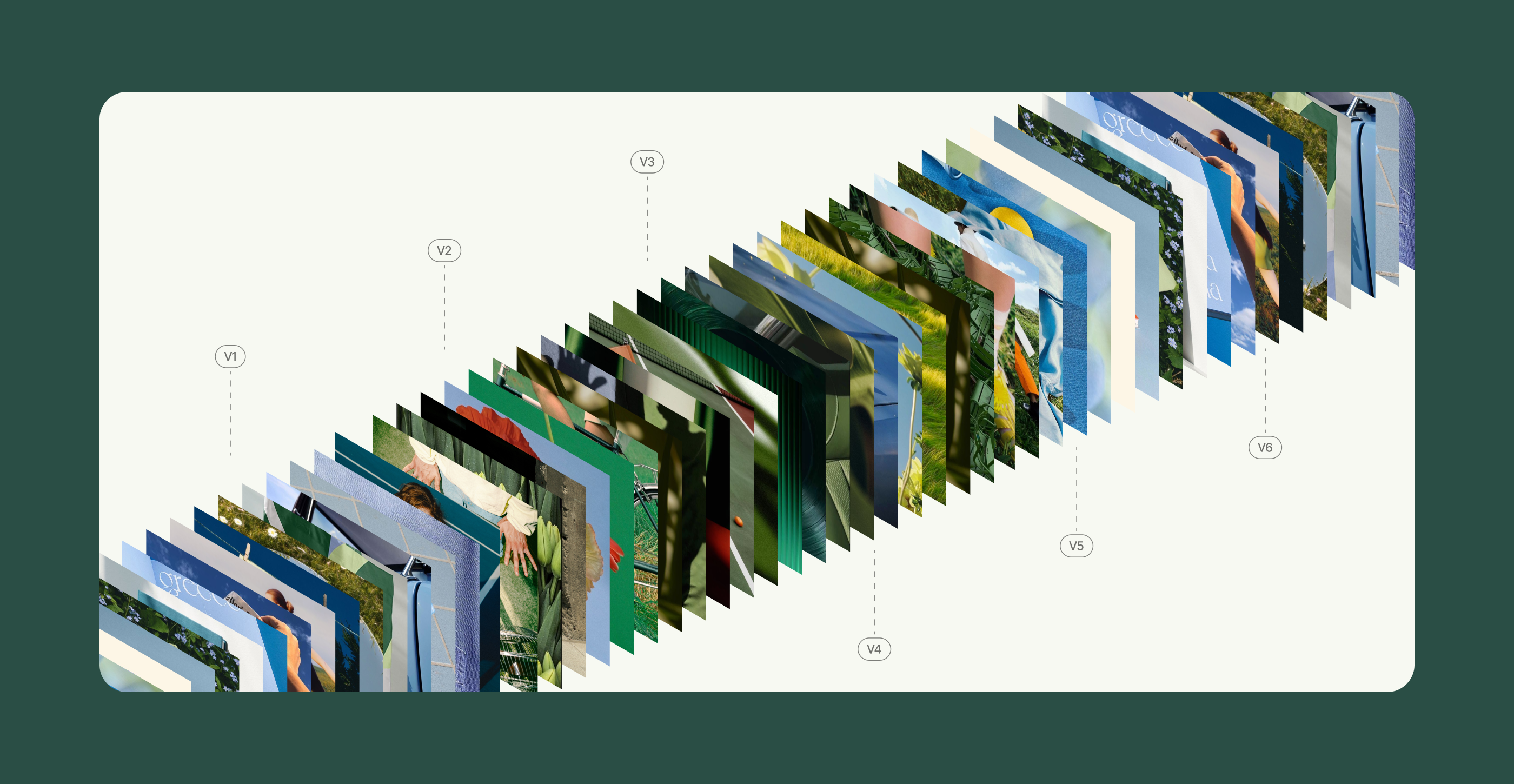
Superside’s creatives have mastered the art of building adaptable brand systems for our customers. These typically include working templates, comprehensive visual libraries, motion and animation extensions and component-based design systems that enable rapid variation creation without sacrificing quality or consistency.
Stage 3: Asset creation and localization
Most enterprise rebranding teams hit their first major stumbling block when faced with the sheer volume of assets that need to be created, updated and localized.
Imagine it. You need to systematically update every customer-facing touchpoint and internal resource. This includes digital properties (websites, apps, email templates), marketing collateral (brochures, case studies, blog graphics), sales materials (pitch decks, proposal templates, product sheets), product and packaging, corporate materials (investor presentations, annual reports) and internal resources (intranet pages, educational materials).
Each of these asset categories could have hundreds of individual assets. Each needs design work. Many require translation into multiple languages. Some need cultural adaptation beyond translation. All need review and approval.
Research varies on just how long the average rebrand takes. Estimates suggest a major brand overhaul can take around 12 to 18 months, but that assumes adequate creative capacity. When brands rely solely on in-house teams or traditional agencies, asset creation can become a bottleneck that seriously stretches timelines.
Equally important at this stage is to establish centralized brand governance. A beautifully designed brand identity means nothing if half your organization’s regional offices still use the old logo six months after launch, or if sales decks contradict website messaging.
Modern creative service providers like Superside solve these rebrand challenges with a unified creative subscription that includes global teams who develop deep brand knowledge. Oversight from creatives who genuinely understand your brand can help ensure assets are rolled out simultaneously across time zones. They can also help check that branding is consistent across all deliverables and markets.
Stage 4: Internal rollout and brand enablement
This critical stage of a rebrand is often the most overlooked. It’s vital for employees across your organization to understand, embrace and use your new brand correctly.
Effective internal rollout starts with communication. It’s essential to train employees not only on what’s changed but also why it matters and how it affects their daily work.
Superside brand services include helping enterprise customers build these internal launch materials, from interactive brand books and comprehensive intranet pages to launch presentation decks and sales cheat sheets.
The investment in enablement pays dividends in adoption speed and brand consistency. When employees have tools that make it easy to do the right thing, brand governance becomes organic rather than forced.
Stage 5: Public launch and long-term governance
After months of internal preparation, the public launch is both the climax and the start of any rebrand journey. It’s when external audiences first encounter your new global brand identity. It also marks the beginning of a new chapter that requires ongoing support.
Going live with a rebrand requires careful orchestration across channels. For example, websites must update simultaneously across regions. Social media profiles must transition in coordinated waves. Press releases need to be distributed at the right time to the relevant markets. Paid media campaigns must launch with new creative. Physical offices need updated signage.
Beyond the initial launch, successful rebrands establish ongoing brand monitoring and maintenance systems. These should include regular brand audits, processes for approving new asset types, systems for onboarding new employees and mechanisms for evolving brand guidelines.
Here’s the reality: Rebrands never truly end. Your brand is a living system that needs continuous care. The difference between brands that maintain consistency and those that drift back into chaos lies in whether they establish a scalable creative infrastructure that sustains the brand long after launch excitement fades.
The role of creative partners in global rebrands
Even the slickest enterprise teams rarely have enough capacity to execute a global rebrand without external support. Business-as-usual creative demand doesn’t pause during a rebrand, while the rebrand itself creates months of intense, specialized work.
The question isn’t whether to engage external creative resources. It’s which type of partner to choose.

Traditional advertising agencies often bring strong strategic thinking and creative concepting, but they’re not always structured to meet the operational execution needs of a scalable brand rollout. Their models usually prioritize high-level creative direction over high-volume, rapid asset production, and their cost structures make them expensive for the level of production work typically required.
The right freelancers can deliver speed and specialized skills, but they can’t scale their services. As a result, enterprise teams are forced to manage a patchwork of contributors, contend with inconsistent outputs and absorb the loss of institutional knowledge every time a project or freelance contract ends.
This gap is what creative partners like Superside were designed to fill: We provide the scale, speed and consistency of in-house teams, with the flexibility and specialized expertise of external partners.
Through dedicated brand pods of Supersiders who develop deep brand knowledge and use AI-assisted workflows, we empower in-house teams to execute hundreds of asset updates simultaneously and rigorously adhere to brand guidelines.
We also familiarize ourselves with your existing brand tools, design systems, and processes to ensure the integration feels seamless.
Superside: Executing global rebrands at scale
From brand identity refresh projects for mid-sized businesses to brand ecosystem transformations for Fortune 500 companies, Superside has helped hundreds of organizations with global rebranding strategy and execution at scale and speed.
Our not-so-secret weapon? Our approach.
The traditional rebrand execution model is sequential and siloed: Strategy, then design, then production, with handovers between phases often disrupting continuity.
Superside’s model is integrated and concurrent: Brand system development, asset creation and rollout preparation occur in parallel workflows, with dedicated teams that maintain continuity from strategy through launch and beyond.
This approach compresses timelines dramatically, not by cutting corners but by eliminating the waiting, handovers and coordination that inflate traditional timelines.
Real rebrand results
Consider how we recently approached our own rebrand, a challenge that showcased the very capabilities we offer our customers.
As part of the project, we had to update our entire look and feel, refine our new logo, develop a whole new visual library, create comprehensive brand guidelines, update our website design and enable internal teams globally to use our new branding, all while maintaining our ongoing customer work.
Superside’s rebrand? Dreamed up, designed and brought to life by our very own Supersiders—from the very first brainstorm to the final pixel. Their only ask was that we do it entirely in-house.

Using AI as our primary creative tool, along with component-based design systems, brand governance design, parallel workstreams and continuous stakeholder engagement, we successfully launched our new Superside brand identity at speed and scale.
I’ve led two major rebrands in the past—DoorDash and Klaviyo—and both were done in partnership with an external agency. The idea of doing it ‘totally in-house’ seemed daunting. It helps that we employ the top 1% of creative talent globally. We brought together an incredibly talented group of designers and strategists from the client side of the business to work with our in-house team.
Pixlmob’s AI-powered rebrand is another demonstration of how AI can accelerate production. In this case, the tech helped us to deliver assets twice as fast. We used AI to design variations, automate asset versioning, create mockups and streamline repetitive tasks, while our creative team collaborated with Pixlmob’s in-house team on strategic and aesthetic decisions.

Meanwhile, the OPA! brand transformation showcases Superside’s ability to handle complex, multifaceted rebrands. This project involved a refreshed visual identity rolled out across multiple touchpoints, including packaging designs for product lines, marketing collateral and other digital assets. The brand identity refresh was completed within one month, further testament to Superside’s highly efficient, AI-driven approach.
The Superside advantage
We’ve hinted at our abilities. Now, let’s take a closer look at what sets Superside apart as a rebrand execution partner:
- Speed and agility through a global talent network that operates across time zones and can deliver thousands of updated assets in parallel.
- Brand consistency and governance are built into workflows through locked templates, AI-powered quality checks, centralized design libraries and single creative teams that can produce all deliverable types.
- AI-enhanced creative acceleration that amplifies human creativity through automated mockup generation, intelligent versioning, rapid variation testing and streamlined production workflows.
- Enterprise-ready integration with existing design systems, digital asset management platforms, project management tools and approval workflows.
- Cost and operational efficiency through a flexible subscription model that eliminates scope creep and offers predictable scaling.
Superside doesn’t just design brands. We deploy them. This distinction matters enormously when execution, not creativity, determines whether global rebrands succeed or fail.
Global rebrands succeed through creative systems, not chaos
Most organizations approach rebrands as creative projects when, in actual fact, they’re operational transformations that demand execution excellence and commitment.
It can be incredibly complex to update thousands of assets, coordinate dozens of stakeholders and maintain consistency across disconnected teams while keeping your business running smoothly.
The brands that succeed treat enterprise rebranding as an infrastructure challenge. They build creative systems strong enough to support their vision on a global scale. They establish governance frameworks to maintain consistency without slowing progress. They use technology and partnerships that provide agile capacity when needed, as well as sustained support over time.
This is why the most successful enterprise rebrands increasingly rely on creative partners structured for operational execution, not just brand strategy.
Superside offers a purpose-built model for the operational realities of global brand rollouts, with dedicated talent, AI-assisted workflows, built-in brand governance and subscription-based flexibility.
A global rebrand is ultimately a test of both vision and operational strength. If you’re ready to find out how Superside can help your enterprise team ace that test, let’s chat.
FAQs


Scale Your Brand
From new brands and sub-brands to refreshes and full rebrands, leverage a full range of branding services that will supercharge your brand experience. Concept and develop stunning on-brand creative quickly and effectively with Superside.

Get global capacity & bandwidth
There really is a better way. Superside’s AI-powered
design services help you scale production, boost
performance and stay on-brand without adding headcount.


Top design capabilities
Explore Superside's full range of design capabilities
with creative examples of our work for clients,
like Amazon, Notion and Reddit.


Your creative team's creative team
Choose the world's leading AI-powered creative service
and get high-performing ads, videos, experiences and
more at scale, on your schedule and to your standards.

Solidify brand identity and fuel growth
Check out our portfolio of brand identity work to see how
Superside can help you seize opportunities and
accelerate your creative pipeline.