


Hiring AI creative talent means finding people with two rare strengths: strong creative instincts and genuine AI fluency. Finding someone with both takes months and costs more than the salary line suggests. Partnering with an already-assembled AI-native team is usually faster and lower risk, though building in-house still makes sense in certain situations.
Ask any creative leader what they need right now and you'll likely hear the same answer: people who can produce excellent creative work and use AI to do more of it, faster.
Finding them is another matter. Exceptional creative thinking has always been hard to find, and proven AI expertise is still in short supply. Requiring both capabilities in the same person narrows the pool considerably.
The market reflects it. 45% of marketing and creative leaders say finding skilled professionals is harder than it was a year ago, and more than half report that skills shortages have already caused project delays. Meanwhile AI literacy is showing up in job descriptions six times more often than the year before, and the mismatch between the skills professionals have and the skills companies need persists.
So the question becomes: do you spend months building the capability in-house, bring in skilled freelancers or tap into an AI-native creative team that already has the talent, technology and workflows in place? This guide breaks down the costs, risks and trade-offs of each path.
Along the way, Ariel Ibanez, Head of Creative AI Enablement at Superside, shares what he looks for when he trains and evaluates creatives on AI.
What AI creative talent means in 2026

The term refers to a combination of strong creative judgment and genuine AI fluency.
Crucially, AI fluency is about more than knowing what today's generative platforms can do.
The strongest AI creatives understand where AI adds value, where human judgment and taste matter more and how to combine the two to produce standout work fast and at scale.
That profile sits at the intersection of two scarce things: the judgment that makes creative work exceptional and the technical fluency that makes AI a genuine amplifier. Creative judgment takes years to develop, while AI fluency requires continuous learning as the tools keep shifting. The result is a relatively small pool of creatives who bring both.
Ariel Ibanez, who trains and evaluates Superside creatives on AI, is blunt about which half of that pairing has to come first.
The designers who should be concerned are the ones not using AI yet, because the gap between them and the rest of the market widens every month. You have to be a good designer first, composition, color, typography, hierarchy, and then AI amplifies what's already there. If you have the foundations, the tools make you faster and more ambitious.

Emerging AI roles
AI has created some new creative roles, but it's mostly changed the skills expected in existing ones. Titles such as AI Creative Director, AI Creative and Creative AI Technologist now appear alongside established roles in design, copy, content, motion, video and creative direction. The titles vary because the field is still evolving.
What matters more is the work these roles require: creative judgment plus hands-on AI expertise, used to develop strong concepts, generate and refine content and build repeatable workflows that help teams keep pace.
Ibanez frames the difference in terms of what survives contact with a real campaign.
One person prompting produces assets, a pipeline produces a campaign, and the pipeline survives volume, deadlines and handoff without the quality drifting.
AI fluency is becoming part of the role rather than a separate job. Creative directors still direct and designers still design, but increasingly designers, creative directors and other professionals are expected to understand where AI fits into the workflow and how to use it well.
What separates AI-fluent creatives from people who merely use AI tools
Using AI doesn't automatically translate into greater productivity, and this is the distinction that matters most when you're hiring.
AI use among designers is now close to universal. The AI in Design Report 2026, from Designer Fund and Foundation Capital, found 91% of designers now use AI in their work at least weekly, up from 54% the year before. Yet research among agency graphic professionals found 47% report an increase in workload rather than relief, according to a 2024 study from CHILI publish.
That gap is the whole point. Almost everyone uses AI now, so usage tells you nothing in an interview.
AI-fluent creatives know how to make the technology genuinely useful: which parts of a workflow AI can speed up, where human judgment and craft matter more and how to connect the two. They don't rely on one-off prompts. They build repeatable workflows for ideation, production, versioning and iteration.
That judgment is both scarce and valuable, and it's exactly what's hardest to screen for in a hiring process.
Ibanez screens for it with a single question, and he listens for how fast the answer arrives.
I ask them about the limitations of the technology. If they can clearly state what AI can't do yet, and the list comes out ready, they know. The list is always specific: the product label that never renders legible, the face that drifts by the fourth shot, the model that got deprecated mid-project.
Why the open market can't produce this talent quickly

Hiring AI creative talent is difficult for many reasons. In most enterprises, three challenges are usually at play.
Challenge 1: The candidate pool is small
AI creative roles rarely require an advanced degree in computer or data science. They do demand an uncommon combination of skills.
AI and machine learning consistently rank among the capabilities employers struggle most to find. Salesforce research in 2023 found only about one in ten workers had the AI skills organizations said they needed, and while usage has climbed sharply since, depth of skill has not kept pace. The World Economic Forum's Future of Jobs report estimates that 39% of workers' existing skill sets will be transformed or become outdated between 2025 and 2030, and that 59 in every 100 workers will need training by 2030. As tools and workflows keep evolving, even experienced creatives have to keep developing new capabilities.
The strongest AI creatives bring more than fluency. They bring creative judgment, empathy, craft and the ability to work across functions, introducing new ways of working while earning colleagues' trust.
Asked how that judgment actually develops, Ibanez describes something the open market can't shortcut.
Judgment comes from reps on real briefs, with someone senior telling them it isn't good enough yet. It comes from running fifty versions for a client who keeps saying no, and then noticing the pattern in what failed.
Challenge 2: AI fluency is hard to assess
AI-native creative talent remains difficult to evaluate because the field lacks widely accepted proficiency benchmarks.
Portfolios demonstrate craft but rarely reveal workflow fluency, and interviews may not distinguish a real track record from a polished command of AI terminology. To make it harder, hiring teams are now wading through AI-generated applications. Robert Half found 67% of HR leaders say reviewing them has slowed hiring, with 20% reporting delays of more than two weeks.
Strong candidates should be able to unpack real projects: which tasks they automated, where human judgment remained essential and how their approach improved quality, speed or scale.
For Ibanez, the giveaway is which part of a project a candidate chooses to talk about.
People who are only using AI tools describe what they generated. People who understand it describe where they stopped generating and did it by hand instead.
Challenge 3: It takes more than one successful hire
Scarcity becomes a bigger constraint when you need a team rather than a single role. Each position requires its own search, evaluation and onboarding, and the strongest candidates often accept other offers before a lengthy hiring cycle concludes.
Even successful hires rarely start at the same time or operate as a cohesive unit immediately. As we explain in our guide to overcoming the AI talent shortage, acquiring AI capability role by role can leave enterprises waiting months for capacity they need today.
The real cost of building an AI creative team in-house
Salaries are only the beginning. Recruiting, benefits, technology, training, management and hiring risk all increase the true cost of building an in-house creative team.
| Cost component | What to budget for |
|---|---|
| Base salaries | A senior graphic designer averages about $81,900 a year in the US, and a creative director about $139,400, rising past $230,000 at the top of the range |
| Recruiting | Roughly $5,475 per non-executive hire, and nearly seven times that for executive roles |
| Employment overhead | Benefits, payroll taxes, paid leave, software licenses, hardware and management time |
| Ramp time | Months from opening a role to full productivity, once notice periods and onboarding are counted |
| Hiring risk | A mis-hire is commonly estimated to cost at least 30% of that person's first-year earnings |
| Opportunity cost | Backlog growth, delayed campaigns and overflow absorbed by your existing team |
Let's unpack the numbers behind that.
- Salaries. In the US, a senior graphic designer's average base salary sits around $81,863 a year, with senior specialists well above that. A creative director averages $139,432, and the top of the range reaches about $230,900. Now recall that you want AI fluency on top of that seniority, which pushes the number higher still. Building a small team of these profiles easily becomes a seven-figure annual commitment.
- The hidden costs. On top of salary come recruiting fees. SHRM's 2025 benchmarking puts the average cost per hire at $5,475 for non-executive roles, and $35,879 for executives. Then add benefits, payroll taxes, software licenses, hardware, onboarding, AI training and the management overhead of running the team.
- Time to hire. Senior and leadership creative roles routinely take months to fill, and skills shortages are lengthening that further. Once you add notice periods and onboarding, it's common to be four to five months from opening a role to that person being fully productive.
- The cost of a bad hire. Hiring the wrong person carries a steep cost. A widely used industry rule of thumb puts it at 30% or more of that employee's first-year earnings, and analyses that include lost productivity and rehiring put the real figure higher. Because AI creative talent is so hard to assess, the risk of a costly mis-hire is significant.
- The opportunity cost. Whether a role sits vacant or gets filled by the wrong person, the consequences compound. Creative backlogs grow, campaigns slip and your existing team absorbs the extra work. These costs rarely appear in a hiring budget, but they hit the business hardest.
Building a strong, AI-fluent creative team requires a significant investment of time, money and management attention. The best approach is to first define the business outcomes and capabilities you need, then decide how to secure access to the right talent. That may mean full-time hires, external talent or a combination.
3 ways to solve the problem and the trade-offs
Enterprises can build AI-fluent creative capability in three ways, each suited to different needs.
| Path | What you get | The trade-off | Best when |
|---|---|---|---|
| Hire in-house | Maximum control and a team dedicated to your business | Salary, recruiting time, hiring risk and months of ramp | Creative is a core, permanent, high-volume function |
| Freelancers and marketplaces | Fast, flexible coverage for specific gaps | Individuals rather than a coordinated team, so you own project management and consistency | Specialized or short-term needs you can manage yourself |
| AI-native creative partner | An established, vetted team with AI capability already in place | Less direct control, so clear governance and collaboration matter | You need AI-fluent capacity quickly and want to avoid hiring risk |
1. Hire AI designers and other creatives
Building in-house gives you maximum control and a dedicated team, but it requires significant investment in salaries, recruiting time and hiring risk. This works best when creative is a core, permanent, high-volume function and you have the resources to build the right team.
2. Use AI-fluent freelancers and marketplaces
Freelancers and marketplaces offer a fast, flexible way to fill specific skill or capacity gaps. Working with individuals rather than a coordinated team does leave your internal staff responsible for project management, quality control and consistency across deliverables. Our guides to working with freelance designers and comparing CaaS, agencies and freelancers explore these trade-offs in more detail.
3. Partner with an AI-native creative team

An AI-native creative partner gives you access to an established, vetted team without recruiting for each role. Because the AI capability is already in place, you can begin work immediately and scale capacity as your needs change.
The trade-off is less direct control than an in-house team, along with a need for clear governance and close collaboration. For enterprises that prioritize speed and flexibility, though, this model offers a practical way around scarce talent and lengthy hiring cycles.
What to look for, whether you hire or partner
Whether you're hiring AI creative talent or vetting a partner, check for the following.
- A portfolio that shows human judgment. AI makes it easy for anyone to generate volume. The real differentiator is taste, craft and knowing which outputs are good enough to scale. Look for evidence of sound creative judgment and work that solved real problems.
- Proof of real AI fluency. Familiarity with individual tools has value, but the stronger signal is the ability to integrate AI into a repeatable workflow. Ask candidates or partners to explain what they've automated, where they applied human judgment and how they improved quality, speed or scale.
- Systems thinking and brand stewardship. Strong AI creatives translate brand, compliance and ethical standards into clear guardrails for AI-assisted work. Look for processes that preserve brand consistency at scale while addressing risks like bias and copyright.
- Speed with a quality bar. AI fluency should show up as faster, better work, not faster and worse. Ask for examples that quantify improvements in turnaround, and ask how quality was assessed and maintained.
On that second point, Ibanez draws a hard line between tool-fluent and AI-skilled.
They build a system instead of a picture. Tool-fluent means opening a window and prompting until something looks right. AI-skilled means building the graph, reference in, style locked, cleanup and upscale at the end, so the process runs the same way every time and someone else on the team can run it too.
If you do hire, structured evaluation helps. Our roundup of design skills tests and guide to effective design leadership are useful for building a rigorous process. If you're building a team from scratch, our framework for building a design team is a good place to start.
Why partnering with an AI-native creative team makes sense
Once you've run the math on building in-house, the case for partnering gets strong. A creative partner gives you access to a vetted, AI-fluent team without recruitment, training or a months-long ramp.
This is what Superside, the world's leading AI-first creative partner, is built to deliver. Being AI-first means AI isn't just powering individual tools. It's embedded across the entire creative model, from how teams are trained to how brand knowledge compounds over time.
We recruit top-tier creative talent from around the world and train them in AI. More than 800 Supersiders across 67 countries give you specialist depth on one engagement, and almost 100% of our creatives are AI-certified.
Ibanez runs that training. He explains why it moves faster than a hiring cycle, and what it still depends on.
If the fundamentals are strong, we take someone from zero to expert in about a month. What makes that possible is teaching systems thinking rather than software, so when a model gets deprecated or a new one ships they adapt on their own instead of starting over. The month only works on top of real craft, though.
That's unusual. In a Superside survey of 190 creative leaders, only about 2% had fully integrated AI into their creative workflows, even though nearly all knew AI speeds up production.
Our flexible partnership models also change what you're buying. Instead of paying for fixed headcount and carrying the hiring risk, you get capacity and outcomes.
When Superside becomes your creative team's AI-native creative team, every brief, review, feedback loop and delivery runs through Superspace, our AI-powered creative management platform.
At its center, your brand's unique Brand Brain captures the nuance of your brand and gets smarter with every project, keeping output consistent and distinctly yours.
Combined with custom brand models, over 40 proven AI workflows and a human-led team of creative experts, it gives you the talent, technology and brand knowledge to scale in ways no single hire could match. And the ramp is short: the average time from contract start to submitting a first project with us is 7.6 days, which sidesteps the months-long process of hiring and onboarding.
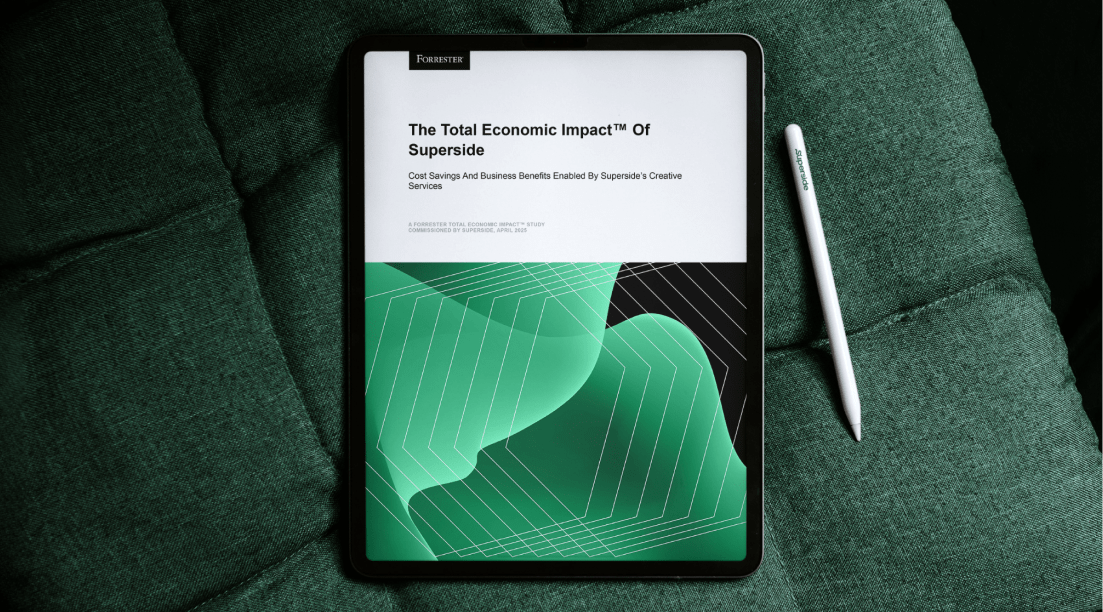
The model pays off. A commissioned Forrester Total Economic Impact study (April 2025) found a composite Superside customer achieved a 94% ROI with payback in under six months. Compared with a seven-figure in-house build that takes months to assemble and carries real hiring risk, partnering gives you more capability sooner at a more predictable cost.
That's why many enterprises use Superside as an extension of their in-house team rather than a replacement, adding hard-to-find AI fluency to the creative capability they already have.
How to decide, a simple framework
This doesn't have to be a one-path-forever decision. Here's a simple way to think about it.
- Build in-house if creative is a permanent, core, high-volume function you want to own, you can absorb a four to five month ramp and you have the budget and recruiting muscle to win scarce talent.
- Use freelancers for specialized or short-term needs, if you can manage the coordination yourself and consistency across projects isn't critical.
- Partner with an AI-native team if you need AI-fluent creative capacity quickly, want to avoid hiring risk and fixed headcount and value outcomes and scale over owning every seat.
Many teams end up with a blend: a lean in-house core for strategy and brand ownership, plus an AI-native partner for scale, speed and specialist depth. That combination gives you control where it matters and capacity where you need it.
The talent gap exists, but hiring isn't the only answer
Demand for creatives who pair excellent judgment with real AI fluency will only grow, and the market isn't going to catch up soon.
That leaves enterprise marketing and creative leaders with a choice. Compete for a scarce profile in a slow, expensive hiring market and hope you evaluate it correctly. Or work with a partner that already has that talent, is fluent in AI and is ready to work as an extension of your creative team.
Building in-house will always be right for some. For many teams, though, partnering is the faster, lower-risk path to AI-fluent creative firepower. To see what that looks like, explore our AI-native creative model or book a call to talk through the build-versus-partner decision for your team.
FAQs


Meet Customers Who’ve Experienced Exceptional ROI
Discover how Shopify got 4,375 assets in 12-24 hours or how Amazon saved 345 hours in three months.



Give your internal teams the power to boost your brand
Publish once. Deliver everywhere. Our Creative Ops platform
puts your brand in front of the right people, everywhere.
Unlock seamless content distribution. Access your audience.


Ready to see it in action?
The best way to understand it is to experience it.
Because once your creative system has memory,
you won’t want to go back to starting from scratch.

The data speaks for itself
According to a Forrester Total Economic Impact™ study, Superside delivers a 94% ROI and pays for itself in six months.


Your creative team's creative team
Choose the world's leading AI-powered creative service
and get high-performing ads, videos, experiences and
more at scale, on your schedule and to your standards.