








Creative quality is one of the biggest drivers of advertising results. Yet many teams still treat click-through rate as effectiveness. This article defines creative effectiveness, lays out the dated evidence and gives you a four-layer measurement framework (pre-launch quality, in-market activation, brand effects and business contribution) that connects short-term metrics to long-term growth.
Brands and marketers spent over $1 trillion on advertising worldwide in 2025. According to System1's Orlando Wood, writing for Think with Google in January 2026, maybe only 6% of it was truly effective.
Wood argues that advertising has lost its balance. Teams have prioritized "salesmanship," which uses rational messages to drive immediate purchases, over "showmanship," which uses stories, characters and emotion to make brands memorable and drive growth.
The only risk is that if you focus too heavily on today's sales, you're probably doing too little to build tomorrow's demand.
But what exactly counts as creative effectiveness, and how do you measure it?
This article unpacks the evidence, explains which metrics matter and highlights what marketing teams often get wrong. It then lays out a four-layer measurement framework that connects immediate results and long-term brand effects to commercial value.
Why creative effectiveness matters more than creative performance
Creative measurement lives at two extremes.
One focuses on immediate creative performance: click-through rate (CTR), cost per acquisition (CPA) and conversions. The other focuses on brand health: awareness, consideration and how readily buyers think of your brand. Both matter, but neither tells the whole story on its own.
Creative effectiveness brings the two together. It asks: How much does our creative contribute to commercial results, both now and over time? Did it generate additional sales? Strengthen brand recognition? Help build future demand? And how much of that impact came from the creative, rather than the audience, placement or media budget?
What creative effectiveness means today
Creative effectiveness measures the commercial value a piece of creative generates relative to what an average or weaker version would generate with the same media spend.
Three principles guide how you measure it:
- The right benchmarks: Compare your creative with relevant category norms, previous campaigns or alternative executions. System1's Star Ratings, for example, predict long-term brand growth from an ad's creative quality, with 3.0 labeled "good." System1 also argues that effectiveness is relative, so how an ad performs against its competition matters as much as its absolute score.
- Different measures for short- and long-term effects: Conversion rate, CPA and incremental sales help assess immediate results. Brand awareness, consideration and mental availability help track effects that support future demand. Measuring both gives you a fuller picture.
- Media support: Results depend on both the creative and how it reaches people. Spend, reach, frequency, placement and targeting all influence outcomes. To isolate the creative's contribution, use controlled comparisons and account for differences in media support.
Don't get your lingo mixed up
Creative quality, creative performance, creative effectiveness and brand health describe related but different things.
Each answers a different question:
| Term | Question it answers | What to measure | When to measure it |
|---|---|---|---|
| Creative quality | Is the creative clear, engaging and recognizably ours? | Message comprehension, emotional response, correct brand recognition and distinctiveness | Usually before launch, with further checks as needed |
| Creative performance | How are people responding to this ad? | CTR, conversion rate and CPA | During the campaign, once enough data is available |
| Creative effectiveness | How much does the creative contribute to our business goals? | Additional sales or profit attributable to the creative, ROI and contribution to longer-term brand growth | Across the campaign and beyond, depending on goals |
| Brand health | How well is our brand known, considered and remembered? | Awareness, consideration, brand associations and how readily the brand comes to mind in buying situations | Regularly over time, often monthly or quarterly |
Our guides to creative performance and improving ad performance go deeper on what to measure before launch and over the short and medium term.
The evidence: Where creative value lives and dies
Short-term metrics show what's working now, but they don't capture the creative's full value over time.
Here's what the research says, with the publisher and date for every figure.
Creative quality drives profit
In a February 2023 study, Kantar matched around 450 ads from its Link database of 250,000+ ads with return-on-marketing-investment profit figures from WARC. The most creative and effective ads generated more than four times as much profit.
Kantar's longer-term measure, which looks at whether ads make a brand feel meaningful, different and salient, showed an even stronger relationship with profit than the short-term sales measures.
Zappi reports a similar link. In its State of Creative Effectiveness report (June 2025), based on 4,000+ US ads, Zappi says its validation research found 30% greater ROI from ads with strong creative effectiveness. It also found a wrinkle worth knowing: ad distinctiveness declines sharply among viewers aged 46 and over.
Creative is the biggest driver of incremental sales
In an August 2023 meta-analysis of almost 450 CPG campaigns, NCSolutions (not Nielsen, as it's often misattributed) found that the factors contributing to incremental sales were:
- Creative: 49%
- Brand: 21%
- Reach: 14%
- Targeting: 11%
- Recency: 5%
Creative contributes more than reach, targeting and recency combined. Its share is also unchanged from the 2017 version of the analysis, which NCSolutions ran with Nielsen.
The cost of dull advertising
The Extraordinary Cost of Dull report, a collaboration between eatbigfish (Adam Morgan), Peter Field and System1, puts a price on creative that fails to move people:
- In the US: Bringing dull TV ads up to the effectiveness of non-dull ads would require an estimated $189 billion in extra media spend.
- In the UK: The equivalent figure is £13.29 billion.
- Neutral reactions: On average, 52% of responses to UK TV ads and 47% of responses to US TV ads are neutral.
The findings reinforce Wood's call to balance salesmanship with showmanship. Ads that prompt an immediate purchase have a role, but relying on them too heavily comes at the expense of the emotional connection and brand preference that support long-term growth.
A longstanding warning about short-term thinking
Dull advertising isn't a new problem. Peter Field's report for the IPA, The Crisis in Creative Effectiveness (2019), covered almost 600 IPA case studies from 1996 to 2018.
Its headline finding was stark: Creatively awarded campaigns had become no more effective than non-awarded ones. Field identified short-termism as the main driver of that collapse in effectiveness and efficiency. The data is now several years old, but the newer research above suggests the warning still applies.
Together, these findings support a balanced approach. Use performance benchmarking and creative experimentation to improve immediate results, and give brand-building creative enough time and support to deliver longer-term growth.
Why has ad effectiveness declined?
The shift toward short-term, sales-led ads is a major reason creative effectiveness has declined. Here's what drove that shift.
Attention moved to the easily measurable. Digital tools have made immediate responses cheap to measure and easy to track. That's useful for assessing short-term creative performance, but it can skew priorities. Many teams now base budgets and creative decisions on the metrics that report fastest, at the expense of long-term brand building.
Rational replaced emotional. The focus on immediate results has pushed many teams toward product facts and sales messages designed to lift CTR and lower CPA. These ads may drive clicks, but they often lack the personality and emotional appeal that build lasting memories and brand affinity.
Volume replaced craft. Ad fatigue and the constant demand for fresh creative leave many teams scrambling to fill ad slots, with little time to craft memorable work. The result is often the dull advertising the research describes. Without proper training, teams also risk using generative AI to produce more of the same.
If you remember one message from this article, make it this one: Your team should absolutely focus on designing high-performing ads at speed and scale. But long-term success also requires a data-driven mindset, a clear AI creative strategy and solid frameworks to measure ROI and creative effectiveness.
How to measure creative effectiveness: The four-layer framework
To measure creative effectiveness accurately, work across four distinct layers.
Layer 1: Pre-launch quality
Before committing ad spend, test whether your creative has the properties that predict effectiveness. Look for:
- Emotional resonance: Is the asset or campaign designed to connect with your target audience?
- Distinctiveness: Will this ad stand out in a busy feed? Is it memorable and recognizable?
- Brand strength: Will people immediately recognize this ad as yours?
- Comprehension: Are the message and CTA clear? Do people understand what you're offering?
Use a simple checklist to review each ad, then test what works. For paid social, that means testing concepts first, then hooks and smaller details, and measuring success against your campaign goals.
Layer 2: In-market activation
Once your ad is live, short-term metrics show how it's performing.
Track click-through rate (CTR), conversion rate, cost per acquisition (CPA) and return on ad spend (ROAS). These help you spot changes and adjust your campaigns. Allow time for conversions to come through and gather enough data before drawing conclusions.
At this stage, also track how long ads stay effective and use A/B testing to compare versions under similar conditions.
It's easy to focus on this layer alone. But while these metrics help you improve immediate results, they don't show the full picture.
Layer 3: Brand effects
Next, assess how your advertising strengthens your brand over time. Review the first two layers alongside these measures:
- Brand salience: Does your brand come to mind in relevant buying situations?
- Asset recognition: Do people correctly link your colors, symbols or characters to your brand rather than a competitor?
- Brand lift: Did your campaign improve awareness, ad recall or consideration? Compare people exposed to the campaign with a comparable group who weren't.
- Brand consideration: Is your brand among the options people would consider buying?
Use consistent audience research to track these measures over time. Where possible, use controlled studies to understand which campaigns drove the changes.
It also helps to work with sales and PR to interpret the findings. Sales can share what prospects remember and why they shortlist your brand, while PR can add context about coverage and public perception. Use these insights to inform your brand strategy.
Layer 4: Business contribution
Finally, look at how your creative contributes to key financial metrics. Does it help drive growth across the business? Does it build value in both the short and long term? Does it help grow market share?
This layer takes longer to build, and it needs to be measured against baselines for your business and category. With repetition and consistent comparisons, though, your team will find it easier to tie specific campaigns back to short- and long-term gains, which is the exact definition of creative effectiveness. Our guide to the ROI of design shows how to make that case.
Putting it all together
This table sums up how to use the four layers together: what you measure, how often you review it and who owns it.
| Layer | Question | Cadence | Owner |
|---|---|---|---|
| Pre-launch quality | Will this work? | Per asset or campaign | Creative team |
| In-market activation | Is this working now? | Weekly | Performance marketing |
| Brand effects | Is it building long-term value? | Quarterly | Brand and insights |
| Business contribution | Did this generate measurable value or profit? | Annually | CMO and finance |
What research tells us about effective creative
Creative that drives tangible results tends to follow a few principles.
1. Product benefits and demos drive results
Kantar's best practices for creative effectiveness (May 2022), drawn from testing more than 13,000 ads across 75 markets, found that:
- Ads that communicate product benefits see a ten-point increase in persuasion.
- Showing the product in use or being consumed lifts brand affinity by ten points.
Kantar also notes that demos can create real empathy with consumers, as long as they feel authentic and natural.
2. Emotional connection beats pure rationality
The research above points the same way. Wood's showmanship argument, Kantar's finding that long-term brand measures predict profit best and the Extraordinary Cost of Dull all suggest that creative people feel something about outperforms creative that only informs.
The IPA and Financial Times research on emotion makes the point in its title: "Emotion. The most rational thing a brand can use."
3. Distinctive, on-brand creative improves recall
Ipsos research (September 2026) found that brands with many strong distinctive assets are 31% more likely to be considered and 38% more likely to be used.
The Ehrenberg-Bass Institute's work explains why distinctive brand assets matter for mental availability. Note, though, that there's no Ehrenberg-Bass "creative effectiveness multiplier," despite what some sources claim.
Most brands still have work to do. In research by Ipsos and Jones Knowles Ritchie reported by Marketing Week, only 15% of brand assets were truly distinctive, and 65% fell into the weakest category.
Five common mistakes that break effectiveness measurement
Watch out for these traps:
- Treating CTR as effectiveness: CTR is purely an activation metric. It says nothing about brand effects or profit, so don't overweight it.
- Measuring the campaign, not the creative: Measure both campaign and individual asset effectiveness. A creative analytics platform like Superads, which works at several levels, makes this much easier.
- Ignoring long-term results because they take time: Brand building doesn't happen overnight. Your framework needs to track long-term progress alongside immediate performance.
- Comparing your results with the wrong benchmarks: What counts as strong performance varies by market and category. Compare your results with relevant norms.
- Relying on weak research and misattributed stats: Base creative decisions on credible research with clear publishers, dates and methods. Finance will check.
How Superside helps deliver creative effectiveness
Putting effectiveness into practice takes craft, disciplined testing and reliable measurement. Superside is an AI-native creative agency that brings those together.
We pair AI-native experts with AI systems to create ad creative that measurably performs. Everyone can generate an ad. Not every ad performs, and that's the gap we close.
- Understand what drives performance: Superads brings ad performance across Meta, Google, TikTok and LinkedIn into clear dashboards and reports, so your team can compare creative, spot trends and feed what works into the next campaign.
- Create campaigns that connect immediately: For luxury jewelry brand Suzanne Kalan, we paired a real mother-daughter duo with TikTok-native storytelling for the #DoubleTheLove campaign. TikTok views increased by 5,124% in three weeks. That's activation.
- Build a brand system that lasts beyond launch: For Colgate-Palmolive, we co-created a global brand system supporting 200+ markets, with guidelines and 1,008+ assets that help employees create consistent communications across channels. The launch achieved about 98% positive social sentiment, and about 99% of employees say they feel proud when they see the new brand. That's brand effect.
Behind the work, Brand Brain, our AI context engine inside our Superspace creative management platform, carries your brand guidelines, past work and feedback into every brief.
Paired with insights from Superads, it helps us build on-brand creative, refine it based on real results and deliver the kind of effectiveness this article defines.
The efficiency case is independently validated too. In a Total Economic Impact™ study commissioned by Superside (April 2025), Forrester found a 94% return on investment and $4.16 million in benefits over three years for a composite organization based on customer interviews, including lower spend on external agencies and time saved for internal teams.
Effective creative wins now and builds for later
Effective creative earns its keep twice: It drives results today and builds demand for tomorrow. To measure that value, look beyond clicks and conversions to what people remember, how they see your brand and whether your creative contributes to business growth.
The teams that get this right make room for emotion, distinctiveness and craft. They measure across all four layers, test their ideas and use what they learn to make the next campaign stronger.
That takes expertise and the right system behind it. Superside can bring both.
Ready to make your creative work harder, now and over time? Book a call with Superside.
FAQs




Meet Customers Who’ve Experienced Exceptional ROI
Discover how Shopify got 4,375 assets in 12-24 hours or how Amazon saved 345 hours in three months.

The data speaks for itself
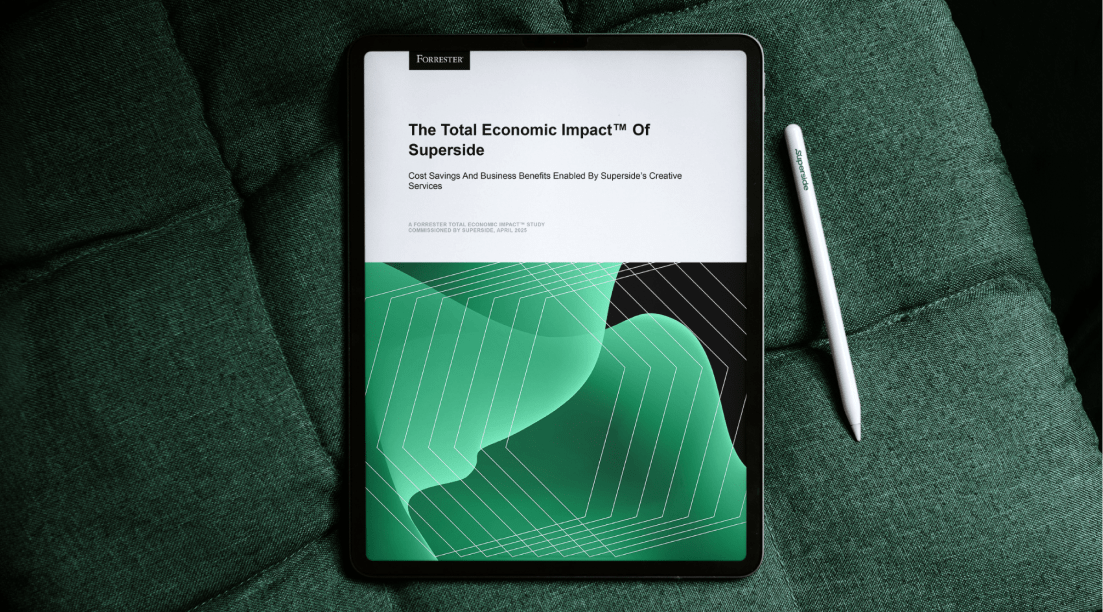
According to a Forrester Total Economic Impact™ study, Superside delivers a 94% ROI and pays for itself in six months.


Say yes to bigger campaigns
Our AI-native creative agency helps your team
take on more formats and markets with no new headcount.


