

An AI roadmap is a phased plan, not a tool list, and it runs across three workstreams: a diagnostic, operational enablement and a go-to-market plan. This guide gives you all three, plus a 90-day starter timeline, the roadblocks to expect and the four metrics that prove it's landing. The proof is Mekanism, a Cannes-winning agency that used this exact structure with Superside to reach 85–90% AI adoption in under eight months.
Most creative teams don't lack enthusiasm for AI. They lack a clear path from experimentation to adoption. They invest in AI-powered tools, test prompts and piece together one-off workflows, but never quite pick up speed, because those efforts never become operationalized.
An AI roadmap changes that.
This guide lays out a step-by-step roadmap for turning an AI-curious creative team into an AI-first one. It also shows the plan in action through Mekanism, a Cannes-winning agency that partnered with Superside to reach 85–90% AI adoption in under eight months.
The problem isn't AI enthusiasm, it's the missing plan
Talk to almost any creative team and you'll hear the same story. Most individual team members use generative AI tools and custom GPTs, but with their own prompts, processes and workarounds. Month after month, not much actually changes in how the team works. Individual trials and even team pilots never become efficient shared workflows.
This failure mode is so common that it has a name: pilot purgatory. The evidence is sobering.
- An MIT report found that roughly 95% of enterprise generative AI pilots deliver no measurable impact on the bottom line, with only about 5% achieving rapid revenue acceleration.
- Gartner predicted that at least 30% of generative AI projects would be abandoned after proof of concept by the end of 2025.
- BCG's 2025 research put only about 5% of companies in the leading group on AI, and those leaders report five times the revenue increases and three times the cost reductions of everyone else.
The gap between those two groups is rarely the technology they bought. It's whether adoption was structured or left to chance.
McKinsey's State of AI research makes the point precisely. Nearly nine in ten organizations now use AI in at least one business function, yet only 44% report scaling it across the enterprise. What separates the high performers is workflow redesign: about three quarters of them fundamentally redesign workflows around AI, compared with roughly a quarter of everyone else. And when revenue gains show up, they're most often attributed to AI in marketing and sales.
The takeaway: adding more AI tools isn't enough. Turning individual experimentation into widespread adoption and real business value means rethinking shared workflows, building the right capabilities and making AI part of how the work gets done every day. That structure is what an AI roadmap provides.
What an AI roadmap for creative teams actually is
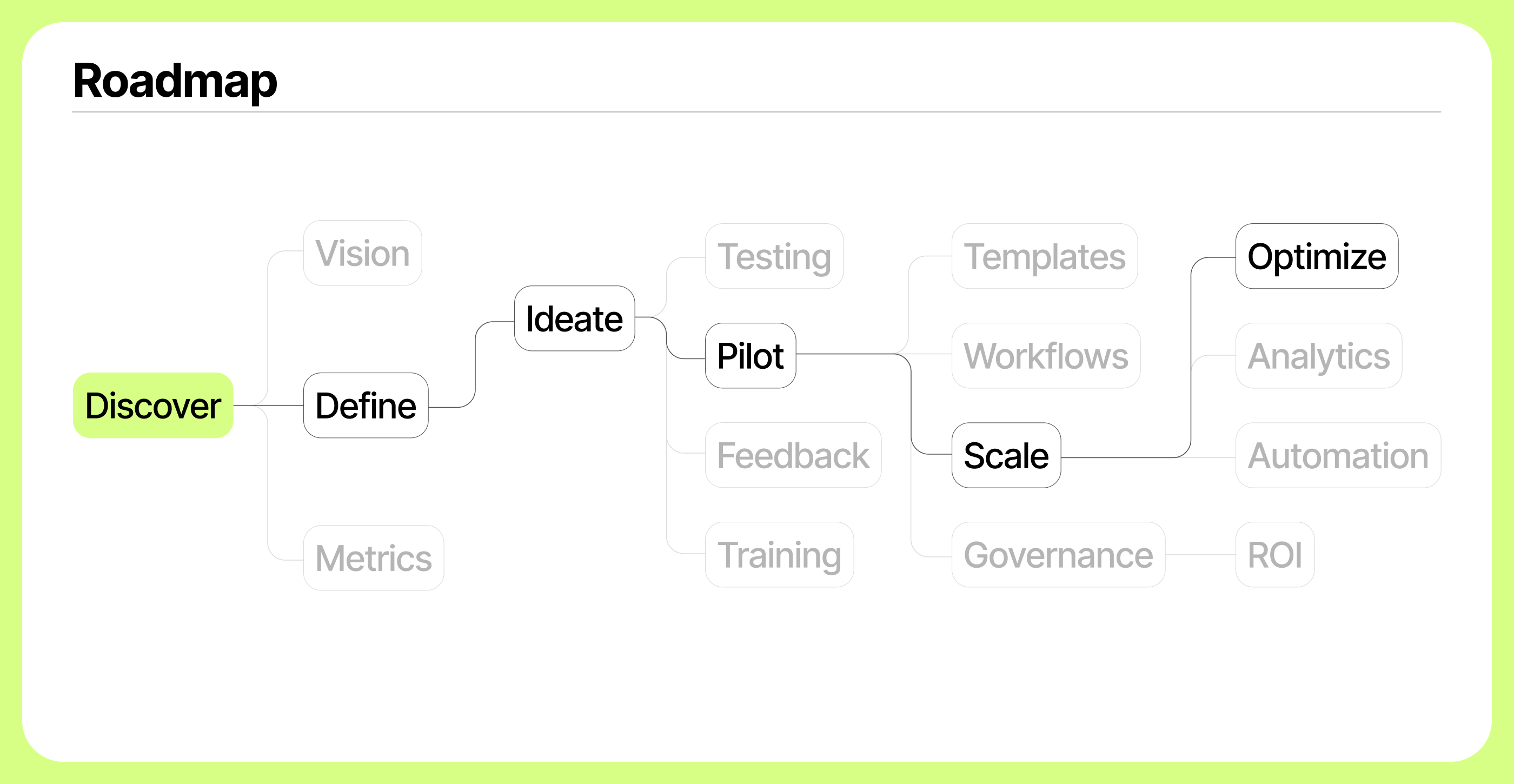
An AI roadmap for creative teams is a phased plan for adopting AI in ways that improve the work, become everyday practice and scale creative output without compromising brand consistency or quality.
It's deliberately not a long list of AI tools and features. Creative technology changes too quickly for that. Instead, it lays out the decisions, priorities and actions that move a team from inefficient individual AI use to shared, AI-powered workflows.
A good roadmap answers four questions in order:
- Where will AI create the most value in our specific creative workflows?
- What skills, workflows and guardrails do we need to build to get there?
- How do we turn that new capability into better output and stronger business results?
- How will we measure success and track progress?
The rest of this guide organizes the roadmap around three workstreams that answer those questions.
| Workstream | The question it answers | What you build |
|---|---|---|
| AI diagnostic | Where will AI create the most value in our workflows? | Readiness baseline, workflow map, use-case shortlist |
| Operational enablement | What skills, workflows and guardrails do we need? | Role-based upskilling, redesigned workflows, change management, responsible AI guardrails |
| Go-to-market plan | How does new capability become output and results? | Capacity plan, faster campaign cycles, positioning and pricing for AI-enhanced services |
This is the same structure that took Mekanism, an award-winning full-service creative and media agency, from AI uncertainty to near-total adoption. More on that case below.
Side note: if you're still aligning your team on the bigger picture, start with why the conversation has moved from "if AI" to "how", then explore the practical foundations of AI adoption for creative teams.
Workstream 1: Start with an AI diagnostic
Before you plan what comes next, you need to understand where you are now.
The first workstream maps your current reality, checks AI readiness, identifies knowledge gaps and finds the highest-value places to apply generative AI. Skip it, and you risk investing in low-impact workflows while overlooking the opportunities that would meaningfully improve your output.
A creative AI diagnostic should cover three things.
- A readiness baseline. Do the research and check in with your team. Where are AI tools already being used, quietly or openly? What are the biggest shifts that need to happen? What do people actually fear? This audit surfaces both hidden AI usage and the resistance you'll need to address. Our AI readiness assessment is a useful template for this step.
- A workflow map. Map how creative work actually moves, from brief and concept through production, delivery and measurement. The goal is to uncover bottlenecks, repetitive tasks and time sinks that AI could streamline.
- A use-case shortlist. Overlay the two. Where will AI create the most immediate value with the least disruption? For most creative teams, ideation, copywriting and rapid prototyping or proof-of-concept development rise to the top. That's exactly what surfaced at Mekanism.
The point of the exercise is to replace guesswork with evidence. An outside perspective helps enormously here, because the people inside a team are often too close to the work to see their own patterns.
Workstream 2: Build operational enablement
A diagnostic tells you what to do. Operational enablement is where you build the capability, and it's the workstream most teams underinvest in. Getting access to the right AI-powered creative tools is easy. Getting a hundred creatives to adopt new workflows is a different story.
Operational enablement has four parts.
1. Upskilling, tailored by role. Training matters, but senior creative directors and junior designers need very different things. Directors need to learn how to direct and evaluate AI-assisted work and redesign their processes around it. Designers and producers need hands-on fluency in the tools in their stack. Generic, one-size-fits-all training is a big reason adoption gets stuck in first gear, which is why Superside approaches AI upskilling and gen AI training by persona rather than as a single course.
2. Workflow redesign. This is the step McKinsey's data singles out as the biggest value driver. Rather than bolting AI onto old processes, rebuild the creative workflow around where AI genuinely helps and where human judgment has to stay in charge. A well-designed workflow for experimenting with AI lets the team learn fast without chaos.
3. Change management. Fear, confusion and quiet resistance kill more AI initiatives than any tool limitation. A deliberate change management process that names those fears, aligns leadership on the direction and identifies internal AI champions is essential. It's worth remembering that large transformations fail about 70% of the time, usually because of people rather than technology.
4. Guardrails and responsible AI. Enablement without governance is a one-way ticket to fast, inconsistent, off-brand work. It also exposes the brand to copyright risk, data exposure, biased output and factual errors. Building responsible AI principles and quality guardrails into the roadmap is what lets a team move quickly without diluting the brand.
The golden thread connecting all four? AI adoption requires a shift in how people think, create and collaborate. Addressing the barriers to AI adoption head-on is what turns occasional individual experimentation into lasting, team-wide practice. If you're at the very beginning, our guide to introducing AI into a creative team is the right first read.
Workstream 3: Add a go-to-market plan
Creating more work in less time may look like success, but efficiency isn't the finish line. This workstream determines where the extra capacity should go, and how it advances marketing priorities and business growth.
For an in-house team, that means turning new creative capacity into more ambitious output, faster campaign cycles and the kind of volume and experimentation that weren't possible before.
For agencies, the opportunity goes further. AI-enhanced creative capabilities can become new service offerings, delivery models or pricing structures. Mekanism used this workstream to work out how to package and position its AI-enhanced creativity as a differentiated offering in market.
Marketing teams have a head start here, because AI use is already widespread in the function. MarketingProfs, reporting on Mediaocean's 2025 research, found marketers using generative AI most for data analysis (47%), market research (46%) and copywriting (34%), with a quarter using it for image generation and creative versioning. What's usually missing is a plan for converting that activity into business value. That's the purpose of this workstream.
For more on putting new capability to work, read our pieces on scaling creative production with AI and our guide to accelerating AI adoption.
How Mekanism reached 85–90% AI adoption in under eight months
Mekanism shows how the three-workstream roadmap takes a top-tier agency from AI uncertainty to near-total adoption.
Mekanism is an award-winning American creative agency with more than 100 employees across North America and multiple Cannes Lions to its name. It works with brands including Alaska Airlines, Peloton, Ben & Jerry's, Jose Cuervo and Amtrak, and its reputation is built on bold, culturally relevant campaigns.

As AI began reshaping the advertising industry, Mekanism hit an inflection point. Leadership wanted the agency to move quickly, but needed a clear approach to tools, implementation, governance and organizational change. The urgency and the desire were there. The structure was not, and neither was a partner who had actually been through it.
We quickly wanted to get at the forefront of AI, and we wanted to figure out what tools, what implementation, and what processes we needed to develop in order to be on the bleeding edge. And we really needed a partner that was an expert in that to help us.

That's why they chose Superside, the world's leading AI-first creative partner. We had already transformed into an AI-first company ourselves, so we could guide the journey from experience rather than theory.
For us, Superside was the right partner because they actually went through a transformation themselves into an AI-led company. And that was really important for us.

We structured the engagement around the three workstreams above:
- AI diagnostic. We surveyed employees, assessed existing workflows and identified the highest-value opportunities. Ideation, copywriting and proof-of-concept creation emerged as the key use cases.
- Operational enablement. We developed tool and deployment recommendations, an upskilling roadmap, change management and governance models, and responsible AI guidelines.
- Go-to-market strategy. We helped define how Mekanism could position, package and monetize AI-enhanced services for its own clients.
What Mekanism valued most was exactly what most AI efforts lack: a process.
They brought a structure for the whole experience and very formally took us through a process that they've been through and applied it to our agency in a really thoughtful way.
The engagement gave Mekanism a clear organizational identity around AI: human-led, AI-augmented. It also produced tangible results. More than 10 senior stakeholders aligned around a common AI direction. The agency launched Mekanism AI Superstudio, a dedicated internal unit built to help teams develop AI skills and apply AI tools. And it defined a positioning and monetization model for offering AI as a service.
Within eight months, AI adoption across the agency reached 85–90%. Over the same period, receptiveness grew rapidly while fear and confusion declined.
The reception of AI at Mekanism has grown almost exponentially in the last eight months.
Your first 90 days
A full AI roadmap unfolds over quarters, but you can get moving in 90 days.
| Phase | Days | What you do |
|---|---|---|
| Diagnose | 1 to 30 | Run the readiness survey, map core workflows, shortlist three to five high-value use cases and set your baseline |
| Enable | 31 to 60 | Launch role-based training and AI demo days, redesign one or two high-volume workflows, put initial responsible AI guardrails in place |
| Scale and define success | 61 to 90 | Expand what's working, retire what isn't, align leadership on business goals and start tracking adoption and time saved |
The goal of the first 90 days isn't full transformation. It's momentum and proof, which is what earns the mandate to go further.
Common roadblocks and how to get past them
Even a well-built roadmap runs into the same recurring obstacles. Plan for them.
- Fear about job security. The quiet worry that AI will replace people slows adoption more than any tool gap. Address it head-on by framing AI as a way to remove the heavy lifting, the time-consuming repetitive work nobody loves, so team members can focus on the work that needs human creativity and strategic thinking.
- Concern about creative quality. Many senior creatives fear AI will dilute brand identity. The answer is clear guardrails and human-in-the-loop review, so AI raises the floor without lowering the ceiling.
- No time to learn. Creative teams are already under enormous pressure, so training gets skipped. Build enablement into real projects rather than treating it as extra homework, and start with the use cases that give people time back fastest.
Naming these openly, rather than hoping they resolve themselves, is what keeps a roadmap moving.
How to measure success
Without metrics, you can't know whether your roadmap is working. Set your baseline, then track a mix of adoption and impact signals.
| Metric | What it tells you |
|---|---|
| Adoption rate | The share of the team actively using AI in their work. The clearest signal that the roadmap is landing |
| Time saved | Hours returned on repetitive tasks and redirected to higher-value creative work |
| Quality and brand consistency | Whether AI-assisted output meets the brand and quality bar |
| Business impact | Faster campaign cycles, more creative output and eventually revenue, measured against your baseline |
For a structured approach, our framework for measuring AI ROI for creative teams and our analysis of AI ROI in creative workflows are strong references. Mekanism's 85–90% adoption figure is itself a model metric: simple, credible and unmistakably tied to the roadmap.
Build the roadmap yourself or bring in a partner

You can absolutely build and run an AI roadmap in-house if you have the time, the internal expertise and the appetite to learn by trial and error in a space that changes monthly. Many teams start there.
But even a team as experienced as Mekanism saw the value of outside support. Working with a partner that had already navigated an AI transformation helped the agency move faster, avoid common missteps and build on a proven approach.
That's what Superside offers as the world's leading AI-first creative partner. We went through our own transformation into an AI-first company, and we now run AI consulting and AI enablement engagements that take creative teams through the same structured roadmap. Being AI-first means AI isn't just powering individual tools. It's embedded across the entire creative model, from how teams are trained to how brand knowledge compounds over time. That's also the thinking behind our human-led, AI-powered approach: great creative still needs great creatives.
The impact is documented. Mekanism reached 85–90% AI adoption, while a Fortune 500 company doubled its adoption rate and Sherweb rebuilt its creative operation around AI. More broadly, a Total Economic Impact study commissioned by Superside and conducted by Forrester Consulting (April 2025) found a 94% ROI for a composite organization, with payback in under six months.
If AI is already part of your team's work but still lives in scattered tools, prompts and workarounds, a roadmap turns that disconnected activity into shared, scalable workflows. Book a call to build yours and let us become your creative team's creative team.
FAQs




Stuck in AI testing mode?
It’s time to move from experiments
to real impact.
Explore AI Reset—a 5-step framework
to embed AI into your creative workflows.


How AI-ready is your team?
Take our free 2-minute assessment to benchmark your AI readiness and get:
- Your AI readiness score
- A snapshot of where your team stands today
- Curated resources to help you apply AI more effectively

AI Consulting Services
Unlock custom AI solutions built for scale, creative impact and real team adoption—guided by Superside's experts.

Your creative team's creative team
Choose the world's leading AI-powered creative service
and get high-performing ads, videos, experiences and
more at scale, on your schedule and to your standards.