




Most B2B teams have an ABM strategy, but with buying groups of 13 to 17 stakeholders, every target account needs more tailored creative than an in-house team can hand-build. These eight ABM campaign examples, from GumGum's bespoke comic for T-Mobile to DocuSign's industry homepages and Engagio's bobbleheads, show how to match personalization to account value and deal stage.
Account-based marketing (ABM) looks simple enough on paper: Choose your target accounts, map the buying committee, use intent data to spot interest and align sales and marketing around the accounts that matter most.
The difficulty starts when you try to make that strategy feel personal.
Demandbase's State of ABM 2026 benchmark found that organizations that align marketing and sales around buying groups achieve up to 2 to 3x higher win rates than teams that still center execution on individual leads. A typical buying group, it says, includes 13 to 17 stakeholders, each with different priorities and levels of influence.
A good ABM strategy can only go so far if the creative operation can't keep up. Without the right production system, personalization shrinks to a swapped logo and a rewritten intro line rather than something that speaks to what a particular buying group cares about.
The eight examples below show what standout ABM creative looks like, which approaches can realistically scale and why account-specific pitch decks deserve as much attention as ads.
8 ABM campaign examples worth learning from
Taking a closer look at some of the best ABM campaign examples is a good place to start.
As you compare them, look at how much personalization each idea required, how repeatable it was and whether it could realistically scale across a broader target list.
1. GumGum's T-Mobile comic: Go bespoke when the account warrants it
 (Source: GumGum)
GumGum, an AI image recognition company, set its sights on telecommunications carrier T-Mobile.
After researching key decision-makers, the team learned that then-CEO John Legere was a big Batman fan. So they created a Batman-inspired comic book, T-Man and Gums in The Data Knight, casting Legere as the hero and GumGum's technology as the sidekick that helps him win.
Why it worked: The asset could only have been made for T-Mobile. For a truly strategic account, that level of effort signals value before the first sales conversation begins.
The lesson: Reserve bespoke creative for the key accounts that justify the investment. Trying to give every target the GumGum treatment breaks ABM economics.
2. Intridea's Ogilvy billboard: Sometimes the channel is the personalization
 (Source: Adweek)
In 2014, product design consultancy Intridea put up a billboard right near Ogilvy and Mather's New York headquarters. Its headline, "Ogle this, Ogilvy," pointed to a custom site with an equally direct message: "Made you look. Now hire us."
As Adweek reported, the stunt was a little blunt, but it seemed to get Intridea in the front door.
Why it worked: The targeting was built into the location. Intridea didn't need sophisticated marketing automation, because the people it wanted to reach walked past the message on their way to work.
The lesson: The channel itself can be part of the creative idea. But a bold move like this depends on getting the tone right. What feels confident to you could feel intrusive to the buyer.
3. O2 Business: Let the account insight become the creative
 (Source: The Drum)
O2 Business has run ABM with its agency, The Marketing Practice, for years. In an early program documented by B2B Marketing, the team piloted the approach within a single account in 2015 and rolled it out to 10 further strategic accounts the following year.
The centerpiece wasn't an ad. It was a bespoke report sent to each account by direct mail, built around that organization's own situation. One sample report for an NHS trust projected potential savings of almost £40 million over three years. The program went on to generate seven-figure closed business and seven-figure pipeline.
The partnership kept evolving. Its later "ABM on First Name Terms" campaign won Best Use of Data and Creativity at The Drum Awards for B2B 2022.
Why it worked: Deep research into each account's priorities gave the creative team something substantial to build around. The insight itself was the asset.
The lesson: Good personalization goes beyond names and logos. It should give the buyer an insight, argument or resource that feels relevant to their business.
4. Loom: Build personalization into a repeatable template
 (Source: Loom)
Loom gave B2B advertising a personal twist with LinkedIn ads tailored to specific target accounts. Each ad featured the target company's logo and showed how many people there were already using Loom, with job title and seniority layers added for the biggest accounts.
That social proof did the heavy lifting. Seeing colleagues already on the product made the ad feel relevant instead of generic.
Why it worked: Loom used its existing product adoption to make each ad specific and persuasive, without designing a new concept for every account.
The lesson: B2B creativity goes beyond visuals. Your targeting and audience segmentation deserve just as much creative thought.
Our roundup of standout B2B creative campaigns explores the Loom example in more detail.
5. DocuSign: Scale relevance by industry
 (Source: DocuSign)
DocuSign took a one-to-many ABM approach. Working with Demandbase, it built industry-specific homepages for six priority verticals, so visitors from target accounts saw messaging, proof points and use cases that matched their sector.
According to the Demandbase case study, DocuSign saw 300% more page views, tripled click-through rates and a 22% increase in sales pipeline.
Why it worked: DocuSign made its content more relevant by tailoring it to each industry's language, proof points and pain points, without rebuilding everything from scratch.
The lesson: Personalization doesn't have to be one-to-one. A few well-chosen segments, supported by modular landing pages and messaging, can make your ABM campaigns scalable.
6. Engagio: Make direct mail worth responding to
 (Source: Nicholas Scarvone)
Engagio, a B2B marketing software company later acquired by Demandbase, wanted to start conversations with marketing leaders at its target companies. Many of them would be at Dreamforce, Salesforce's annual conference, but standing out in a busy exhibition hall wouldn't be easy.
So Engagio created custom bobbleheads that looked like each decision-maker and invited them to pick up their personalized figurine at its Dreamforce booth.
The play, documented in Engagio's own ABM playbook on Business2Community, delivered a 31% meeting rate.
Why it worked: The bobbleheads were personal, memorable and gave prospects a clear reason to show up at a crowded event.
The lesson: A personal gift can give buyers a reason to respond. Connect it to a clear next step so the attention has somewhere to go.
7. Hewlett Packard Enterprise: Create an experience worth showing up for
 (Source: HPE)
Hewlett Packard Enterprise wanted to grow in retail and financial services, where senior decision-makers were already flooded with marketing. Instead of adding more noise to busy inboxes, HPE and its agency McDonald Butler started with research.
The team built detailed profiles of the top 50 retail and financial services companies and the key influencers inside each account. Then they used those insights to shape content and outreach.
Once HPE had established relevance, it moved the conversation offline with an exclusive series of C-level supper club roundtables in premier London venues. The insights from those discussions later fed white papers and blog content.
According to B2B Marketing, the wider program generated a $150 million pipeline and $33 million in revenue wins at the time of reporting.
Why it worked: HPE used deep account research to shape the guest list, discussion topics and follow-up, so the experience felt relevant rather than promotional.
The lesson: Executive experiences work best when they're built around the conversations your target accounts already care about.
8. The account-tailored pitch deck: The ABM asset nobody puts on these lists
This one isn't a single campaign, but it belongs on the list. The pitch deck is one of the most important ABM assets in the sales cycle, and one of the easiest to neglect.
Marketing and sales teams often spend months engaging an account through targeted campaigns, personalized content and advertising, only to reach the decision stage with a generic deck.
At that point, key stakeholders compare options, question the business case and decide whether to move forward. The deck needs to address the account's priorities, pain points and likely objections. It also needs to be 100% on-brand.
Tailoring decks for every account takes time and design skill. That's why teams build modular presentation templates with consistent layouts, reusable slides and baked-in brand elements, so sales can adapt the story for each account without starting over.
For inspiration, see our roundups of the best sales decks and best pitch deck examples, or our guide to sales deck design for enterprises.
Why it works: The closer a deal gets to a decision, the more relevant the creative needs to become. An account-tailored deck lets the sales team answer the buying committee's specific questions and concerns.
The lesson: Don't spend heavily on personalized top-of-funnel creative and then fall back on a generic presentation when the stakes are highest.
What high-performing ABM campaigns have in common
These ABM campaign examples all used different creative approaches. Across the board, though, the brands applied the same principle: They matched the level of personalization to the account, audience and sales stage.
| Example | Creative approach | Estimated relative cost per account | Repeatability |
|---|---|---|---|
| GumGum and T-Mobile | Bespoke hero asset | Very high | Low by design |
| Intridea and Ogilvy | Account-specific media placement | High | Low |
| O2 Business | Account-specific insight report | High | Medium |
| Loom | Modular one-to-one ads | Low to medium | High |
| DocuSign | Industry-specific pages | Low | Very high |
| Engagio | Personalized gifts | High | Low to medium |
| Hewlett Packard Enterprise | Executive experiences | High | Medium |
| Account-tailored pitch deck | Modular account-specific decks | Medium | High |
Note: The most successful ABM teams match investment to account value and deal stage. Then they use modular systems to scale everything else.
Creative quality still decides whether ABM gets noticed
ABM can put your message in front of the right people, but the creative still needs to give them a reason to care. Relevant messaging and precise targeting work best when the assets themselves are engaging.
B2B ad research shows why. A LinkedIn and Magna study tested 67 LinkedIn ads with 1,700 business decision-makers, and many felt B2B advertising fell short:
- 64% believe B2B ads lack humor
- 60% feel they lack emotional appeal
- 59% say they don't see relatable characters
Yet ads seen as creative drove a 40% higher likelihood of purchase consideration than noncreative ads.
Creative also needs enough investment behind it. LinkedIn's B2B Institute and WARC analyzed 435 B2B cases from 2010 to 2021 for The B2B Effectiveness Code and found that "creative commitment," a composite of media budget, campaign duration and number of channels, has declined significantly in B2B.
These findings aren't specific to ABM, but they're a useful reminder: Reaching the right buyers is only part of the job. Teams also need to invest in creative worth noticing and give it time to build familiarity.
Timing matters too, because buyers aren't always ready to purchase. The Ehrenberg-Bass Institute's 95-5 rule suggests that most potential buyers in many B2B categories are out of market at any given time. Professor John Dawes explains the math behind it:
Corporations change service providers such as their principal bank or law firm around once every five years on average. That means only 20% of business buyers are 'in the market' over the course of an entire year; something like 5% in a quarter, or put another way, 95% aren't in the market.
Dawes is clear that the number is a heuristic, not a law: "The 95% figure is not meant to be a precise rule."
For ABM teams, the practical lesson is to plan for both immediate and future demand. Some target accounts may be ready for a sales conversation. Others need to remember your brand when a relevant need comes up. Your creative should support both.
Map ABM creative to the sales cycle
For creative teams, the math gets uncomfortable quickly. More stakeholders, channels and account-specific messages mean more creative to produce across every target account list.
The creative behind effective ABM campaigns needs to change as an account moves through the funnel.
- Early stage: LinkedIn ads, display, video and thought leadership build familiarity across the buying group. Our LinkedIn marketing strategy guide covers the channel in depth.
- Mid-funnel: Content, email, retargeting and customer proof give sales and marketing the material they need to address specific pain points and deepen engagement.
- Decision stage: Creative volume may drop, but its importance increases. Executive decks, business cases and proposals need to become more account-specific as buyers compare options and look for reasons to choose one partner over another.
Our guide to high-performing cross-channel campaigns shows how to coordinate these formats without fragmenting the experience.
How to brief ABM creative so it comes back specific
Strong ABM campaigns depend on briefs that do more than say, "Personalize this for account X."
If you're responsible for ABM briefs, answer these questions before work starts:
- Who are we trying to influence? Define the audience inside the account, including the roles and key stakeholders you need to reach.
- What matters to them? Bring in intent data, sales conversations, industry context and the account's current priorities. Personalized content is easier to craft when the creative team has something specific to respond to.
- What must the asset do? A LinkedIn ad, a CFO business case and a pitch deck solve different problems.
- How far should personalization go? Be clear whether the account warrants bespoke work, modular variants or vertical-level relevance, such as pages or messages tailored to an industry.
Remember: The better the input, the stronger the output.
How to turn your ABM strategy into creative at scale
At enterprise scale, creative production becomes part of your broader marketing operations. ABM campaigns can only scale if your production system can support the volume and variation they require.
Here's how to get it right:
- Start with modular creative: Build a strong core idea with messages, proof points and formats that can change by account, so your team doesn't rebuild the campaign every time.
- Protect the brand system: Build safeguards into your creative process so brand identity holds up at volume. At Superside, Brand Brain, our AI context engine, carries each client's brand voice, visual rules, past work and feedback into every new brief, so variations stay on-brand.
- Plan for peaks: Live deals create urgent requests that rarely fit a stretched in-house team's schedule. Our creative operations guide explores how to manage peak demand and build flexibility into how you work.
Together, these three practices form an operating model for ABM creative at scale. Modular assets give teams a repeatable foundation, brand systems keep variations consistent and flexible support absorbs changing demand. For more on producing at volume, see our guide to high-volume graphic design.
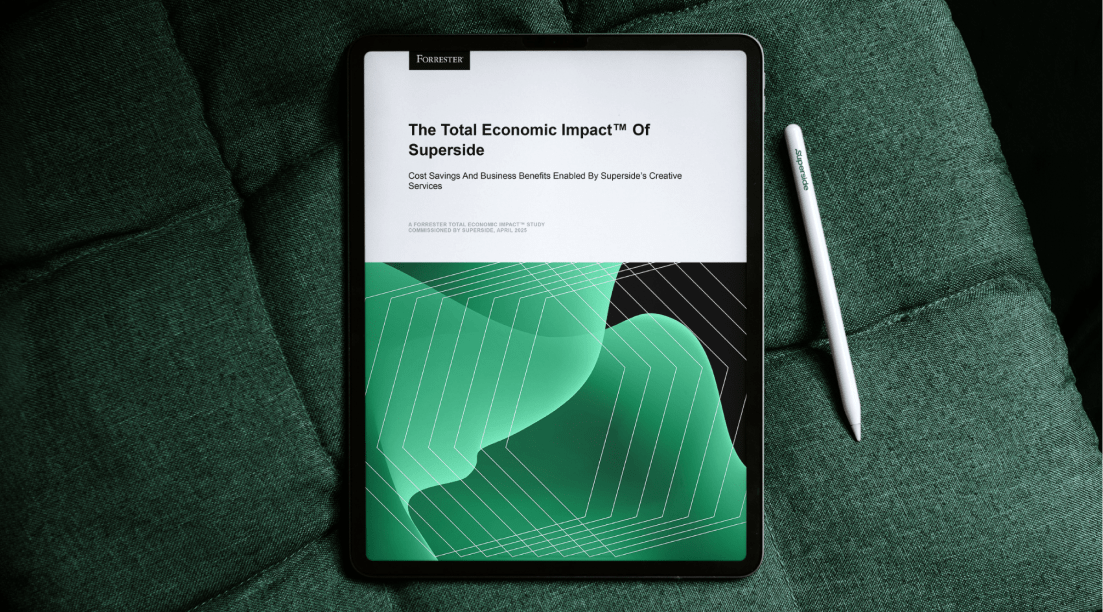
There's independent proof that this model pays off. In a Total Economic Impact™ study commissioned by Superside, Forrester found a 94% return on investment and $4.16 million in benefits over three years for a composite organization, with payback in under six months and more than 60% of feedback rounds avoided.
How Superside supports successful ABM campaigns
For ABM teams, the problem is rarely another targeting idea. It's producing enough high-quality, on-brand work for real accounts and live deals.
Superside is an AI-native creative agency. We pair AI-native experts with AI systems, so real creatives lead every idea while the systems keep the work fast and consistent. Everything runs through Superspace, our creative management platform, with Brand Brain keeping every variant on-brand.
That means one strong asset can become tailored variants for every account, role, market or channel in your ABM program. A master pitch deck can become a set of account-specific presentations without sacrificing narrative quality or brand control.
It's why brands like Microsoft, Reddit and Thomson Reuters work with us. To see how enterprise teams like Twilio tell their stories at scale, read about our creative storytelling model and how enterprise brands scale customer storytelling.
Explore our ad creative and presentation design services to see how we can support your next ABM campaign.
ABM wins when personalization can scale
Comics and billboards make memorable ABM stories. But most enterprise teams win with less theatrical work: knowing when an account deserves something bespoke and having a system to personalize everything else.
Your ABM strategy is probably fine. The question is whether your creative function can produce what that strategy promises, across every account on the list, at the quality your top-tier accounts expect.
If it can't, that's a production problem with a known fix. See how Superside supports enterprise teams that run ABM at scale, or book a call to talk through your target list.
FAQs
The data speaks for itself
According to a Forrester Total Economic Impact™ study, Superside delivers a 94% ROI and pays for itself in six months.
Creative support that works
Work with an AI-native creative agency that
understands your brand and your process.