


A rebrand is one of a company's most visible investments, yet most teams can't confidently say whether it worked, because they never set a baseline and they measure the wrong things at the wrong time. This guide gives you the five metric categories that matter, the operational rollout metrics almost everyone skips and a realistic timeline for each. Colgate-Palmolive's global rebrand, built with Superside, is the proof: roughly 98% positive sentiment at launch and roughly 99% employee pride.
The new logo design lands. The website goes live. The launch video is shared. Then everyone has an opinion, and before you know it, the CEO asks, "Did the rebrand work?"
For many marketing leaders, that's when the scramble starts. Without a pre-launch baseline or measurement plan, they can report what launched, but not whether the rebrand actually changed brand awareness, public perception or business performance.
That's a costly gamble. Bynder's research found that 82% of marketers have worked on a rebranding project, and that a typical rebrand involves updating 215 assets and lasts seven months, from initial talks to rollout. The assets at stake can also be extraordinarily valuable, as the multibillion-dollar brand valuations in Interbrand's Best Global Brands ranking demonstrate.
So how do you measure a rebrand?
Start with solid baseline data, track the right metrics at the right time and look beyond external results. Employee pride, internal adoption and rollout consistency also reveal whether the rebrand was a success.
This guide lays out the brand refresh metrics that matter, a measurement framework you can copy and a realistic timeline to follow. It also uses Colgate-Palmolive's global rebrand, built with Superside, to show what strong measurement and results look like.
Start with baseline data before you launch

The most common reason companies fail to prove whether a rebrand was successful is that they never captured where they started.
It's critical to define what success looks like and set your baseline metrics before the rebrand rollout. A baseline is the difference between "the rebrand felt successful" and "positive sentiment reached roughly 98% at launch." One is an opinion. The other is proof.
Think specific, time-bound targets. For example, set a goal to increase conversion rate from 3% to 3.5% within 12 months, or to improve customer retention by five percentage points.
At a minimum, collect baseline data on:
- Brand awareness: aided and unaided brand recall, brand recognition and share of voice.
- Brand perception: Net Promoter Score, customer sentiment and associations with key brand attributes.
- Business performance: revenue, conversion rate, customer retention, win rate and average deal size.
- Digital performance: branded search volume, direct traffic, branded website traffic, engagement rate and conversions on priority pages.
- Employee sentiment: employees' pride in, understanding of and confidence in representing the current brand.
Rebrand success metrics, 5 categories to track
Rebrand measurement spans five categories. When you track the categories relevant to your objectives, you get a balanced view of how the rebrand is landing, both internally and externally.
1. Brand awareness and brand recognition
Track aided and unaided brand awareness through regular surveys and compare the results with your pre-launch baseline. Customer interviews and open-ended survey responses can help explain why brand awareness has or hasn't changed.
Also monitor digital signals such as:
- Branded search volume: the number of searches for terms containing your brand name.
- Share of search: the percentage of branded searches that belong to your brand, compared with selected competitors.
- Direct and branded traffic: website visits driven by people who already know or specifically seek your brand.
- Social mentions and share of voice: your brand's share of the total visibility or conversation within a defined market.
Impressions show how widely the launch was distributed, while changes in branded search and survey-based recall provide stronger evidence that awareness is genuinely growing. For the bigger picture, see our guide on how to write a brand positioning statement.
2. Brand perception and sentiment
Awareness tells you whether audiences noticed your rebrand. Perception tells you what they now think and feel about your brand.
Work with your communications team to set up brand-attribute surveys that test whether intended associations, like "innovative," "approachable" or "trusted," have strengthened. Then supplement these with Net Promoter Score, qualitative customer feedback and sentiment analysis of social and press coverage.
Note that NPS isn't a direct measure of rebrand success, but it's a useful longer-term indicator of customer loyalty. Bain and Company found that an industry's Net Promoter leader outgrew its competitors by a factor greater than two times.
3. Financial and business impact
Business results usually take the longest to show, but they typically matter most to leadership.
To build a credible view of rebrand ROI, work closely with the sales team. Compare revenue, conversion rate, customer retention, average deal size, win rate, customer acquisition cost and sales cycle length against your pre-launch baseline.
For B2B brands, break results down by customer type and track how quickly deals move through the pipeline. Meaningful movement may take 6 to 12 months or longer, particularly with long sales cycles.
Account for pricing changes, campaign activity, seasonality and wider market conditions before you attribute a result to the rebrand.
4. Digital engagement
Because data driving creative performance is measurable in near real time, digital engagement is one of the fastest ways to see whether the rebrand is connecting.
Compare engagement rate, key-event completion and conversion rate on priority pages with the pre-launch baseline.
Segment results by traffic source, audience and page so changes in campaign spend or traffic mix don't distort the comparison. Clicks, shares and interactions with launch content provide early feedback, but interpret them alongside awareness, perception and conversion metrics.
5. Employee pride and internal adoption, the metric everyone forgets
Employees are a critical early audience, because their understanding and adoption influence how consistently the new brand gets applied. If employees understand the strategy, believe in it and feel confident representing it, they also become credible brand advocates, with content shared by employees earning significantly more engagement than the same content shared through brand channels.
Measure pride, understanding and confidence through internal surveys before and after launch. Track adoption through completion of brand training, use of approved templates, downloads of new brand assets, retirement of legacy materials and compliance audits. Voluntary employee sharing is an additional signal, but shouldn't be the primary measure.
The operational metrics that prove the rollout actually happened
There's a second layer of measurement most teams miss entirely: the rollout itself. A beautiful new logo is worthless if half the organization still uses the old one six months later.
- Asset conversion rate. What percentage of your live assets, from landing pages to sales decks and packaging, now use the new brand identity?
- Legacy asset retirement. How quickly are legacy materials being removed from circulation? Lingering old assets create creative debt, which steadily slows your team's ability to ship new work.
- Brand consistency and compliance. How on-brand is the work being produced across teams, channels and markets? This is measurable through audits and, increasingly, automated checks.
- Rollout speed. In a global rebrand, measure how quickly each market completes the refresh. Speed is a direct measure of how usable your new system is.
Clear brand guidelines, approved templates and reusable design systems give teams across the company a shared standard for deciding whether new work is on-brand.
A rebrand measurement framework you can copy
For every rebrand objective, document six things before launch: the baseline and comparison period, the metric, the target audience or segment, the data source, the review cadence and the person responsible for reporting it.
Then work to this framework.
| Category | What to baseline | Review cadence |
|---|---|---|
| Brand awareness and recognition | Aided and unaided awareness, branded search volume, share of search, share of voice | Early signals at one month, then three, six and 12 months |
| Brand perception and sentiment | Target brand attributes, customer sentiment, Net Promoter Score | Direct feedback immediately, but allow several waves before drawing conclusions |
| Financial and business impact | Revenue, conversion rate, retention, average deal size, win rate, CAC, sales cycle length | Quarterly, with a broader read at 6 to 12 months or longer |
| Digital engagement | Engagement rate, priority-page conversions, key-event completion | From launch onward, comparing equivalent periods |
| Employee pride and internal adoption | Pride, understanding and confidence, plus training completion and template use | First 30 to 90 days, then at regular intervals |
| Operational rollout | Assets converted, legacy assets still live, compliance scores, market completion | Ongoing until rollout completes |
These aren't universal promises of improvement. Set your targets from your own baseline, business model and expected sales cycle.
How long before you see results? A realistic timeline
Rebrand metrics move at different speeds. Measure too early, or expect every metric to improve at once, and it's easy to reach the wrong conclusion.
- Launch to 30 days. Track rollout completion, asset conversion, employee adoption, digital engagement and qualitative launch sentiment. These show whether the rebrand was delivered and how audiences initially responded.
- 1 to 3 months. Look for directional movement in brand awareness, branded search, share of voice and intended brand associations. Compare like-for-like audiences and periods wherever possible.
- 3 to 6 months. Repeat perception and customer surveys, and begin reviewing leading business outcomes such as conversion rate, pipeline movement and win rate.
- 6 to 12 months. Assess broader changes in revenue, retention, CAC, average deal size and sales-cycle length, accounting for seasonality, pricing, campaigns and market conditions.
- 12 to 18 months and beyond. Longitudinal tracking provides the strongest evidence of sustained change. Longer evaluation periods are necessary for businesses with long sales cycles.
Rebrand measurement in action at Colgate-Palmolive
The clearest way to understand rebrand measurement is to see it applied at global scale. Consider Colgate-Palmolive, which marked its 220th anniversary in 2026. It employs more than 33,000 people across over 100 countries and markets its products in more than 200 countries and territories, spanning oral care, personal care, home care and pet nutrition.
The company's corporate mark had remained largely unchanged for more than 40 years. Meanwhile it had undergone a major digital transformation, and its existing design system no longer reflected what the business had become.
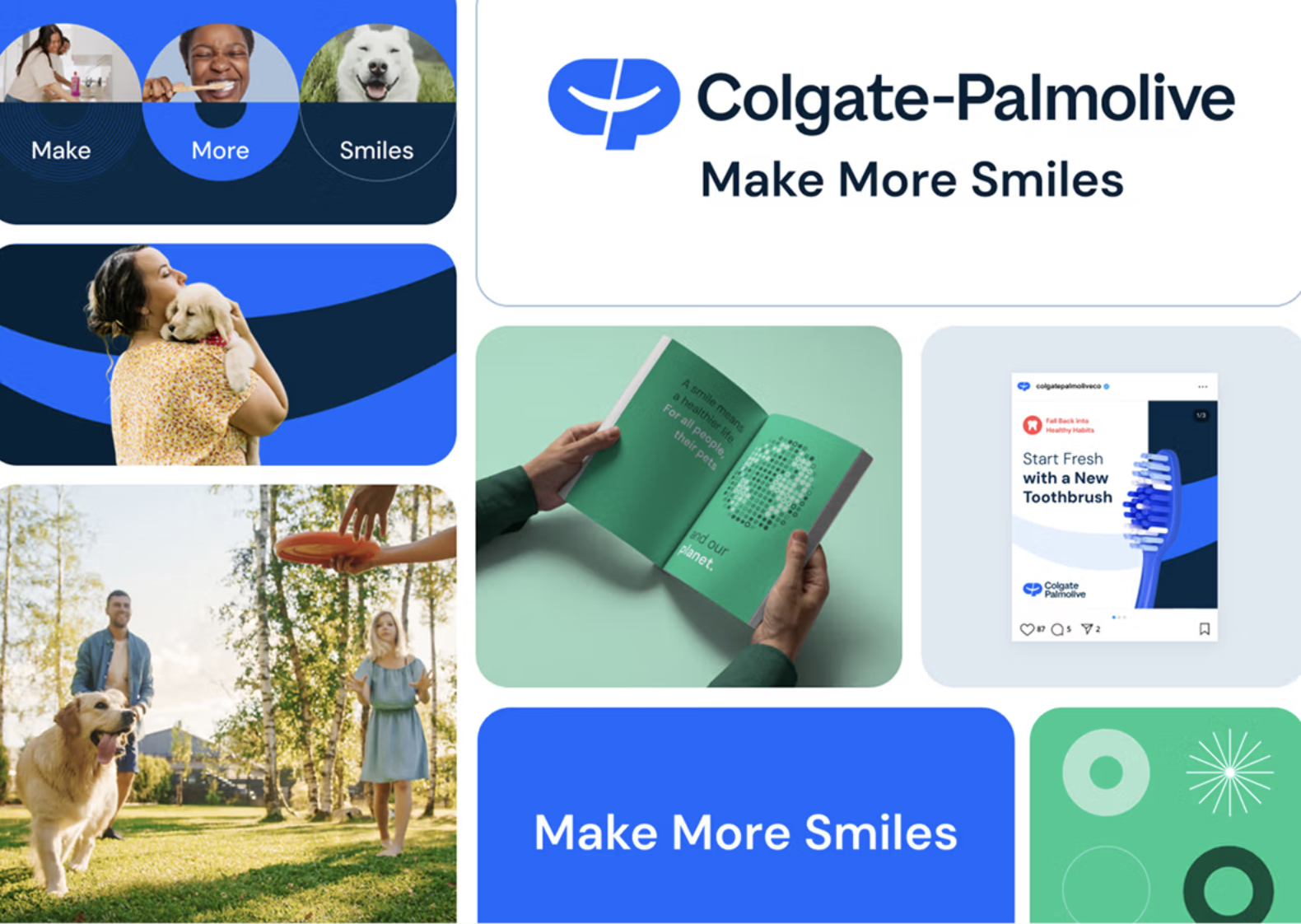
In 2024 the company embarked on its most significant corporate brand refresh since the 1980s, introducing a refreshed corporate logo and the "Make More Smiles" tagline. The harder challenge was translating that purpose into a practical brand system employees around the world could use consistently.
Colgate-Palmolive chose Superside as a strategic creative partner to co-create a scalable corporate brand and design system.
We were looking for a creative, strategic partner to help us build a new design system and corporate brand that could scale across every touchpoint.

Working closely with Colgate-Palmolive's team, Superside expanded the refreshed identity into global guidelines and tools built to reflect the company's purpose and help employees produce polished, on-brand communications. That included translating the brand principles of Connection, Variation and Momentum into a complete design language, developing a Visual Communication Graphic Scale running from minimal to expressive, and packaging everything into global toolkits designed for employees across geographies and skill levels.
Most of the work we did with Superside was strategic, taking parts of the brand identity that already existed and storytelling around them to make them make sense within the cultural DNA of our company.
Now look at how the results were measured, across several of the categories above.
| Metric category | Result |
|---|---|
| Perception, measured at launch | Roughly 98% positive sentiment on social, which the team benchmarked at five to seven times higher than industry benchmarks |
| Awareness and digital engagement | More than 500,000 organic LinkedIn impressions during launch month alone |
| Employee pride | Roughly 99% of employees feel proud when they see the new brand, according to global employee surveys |
| Operational rollout | 1,008+ assets delivered, built across 2,956 hours of strategy, design and system development |
99% of Colgate-Palmolive employees feel proud when they see our new logo. Over 500,000 impressions in August when we launched our new corporate brand on LinkedIn. It was so embraced and so loved.
That single quote contains three of the five metric categories: perception, awareness and employee pride. It's what good rebrand measurement sounds like.
The system is now live across digital and physical touchpoints, including the corporate website, social channels, recruitment materials, internal communications, reports and signage.
Any employee, across any geography, regardless of design skill level, could create more on-brand, polished communications with the new design system we built with Superside.
You can read the full story in our Colgate-Palmolive case study.
Common rebrand measurement mistakes to avoid
- No baseline. Without a "before," every "after" number is unprovable.
- Measuring too early. Financial results take time. Use awareness and perception metrics as early indicators before judging business impact.
- Relying on vanity metrics. Impressions show how far a rebrand traveled, not how well it landed. Pair reach and engagement with perception, business performance and internal adoption.
- Overlooking employees. Employees bring the rebrand to life. If you don't measure their understanding, pride and adoption, you can't know whether the brand is taking hold internally.
- Confusing activity with results. Launching hundreds of assets doesn't prove the rebrand worked. Measure whether those assets are used consistently and whether they move the outcomes that matter.
How Superside helps make rebrands measurable

A rebrand becomes easier to measure when you have a clear, practical system for implementing it.
Brand guidelines, templates and toolkits make it possible to track adoption, retire legacy assets and assess whether the new identity is being applied consistently.
Superside, the world's leading AI-first creative partner, helps brands build that operational foundation. For Colgate-Palmolive, we translated a refreshed identity into a scalable corporate brand and design system, and we applied many of the same lessons during our own rebrand. Being AI-first means AI isn't just powering individual tools. It's embedded across the entire creative model, from how teams are trained to how brand knowledge compounds over time.
When you partner with us, all work runs through Superspace, our AI-powered creative management platform. Your unique Brand Brain, the living AI layer inside that platform, captures the details that make your brand distinct. It learns from your briefs, feedback and past work, so what comes out actually reflects how your team thinks and creates.
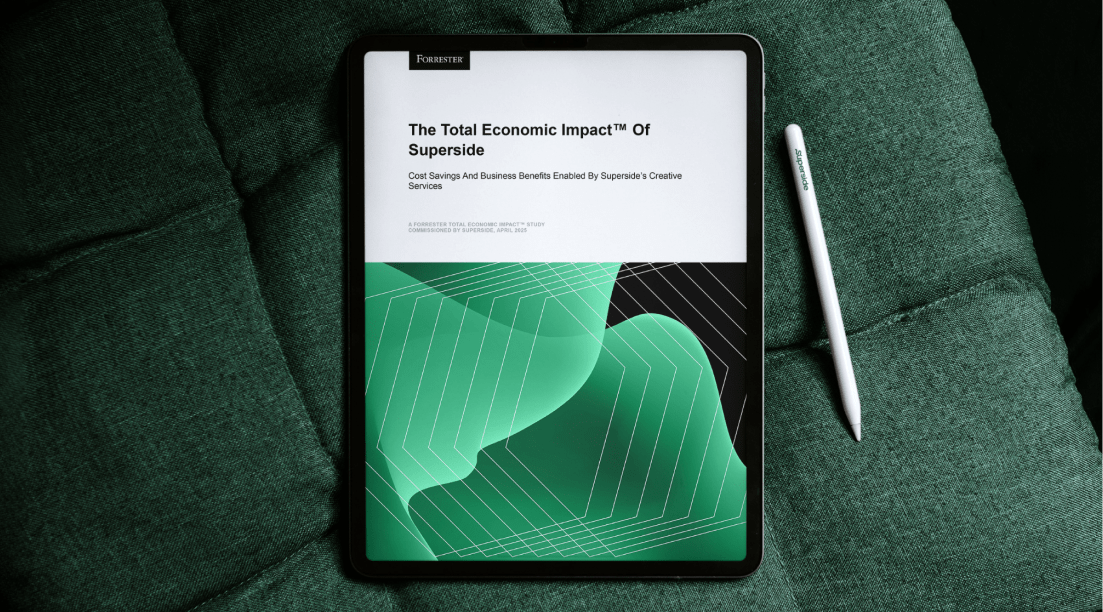
The wider business value is measurable too. A Total Economic Impact study commissioned by Superside and conducted by Forrester Consulting (April 2025) found that a composite organization achieved a 94% ROI with payback in under six months.
If you're wondering how to measure a rebrand and execute it successfully, explore Superside's branding services and selected work. Alternatively, book a call and we'll help you set up the system that makes your rebrand measurable, as your creative team's creative team.
FAQs


Brand systems that scale with you
From one-off email assets to AI-powered workflows,
we make sure your brand grows with no compromise.
Schedule a chat to learn more.


Meet Customers Who’ve Experienced Exceptional ROI
Discover how Shopify got 4,375 assets in 12-24 hours or how Amazon saved 345 hours in three months.




The data speaks for itself
According to a Forrester Total Economic Impact™ study, Superside delivers a 94% ROI and pays for itself in six months.


Your creative team's creative team
Choose the world's leading AI-powered creative service
and get high-performing ads, videos, experiences and
more at scale, on your schedule and to your standards.