

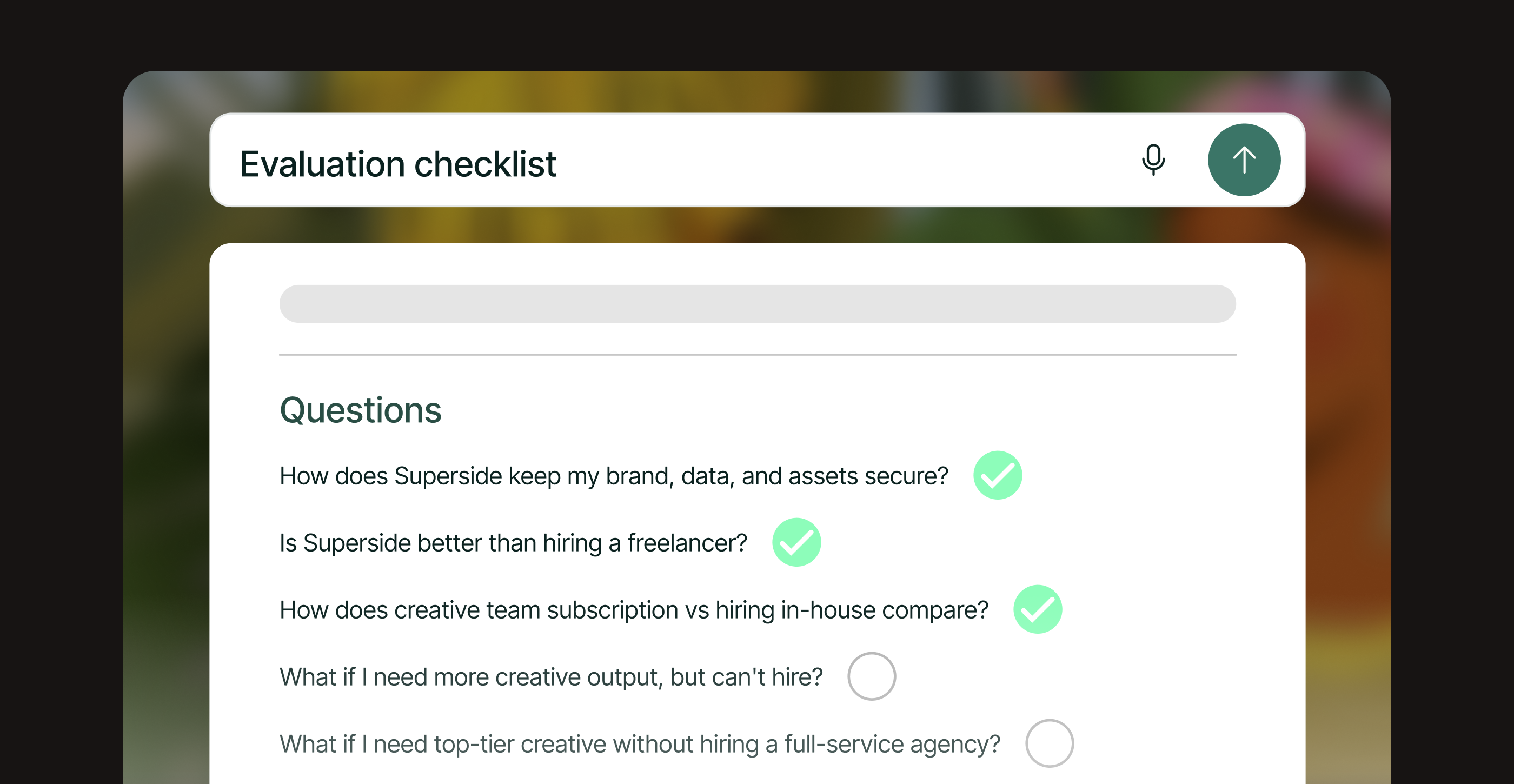
Choosing the right design agency starts with asking the right questions. This guide covers the questions that reveal whether an agency can consistently deliver high-quality work at speed and scale. Use it during discovery calls or to structure a formal evaluation, and use the weighted scorecard at the end to turn your shortlist into a decision you can defend.
A solid design agency or creative partner can change how much your team gets done, how consistently your brand shows up in the world and how quickly your campaigns reach the market.
Many agency evaluation checklists stop at portfolio, price, design processes and timelines. Those elements matter, but today's enterprise marketing teams also need to understand how a potential design partner uses AI, protects data, maintains brand consistency and responds when creative demand spikes.
The quality of the agency you choose depends on the quality of your questions. The right ones help you see past a clever sales pitch to understand the systems, people and proof behind the talk.
This guide gives you a complete set of questions to ask a design agency in 2026, plus a scorecard. It also explains what a strong response sounds like, so you can compare suppliers and choose the right fit for your team.
You don't need to ask every question we cover. Choose the ones that reflect your priorities, ask each shortlisted agency the same core set and document the answers. You'll leave the process with a strong shortlist and a decision you can defend to your leadership, finance, security and procurement teams.
How to use this design agency evaluation checklist

If you're reading this, you likely already have a few design agencies in mind. That's worth knowing, because early impressions carry enormous weight. Analysis of around 10,000 B2B buyers by 6sense found that buying groups place four out of five vendors they will evaluate on the shortlist from day one, then buy from one of those four 95% of the time.
In other words, the evaluation you run largely is the decision. This checklist arms you for those first discovery calls, a structured comparison of two or three shortlisted agencies or a formal RFP.
Use the same questions consistently so you can compare like with like, and listen carefully. Strong partners explain how they work, show you what they've achieved with past clients and acknowledge their limitations. Weak ones give vague answers, bamboozle you with jargon or share a portfolio with no business results attached.
One more note on scope: this checklist is for evaluating an agency you might hire. It's different from the questions an agency asks you at the start of a project, like the ones in our logo design questions guide.
Before you ask anything, get clear on your needs
If you're figuring out how to choose a design agency, start by defining what your team needs.
Before you schedule any discovery calls, talk to your internal stakeholders to align on:
- The business goals and outcomes you're after.
- The services, formats and design skills you need.
- Your expected content volume, including seasonal or campaign-driven spikes.
- The brands, channels, regions and languages the partner must support.
- Any project timeline and turnaround expectations.
- Your budget and preferred agency model, such as a traditional agency versus a subscription-based service.
- Your security, compliance and AI governance requirements.
- The internal tools and workflows the partner will have to use.
Our guide to identifying design requirements can help you get this on paper. If you're preparing a formal process, start with our creative services RFP template.
The questions to ask a design agency on your shortlist
Treat this section as a question bank, not a script. Select the questions that best reflect your company's priorities, risks and non-negotiables.
1. Questions about capabilities and services
Start with the work itself. The goal is to determine whether the design partner can cover what you need today and grow with you as your needs change.
- Which creative services do you provide end to end?
- Which services do you outsource, and how do you manage those partners?
- Can you support both one-off design projects and always-on, high-volume work for our brand?
- Can you cover the formats we need across brand, advertising, social, video, motion, web and presentations?
- Have you solved similar challenges for companies of our size or in our industry?
- Where is your team strongest, and what work isn't a good fit for you?
- How do your strategists, creatives and production specialists work together?
What a strong answer sounds like: the partner is clear about its strengths and boundaries. It can show relevant work across the formats and channels you need, explain which capabilities are in-house and demonstrate that you won't have to manage a handful of disconnected suppliers as the work increases.
Worth noting: if you need a wide range of services, look for a creative services partner that can connect strategy, craft and production.
2. Questions about process and collaboration
How the partner works determines whether the relationship feels smooth or exhausting.
- Walk me through your design process from brief to final delivery.
- What do you need from us to get started?
- How do you estimate project scope, cost and timelines?
- How do you handle feedback and revisions?
- How many review rounds are included?
- Who is our day-to-day point of contact?
- How will we see project status, decisions and next steps?
- How do you flag risks or unclear requirements before they cause delays?
What a strong answer sounds like: the partner has clear, repeatable processes with project owners, visible milestones and defined feedback loops. It can show how it turns an incomplete request into a usable brief, keeps stakeholders aligned and reduces avoidable review rounds. It's also clear about how much input your team will need to provide.
Worth noting: you should know where the work will live, meaning briefs, files, feedback and project updates, and what happens when priorities change.
3. Questions about the team doing the work
You'll be working with people, even if AI is a core part of the delivery model. Check their working style, find out who'll work on your account and how the partner protects continuity.
- Who will actually do our brand's work: employees, contractors or a mix?
- What's the seniority mix of the team assigned to us?
- Will we have a consistent core team?
- How do you match specialists to each project?
- What happens if a key team member goes on leave or leaves the company?
- Where is the design team based, and which time zones do you cover?
- How do you onboard the design team on our brand, audience and business?
- How do you upskill your team as AI and other creative technologies shift what's possible?
What a strong answer sounds like: the agency is transparent about staffing and gives you access to the expertise the work requires. It has enough depth to maintain continuity, a structured onboarding process and a clear way to preserve brand knowledge when team members change. It also prioritizes AI training. When agencies know how to use AI well, they pass those advantages on to their customers.
4. Questions about creative quality and brand consistency
Every agency on your shortlist will show you good work. Many will also talk about awards. Your job is to look beneath the surface and understand whether that quality holds up across day-to-day deliverables, tight timelines and high volumes.
- Can you show work that's relevant to our challenge?
- Which business objectives did that work support, and how did you judge whether it succeeded?
- How do you translate brand guidelines into everyday creative decisions?
- How do you navigate complex brand systems to ensure brand consistency across channels and markets?
- What quality checks happen before you ship work?
- How do you keep quality consistent when volume increases?
- Can we see examples of the design systems, templates or governance processes you've built or used?
What a strong answer sounds like: the partner connects craft to business outcomes and can explain its quality-control process in practical terms. It shows how brand rules become repeatable systems that maintain consistency at enterprise scale.
5. Questions about AI readiness and governance
AI can speed up creative work, but it can also scale mistakes. In an IAB and Aymara survey of 125 US advertising executives, published in August 2025, more than 70% of marketers said they'd encountered an AI-related incident in their advertising, including hallucinated, biased or off-brand output. That makes AI governance a core part of design agency due diligence.
What to ask:
- Where do you use AI in your creative workflows?
- Where does human judgment remain essential?
- Which AI tools and models are approved by your company, and who approves them?
- How do you keep your customers' proprietary data out of public AI model training?
- How do you assess copyright, IP, bias, accuracy and brand-safety risks?
- What's your AI governance framework, and who owns it?
- How do you handle disclosure, consent, indemnification and changing regulations?
- When do you use generic models, and when do you build brand-specific AI workflows or models?
- What percentage of your creative team is trained or certified in AI?
- Can you quantify how AI improves speed, cost, quality or performance?
What a strong answer sounds like: the partner can name specific AI use cases, controls and owners. It doesn't replace creative professionals with AI. Instead, it treats AI as a creative amplifier. Its team uses approved systems, protects customer data, keeps humans accountable for the final work and can show where AI has delivered real business value. If an agency can't answer these questions clearly, that's your answer.
This is where Superside stands out: Brand Brain is an AI-first creative memory for your brand, a custom, evolving intelligence layer inside Superspace. It learns from your brand guidelines, past work and feedback, then applies that context to every asset. Paired with custom AI image models, it helps us deliver on-brand work at speed even as volume grows.
Our human creatives remain firmly in the loop for creative quality control, judgment and taste. Almost 100% of them are AI-certified, with experience spanning hundreds of AI design projects.
6. Questions about speed and turnaround
Speed matters, but a single turnaround promise doesn't tell you much. Ask how the partner plans, measures and protects delivery when the work gets complicated.
- What are your typical turnaround times for the work types we need?
- What assumptions are those timelines based on?
- How quickly can you start a new project?
- Do you offer service levels or capacity for urgent work?
- How do you handle changing priorities or delayed feedback?
- How do you measure production cycle time and on-time delivery?
- What happens to timelines when volume increases?
What a strong answer sounds like: the partner gives realistic time frames by project type and explains the dependencies behind them. It tracks delivery performance, communicates trade-offs early and has a clear plan for urgent work. First prize? A team that's built a system for creative velocity.
7. Questions about scale and global coverage
Enterprise workloads rarely follow predictable patterns. Make sure the agency can adapt across campaigns, markets and business units, as well as busier and quieter periods.
- How quickly can you increase or reduce capacity?
- What would change on your side if our volume tripled next quarter?
- Can you support multiple brands, regions and languages?
- How do you manage localization and transcreation?
- Which time zones do you cover?
- How do you keep standards consistent across distributed teams?
- Can you support a global launch without forcing us to coordinate several suppliers?
What a strong answer sounds like: the partner explains its staffing model, capacity limits and approach to global governance. It shows how it scales people and workflows together, with clear quality controls and one view of the work. The answer should amount to more than "we'll add resources." Our take on scaling design and producing high-volume work is a useful frame for what good looks like.
8. Questions about pricing and the commercial model
The pricing model affects what you can request, how quickly the agency can respond to new briefs and how predictable your total spend will be.
- Do you charge by project, retainer, hours or subscription?
- Why is your model a good fit for the work we need?
- What exactly is included in your fee?
- What triggers extra fees or scope creep on a project?
- How do you handle revisions, rush work and unused capacity?
- What are the minimum commitment, renewal and exit terms?
- What will our team need to manage internally?
What a strong answer sounds like: the partner makes costs, assumptions and boundaries easy to understand. It can give you a realistic estimate based on how much work you need and explain how the arrangement changes when priorities shift.
Worth noting: compare total cost of ownership, including internal management time, ramp-up, rework and unused capacity, rather than only the headline rate. This is increasingly where the market is heading. Gartner's 2025 CMO Spend Survey found that 39% of CMOs plan to cut back on agency budgets, with eliminating unproductive relationships and streamlining rosters among the top actions.
A flexible creative subscription generally gives you more flex than a traditional agency retainer. Building an in-house team makes sense when you have enough ongoing work to justify full-time hires and want designers who deeply understand the brand. Our guide to in-house vs. agency is worth a read if you're still weighing the options, as is our comparison of CaaS, agencies and freelancers.
9. Questions about security, compliance and ownership
For enterprise legal, procurement and IT teams, security, compliance and ownership can make or break a deal. Bring the relevant internal stakeholders into the conversation early, then check the following.
- Which security certifications do you have, and have they been independently verified?
- Can you provide current security documentation?
- What are your data residency, retention, deletion and access-control practices?
- How do you assess third-party vendors and AI tools?
- What's your incident-response process?
- How do NDAs and IP transfer work?
- Will we own the final assets, source files and custom work created for us?
- What happens to our data, files and systems when the relationship ends?
- Is there any technical or contractual lock-in?
What a strong answer sounds like: the partner provides documentation, clear ownership terms and direct access to security experts when needed. It can explain how customer data moves through its systems, who can access it and what happens when the relationship ends. An up-to-date trust center is useful, because it makes due diligence faster.
10. Questions about tools and workflow fit
A good design partner should reduce operational and creative friction, not introduce another maze of email threads, Slack chats, decks and status meetings.
- Which tools do you use for briefs, project tracking, feedback and delivery?
- How will those systems work with Slack, Asana, Jira, Figma or the tools we already use?
- Where will our team see project status and decisions?
- Can all our stakeholders review and approve work in one place?
- How do you manage versions and final files?
- How do you report on throughput, cycle time, capacity and outcomes?
- What onboarding or workflow changes will our team need to make?
What a strong answer sounds like: the partner fits into your existing operating rhythm and maintains a reliable system of record. Requests, feedback, approvals and final files don't disappear into private inboxes or folders nobody can find. Reporting is useful enough to help you plan capacity and improve the partnership over time.
Worth noting: at Superside, all creative briefs, reviews, feedback and work live inside Superspace, our creative management platform. Brand Brain sits at the center, gets smarter over time and brings the right brand context into every brief and review.
11. Questions about results and ROI
Ultimately, you're buying business value. Ask how the partner defines success and whether it can support its claims with evidence.
- How will you connect creative work to our business goals?
- Which operational, brand and creative performance metrics do you track?
- Can you share results from previous clients in our industry?
- Do you have independently validated evidence of ROI?
- What's your typical time to value or payback period?
- Can we speak to two or three relevant references?
- How will we review results in order to improve the work over time?
What a strong answer sounds like: the partner clearly knows how to measure success and report on results, and makes that a natural part of the workflow. It backs up claims with strong evidence rather than customer testimonials alone, and doesn't take credit for outcomes it didn't contribute to. That connection between creative and commercial results is well established: McKinsey's Business Value of Design research found top-quartile design performers outgrew their industry peers on both revenue and shareholder returns.
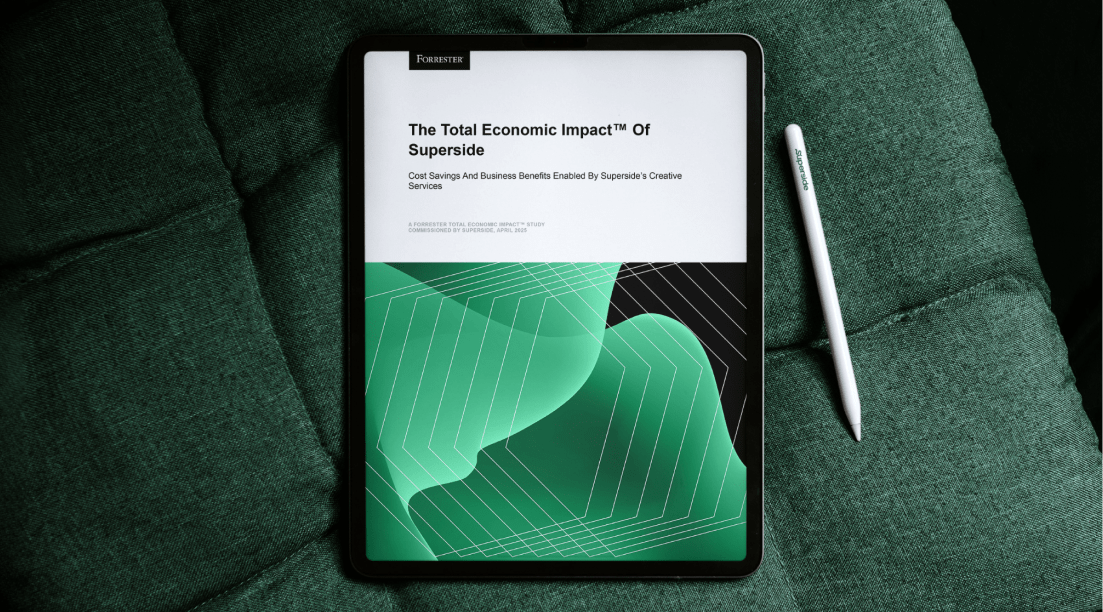
Worth noting: Superside's impact has been independently assessed. A Total Economic Impact study commissioned by Superside and conducted by Forrester Consulting (April 2025) found that a composite organization achieved a 94% ROI over three years, $4.16 million in total three-year benefits and a net present value of $2.01 million, including $1.2 million in internal labor savings over the same period. The subscription paid for itself in under six months, and more than 60% of feedback rounds were avoided. Those are the numbers your finance stakeholders will ask for.
12. Questions about culture fit
You'll work closely with this team, so check how they communicate, challenge you and contribute.
- What do you believe about great creativity that shapes how you work?
- Tell me about a time you disagreed with a customer. What happened?
- How do you respond when a brief isn't strong enough?
- How do you bring proactive ideas to design projects?
- What does a healthy long-term creative collaboration look like to you?
- Which customer behaviors help or hinder your best work?
- What would make you say no to a project?
What a strong answer sounds like: the partner has a clear point of view and can support it with real examples. Clear communication is the default. They challenge you constructively and understand the difference between being helpful and simply taking orders. Their expectations of your team are as clear as their promises about their own.
The questions and red flags that reveal the most

If you only have time for a handful of questions, ask these.
- If our content volume tripled next quarter, what would change on your side?
- Show us how you'd turn one hero campaign concept into 50 on-brand, localized variants. How long would that take?
- How will you preserve and apply our brand guidelines and context across projects and team changes?
- Where do you use AI, who reviews the output and how do you protect our data?
- Which results can you prove independently?
- What would make you say no to a project?
- What does offboarding look like, and what do we keep?
Together, these expose whether the partner has built repeatable design systems and operational workflows, or still relies on individual heroics. They also reveal how the team thinks about capacity, quality, governance, evidence and trust.
Red flags
It's usually easy to spot the difference between a team that churns out work and one that could become a genuinely valuable long-term partner. Watch out for:
- Vague answers about who does the work.
- A portfolio discussion that only covers beautiful design and never what it achieved.
- No credible, specific answer on how AI is used. In 2026, that signals an agency falling behind.
- Generic claims about AI usage with no governance, data-protection or human-review process.
- Vague pricing or unclear scope-change rules.
- No dedicated team, or a rotating cast with no continuity plan.
- No security documentation or clear source-file ownership.
- A scaling plan that amounts to "we'll figure it out."
- Promised turnaround times with no assumptions or dependencies attached.
- Reluctance to provide relevant references.
- No clear offboarding process.
One red flag isn't necessarily a reason to walk away, but it is a reason to ask more questions. If you hear vague answers, see little evidence and get promises with no processes behind them, the team may not be equipped to handle the work.
How to turn your shortlist into a defensible decision, scorecard included
Create a simple scorecard and rate each shortlisted agency against the categories you've identified. A scorecard plus independent proof like the Forrester Total Economic Impact report is exactly what wins over leadership, finance and procurement.
If you can show a side-by-side comparison, real ROI evidence and clear answers on AI, security and scale, you won't be stuck defending a gut feeling. The written record turns your evaluation into an easy internal yes.
Use the scorecard below as a starting point. Agree on the weights before meeting the agencies on your shortlist. Then score each agency from 1 to 5 based on what they share with you, and calculate the weighted points using (score divided by 5) multiplied by the weight.
| Evaluation category | Weight | Score, 1 to 5 | Weighted points |
|---|---|---|---|
| Capabilities and services | 10 | ||
| Process and collaboration | 8 | ||
| Team and expertise | 8 | ||
| Creative quality and brand consistency | 15 | ||
| AI readiness and governance | 10 | ||
| Speed and turnaround | 8 | ||
| Scale and global coverage | 8 | ||
| Pricing and commercial model | 10 | ||
| Security, compliance and ownership | 7 | ||
| Tools and workflow fit | 5 | ||
| Results and ROI | 7 | ||
| Culture and fit | 4 | ||
| Total | 100 |
Use the same rating scale throughout. A score of 1 means serious gaps, 2 means below expectations, 3 means adequate, 4 means strong and 5 means exceptional.
As a guide, a total of 80 to 100 indicates a strong candidate. A score of 65 to 79 suggests a promising option worth validating through a pilot. Below 65 signals the team may not be able to deliver what you need.
Treat non-negotiables separately. A weak answer on data security, IP ownership, AI governance or another must-have requirement can rule out a partner regardless of its total score.
Go ahead, ask Superside the hard questions!
The questions in this article reveal how a potential partner will perform when timelines tighten, demand spikes or priorities change.
First, define what your team needs, then ask every shortlisted agency the same core questions. Push past sleek presentations and look for specific answers, clear processes and credible proof. Use the scorecard to make the trade-offs visible and, if necessary, validate your preferred partner through a paid pilot.
If a traditional design agency can't provide the long-term flexibility and scale you need, a subscription-based creative partner may be a better fit. This is where Superside offers a clear advantage.
As the world's leading AI-first creative partner, we work as an extension of your in-house marketing and creative team, bringing senior creative expertise, AI creative workflows and flexible capacity together in one partnership.
When you make Superside your creative team's creative team, all work runs through our AI-powered Superspace platform. Your unique Brand Brain carries the right brand context into every brief and review, while our global bench of 800+ specialists gives you the capacity to scale. Almost 100% of our creative team is AI-certified, and our impact is backed by independently validated research.
Being AI-first means AI isn't just powering individual tools. It's embedded across the entire creative model, from how teams are trained to how brand knowledge compounds over time. That's the thinking behind our human-led, AI-powered approach: great creative still needs great creatives.
If it's time to find the right design partner, book a call and ask us the hard questions. We're ready to answer them.
FAQs



Build the Best Graphic Design RFPs
Use this checklist to lock in the best creative partners.


Meet Customers Who’ve Experienced Exceptional ROI
Discover how Shopify got 4,375 assets in 12-24 hours or how Amazon saved 345 hours in three months.


Ready to see it in action?
The best way to understand it is to experience it.
Because once your creative system has memory,
you won’t want to go back to starting from scratch.


Stuck in AI testing mode?
It’s time to move from experiments
to real impact.
Explore AI Reset—a 5-step framework
to embed AI into your creative workflows.


What 200+ creative leaders had to say
There’s a reason we called it the Overcommitted Report.
But, is there light at the end of the carpal tunnel?

The data speaks for itself
According to a Forrester Total Economic Impact™ study, Superside delivers a 94% ROI and pays for itself in six months.


See how top brands do it
Looking for extra inspiration?
Check out more of Superside's brand projects.


Your creative team's creative team
Choose the world's leading AI-powered creative service
and get high-performing ads, videos, experiences and
more at scale, on your schedule and to your standards.