

What happens when every creative team has access to the same AI? Leaders from Zoom, Booking.com, Leonardo.AI and Superside share six lessons on the role of taste, collaboration and creative judgment.
Producing content has never been easier. Producing great content that people will remember has never been harder.
Every marketing team now has access to AI tools that can generate copy, images and video in minutes. The barriers to creation continue to fall, while the volume of content continues to rise. People are truly inundated with content left and right.
If AI can create almost anything, what sets brands apart? What can brands do to create memorable scroll-stopping content?
That question sat at the center at SHIFT: The Creative AI Summit, where creative leaders from Zoom, Leonardo.AI, Booking.com and Superside explored what happens when every company has access to the same technology. Although the discussion covered everything from brand governance to creative workflows, the conversation kept circling back to the same idea.
Taste is becoming one of the few competitive advantages AI can't automate.
1. Taste has never been about aesthetics alone
When people talk about taste, it's easy to think about visual style.
Beautiful photography.
Strong typography.
The perfect color palette.
Dan Schunk, Head of Creative at Zoom, challenges that definition. "Something beautiful can be created, but if it's not resonating with your goals, if it's not resonating with the overall objective, it just becomes a beautiful picture that doesn't work,” he explained.
It's a subtle distinction, but an important one.
Creative teams are no longer constrained by their ability to produce options. AI can generate hundreds of them. The harder task is deciding which direction deserves to move forward.
Does it communicate the strategy? Does it strengthen the brand? Does it speak to the audience the way you intended?
Those decisions remain deeply human. This means that as AI lowers the cost of execution, judgment carries more weight.
2. Develop your taste before your prompting skills
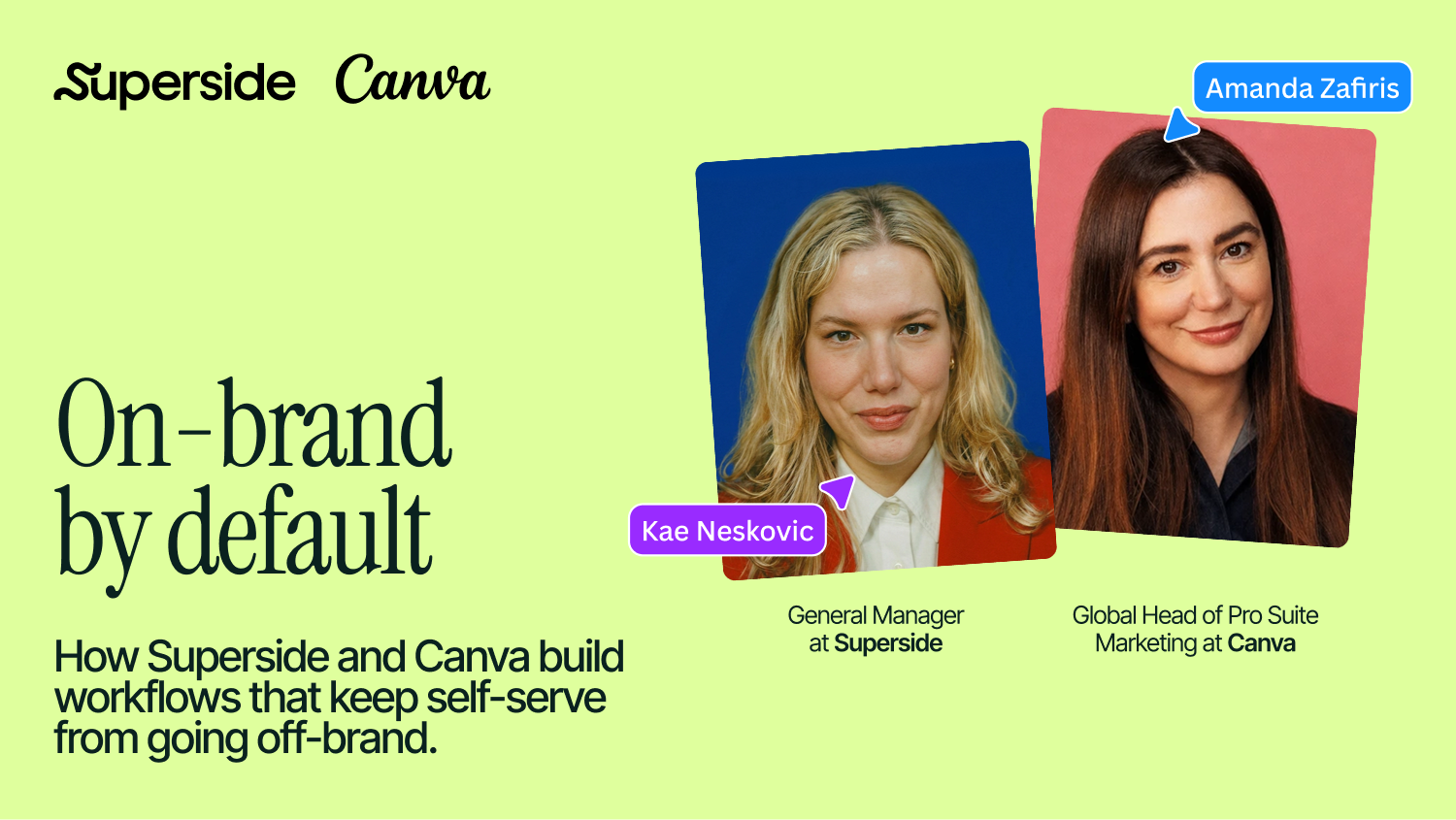
While taste is unique to each creative and brand, Kae Neskovic, General Manager of Creative Studios at Superside, argues that a lot of it relies on context and culture.
I feel like what taste is, it's actually a really accurate understanding of visual culture and history and knowing what is appropriate and for what purpose.

That perspective reframes how many teams think about AI.
Prompt engineering matters, but prompts don't exist in isolation. They're informed by years of looking at great advertising, understanding photography, studying design systems and recognizing what feels culturally relevant.
Dwayne Koh, Head of Creative at Leonardo.AI, described how his team deliberately builds those instincts. “We always get so caught up in these tools. Just look at styling, look at what's new, look at old trends in the sixties. Anchor yourself in taste again before you get into the world itself,” he said.
That habit feels particularly relevant today. Many conversations about AI focus on learning new tools. Far fewer focus on developing the creative muscle that makes those tools valuable in the first place.
3. Keep your creative process collaborative
Perhaps the most unexpected insight had very little to do with image generation.
Jeff Johns, Senior Creative Producer at Booking.com, reflected on how creative work itself has changed. For decades, creative work was something teams could observe. You could glance across the room and see someone refining an edit or working on a complex design. Even if you weren't working on the project yourself, you absorbed techniques, understood who the experts were and learned how different people approached creative problems.
The content production itself has never been more of a black box. It's largely hidden. And especially in small creative teams, you used to be able to see somebody on Final Cut or somebody playing with 20 layers on Photoshop, and you could see the work that other people were doing. It gave you a real-time sense check about the skills, the abilities, who the experts are in the team, who is doing what, and how they were doing it.

Years ago, creative teams learned simply by sitting near one another. You could watch how a designer approached a layout or see how an editor solved a difficult problem. Today, much of that thinking happens privately inside prompts, chats and AI workflows.
Kae immediately connected that observation to a broader shift. "AI flattens the process. And without process, there is no teamwork," she explained.
It's a challenge many organizations are only beginning to recognize.
As AI compresses creative workflows, leaders have to become more intentional about sharing knowledge, documenting decisions and helping teams learn from one another.
It's really about checking in with your team. If you're working with a core team and everybody has different levels of expertise, different tools that they're mastering it's really important to just speak up, be open, share your struggles, share your learnings, and then you can understand how to pass things off. At the end you get something that is tasteful and relevant for your brand.
4. Build brand systems that teach people how to think
For years, brand guidelines have largely documented visual standards. Logos. Colors. Typography. Photography.
When only a handful of people created branded assets, that approach worked well.
Today, marketers, sales teams and executives all have the ability to generate content themselves. That changes the role brand systems need to play. Brand guidelines are no longer static documents, but changing and evolving systems.
It started to become more of an operating system. The process was more like ‘here are the guidelines, these are the rules of the road, but if you need to create something new, and if you need to expand on this, these are the right ways to approach it’. It wasn't necessarily, like, "Here's the box and this is what you live in, but this is the open field and then as you explore, these are the right ways to be able to do it.

Instead of prescribing every possible execution, modern brand guidelines increasingly provide principles that help people make good creative decisions independently.
As the document becomes less static, the thinking behind it becomes more important.
It's not a PDF. It is a living, breathing document.
5. Treat AI as another creative tool, not the creative process
Throughout the conversation, nobody suggested AI should replace creative thinking. Instead, the examples showed AI becoming another tool within an existing workflow.
AI is just a tool. It shouldn't be at the forefront... these tools help get you there.

Dan Schunk shared a similar example from Zoom, where AI helped visualize a television commercial before the team moved into traditional production.
His conclusion applies far beyond a single campaign. "Just because you can use it doesn't mean you should always use it."
The new challenge for creative leaders is understanding when AI or traditional processes create the most value.
6. Ask one final question before every piece of work
How can a creative leader judge creative work in a time when processes, tools and content are changing so rapidly and significantly?
Dan Schunk offered perhaps the simplest test.
"Would you stand behind it?"
It feels like an appropriate question for the AI era.
Technology will continue to improve. Models will become more capable. Production will become faster. Those changes make creative judgment more visible, not less.
The teams that consistently produce memorable work will still spend time debating ideas, refining concepts, understanding audiences and protecting the standards that define their brands.
While AI changes how creative gets made, taste still shapes what deserves to be made in the first place.

The Creative AI Summit
Watch the full SHIFT Summit recordings
and explore how AI is reshaping
creative workflows, teams,
and production at scale.

Your creative team's creative team
Choose the world's leading AI-powered creative service
and get high-performing ads, videos, experiences and
more at scale, on your schedule and to your standards.