



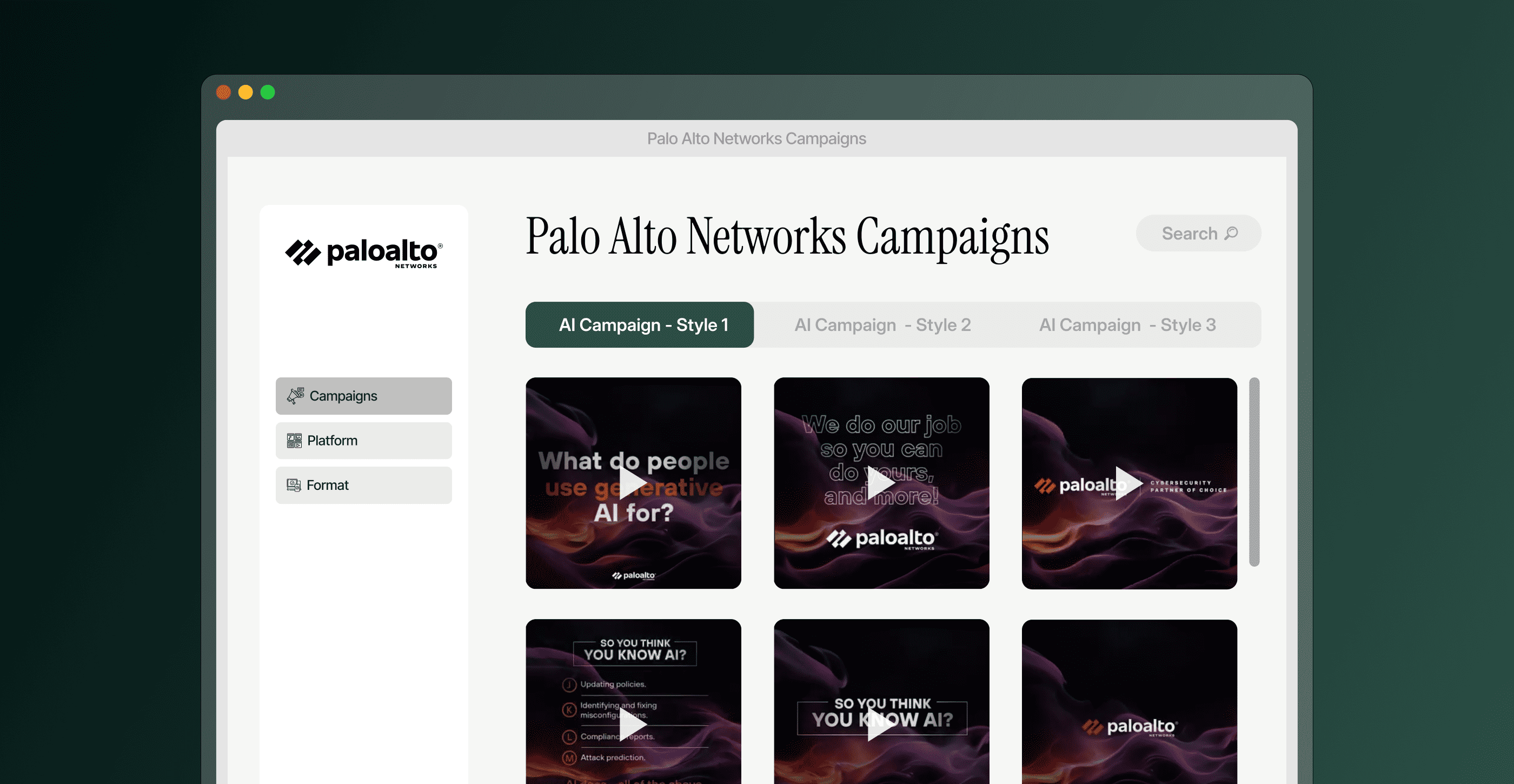
Enterprises often struggle to produce enough quality social content quickly. Thanks to flexible, scalable creative capacity, Superside solved this challenge for Palo Alto Networks. Learn what it means to build social-first processes, balance volume with quality, make data-driven decisions and choose the right support for your next campaign.
Social media has fundamentally changed how enterprises communicate. What began as experimental marketing channels has evolved into business-critical platforms.
Today, companies launch products, respond to crises, increase brand awareness, humanize their brands, foster community engagement, build thought leadership and drive sales through social media channels like Facebook, Instagram, X and LinkedIn.
A recent survey of 1,200 global marketing leaders found that social media drives major results, such as customer acquisition (60%), customer loyalty (58%) and revenue (56%). Of the leaders surveyed, 80% reported plans to reallocate funds from other digital marketing channels to social media.
But a more significant investment in social media marketing calls for more than the ability to create higher volumes of content faster. It demands expert social strategy and, critically, the right balance of speed, quality and volume.
To scale enterprise social media creative successfully, companies must produce high-quality content at high volume without proportionally increasing costs, time or team size.
When cybersecurity powerhouse Palo Alto Networks struggled to maintain a steady flow of high-quality content across multiple social channels, they encountered a problem familiar to enterprise-level digital marketing leaders everywhere: How to scale enterprise social media creative without sacrificing quality or the in-house team’s sanity.
Marketing manager, creative lead or brand director? Read on to discover how Superside plugged into Palo Alto Networks’ creative team to overcome this challenge. Use the Superside case study as a real-world blueprint for social media success and unpack the principles, infrastructure, processes and partnerships that help global enterprises scale their creative output and truly own the social space.
For a deeper dive, check out the in-depth walkthrough of our journey with Palo Alto Networks in the slides above.
Why scaling social media creative matters
For enterprise brands, social media performance isn’t just about likes, shares and follower growth. It’s about tangible business outcomes. Social media is also where thought leadership, product launches and community interactions intersect in a constant stream of posts, videos and campaigns.
Consider the scope: A typical enterprise might manage several accounts across LinkedIn, X, TikTok, Instagram, Facebook and other social media platforms. Each account requires regular posting, timely responses, product launch support, campaign amplification and evergreen content that educates and gets target audiences to perform a desired action.
At a time when competition is fierce and new platforms emerge overnight, enterprise teams also have to deliver higher-quality content faster than before. But to do this successfully, they need systems that can help them balance volume, speed and quality.
Scaling this kind of output demands strong creative ops for social teams. Without the right operational foundation, even the most talented social and creative teams struggle to keep pace with enterprise-level demands.
Once good processes and structures are in place, creative teams can produce enough content to help their brands stay relevant, ensure every asset reflects brand standards and keep target audiences interested.
In B2B spaces like cybersecurity, where Palo Alto Networks operates, translating complex technical concepts into engaging social content is another challenge.
While we're business to business, we're not business to boring, right?

But it can be tough to consistently produce standout social media content, which is why many enterprise teams now turn to outsourced creative marketing services like Superside for help.
AI-powered Creative Services for Enterprises
Discover why the world’s biggest brands choose us









The challenges of scaling social media creative
Understanding why it’s hard to scale enterprise social media creative can help you develop better solutions. Typically, the challenges are structural, operational and strategic, and they compound as the organization grows.
Let’s unpack this a bit more.
1. Limited in-house resources
Most enterprises face a fundamental mismatch between creative demand and creative capacity. Social media teams are often small, even at large organizations, while the volume of content required continues to grow exponentially.
For example, an enterprise could manage five major product lines, operate in six regions and maintain an active presence on four social platforms. Each product line requires regular content. Each region needs localized assets. Each platform demands platform-specific formats and approaches. This kind of workload quickly becomes unsustainable for small internal teams.
Traditional solutions, such as building larger in-house creative departments, don’t always solve the core problem. Plus, it takes time and money to recruit specialized creative talent. Onboarding takes even longer. And even after you’ve built a bigger team, you’re still limited by the fixed capacity of your headcount.


Increase your creative capacity
Let your in-house team reach for the stars,
while Superside keeps your day-to-day creative needs
at an industry-leading level. Ready to scale?
2. The pace of social media
The world of social media shifts very quickly. Trends come and go within days. News cycles demand immediate responses. Product launches require coordinated global rollouts. Cultural moments create opportunities for brand participation, but only for those that can create and publish content fast enough to be relevant.
This speed creates unique operational challenges. Traditional creative workflows, with their lengthy briefing, review and production processes, can’t keep up. What might’ve worked for print campaigns or websites is too slow for social media.
For enterprise brands in dynamic sectors like technology and cybersecurity, this pace can be particularly demanding. Palo Alto Networks, for one, needs to respond to security threats, industry developments and competitive moves with content that’s timely and on-brand.
With Superside, Palo Alto Networks found a partner that could become their creative team’s creative team. We helped them keep up with social media’s pace and adapt to new platforms while maintaining quality and brand consistency across every asset.


Produce ad creative that converts
Explore our ad design services
and get support to scale all from
static and motion ads to out-of-home
and social media campaigns.
3. The scale of enterprise demands
Enterprise-level social media marketing typically involves a complex ecosystem with many moving parts. Each type of content (e.g., product marketing, thought leadership, evergreen content, campaign support and global/regional content) has unique requirements.
- Product marketing: Every launch needs social support with dedicated creative assets. New features, for example, require visual content, product updates pair well with explainer videos, and success stories are best told with data visualizations.
- Thought leadership: Executive voices need amplification through social media content. Industry perspectives typically require infographics and quote cards, while research and reports need to be packaged into easily digestible content snippets.
- Evergreen content: Educational assets can fill content schedules and keep digital marketing momentum going. But “evergreen” content also needs to be refreshed regularly. Both search engines and AI models reward content that’s frequently updated and highly relevant.
- Campaign support: Large-scale campaigns require coordinated creative execution and distribution. Think ongoing optimization, quick-turn variations and rapid creative refreshes based on creative performance insights.
- Global and regional content: Marketing teams at enterprise headquarters typically create core assets, while regional teams handle localized versions. This dual-layered approach demands exceptional coordination and agility to ensure brand consistency and relevance across different cultures and languages.
B2B enterprises like Palo Alto Networks also typically don’t have the luxury of focusing on a single campaign at a time. Many run several campaigns in parallel, each requiring adaptation to target demographics, alignment with industry trends, and coordination across various platforms. Plus, to stand out in a crowded marketplace, every single asset must be exceptional.
I needed help [...] making sure every single piece of content that we were putting out was the best possible.
4. Agency limitations
Traditional agency models often fail to meet enterprise social media needs for several reasons.
- Inflexibility: Traditional agencies work on contracted scopes and monthly retainers that don’t easily adapt to fluctuating demand. When you suddenly need three times your normal volume of content for a product launch, most agency relationships can’t flex accordingly.
- Speed: Agency workflows involve account managers, creative briefing processes and production timelines built for longer-form work. A two-week turnaround doesn’t work when you need content tomorrow.
- Cost structure: Agency pricing models are usually built around hourly rates and project fees, which can make global campaign content production expensive. The cost per asset is often too high to sustain the volume enterprise-level social media output demands.
- Communication cost: Working with agencies typically involves multiple rounds of communication, including briefs to account or project managers, meetings to discuss concepts, and formal presentations for feedback and revisions. This lengthy process slows down production and limits agility.
- Generic solutions: Many agencies lack specialized social media expertise. They may excel at brand campaigns or traditional advertising, but struggle with the platform-specific nuances that make social content effective.
These limitations, combined with the need for agile, innovative creative support, highlight the gap Superside was poised to fill for Palo Alto Networks.
How Palo Alto Networks scaled its social media creative with Superside
As we became a seamless extension of their creative team, Superside could provide the scale, speed and creative excellence that Palo Alto Networks required for its social-first strategy.
Let’s take a detailed look at the principles and practices that continue to make this partnership so successful. It’s also a masterclass in how to scale social media creative for your own brand.
1. We built a social-first creative strategy
Palo Alto Networks recognized that social media wasn’t just a space for repurposed content. The team required a dedicated social media strategy and platform-optimized content.
This social-first mindset influenced how the work was approached from the start. We knew that content designed for social consumption had to include shorter, more visual, conversational assets that made complex cybersecurity concepts accessible.
Everyone has a computer, everyone has a phone and everyone needs cybersecurity in some way. We have a very big responsibility to make sure that we're talking about this topic in a way that people will understand.
Our first move? We developed evergreen content, the always-relevant informational assets that form the foundation of any brand’s social presence. From there, we went on to support thought leadership campaigns, product marketing initiatives and eventually broader creative needs across multiple product lines.
Superside has been instrumental in our creative strategy over the last year. They’ve been really supportive and helped bring our products and solutions to life.
2. We created agile, scalable processes
Traditional creative workflows couldn’t support the velocity and volume Palo Alto Networks required. So, we introduced operational efficiencies that transformed their creative production capacity.
- Centralized project management: Our Superspace platform made it easy for both teams (Superside and Palo Alto Networks) to manage all creative requests via a single dashboard, track project status, provide feedback and maintain visibility across multiple initiatives.
- Flexible capacity: Unlike traditional agencies with fixed capacity, our model allowed Palo Alto Networks to scale resources up or down based on demand. This meant they didn’t have to pay for unused capacity or face bottlenecks when demand for content increased.
- Fast turnarounds: Streamlined processes and advanced tools enabled the kind of speed that would have been impossible with traditional agency workflows. When time-sensitive opportunities emerged, Superside could deliver quickly without sacrificing quality.
- Collaboration: Rather than the formal revision rounds typical of agency relationships, Superside’s processes enabled a more fluid partnership. This approach allowed for quicker refinement and better final results.
3. We elevated product launches on social
The true test of any scaled creative operation is high-stakes moments, and product launches are among the highest-stakes in enterprise marketing. The Palo Alto Networks Precision AI launch showcased how effective their partnership with Superside had become.
Precision AI represented a major strategic initiative for Palo Alto Networks: A new brand within their cybersecurity portfolio that required significant market education and executive visibility.
The launch needed to bring together multiple content types, channels and stakeholders. At the same time, the team had to maintain message consistency and creative excellence.
Superside helped us with our overall campaign by really brainstorming how we officially announced and explained Precision AI on social.
Our collaborative approach meant Superside didn’t just execute creative briefs. We helped shape the launch strategy itself.
The campaign included video content that distilled complex AI and cybersecurity concepts into engaging, shareable social media assets. It also involved a press release launch, blog content explaining the new brand, and amplification across multiple social channels.
The executive event was broadcast globally, creating real-time engagement opportunities that required immediate content deployment.
That morning at 5 a.m., we launched our press release and our blog post explaining what this new amazing brand was. My personal LinkedIn feed was overtaken by everyone sharing this video about what Precision AI is.
This is precisely the kind of organic amplification that successful content creates. The campaign resonated because it was explicitly designed for social media and created quickly enough to align with launch timing. It also maintained the quality standards customers expect of major enterprise brands.
4. We delivered creative workflows at scale
The success of campaigns like Precision AI demonstrates the scalability of the Superside model. In fact, Palo Alto Networks expanded its partnership with us beyond one-off projects to support other departments and product lines.
This expansion demonstrates a critical aspect of successful scaling: Once you’ve established processes and relationships that work, you can extend them across your entire organization.
For Palo Alto Networks, this means:
- Multiple product teams can access top-quality creative. Different product lines within the business can now tap into the same creative partnership with Superside. This approach ensures consistency while meeting specific needs.
- Diverse content types are easy to deliver. From product announcement graphics and thought leadership videos to event promotional materials, Superside supports the full spectrum of Palo Alto Networks’ social creative needs with the right tools and skills.
- Ongoing campaigns are no longer a headache. Continued support with global campaign content production keeps Palo Alto Networks’ social channels active and engaging.
- Strategic expansion is finally possible. As comfort and trust in Superside have grown, the relationship has evolved from tactical execution to strategic collaboration. Superside has become a true extension of the internal team.
Superside is helping us bring our vision to life across social because frankly, you know, speed and scale and creativity. And that’s really what we need. And now we’re even leaning into all of our other product lines and solutions and having Superside really support all of those efforts.
Key takeaways: Lessons for enterprises that look to scale social media creative
The Palo Alto Networks x Superside case study offers clear lessons enterprises can apply when it’s time to scale creative operations for bigger social media impact.
1. Invest in a social-first mindset
Social media content can’t just be repurposed from other channels. A dedicated social media strategy and platform-specific creative is the only way to cut through the noise.
Enterprises that succeed in their social media efforts recognize social as a distinct medium with its own rules, formats and opportunities.
This mindset shift means:
- Choosing the right platforms to reach your ideal customers. Robust audience research is the only way to get a clear picture of where you can expect the most engagement.
- Platform-specific content creation rather than generic content that’s used across all channels (e.g., the exact same piece of content won’t work for LinkedIn and Instagram).
- Visual-first thinking rather than text-heavy approaches for maximum impact and attention.
- Conversational tone rather than the more formal language often used in traditional marketing material.
- Trend responsiveness that allows for timely participation in cultural moments and industry conversations.
2. Build agile processes
Traditional creative workflows are too slow for the fast pace of social media. In our experience, most enterprises have to redesign their processes to deliver speed, scale and flexibility.
In practice, your enterprise may have to:
- Reduce approval layers to cut production time.
- Create feedback loops that allow for quicker iteration and revisions.
- Establish clear briefing templates to reduce back-and-forth clarification before work can begin.
- Use technology to increase visibility, such as project management tools that provide real-time status updates and eliminate the need for meetings, emails and chat messages.
- Build operational models that can scale capacity up over peak periods and down during slower times (as opposed to fixed resources that create bottlenecks or waste).
3. Balance volume with quality
Flooding social channels with low-quality content doesn’t equate to effective scale and can, in fact, jeopardize your brand reputation.
It’s critical to balance content volume and quality. Here’s how:
- Set clear quality standards and apply them consistently, regardless of work volume.
- Choose creative partners who deeply understand your brand, products and target audience, so you can trust them to maintain quality and brand consistency.
- Invest in template libraries and design systems to produce higher-quality content more quickly while maintaining quality and brand identity.
- Track creative performance and use social media analytics to enable data-driven decision-making that will improve creative output.
- Ensure all social media posts serve a strategic purpose. If they don’t, they’re just clutter.
4. Choose the right creative partner
The best creative partners for enterprise-level social media content production have several essential characteristics:
- Specialized social expertise with a thorough understanding of social platforms, different audiences, trends and best practices.
- Flexible operating model, business hours and fee structure, with the ability to scale up and down with your needs.
- Speed and responsiveness, with turnaround times measured in days, not weeks.
- Tech-enabled processes and online tools that enable transparent, efficient project management.
- A collaborative approach, which makes the creative partner feel like an extension of your internal team rather than an external vendor.
- Quality consistency across all projects, not just the high-profile ones.
- Cultural fit, for ease of communication and a shared commitment to excellence.
Why Superside is the right partner for social media creative at scale
At a time when social media is often the first line of communication between brands and audiences, enterprises can’t afford to treat it as an afterthought. The ability to produce high volumes of engaging content across social channels directly impacts business outcomes in today’s landscape.
The Palo Alto Networks story demonstrates what’s possible when enterprises approach this challenge with the right strategy, processes and partnerships. By building a social-first creative operation with Superside, Palo Alto Networks transformed its ability to launch products, build thought leadership and engage audiences.
We have this big undertaking of being the cybersecurity partner of choice and talking about one of the most important topics (cybersecurity), which is a huge, huge, huge responsibility. And I am really honored and thrilled that I’m able to do that with partners like Superside.
Ready for greater social media marketing success? Then, Superside it and take the first step toward a strong social media presence and tangible results.


How 500+ brands get more work done, without doing more
They Superside it. Fast, high-quality creative from the
AI-powered creative service that handles it all.
FAQs