

Enterprise creative teams spend too much time on repetitive design tasks. As Canva's strategic agency partner, Superside helps brands like Grammarly, Amazon, and HubSpot turn recurring creative work into reusable templates.
Think about how much of your creative team's time goes into work that's already been designed.
The webinar campaign is ready, but next quarter someone needs to update the speaker headshots, dates, and copy. A paid ad is performing well, but the team needs another 20 variations to test different messages. A regional marketing team needs to adapt a global campaign for its local audience.
None of these requests necessarily calls for a new creative concept. But they still end up in a designer's queue.
We hear this from enterprise marketing teams all the time. These creative production bottlenecks show up even in teams with talented designers. They have top creatives working on big campaigns, but those same people are also spending hours resizing assets, swapping images, and updating layouts that were approved months ago.
Working with hundreds of brands has taught us that solving this problem starts well before the next request comes in. When we're designing something, we also think about how it'll be used after delivery:
- Who will need to update it?
- What will they need to change?
- How can we make sure they don't need to come back to a designer every time?
That's the thinking behind our partnership with Canva.
Canva gives teams an accessible place to create and adapt content while Superside brings the creative expertise to turn existing brand assets, campaigns, and guidelines into systems people can actually use.
Together, we're helping enterprise teams move routine creative production out of the design queue, while keeping the quality and consistency their brands depend on.
Making self-service work for enterprise teams
Giving everyone access to a design tool is easy. Helping hundreds of people maintain brand consistency at scale is a different challenge.
For that to happen, someone needs to do the creative thinking upfront.
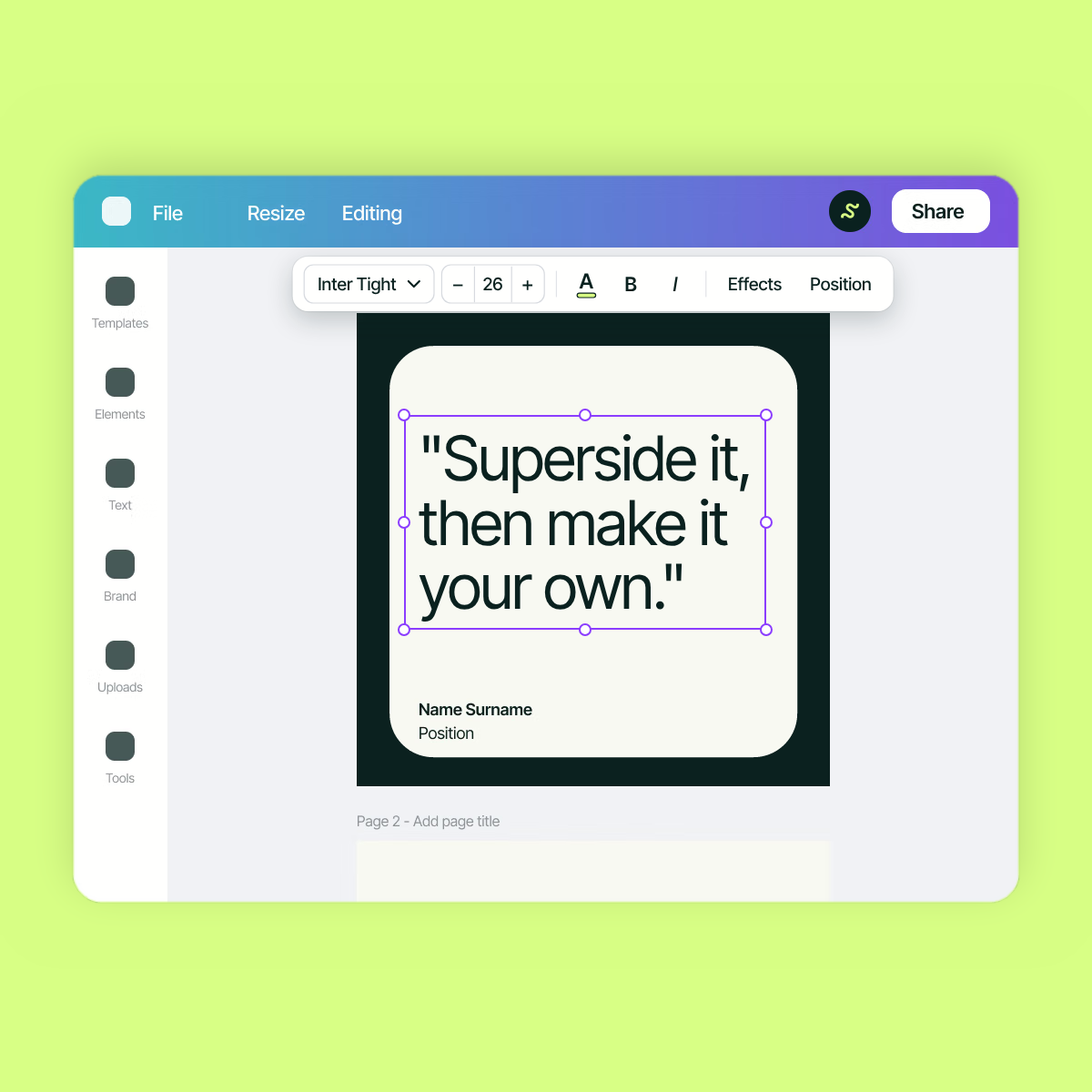
That's where Superside comes in. We work with enterprise teams to decide what should be editable, what needs to stay consistent, and how to organize their Canva workspace around the content they produce every day.
Our partnership brings together three areas:
1. Set up for scale
We build Canva Brand Kits, reusable template libraries, and organized workspaces, with the right brand assets and permissions in place. Instead of searching through old files or copying last quarter's campaign, teams know where to find the approved version and what they can safely change.
2. Enable teams
We help marketers, sales teams, and other non-designers use those systems confidently, with practical guidance and relevant Canva AI tools. The goal isn't to turn everyone into a designer, but to make the everyday creative tasks they're already responsible for easier to handle themselves.
3. Produce at volume
We design repeatable systems for campaigns, localization, and content variations, combining Canva's editing and bulk creation capabilities with Superside's ongoing creative support. Teams can take care of routine updates while experienced designers focus on the work that needs their expertise.
Here's how that looks in practice.
Amazon Autos: Giving local dealerships the freedom to market themselves
Imagine managing marketing for hundreds of independent dealerships.
Every location needs materials that speak to its own customers. But the national brand still needs to look and feel consistent, whether someone sees a digital ad, a social post, or a printed piece at their local dealership.
Without a shared system, that creates two difficult options: ask the central creative team to handle countless local requests, or let dealerships build their own materials and risk inconsistent branding.
Amazon Autos needed a better way to support local marketing at scale, with a system that could work across brands and teams.
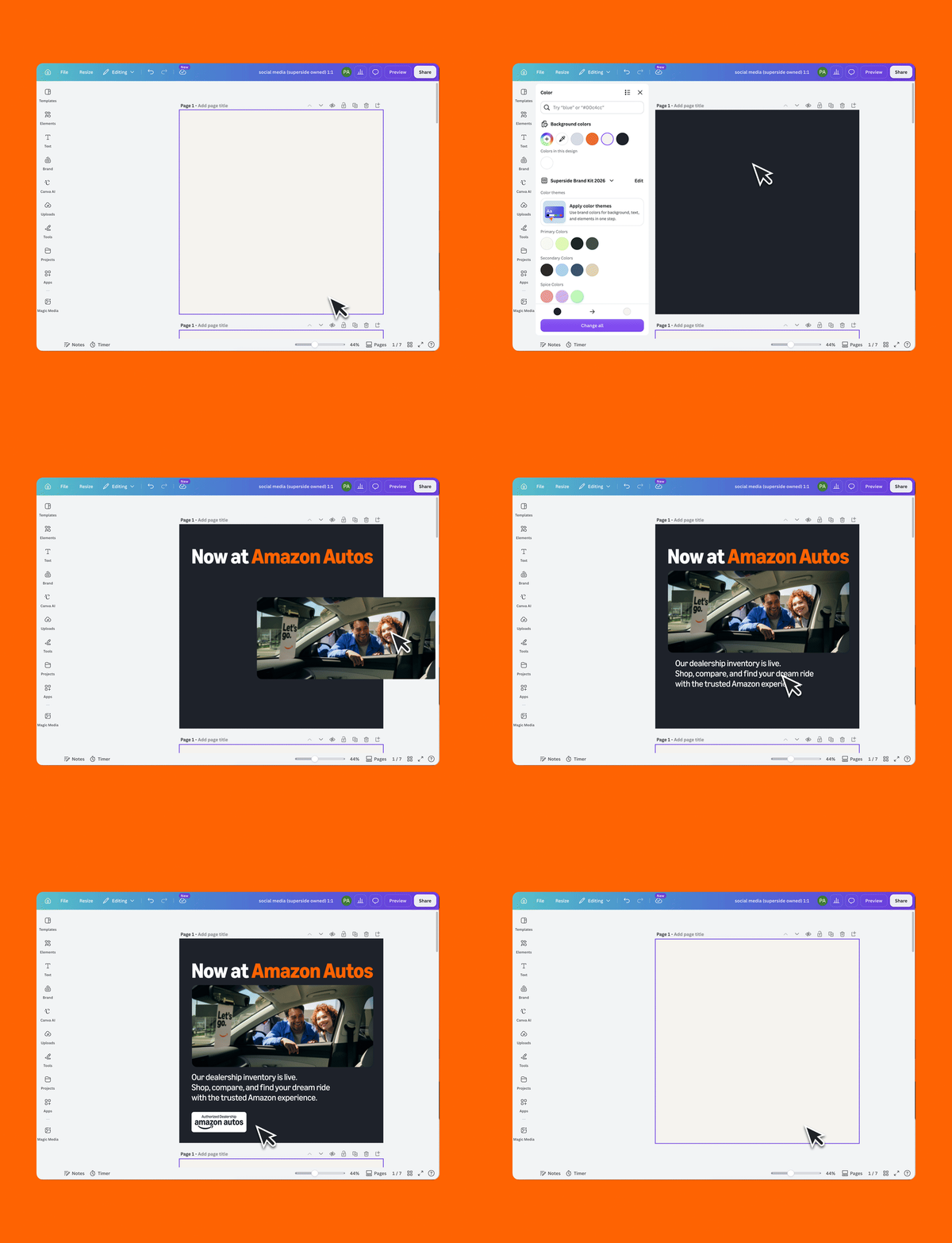
Superside developed 10 campaign systems comprising 210 deliverables: 110 static and 100 animated assets, including digital and print materials, co-branded creative, reusable components, and lightweight motion graphics.
But the value wasn't simply having 210 assets ready to use.
We built the toolkit around what dealerships would need to do next: take nationally developed creative and adapt it for their local marketing needs.
Using Canva, dealers can work with editable campaign materials instead of needing professional design software or rebuilding approved creative. The toolkit gives them a practical starting point, with reusable layouts and brand elements already established.
Superside's role was to make that flexibility possible without sacrificing the quality of the original campaigns. We designed the assets and the reusable system together, considering which elements dealerships would need to customize and which should remain consistent.
HubSpot: One creative workflow, six different media brands
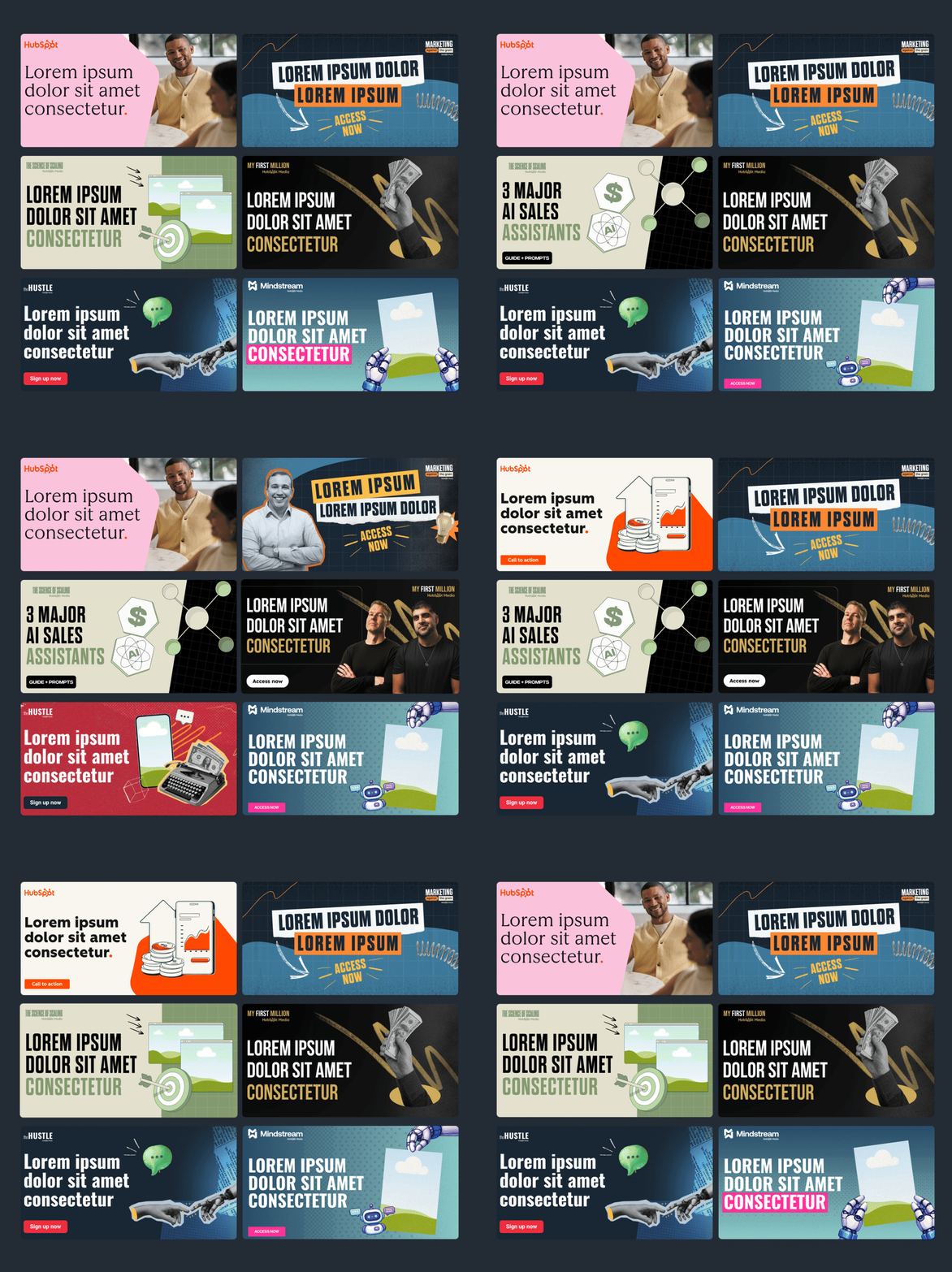
Managing content for one brand is demanding enough. Managing six publications, each with its own identity and promotional calendar, adds another layer of complexity.
That's the challenge behind HubSpot's media portfolio.
Each publication needs regular promotional creative, with different headlines, images, and messages. And each one needs to remain recognizable.
The goal wasn't to make all six brands look alike and to make producing content for them easier.
Superside created a Canva template ecosystem with layouts tailored to each publication's visual identity. Marketers can swap copy, images, and logos while working within designs established for the specific brand.
We also provided guidance on organizing and publishing the templates in HubSpot's Canva workspace, so teams could find and use the right materials.
Think about what that changes during a typical publishing week.
Instead of sending every new article promotion back to a designer, a marketer can start with the appropriate publication template, add the latest headline and imagery, and prepare the asset in a familiar workspace.
And because the visual rules are already built into each template, the team doesn't need to recreate the brand identity with every post.
Canva makes the day-to-day editing accessible to people who aren't designers. Superside makes sure the underlying designs are strong enough to support that independence.
For companies managing multiple brands, regions, or business units, the lesson is simple: you can standardize how teams produce content without standardizing how every brand looks.
Grammarly: Keeping recurring campaigns out of the design queue
If your team runs webinars, newsletters, or paid campaigns, you know how repetitive production can get.
The creative concept might be approved once, but every new edition brings another round of changes. A different speaker. A new headline. Another event date. Updated customer messaging.
For Grammarly's Demand Gen team, the opportunity was to make those recurring updates easier without starting from scratch or asking a designer to adapt every asset.
Superside developed 46 editable Canva templates across Grammarly's Margins newsletter and webinar campaigns. We reviewed existing creative, refined the designs, and standardized the layouts around the elements marketers needed to change most often.
The result was a reusable system: instead of treating each webinar or newsletter edition as a new design request, marketers could work from established layouts, update the relevant content, and prepare the next edition in Canva.
We applied the same thinking to Grammarly's paid acquisition work.
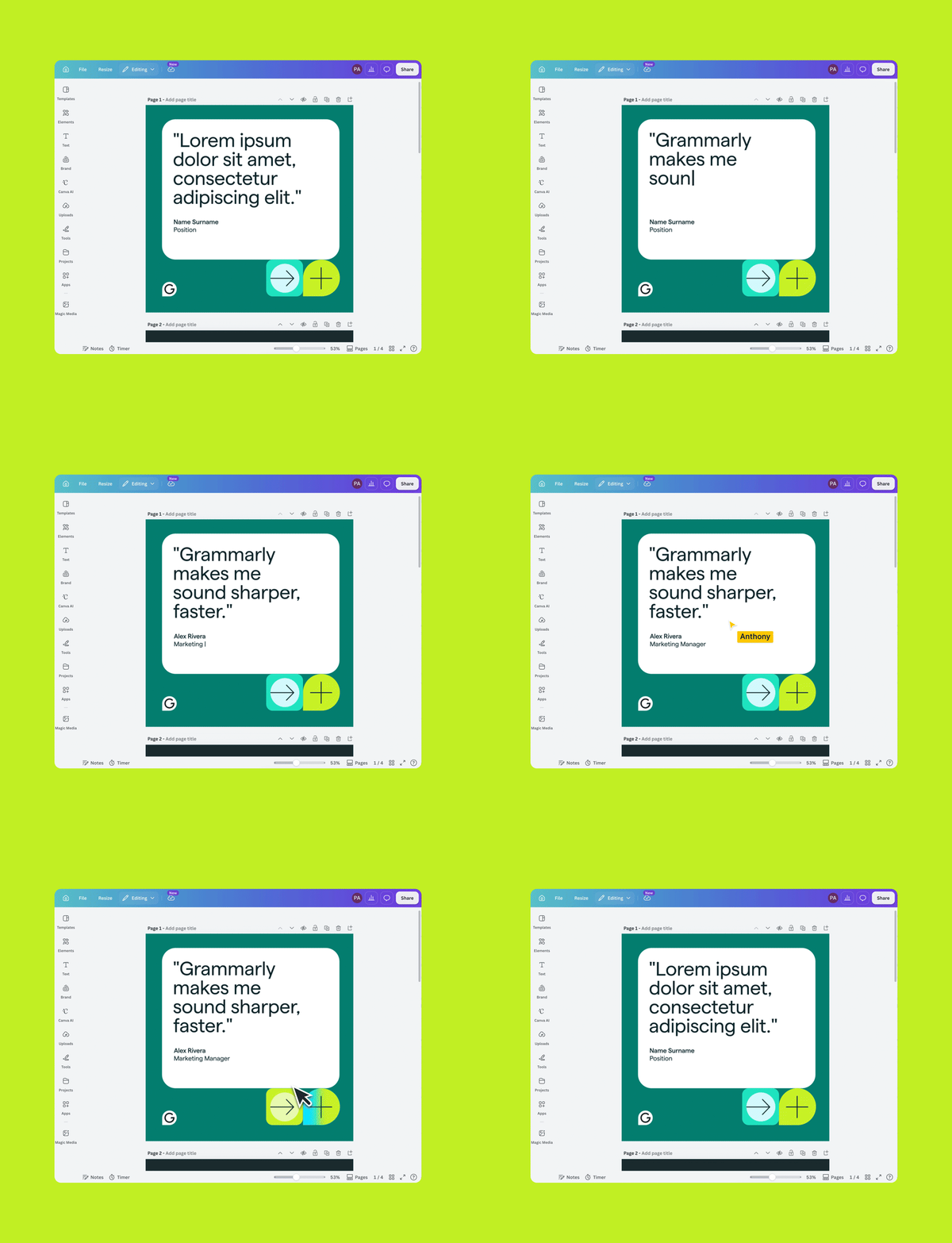
Customer quote campaigns need constant creative variations to accommodate different messages and placements. Superside organized layouts for nine paid media formats into a centralized Canva library, with editable areas for the content that changes from one ad to the next.
The important distinction is that Grammarly's marketers aren't being asked to make design decisions from scratch. Superside has already established the layouts, hierarchy, and brand rules. Canva gives the team a straightforward way to make the updates.
That means routine campaign production can happen closer to the people managing the campaigns, while designers have more time for new concepts, creative testing, and higher-impact work.
Fortive: Turning event footage into same-day social content
Your team is at an important industry event. Someone captures a great customer interview or a quick reaction from an executive on their phone. It's exactly the kind of content you'd want to share while the conversation is still happening.
But first, the footage needs editing. Someone has to add captions, apply the brand elements, format it for LinkedIn, and prepare the final video. By the time everything is ready, the event might already be over.
Fortive needed a faster way to turn footage from a leadership conference into branded social content without putting every video through a traditional production process.
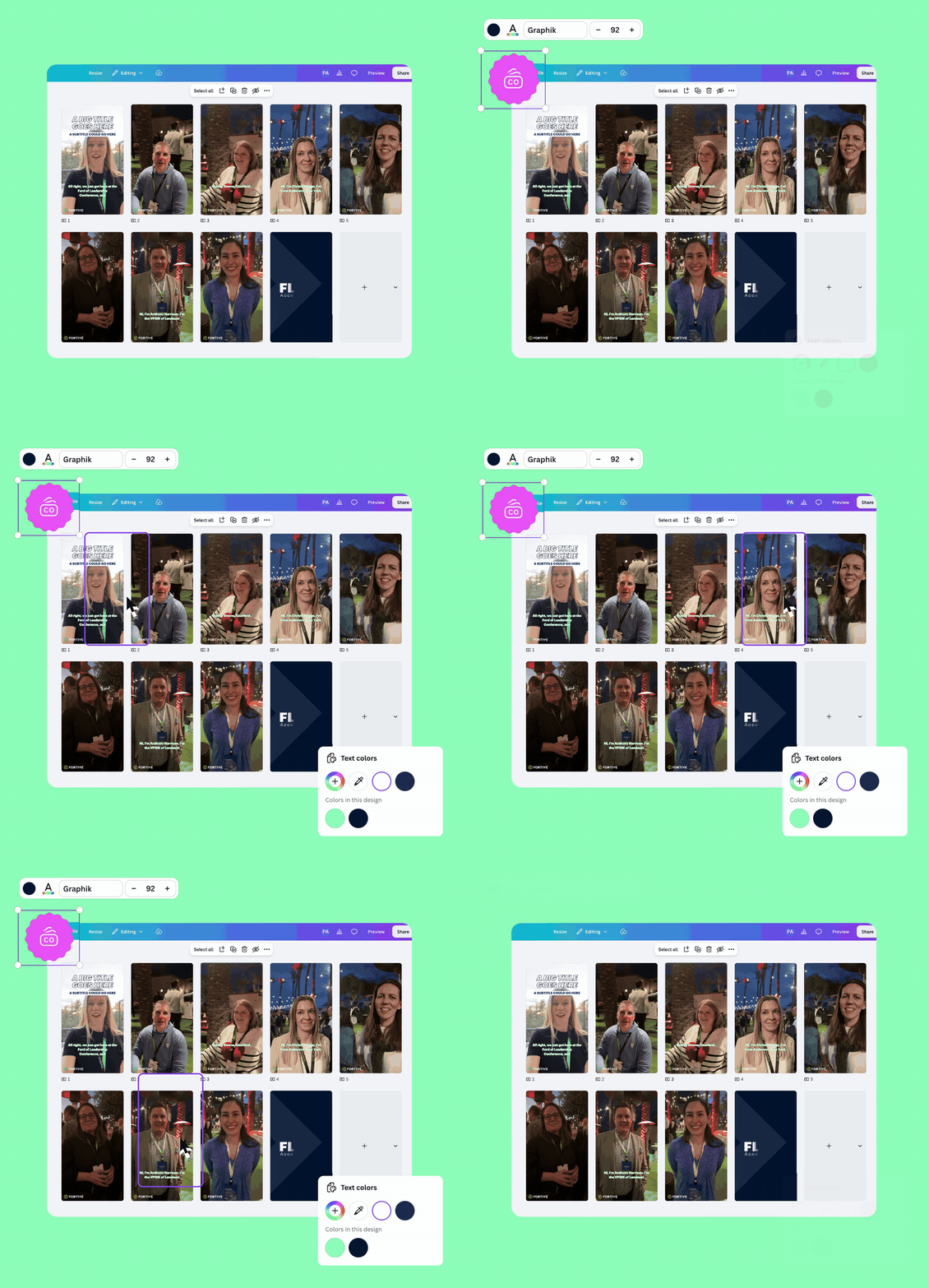
Superside built a reusable Canva video system designed for mobile-first content. It included branded caption styles, on-screen text, animated end cards, and visual elements that could be applied to new footage.
Instead of starting every video edit from scratch, Fortive's internal teams could bring their phone footage into Canva, work within the established templates, and prepare content for LinkedIn themselves.
Superside handled the creative decisions upfront, making sure the videos had a consistent look and the right elements for social. Canva made those designs easy for internal teams to reuse without needing professional video editing software.
That changed what was possible during an event. Teams could prepare branded videos for same-day publishing, while the conversations and moments they captured were still relevant.
And because the system was reusable, the same approach could support future events without rebuilding the production workflow every time.
Tubular Labs: Helping non-designers build polished reports

Some content is particularly difficult to make self-serve.
Reports are a good example. They need to present complex information clearly, but the people closest to the data aren't always designers.
Every new report can mean another round of decisions about charts, layouts, spacing, and how to make the information easy to understand.
Tubular (acquired by Chartbeat) faced that challenge with its Tubular reporting work.
The team needed a repeatable way to produce on-brand reports without requiring a designer to assemble each one.
Superside built a 24-slide modular Canva system, with four visual themes, four core layout types, and standardized chart styles.
We deliberately limited the layout options and added instructions directly into the templates.
That way, someone building a report doesn't have to decide how every page should look. They can choose a layout that fits the information, add the relevant data and insights, and follow the guidance already included.
Canva gives non-designers an accessible place to assemble and edit the reports. Superside provides the design structure that makes the final result feel professionally produced.
And the benefit goes beyond saving time on individual slides.
When a reporting team has a reliable system, it can spend more time analyzing the data and shaping the story, rather than adjusting text boxes and rebuilding charts.
As Nicolette Oñate at Chartbeat put it:
"The modular system Superside built allows our non-designers to produce polished, on-brand reports in a fraction of the time. It's been a game-changer for our team's scalability."
That's what a good template system should accomplish: make quality easier to repeat, even when the person using it isn't a designer.
Boomi: Putting years of brand knowledge into a reusable creative system
One of the biggest advantages of working with a dedicated creative team is everything that team learns about your brand over time.
They know which layouts work, how your messaging has evolved, what your stakeholders expect, and how to make new work feel consistent with everything that came before.
But what if more people across your company could benefit from that knowledge, even when they're creating something themselves? That's part of what it means to scale creative operations, and that's the opportunity we saw with Boomi.
Superside has supported Boomi since 2023, working across social content, events, campaigns, and larger creative initiatives. Our dedicated team has developed a deep understanding of Boomi's visual identity and how it needs to work across different channels.
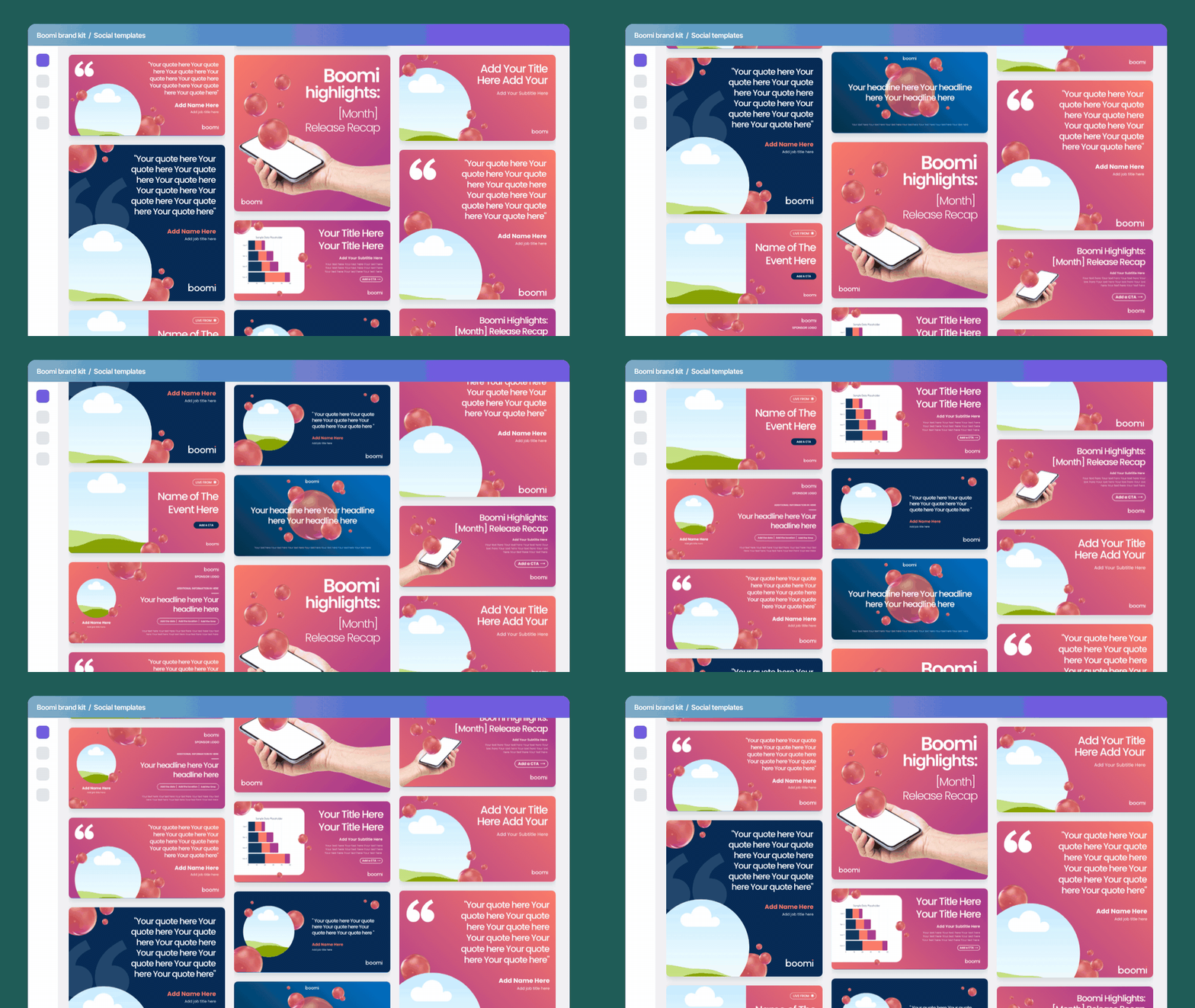
We used that knowledge to build a reusable Canva template library for Boomi's social, event, and content marketing needs.
Instead of having to brief the creative team for every routine asset, Boomi's marketers have approved layouts they can adapt themselves.
Canva makes those updates accessible in a shared workspace, without requiring every user to work in professional design software. Superside makes the system useful by translating years of creative knowledge into templates that reflect Boomi's brand.
Your creative team should be creating, not recreating
Look at the work your creative team receives in a typical week.
How many requests are genuinely new creative challenges? And how many involve changing something that's already been designed?
A new webinar date. Another paid ad variation. A localized campaign asset. A refreshed presentation. A quarterly report.
Those requests aren't going away. As enterprise teams grow, they usually become more frequent.
But they don't all need to take up the same amount of creative time.
That's why Canva is such a valuable platform for enterprise teams. Its accessible editing experience, shared workspaces, Brand Kits, and reusable templates make it easier for people across the business to create and adapt content without needing professional design skills.
And that's where Superside adds value.
We don't just move existing designs into Canva. We help companies figure out which work should become self-serve, build the creative systems to support it, and give teams the guidance they need to use those systems confidently.
The result is a better division of creative work.
Marketers can move faster on the content they manage every day, and designers can spend more of their time on the things that actually require their expertise: developing new campaign ideas, building distinctive brands, exploring new creative approaches, and solving the bigger challenges that help your business grow.
That's what it means to Superside it with Canva. Build the right creative system once, make it useful to the people who need it, and give your creative team more room to do the work only they can do.
Ready to make everyday creative production easier? Talk to Superside about building a Canva system for your team.