

Enterprise video teams stall on AI not because they lack tools, but because they apply them informally without governance or workflow redesign. This article unpacks where AI actually fits, what blocks adoption at enterprise scale and how Vimeo’s structured diagnostic with Superside identified 20%+ efficiency potential across creative workflows.
We’re at a point where enterprise video teams no longer debate whether to use AI. Now, they focus on where to apply it, how to implement it and how far they can scale it.
Wondering what separates teams that make real progress from those stuck in an inefficient, experimental phase? Structure.
The teams that successfully adopt AI have a clear understanding of:
- Which stages of enterprise video production are most time-intensive.
- Which AI applications can relieve the biggest bottlenecks.
- What governance and infrastructure are needed to scale AI adoption across the organization.
This article breaks down all three areas, with real data from Vimeo’s AI diagnostic with Superside and expert insights from Manuel Berbin, our Generative AI Researcher and Creative, and senior creative and production leaders at Vimeo.
Why AI in video production for enterprise teams stalls
While many enterprises already apply AI across departments, from marketing and training to internal communications, AI adoption for creative teams presents several unique challenges.
The scale problem is different at the enterprise level
A startup or small creative team can adopt a new AI tool with ease. One person experiments, shares what they’ve learned, and the team adjusts. Enterprise teams operate on a fundamentally different basis.
When Vimeo, for example, considers adopting a new AI tool, the question isn’t just whether the tool works. Enterprise teams also need to ask:
- Is the tool approved under our IP and security policies?
- Does its use create copyright or compliance exposure?
- Will the output meet brand standards consistently across global teams, campaigns and projects?
These aren’t just barriers to adoption. They’re real questions that directly impact the quality and legal defensibility of the work. In other words, the stakes are high.
Fragmented experimentation does not scale
Most enterprise creative teams already experiment with AI, but typically in a siloed, informal way. One producer might use an AI scriptwriting assistant, while another relies on AI-assisted captioning tools.
Without shared standards, these different team members often produce inconsistent outputs. And without legal input, the organization carries exposure that no one has explicitly assessed.
The result is a pattern Superside has consistently observed. Individual AI capabilities that fail to deliver organization-wide efficiency gains. Why? Because the AI video production workflow teams need hasn’t been thought through.
The most effective enterprise AI video production workflows are hybrid by design. AI supports specific stages of the video production process while humans shape direction, maintain brand alignment and apply editorial judgment to produce truly standout work.
We like to think about the use of AI in video in black and white. But the reality is always mixed.

The legitimate concerns that slow things down
Creative professionals who’ve spent years building their skills and reputation naturally question how AI might affect the quality of their work.
When Superside first partnered with Vimeo to introduce AI into their video workflows, we discovered that some designers shared these hesitations. To address this, Vimeo had to provide clear answers and build real capabilities, not push adoption for its own sake.
Where AI fits in enterprise video production

Source: The Overcommitted Report
The most useful approach to AI adoption creative teams can benefit from isn’t asking “what can AI do?” but “where are we spending time on work that doesn’t require creative judgment?”
These are the stages where AI integration typically produces real efficiency gains.
Ideation and concept development
One of the highest-value AI applications for video creation is in the early ideation phase.
LLMs can accelerate the development of strategic and conceptual frameworks, draft scripts, shot-list structures and concept direction. Where these tasks would usually take creative teams days, AI-assisted tools can dramatically reduce turnaround time.
AI isn’t meant to outperform experienced creative professionals at generating ideas. Instead, it’s best used to free up creative teams to explore more directions faster, surface the strongest options earlier and achieve stakeholder alignment with less time spent on repetitive pre-production work.
The right questions, Berbin says, aren’t “should we use AI?” but “could AI speed up our storyboarding phase?” and “can AI help us explore visual styles before we commit to a direction?”
These questions help identify workflow stages where AI provides real, measurable value.
Image generation and visual reference
It takes time and effort to source visual references, build mood boards and generate rough visual content as part of the video production process.
AI image generation tools can cut the time spent on these traditional video processes. The technology helps teams quickly create high-quality reference visuals to refine ideas and align expectations before production starts. This approach is particularly valuable for global teams that regularly produce high volumes of video content across multiple marketing campaigns.
Production asset generation
AI excels at generating what Berbin describes as “building blocks, not finished products.” Think:
- Short motion loops
- Intro transitions
- Surreal visual sequences
- Cinematic cutaways
These elements enhance social ads, brand videos, short-form videos and website content.
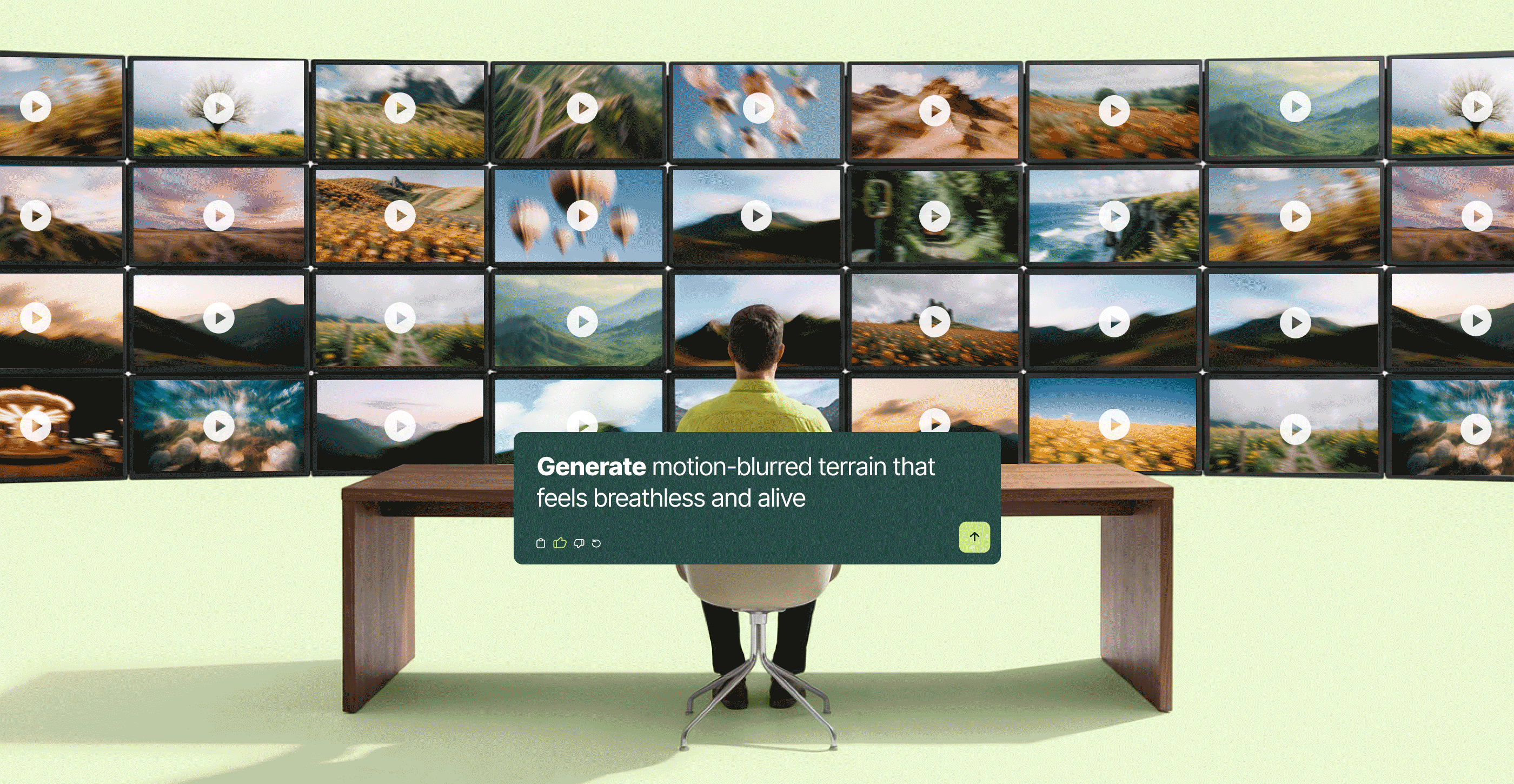
Remarkably, AI can now generate them to a standard that previously required significant animator time. This doesn’t mean AI is a substitute for a good motion designer or senior editor. The technology simply helps human professionals generate more high-quality component assets faster, giving creatives more to work with in less time.
There’s no instant shortcut where a small investment in an AI tool produces a blockbuster-level film. High-quality video still requires expert editing, sound design and a clear creative vision.
Post-production and format adaptation
Post-production tasks are often the most time-consuming. Captioning, format adaptation across platforms, background replacement for variant creation and color correction passes can take days.
Format adaptation carries a particularly high and often overlooked cost. Producing multiple versions of the same core video to meet different platform requirements is a repetitive, high-volume task that adds little creative value.
This is where AI often delivers the most impact. The right AI-powered tools and setups can automate these processes efficiently and free up creative teams to focus on higher-level creative work.
AI helps move fast—but it’s Superside’s strategic creative direction that makes sure you’re moving in the right direction.
How Vimeo built an enterprise AI video strategy with Superside

Vimeo is one of the world’s most recognized video creation platforms, trusted by over 300 million active users. Its brand and production teams deliver high-quality creative to a customer base that spans independent filmmakers and large enterprise marketing teams.
The internal stakes are unusually high. Vimeo’s audience understands what excellent video looks like. They expect quality, speed and scale in the company’s own creative outputs.
Superside’s relationship with Vimeo started with creative support on a few projects. Soon, however, it became clear that the team needed more. They needed a structured approach to embedding AI into their video workflows to deliver real impact.
Our team proposed an AI diagnostic to assess Vimeo’s creative and production workflows as well as its readiness and governance frameworks. The assessment was designed to identify the highest-impact AI opportunities and develop a concrete roadmap for capturing them.
For this engagement, we worked directly with Vimeo’s Meagan Wood, Director of Integrated Production, Bia Castro, Director of Brand and Creative, and Leif Huron, Lead Production Manager of Creative Operations.
Why the partnership made the diagnostic work
Superside already had years of experience working with the Vimeo brand, production culture and workflow patterns. That context made it easy for us to step in and help Vimeo do the crucial diagnostic work.
It felt very easy to do because the opportunity was coming from a company [Superside] that was already folded into our workflow. They knew our brand, they knew us; the relationship and trust were already built.

A consultant who started without context would have spent the first phase of the engagement learning. The specificity of Superside’s recommendations reflected how well we already knew the brand.
Stage 1. Readiness assessment across creative, legal and IT
The first stage was about people, not AI tools. We surveyed Vimeo’s creative team and conducted 15 one-on-one interviews across the creative, legal and IT functions. Our goal was to understand where individuals were in their AI journey and what was needed for adoption to succeed.
Bringing legal and IT into the process early proved critical for adoption.
The AI Diagnostic Process that we went through with Superside allowed us to take all of the different disparate interests and get everyone in the same room and have the conversations about what we can and can’t do.
The readiness assessment surfaced four interconnected challenges that slowed down Vimeo’s AI adoption process:
- Fragmented experimentation without shared standards.
- Legal and compliance uncertainty, which created a drag on tool use.
- Creative team hesitations around quality and craft.
- Workflow integration challenges that caused AI to create friction rather than remove it.
Stage 2. 20% efficiency identified through impact analysis
Next, Superside analyzed how Vimeo’s creative team actually distributed their time across tasks. We then benchmarked that against our AI-enabled efficiency standards from our own production operations.
The analysis identified more than 20% efficiency potential in selected creative workflows. The highest-impact opportunities were in creative ideation, image generation and image sourcing.
AI tools presented an opportunity to accelerate the work in these stages without compromising creative quality.
It felt like a leadership step that was really important for workflows and processes, but also just to make sure our team across the board were all really staying ahead of the curve and looking around the corner.
Stage 3. Curated AI toolkit recommendations
Superside delivered an enterprise plan with AI tool recommendations tailored to Vimeo’s workflows and legal requirements. Rather than generic guidance, we provided a vetted shortlist of tools based on hands-on production experience and aligned with Vimeo’s legal and enterprise-grade security standards.
The recommendations included platforms such as Krea and Suno.
The AI assessment was beneficial because it narrowed down the focus to the AI tools that were approved for use in accordance with our Vimeo legal and security policies, avoiding issues with tools that lack legal clarity on accountability.

Side note. AI companies release new products and features continuously, and the legal status of many of these tools is genuinely unclear. A vetted shortlist gives teams permission to use tools with confidence rather than defaulting to avoidance.
Stage 4. Roadmap and change management
The final stage translated all the AI diagnostic findings into a concrete action plan across three areas:
- Governance and foundations. Established clear AI brand guidelines for creative use, defined governance structures and set KPIs to monitor AI adoption over time.
- A customized upskilling path. Specific training on image generation, video, animation and storyboarding. The upskilling path was designed to address concerns from the readiness assessment and build genuine capability rather than just providing tool access.
- Change management infrastructure. Included a recommendation to establish monthly Creative AI Town Halls to share what works, troubleshoot what doesn’t and keep organizational momentum around AI alive.
This allowed us to have a holistic, transparent strategy with boundaries and guidelines that had everybody marching in the same direction. For me as a production leader, it’s extremely satisfying.
The results of the Vimeo diagnostic

The diagnostic delivered four concrete outcomes that represented a genuine shift in how Vimeo approached AI-enabled video creation:
- Over 20% projected efficiency gains in selected creative workflows, backed by 10+ prioritized AI use cases and seven vetted tool recommendations.
- A cross-functional governance structure that enabled creative, legal and production teams to meet regularly and align on AI video production workflows.
- A cultural shift where designers who were initially hesitant began engaging with AI, supported by leadership advocacy and a clearer understanding of how it improves their work.
- Legal clarity through a unified, enterprise-approved AI toolkit with responsible-use policies that teams could follow.
We now have an in-house tiger team assembled to define our AI governance, establish our best practices, and articulate our mission statement. That has been both very grounding and eye-opening.

The most important framing of the outcome came from Meagan Wood, who said the real value wasn’t the diagnostic report itself but the Vimeo team’s collective involvement in shaping it.
The process led to new initiatives, deeper team alignment and a stronger organization-wide ambition to adopt AI. This structural and cultural outcome made the efficiency gains sustainable.
Superside really helped us solidify our approach toward AI and gave us better insights into the tools. Even our legal team was part of the assessment.
How Superside supports enterprise AI video production

Superside operates at the intersection of two creative capabilities rarely combined in a single partner. Enterprise-grade video content and hands-on AI expertise developed by integrating AI-powered solutions into production workflows at scale.
As an AI-first creative partner, we’re your creative team’s creative team. Here’s how we help enterprise teams unlock AI in video production.
AI-powered video production
Superside’s video production services span the full range of enterprise video needs. We cover:
- Results-driven video content for ad campaigns
- Brand and product films
- Motion design and animation
- Social and short-form content at scale
- Full-service commercial production
All of it runs on a production model that integrates AI at the stages that matter most. More than 1,000 videos delivered on brief and on time reflect a video production infrastructure refined to handle enterprise volume and variety.
Structured AI consulting for creative teams
The Vimeo partnership is a shining example of how Superside approaches AI consulting for enterprises. Our diagnostic methodology covers organizational readiness, workflow impact analysis, curated tool assessment and change management planning. It’s a four-stage approach that produces a roadmap tailored to the organization’s situation rather than generic best practices.
For creative directors and video strategy leads, this structured approach answers the questions that matter at enterprise scale. Where in the workflow to use AI, which governance frameworks are required and how to build organizational alignment that makes adoption stick.
The production context advantage
Production context also distinguishes Superside from a pure AI consultancy.
Berbin and the Superside creative team run AI features in actual production environments daily. This means that, when Superside recommends a specific tool for a specific workflow stage, the recommendation is grounded in production experience at scale.
Berbin’s “bullsh*t talks, testing walks” approach reflects a production culture that experiments quickly and lets results, rather than arguments, shape creative direction. That culture transfers to our customers, making AI adoption feel like a creative opportunity rather than an IT initiative.
Nail AI in video production for enterprise teams with Superside
Giving team members the AI tools they need without a proper diagnostic and the right guidance very seldom leads to the kind of efficiency that unlocks scale.
In 2026, brands need tailored approaches to integrate AI into their video workflows, establish clear governance standards and build a culture that supports adoption. Vimeo’s work with Superside offers a clear blueprint for doing this at enterprise scale.
Being AI-first means AI isn’t just powering individual tools. It’s embedded across the entire creative model, from how teams are trained to how brand knowledge compounds over time. That’s the thinking behind our Human-Led, AI-Powered approach.
If your video team wants to nail AI adoption, it makes sense to partner with Superside.
We’re not a traditional agency. And we’re definitely not a freelance marketplace or just another AI tool. Superside is something better, an AI-first creative partner that can help you achieve the kind of AI transformation Vimeo did.
FAQs
Stuck in AI testing mode?
It’s time to move from experiments
to real impact.
Explore AI Reset—a 5-step framework
to embed AI into your creative workflows.


How AI-ready is your team?
Take our free 2-minute assessment to benchmark your AI readiness and get:
- Your AI readiness score
- A snapshot of where your team stands today
- Curated resources to help you apply AI more effectively


Increase your creative capacity
Let your in-house team reach for the stars,
while Superside keeps your day-to-day creative needs
at an industry-leading level. Ready to scale?