

AI can help creative teams make more, faster—but the real edge in 2026 will be knowing what’s worth making, why it matters and when human judgment should lead.
AI can make creative faster. It can make it scalable. It can even make it feel endless. But according to HelloFresh’s James Hurst, that only makes one thing more important: knowing what’s actually worth making.
For creative teams, the AI conversation has moved quickly from curiosity to urgency. Every day brings a new tool, a new workflow, a new promise that teams can produce more assets, more variations and more ideas in less time.
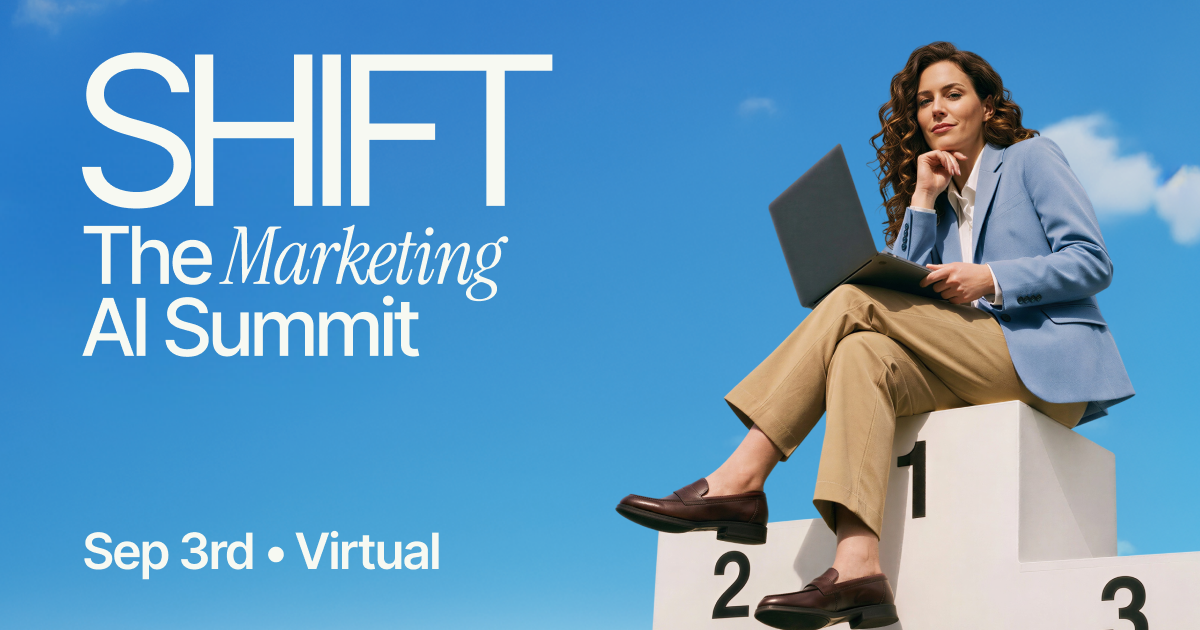
But in Superside’s SHIFT summit, Kae Neskovic, GM of Creative Studios at Superside, and James Hurst, VP of Global Creative at HelloFresh, pushed past the obvious question of what AI can do.
Instead, they asked the harder one:
What does good creative look like when volume is no longer the constraint?
Their answer was clear. The future of creative excellence won’t belong to the teams that simply make more. It will belong to the teams that can think better, judge better and use AI with intent.
When everything is fast, quality gets harder to define
AI has made it easier than ever to generate options. A team can produce dozens of visual routes, social ads, campaign lines or logo explorations in minutes. That speed can be useful, even thrilling. But Hurst warned that many teams are already confusing quantity with quality.
The cost of creating stuff and the speed to create stuff races to zero. We still have to ask ourselves, what’s the stuff that we should create.

That question matters because AI can quickly produce what looks like a solution. But a solution is only valuable if it’s solving the right problem.
Hurst described a pattern many creative leaders will recognize: teams presenting polished outputs that are “definitely a solution” but are “looking for a problem to solve.” The danger isn’t just bad execution. It’s the erosion of creative thinking itself.
Good creative, in this context, starts before the asset exists. It starts with understanding the problem, interrogating the brief and deciding what should be made in the first place.
AI can support that work. Hurst uses AI at specific points in his own process to explore more possibilities, pressure-test thinking and move faster. But he was clear that AI should not be treated as an end-to-end answer.
The strongest teams in 2026 won’t ask, “How much can we make?” They’ll ask, “What is worth making, and why?”
Performance is not the same as a click
Nowhere is the tension between volume and quality more visible than in performance marketing. Paid social, lifecycle campaigns and growth channels demand a constant flow of assets. That pressure can make creative teams feel like they’re feeding a machine.
Neskovic pointed to a familiar argument: some people claim that ugly creative performs better.
Hurst pushed back. He argued that this view often misunderstands both design and performance. When people say something “performed,” they may only mean that it got a click. But a click is not the same as building brand meaning, driving purchase intent or creating a lasting customer association.
If people are saying it’s performing, what they really mean is we created something provocative in a stream of stuff and somebody clicked on it. That is not a measure of performance. That’s a measure of a click.
For brand and creative teams, this distinction is critical.
A high-performing asset should not only interrupt the feed. It should also move people toward the right understanding of the brand. It should create the right associations, spark the right memory and support the broader business goal.
The lesson for 2026: creative teams need sharper language around performance. Without alignment on what performance actually means, teams risk optimizing for shallow signals while weakening the brand over time.
Speed is both a gift and a curse
AI’s speed is not inherently bad. In fact, both Neskovic and Hurst acknowledged that it can unlock more experimentation and make creative exploration more playful.
Teams can test directions faster. They can visualize ideas earlier. They can create prototypes that would have once required far more time, budget and production effort.
But speed can also create a dangerous shortcut: moving from “I want this thing” to “here is the thing” and assuming it is ready for production.
That leap makes Hurst uncomfortable. Not because AI outputs are always poor, but because speed can collapse the critical space between exploration and decision-making.
Creative teams still need time to ask:
- What references are we using?
- Do we understand the cultural meaning behind this visual language?
- Are we borrowing, remixing or appropriating?
- Does this idea serve the brand, the audience and the problem?
- Is it just cool, or is it right?
Hurst gave the example of someone using a Bauhaus-inspired visual approach without understanding anything about Bauhaus beyond the fact that it “looked cool.” That, he argued, is one of the risks of AI-enabled making: it can detach aesthetics from meaning.
In a world where everyone can generate something visually impressive, taste becomes less about spotting what looks good and more about understanding why it works.
AI won’t replace creative judgment
The fear of replacement is real, especially for younger creatives. Hurst acknowledged that many of the tasks AI can now accelerate are the same tasks junior creatives once used to build their skills.
That creates pressure at the entry level. It also creates responsibility for creative leaders.
We’ve got to make sure that we can create and nurture the next generation of the industry. We’ve got to make sure that we know how we’re going to help them navigate this ocean.
But Hurst does not see AI as a total replacement for creative people. He sees it as a tool, albeit a powerful one. Tools change workflows. They change expectations. They change what teams value. But they do not remove the need for human judgment.
Someone still has to ask whether the work is good. Someone still has to decide whether it is right. Someone still has to understand the brand, the customer, the context and the consequences.
For young creatives, that means the path forward is not just learning how to make. It is learning how to think.
Neskovic summed it up well: when ideas are cheap and endless, the real skill is knowing which ideas not to make.
The best ideas won’t come from copying other brands
One of Hurst’s strongest warnings was against derivative creative. AI can make it easy to blend existing references: a little of one brand, a little of another, remixed into something that feels familiar but lacks originality.
He described the problem simply: people are making work by looking at “Mega brand” references and smushing them together.
The antidote is first-principles thinking.
Instead of asking AI to make something that looks like two existing brands, teams should return to the fundamentals:
- What problem are we solving?
- What is true about this audience?
- What behavior are we trying to change
- What category conventions should we use, challenge or ignore?
- What should this brand uniquely own?
AI can still play a role in that process. But it should help teams explore the problem more deeply, not avoid the problem altogether.
A practical framework: Discover, Develop, Distill
Hurst shared a simple framework for using AI more intentionally: Discover, Develop, Distill.
In the Discover phase, AI can help teams get smarter about a problem. This might include researching visual cues, customer behaviors, category patterns, cultural references or semiotic signals. Hurst asks whether he is trying to “weird the normal or normal the weird”—in other words, whether the creative task is to make something familiar feel fresh or something unfamiliar feel accessible.
The first question I always ask myself is, ‘am I trying to weird the normal or normal the weird. Am I taking something really, really strange and I'm going to make it feel pedestrian or am I taking something really pedestrian and make it feel more interesting than it really is?’
In the Develop phase, AI can help expand and pressure-test ideas. This is where teams explore what the work could look like, feel like and do. They can use AI to generate territories, provoke new directions and consider different customer experiences.
In the Distill phase, AI can help turn thinking into artifacts. That might mean prototypes, storyboards, key art, presentations or MVPs that help stakeholders understand and invest in an idea.
The key is that AI plays a different role in each stage. It is not simply a production button. It is a tool for thinking, exploring and communicating when used with discipline.
The creative advantage in 2026: courage
When Neskovic asked what will set the best teams apart in 2026, Hurst’s answer had little to do with tools.
The advantage, he said, will be courage.
Courage to think.
Courage to take a non-consensus view.
Courage to push a brief into unexpected territory.
Courage to challenge the problem a stakeholder thinks they have brought you.
Courage to pitch the strange idea alongside the sensible one.
That courage matters because AI will make the expected answer easier to reach. If everyone has access to the same tools, prompts and workflows, sameness becomes the default.
The best creative teams will resist that default. They will listen carefully, reframe problems and bring back ideas stakeholders did not know to ask for.
What to do when stakeholders say, “AI can do this faster”
What happens when non-creative coworkers or leaders insist on making creative with AI tools?
Hurst’s advice was not to start with defensiveness. Start with curiosity.
Ask what they have seen. Ask why they think it is good. Ask what problem they are trying to solve. Often, when someone says “use AI,” what they really mean is “do it quickly.”
That opens the door to a better conversation. Maybe AI is the right tool. Maybe it is not. Maybe the request reveals a need for speed, not necessarily a need for AI-generated output.
The creative team’s role is to help stakeholders understand the implications, dependencies and tradeoffs. That requires education, not gatekeeping.
As AI becomes common, human craft may become more valuable
The final question of the session looked ahead: if AI becomes accessible to every brand, will human-made craft become a stronger marker of quality?
Hurst believes it will.
He compared the current moment to earlier periods of rapid manufacturing and automation, when craft movements emerged in response to cheaply produced goods. When mass production rises, human craft can take on new meaning.
The future likely will not be binary. Brands and teams will move between AI-assisted work and human-made work depending on the context. But Hurst expects a rising appreciation for creative made with visible human care, judgment and craft.
Just as brands now highlight sustainability commitments or ethical certifications, there may be a future where human-made creative becomes its own signal of value.
Great creative in 2026 will be more human, not less
The AI hype cycle has made it easy to focus on tools. But as Neskovic, Hurst and Rafael Costa emphasized throughout the session, AI itself is not the story. Clarity is.
Creative teams are moving from scattered experimentation to more intentional systems. The opportunity is not just to make more things faster. It is to build more confident, capable and imaginative teams.
In 2026, great creative will not be defined by how much AI was used. It will be defined by whether the work solves a real problem, builds meaning, shows taste, reflects judgment and carries a point of view.
AI can help teams get there faster.
But it cannot decide where “there” should be.

Turn insights into action.
Watch the full SHIFT Summit recordings
and learn how top teams are
making AI actually work.


Stuck in AI testing mode?
It’s time to move from experiments
to real impact.
Explore AI Reset—a 5-step framework
to embed AI into your creative workflows.


AI-powered creative services
Unlock tomorrow's possibilities, today.
Learn more about our AI Creative
and AI Consulting Services.