




Monks is a global network that wins on flagship campaigns, experiential builds and integrated media. Superside is an AI-native creative agency built for the volume tier: continuous, on-brand creative from one integrated team, with published pricing. Match flagship work to a network and everyday production to a flexible partner, because buying one with the other is the costliest mistake in enterprise creative.
If you're comparing enterprise creative partners, Monks is likely on your list.
Monks, formerly known as Media.Monks and part of S4 Capital, is a global creative, media, production and technology company. It works across brand strategy, identity, digital experiences, content and media.
The two companies often come up in the same conversation, but they're built for different jobs.
Let's start with what Monks does better. It has a strong track record in high-end experiential work, brand production, media buying and award-winning campaign creative for global brands.
If you need a landmark brand campaign, an experiential build or integrated media, that's firmly Monks' territory.
Superside's model meets a different need: high volumes of on-brand creative, consistent quality and support that scales as demand changes.
This article compares the two companies' delivery models, AI, pricing and public financial picture, and shows how to decide which of your work belongs where.
Who Monks is, from the filings
Monks began as MediaMonks, founded in the Netherlands in 2001. S4 Capital, established by Executive Chairman Sir Martin Sorrell in 2018, acquired it that year, and the network now operates under the single Monks brand. It also features in our roundup of top ad creative agencies.
S4 Capital is publicly listed, so its results are audited and public rather than self-reported.
The results won't tell you everything about the quality of the work. But revenue, profitability and headcount trends offer useful context when you're choosing a partner for a significant or multi-year engagement.
S4 Capital's H1 2026 results
For the six months ended June 30, 2026, S4 Capital reported:
| Metric | Figure | Change |
|---|---|---|
| Revenue | £344.0m | Down 4.6% reported, 3.2% like-for-like |
| Net revenue | £308.0m | Down 6.2% reported, 4.7% like-for-like |
| Operational EBITDA | £38.0m | Up 82.7% reported, with a 12.3% margin |
| Net debt | £66.3m | Not applicable |
| Headcount | 6,156 | Down 10.5% year over year |
With the results in August 2026, the company said it expects full-year like-for-like net revenue to be down by a mid-single-digit percentage. It also pointed to operational EBITDA at the current analyst consensus of £85 million, with the margin up 140 basis points, and approved an inaugural interim dividend of 1.35p per share.
The company cited a scope reduction in BMW, primarily in EMEA, as one factor in its Marketing Services performance.
The company's audited 2025 results, published in March 2026, included that revenue and headcount fell year over year in both FY2025 and the first half of 2026, while operational EBITDA rose sharply in H1 2026.
The results also show where S4 Capital does most of its business. In FY2025, the Americas accounted for 80% of net revenue, EMEA for 15% and Asia-Pacific for 5%.
What to take from the results
The figures are group-wide, so they don't show what's available in your markets or what the work will look like.
If you're considering a major campaign or multi-year partnership with Monks, ask three questions:
- Who will do the work? Ask to meet the creative leads and find out who'll be on your account day-to-day.
- How will Monks cover our markets? Find out which teams are local, which services come from a regional hub and who owns delivery across markets.
- What happens when demand spikes? Ask how Monks would staff a major launch or a sudden jump in production, and what that would mean for timelines and fees.
Superside vs. Monks: Where the models differ
So how do the two models compare? Here they are, side by side:
| Monks | Superside | |
|---|---|---|
| Scope | Creative, media, content production and technology services | Creative strategy, design and production, plus creative systems and AI integrations |
| Delivery structure | Global teams across marketing and technology practices | Flex teams staffed to the work, Dedicated teams for continuity and custom setups that can include engineering |
| Commercial model | Engagements scoped with Monks | Subscription plans on an annual term, plus custom engagements |
| Pricing transparency | Pricing and rates not published | Published starting prices |
| AI approach | Monks.Flow, an AI-powered managed service that deploys agents across marketing | AI-native experts work with Superspace and Brand Brain to bring brand context into every brief |
| Client use of AI | Monks says Monks.Flow integrates with clients' existing tools and workflows | Clients use AI agents directly in Superspace to brief and review work |
| A good fit for | Major campaigns that combine creative, production, media and technology | A steady flow of on-brand creative that scales with demand |
A few of these differences are worth unpacking.
How Monks and Superside staff creative work
A campaign that spans several markets may need creative, media, technology and production specialists working together. A steady stream of creative requests poses a different challenge: How do you move each brief forward without re-explaining the brand, revisiting past decisions or hunting for approved assets?
Monks' breadth helps when a project needs specialists from several disciplines or teams across many markets. Superside's AI-native experts and AI systems suit ongoing work better. You can work with a Dedicated team that learns your brand over time or draw on a wider pool of specialists as needs change. Either way, shared brand context cuts repeat briefing and review time.
Superside makes sense when the challenge is delivering on-brand creative consistently and at scale, or when you need help operationalizing creative operations.
How Monks and Superside bring AI into your workflow
Both companies build AI into how they deliver work, but in different places.
Monks describes Monks.Flow as an "AI-powered professional managed service" that deploys specialized agents across a client's marketing ecosystem and integrates with existing tools and workflows. As a managed service, it runs on Monks' side.
Superside clients use AI agents directly in our Superspace platform to build creative briefs, brainstorm ideas and review and approve work in the same place. Brand Brain, our AI context engine, carries brand guidelines, past feedback and creative decisions from one project to the next.
Pricing transparency
Monks doesn't publish standard pricing, day rates or package sizes online. If you'd like to work with Monks, you'll need a quote to model the cost.
Superside publishes its pricing. Subscriptions start at a $15,000 monthly minimum on an annual term, plus a $1,000 monthly software fee, and unused Flex budget rolls over for up to three months. Our pricing page breaks down what each plan covers, so you have a starting point for budgeting before the first call.
What independent coverage says
Independent coverage adds another perspective.
Campaign's Agency Performance Review 2025 highlighted Monks' client retention of 92% in 2024, up from 85% in 2023. It also noted 20 new accounts, including General Motors and Burger King, eight awards at Cannes Lions 2024, B Corp certification and AI used in 25% of its creative work.
The same review noted voluntary turnover rising to 19.1% in 2024 from 16.8%, a headcount that continues to shrink and that Monks declined to share its pitch numbers.
Employee reviews tell a similar story to the audited headcount figures. Monks averages 3.3 out of 5 on Glassdoor from 1,286 employee reviews (as of November 2026), with 58% saying they'd recommend it to a friend. Superside holds a 4.5 out of 5 rating on G2 from 115 customer reviews.
These ratings come from different audiences, employees and customers, so they aren't directly comparable. But for a buyer, staff turnover is a delivery consideration worth asking about.
The two tiers of enterprise creative demand
A key global campaign might bring a creative director, designers and production specialists together for weeks or months. Day-to-day creative calls for a team that turns around a steady stream of requests and keeps every asset on brand.
For enterprise teams, it helps to think about creative demand in two tiers.
1. The flagship tier
These are the big, high-profile projects that happen a few times a year: a new brand platform, a global campaign, an experiential activation or a hero film. They carry big budgets, take weeks or months to deliver and need a team of top specialists.
This tier rewards a network. You want the best creative director, the best 3D team and the best strategist assembled for one project. Handoffs are an acceptable cost because the project justifies the coordination.
Media.Monks alternatives in this tier include the big holding-company networks, such as WPP, Publicis Groupe, Omnicom and dentsu.
2. The volume tier
Then there's the creative that keeps marketing moving week to week: campaign assets for different channels and markets, social graphics, presentations, landing page refreshes and new ad versions to test.
This is where the bulk of day-to-day enterprise creative happens, and it's rarely what a network is optimized for. Priorities include volume, turnaround, reliable execution, brand consistency and the ability to scale up or down.
Superside is built for this kind of ongoing demand, with creative services that span ad creative, video, motion, product design, web design, branding, copywriting and more. You choose a Dedicated team or a Flex plan that scales with your workload.
Other players in this tier include design subscription services such as Design Pickle, Kimp, ManyPixels and Designjoy, as well as platforms such as Designity. Embedded agencies such as OLIVER offer another route.
Match the work to the tier
Neither tier matters more than the other. The point is to match how you buy creative with the work you need.
Here's how the two tiers differ:
| Flagship tier | Volume tier | |
|---|---|---|
| Frequency | A few times a year | Continuously |
| What matters most | Craft depth and ideas | Consistency, speed and flexibility |
| Cost of handoffs | Acceptable | Compounding |
| Right model | Network | Flexible partner |
Why a mismatch is expensive
Buying volume-tier work from a flagship-tier model is one of the most common structural mistakes in enterprise creative procurement.
An agency process built for flagship campaigns is ideal for major projects, but it can slow down everyday work. Extra handoffs and review rounds can make a simple ad resize or landing page update take longer than it should.
The reverse problem exists too. An internal team plus a handful of freelancers can cover routine requests. But when a launch suddenly needs more assets or specialist skills, you may have to find, brief and coordinate extra people who don't know your brand.
Superside sits between the flagship agency and the in-house team, offering the breadth of a global creative agency with the simplicity of one integrated team and platform.
Your marketing team may still need more than one type of partner. Take Amazon. S4 Capital named Amazon among the major accounts that expanded in 2025, while Superside's work includes ad creative and video production for Amazon Pharmacy.
Which model fits which problem
Still not sure whether a network like Monks or a flexible partner like Superside is your best option? Run your creative demand through these lists:
Choose a network like Monks when:
- You need a flagship brand platform or experiential build.
- Media buying is part of the same brief.
- Award-level craft is the objective.
- You need technology services alongside creative.
- You're comfortable with a project lead coordinating work across several teams.
Choose a flexible partner like Superside when:
- Ongoing volume, creative quality control and brand consistency are priorities.
- You want one integrated team instead of coordinating separate vendors.
- Demand varies through the year, and you want a plan that flexes month to month.
- You want published pricing to make budgeting easier.
- You want AI systems your marketing team can use directly.
Related reading: Our guides to creative vendors for enterprises, enterprise creative agencies and creative partner agencies are useful if you're still weighing your options.
Questions worth asking either partner
If both models are on your shortlist, put the same questions to both:
- How will our work get done? Ask who receives the brief, who manages the project and how many teams are involved from start to finish.
- How quickly can we start? Find out what happens in the first weeks, how onboarding works and when the first project lands.
- What does a scope change cost in money and time? Scope-by-scope agency engagements and subscriptions answer this very differently.
- Will our team have direct access to AI systems? For any AI claim, ask what your team logs into versus what happens on the partner's side.
- What will we spend over the full contract? Ask each partner to price a typical year of work, including onboarding, platform fees, minimum spend and separately billed production. Factor in unused budget and your own team's coordination time.
- What are the contract terms? Check the minimum term, how fees are set and what flexibility you have within the term.
Planning or already have a shortlist? Explore our side-by-side comparisons of Superside and other creative partners.
What Superside brings
Monks brings creative, media, production and technology together around a major brief. Superside, the world's largest AI-native creative agency, keeps a steady stream of creative moving. We pair AI-native creatives, technologists and engineers with AI systems, with real creatives behind every output.
A partnership with Superside brings you:
- Support that fits the workload: With a Flex plan, we bring in specialists as your needs change. With a Dedicated plan, you work with the same team every month, so they get to know your brand deeply. You can also work with us on high-impact projects with a fixed scope and timeline.
- Brand context that carries across projects: Brand Brain brings your guidelines, past feedback and creative decisions into each new brief in Superspace. That matters most when you adapt a campaign for several markets or produce new ads every week.
- Efficiency you can see in the work: On video production, using AI to storyboard faster and automation to roll out hundreds of versions has saved over 40% on video costs. For Bolt, we delivered a 600% increase in creative output for an on-time animated explainer.
- Custom systems for recurring work: If your team needs design systems, a repeatable way to adapt campaign assets or AI connected to existing production workflows, our creative and engineering specialists build it. Depending on the engagement, we run the system or train your team to run it. Our AI Excellence page has the details.
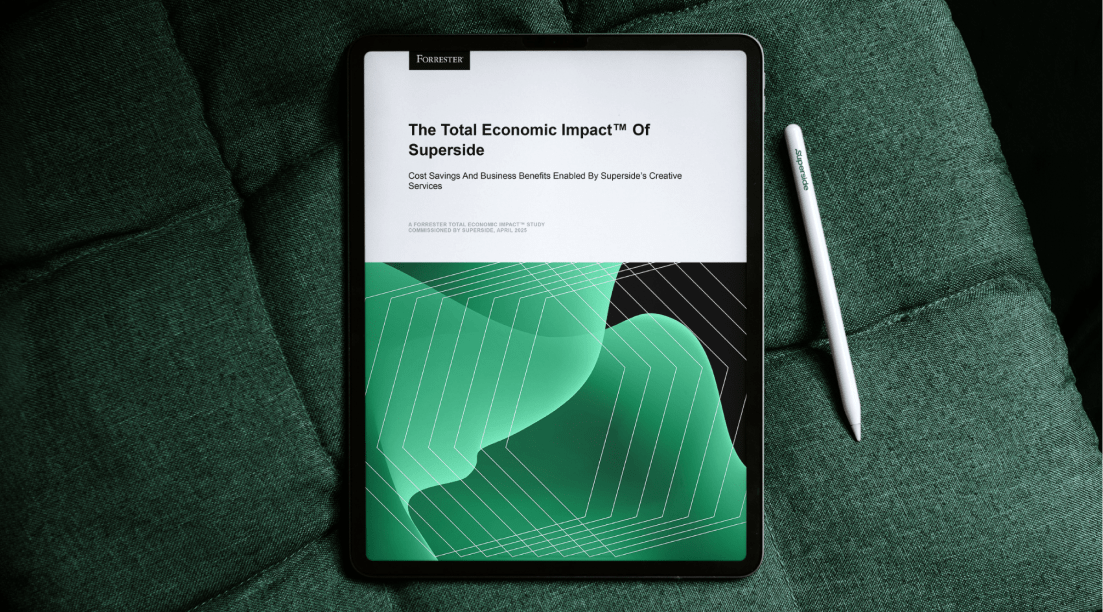
- A modeled business case: In a Total Economic Impact study commissioned by Superside (April 2025), Forrester modeled a 94% ROI over three years for a composite organization, with payback in under six months, $1.9 million in avoided agency fees and more than 60% of feedback rounds avoided, all as three-year present value.
Different models, different solutions
Monks and Superside solve different creative challenges. Monks is well suited to flagship brand work, experiential production and integrated media. Superside is built for ongoing, high-volume creative delivered through one integrated team.
Most teams' creative needs don't fit neatly into one category. The key is to match the partner to the work, and for some enterprises that means using both.
Ready to see what a flexible model could do for your volume tier? Book a call with us now.
FAQs




How top brands get more work done, without doing more
They Superside it. Fast, high-quality creative from the
AI-powered creative service that handles it all.

The data speaks for itself
According to a Forrester Total Economic Impact™ study, Superside delivers a 94% ROI and pays for itself in six months.


Say yes to bigger campaigns
Our AI-native creative agency helps your team
take on more formats and markets with no new headcount.