


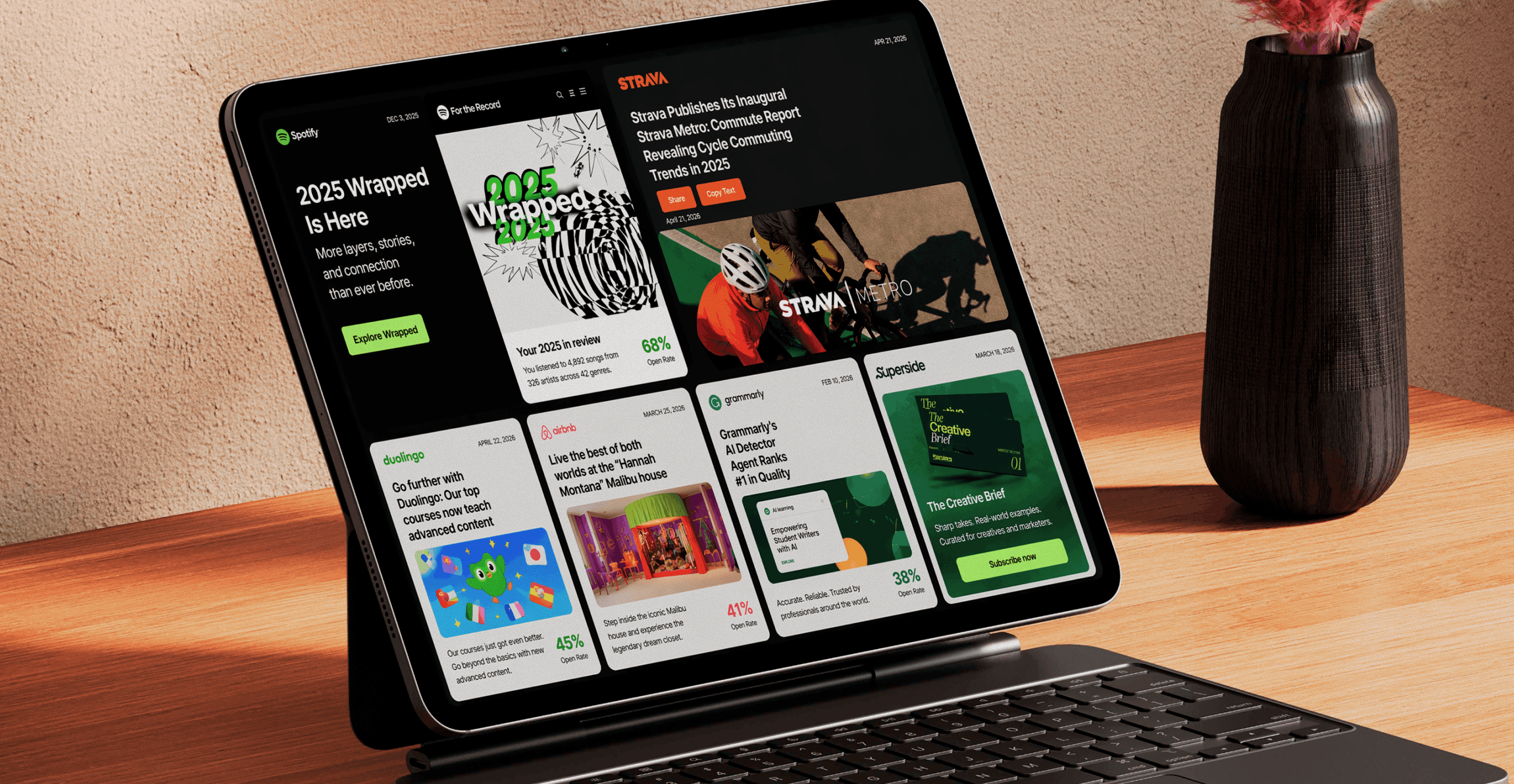
Most email marketing campaigns underperform because the creative is generic, poorly timed and easy to ignore. We highlight the top high-performing email marketing campaign examples and explore why they worked, what you can apply and how other enterprise teams use Superside to scale high-quality email creative fast.
With an average ROI of $36 for every $1 spent, no other channel comes close to email marketing. In 2025, 4.48+ billion people used email, a number that could reach 5 billion by 2028, and an estimated 376 billion emails were sent daily.
And email’s momentum isn’t slowing down. The global email marketing market is projected to grow from $11.5 billion in 2025 to $17.9 billion by 2028. Perhaps most telling, 60% of consumers still say email is their preferred channel for hearing from brands.
But these numbers obscure how badly most email marketing efforts actually perform. Across 3.6 million campaigns tracked by MailerLite, the average email click-through rate (CTR) across all industries was just 2.09%. The reality is that most emails get ignored because of poor subject lines and bad creative decisions.
What separates the emails people open, engage with and remember from the ones they immediately archive or delete is discipline: Clear objectives, relevant design, deliberate personalization, strong visuals and solid branding execution.
This article explores email marketing campaign examples that demonstrate this discipline across key campaign types. For each, we break down why the email worked and provide takeaways for your own email marketing campaigns.
These successful email marketing campaign examples draw on documented case studies and analyses, supplemented by our own creative expertise in enterprise email design.
Best email marketing campaigns in 2026
Let’s take a closer look at a few of the world’s top email marketing creative examples.
1. Spotify Wrapped: Personalized data storytelling at scale
 (Source: Techradar.com)
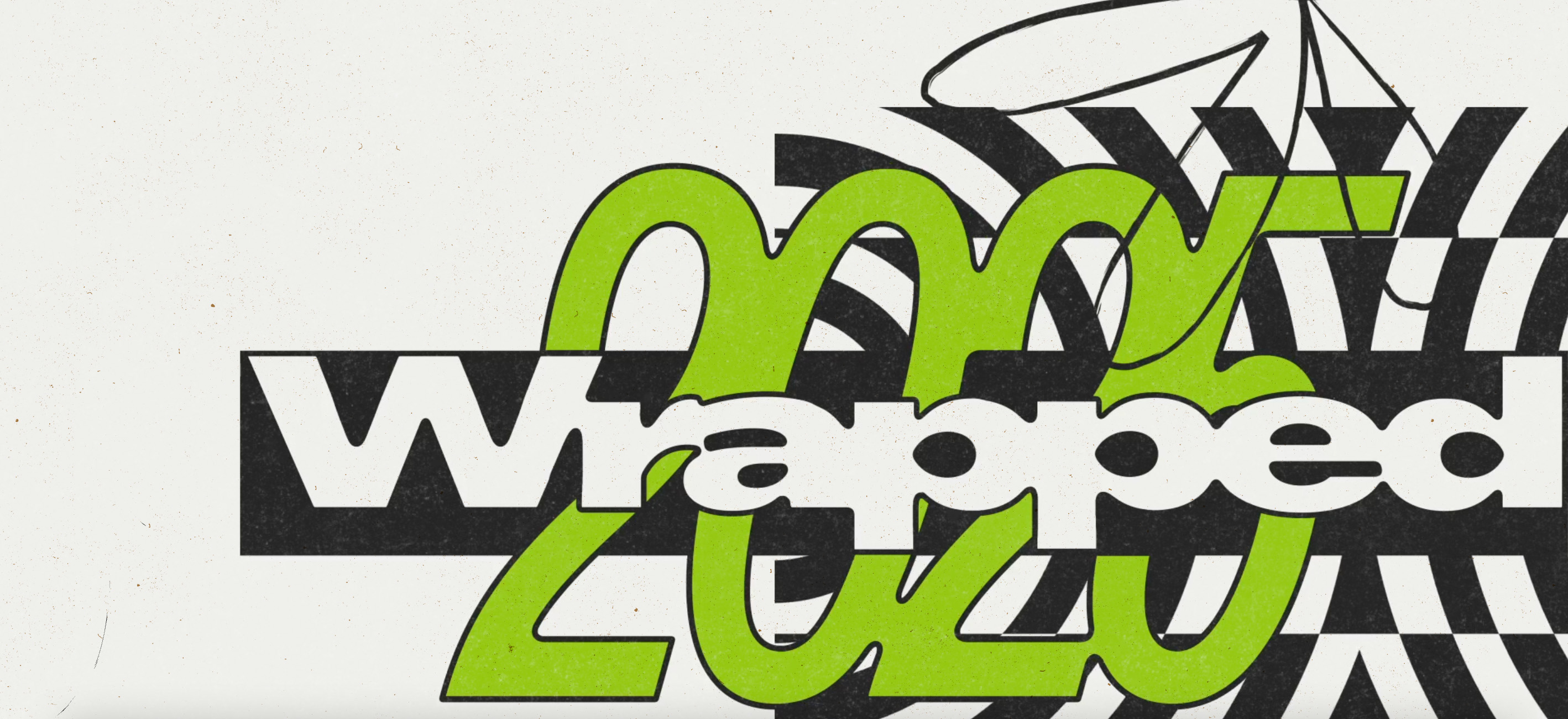
Spotify’s “Wrapped” campaign is one of the most effective earned-media engines in modern email marketing, and one of the most studied email campaign examples.
In December 2025, “Wrapped” reached 200 million engaged users in just 24 hours and generated an estimated 500 million social shares, up 41% from 2024.
The email campaign plays a strong supporting role: A personalized experience that recaps users’ listening habits and nudges them back into the full in-app story.
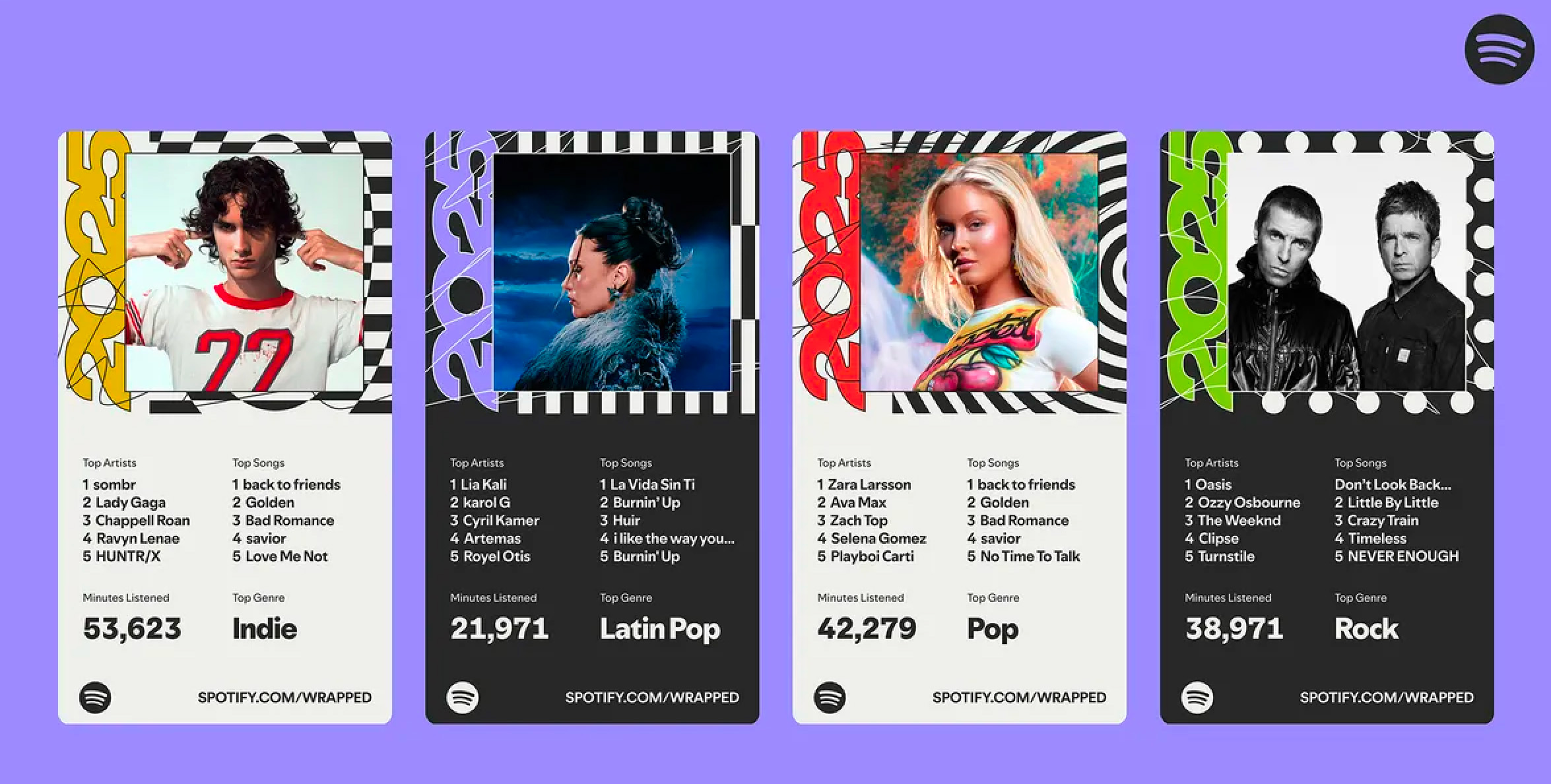
Spotify clearly understands that personalization at scale isn’t merely about inserting a first name into subject lines. Wrapped takes hundreds of data points per user (e.g., total streams, top artists, listening hours) and assembles them into a coherent story that reflects the user’s identity.
The email’s job is to say: “This data is yours. It says something true about you, and you’ll want to share it.“
What to steal: Explore your customer data and consider how it can be shaped into a narrative about them. Annual or milestone summaries can create identity-driven engagement if the narratives are personal and the designs make the stories shareable. Email can then become the gateway to the full, personalized experience.
2. Grammarly: Weekly personalized insights that build good habits
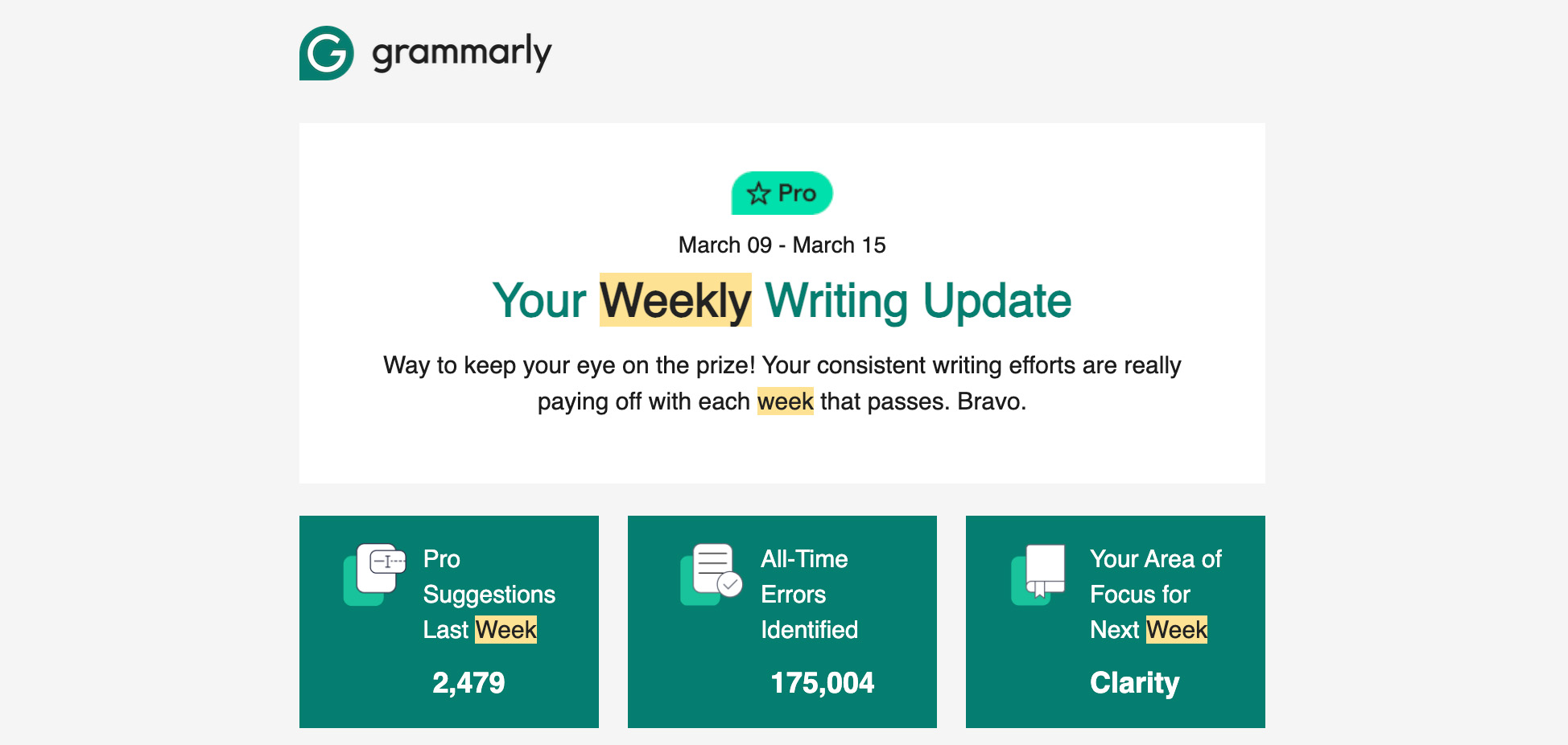 (Source: Grammarly)
Grammarly’s weekly “Insights” report is one of the most documented email examples of behavioral marketing done right.
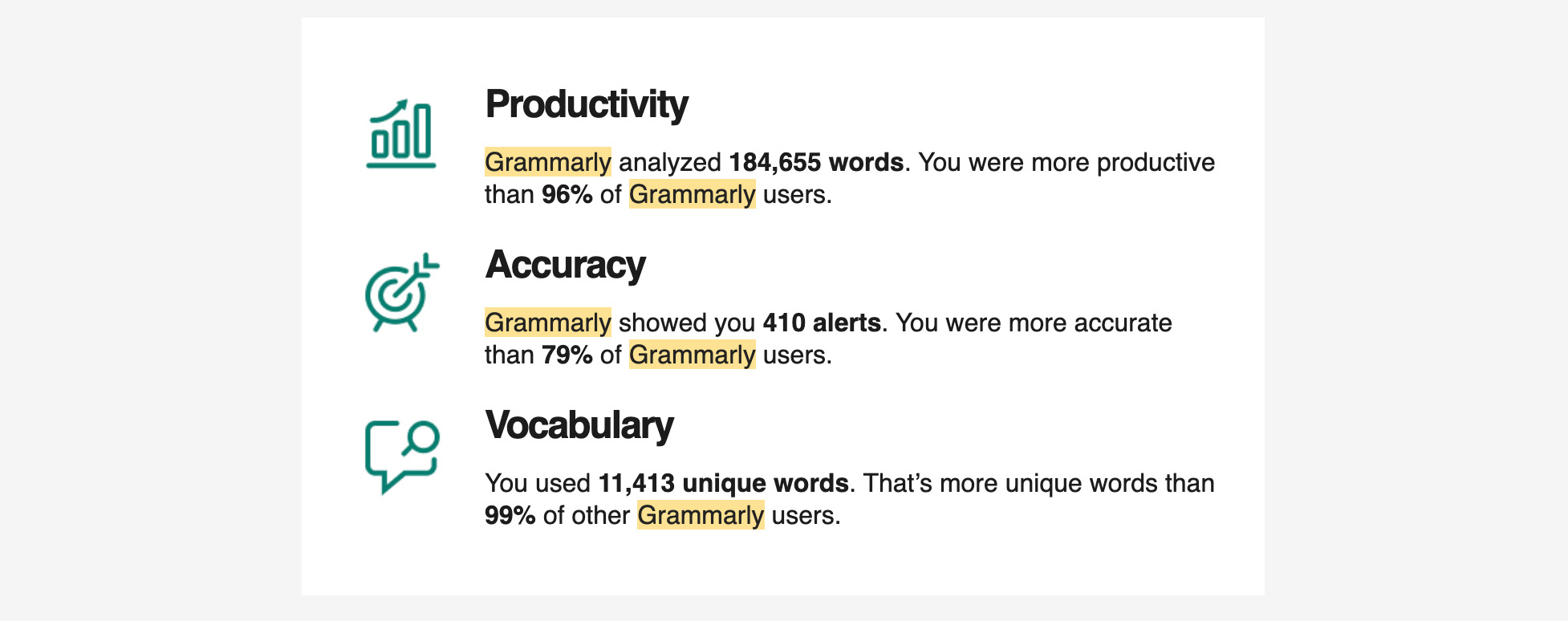
Each customer receives a personalized breakdown of their writing activity: Words written, accuracy score, top writing strengths, vocabulary richness and performance compared to others. The data is user-specific down to individual writing patterns.
Grammarly analyzes each user’s writing data using powerful data tools, then uses other systems to deliver those personalized insights to each user in a scalable way.
The annual personalized insights go a step further. AI analyzes each user’s writing history to create an archetype profile (e.g., “The MVP”). This turns a year’s writing data into a narrative about the user’s communication style and influence.
What to steal: Use weekly or monthly behavioral data that reflect a user’s specific activity to create regular, habit-forming emails. This makes the product feel responsive to each individual. It shows them progress, reinforces value and gives them a reason to keep coming back. Focus on small, motivating wins (also in subject lines) so each email feels rewarding.
3. Airbnb: Lifestyle-driven design with clear visual hierarchy
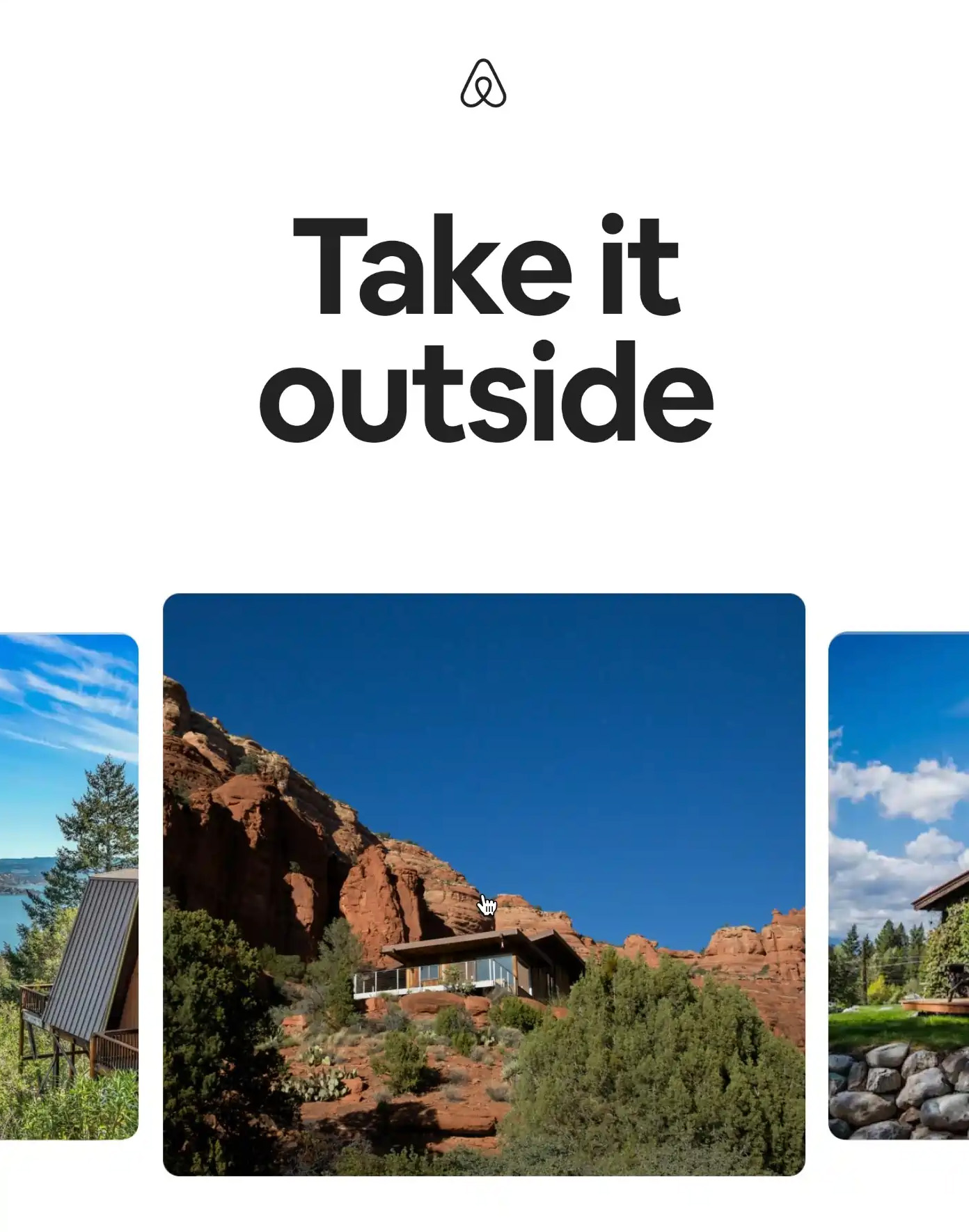 (Source: Audienceful)
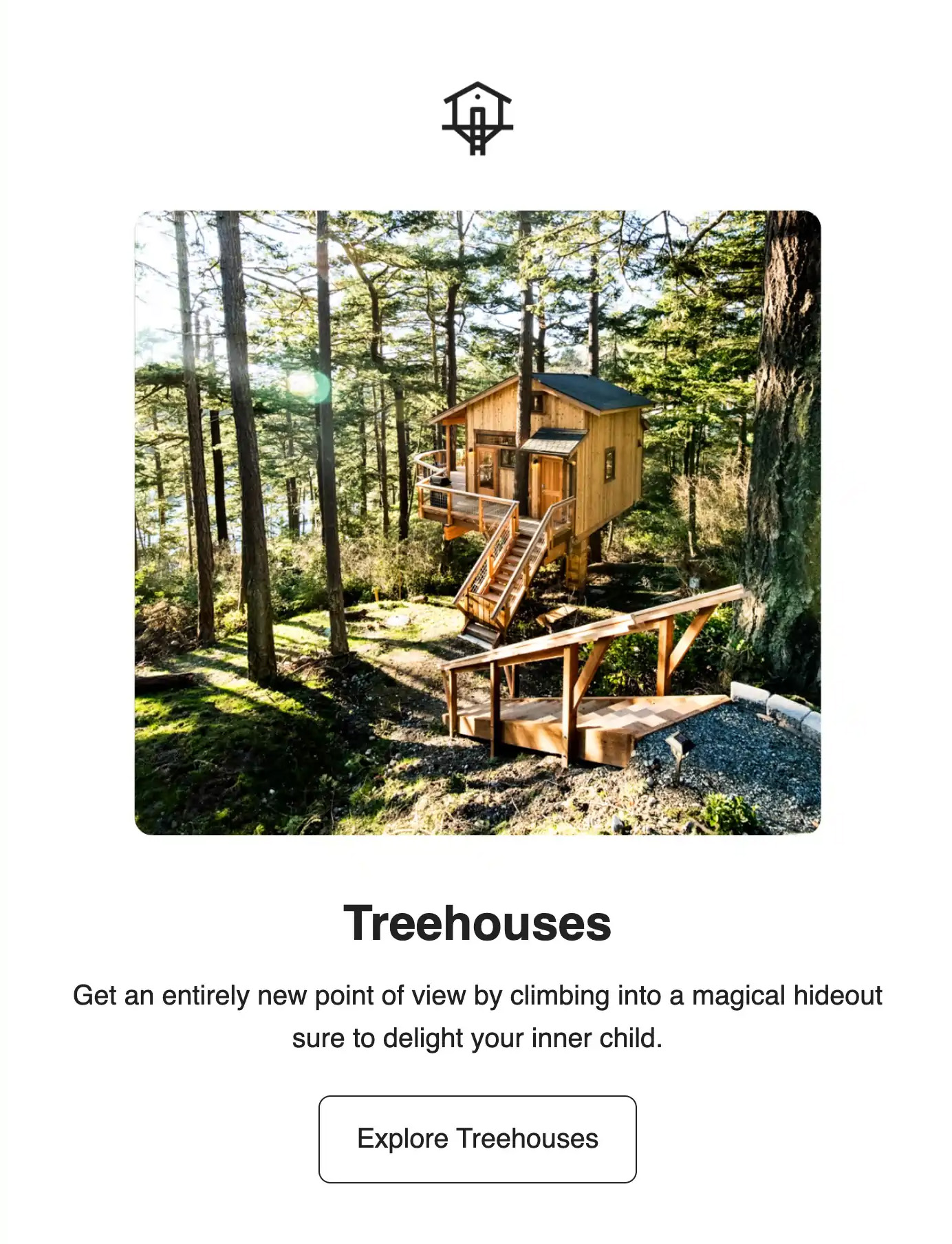
Airbnb’s email program solves the tough problem of making a product catalog feel aspirational rather than transactional.
Where most travel brands fill promotional emails with staged property images and price callouts, Airbnb leads with lifestyle photography: Eye-catching images of people enjoying experiences.
Every email uses a clean layout with generous white space. The visual hierarchy is also deliberate: A compelling header image establishes emotional context, a single benefit-forward headline interprets the visual, and clear CTA buttons drive action. Nothing competes for attention simultaneously.
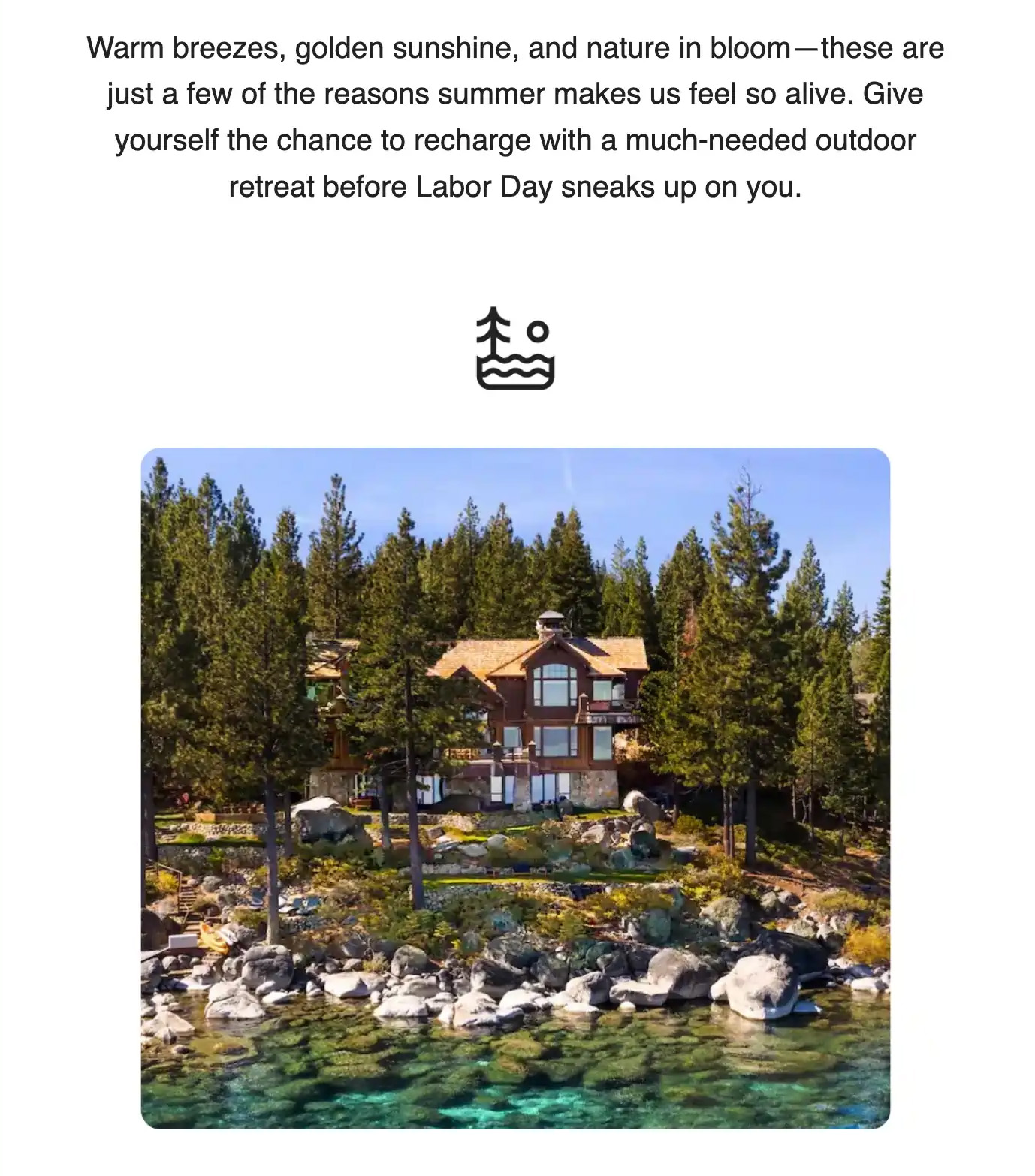
Airbnb also treats mobile as the primary canvas. Given that 62% of all emails are now opened on mobile devices and emails not optimized for mobile are deleted by 70% of recipients within 3 seconds, a mobile-first mindset has become non-negotiable.
The brand also consistently uses user-generated content (UGC) in its emails, which drives 4x higher CTRs than branded content.
What to steal: Reduce visual complexity until the email has one clear focal point. Opt for lifestyle imagery, which outperforms product imagery (it sells the outcome, not the product). Prioritize mobile and keep CTA buttons clear and large enough to tap comfortably.
4. Duolingo: Gamified re-engagement and the power of streak emails
 (Source: Duolingo)
Duolingo is especially good at using email to build user habits, not just to promote itself or get sign-ups.
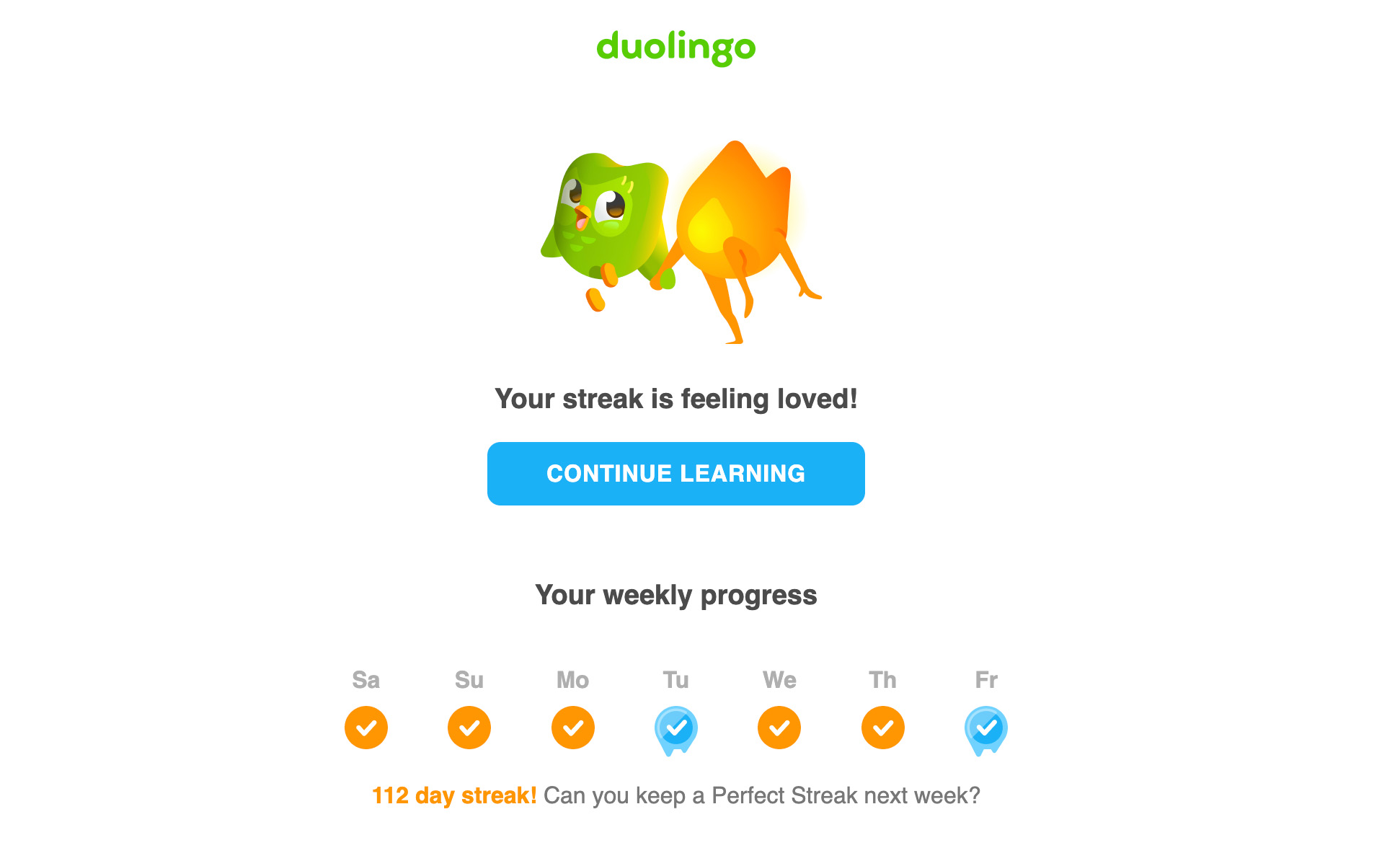
Its re-engagement strategy focuses on “streak” emails, automated messages sent when users miss their daily lessons (a “streak” reflects the number of days in a row you’ve practiced on the app).
Subject lines like “🤔 How do you say ‘quitter’ in Japanese?” reflect the brand’s lighthearted, cheeky tone and are designed to nudge users to do their lessons. They work because they reference a specific user behavior (the broken streak) rather than just giving generic encouragement.
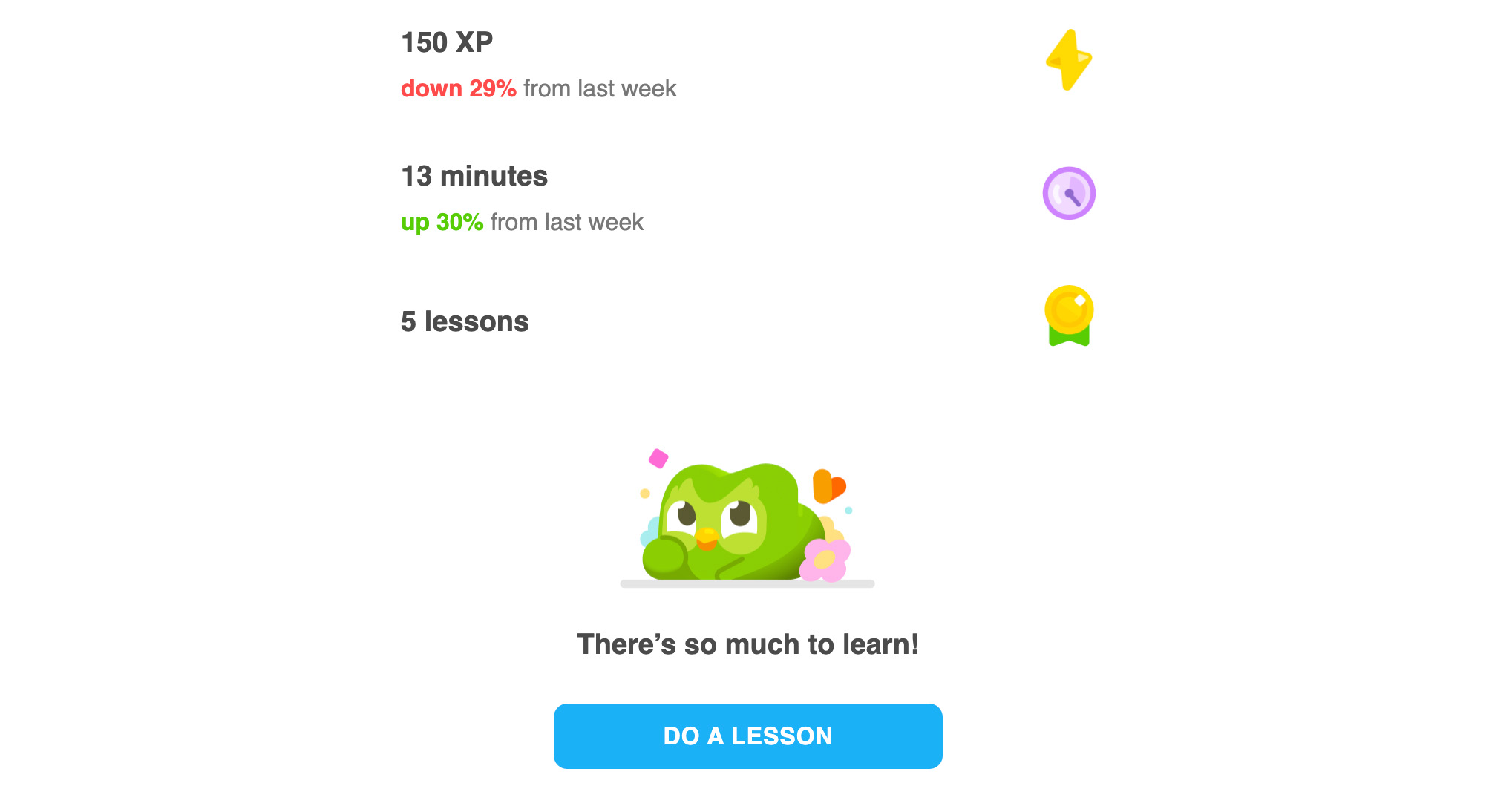
The emails extend Duolingo’s gamified app experience into the inbox. Personalized progress reports show completed lessons, earned points and streak status. The visual design also perfectly mirrors the app.
What to steal: Use gamification to drive re-engagement. Streaks and milestones create urgency and make inactivity feel like something to avoid. Timely behavioral trigger emails that reference a specific user action (or inaction) typically outperform broadcast sends because they’re relevant at the moment of receipt. Another lesson: Design email as an extension of your product experience, not a separate brand expression. And add personality to your re-engagement subject lines.
5. Canva: Product launch emails that lead with benefits, not features
 (Source: Canva)
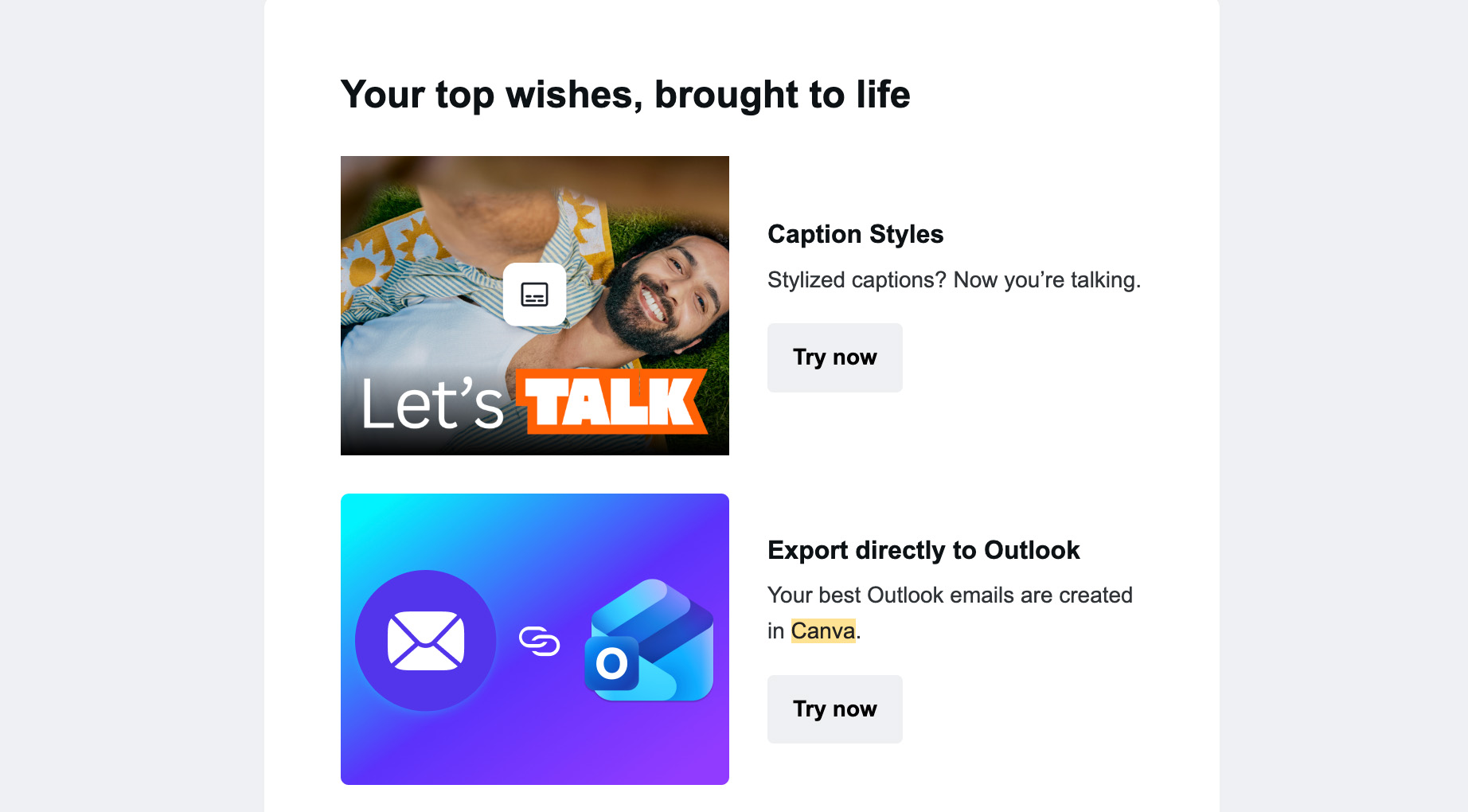
Canva’s Visual Suite 2.0 launch email shows how to communicate a complex product update to a mostly non-technical audience.
The email opened with the headline “Productivity, meet creativity,” which immediately addressed a genuine frustration (juggling too many disconnected tools) before describing the features.
Instead of listing technical specifications, the email presents capabilities as outcomes, e.g., “reimagined spreadsheet” and “text-to-interactive experiences.” This language resonates with marketers and designers who care less about how the software works and more about what it enables them to do.
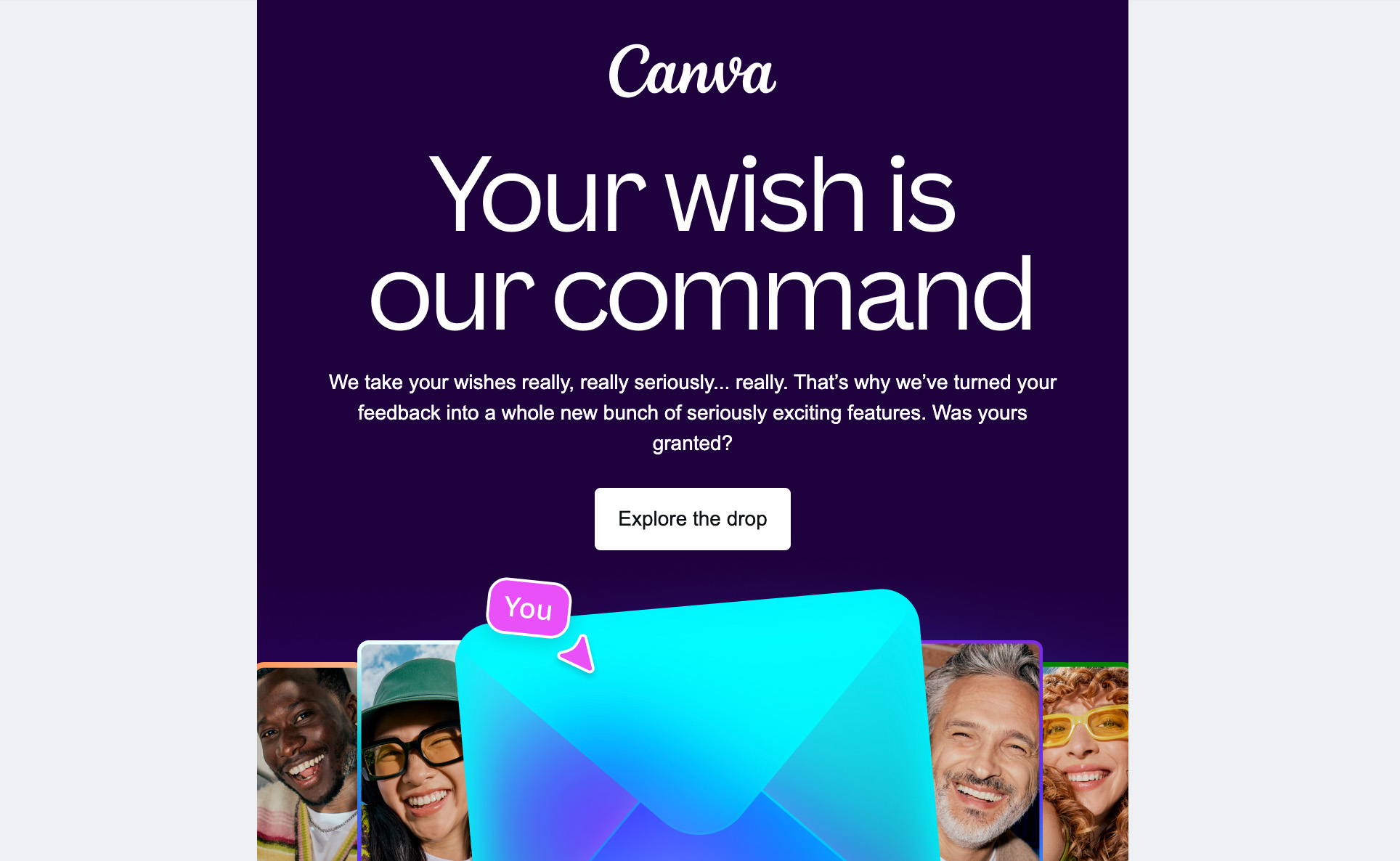
Canva’s emails are also accessible, colorful and demonstrative, like the rest of the brand. And product launch emails typically include GIFs or engaging animation loops that show product features in motion.
What to steal: Product launch emails fail when they just list features. Lead with the problem being solved and show, don’t tell, what the user can create or achieve. GIFs and animations that showcase features also increase CTRs. Also, remember to frame product updates around the user’s context (not your product roadmap).
5 top email campaign types to use
Let’s analyze the five different types of email campaign examples you can customize and apply to your strategies.
These are evergreen, forever-useful campaigns that can be shaped in various ways to achieve higher open rates and more conversions aligned with your key goals.
1. Welcome emails: The highest-value email most brands neglect
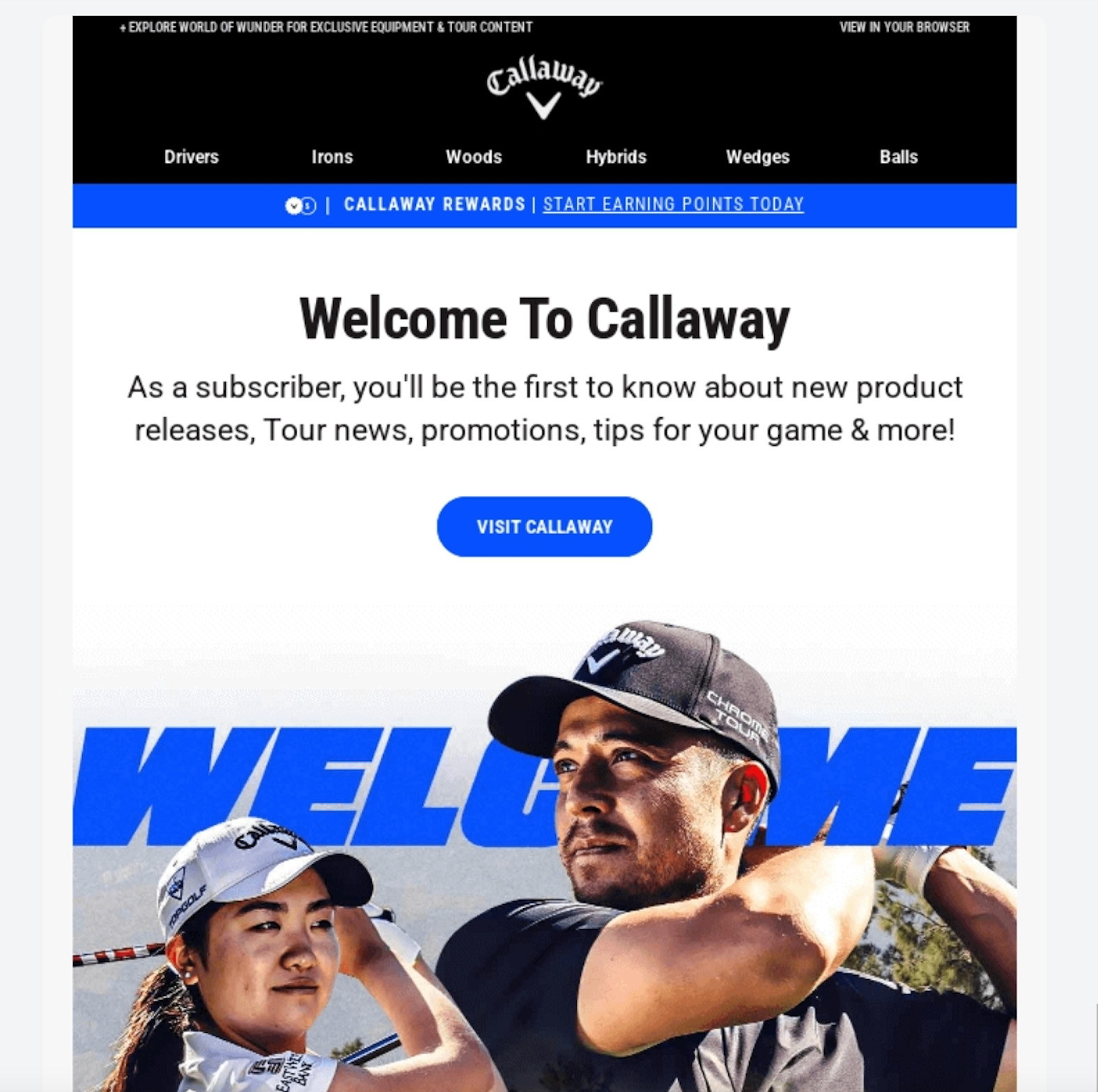
Welcome emails are disproportionately high-value, achieving 68.6% open rates across all industries and a conversion rate 9x higher than typical emails. The reason: Subscribers are at their most engaged when they’ve just chosen to sign up to communications.
 (Source: Really Good Emails)
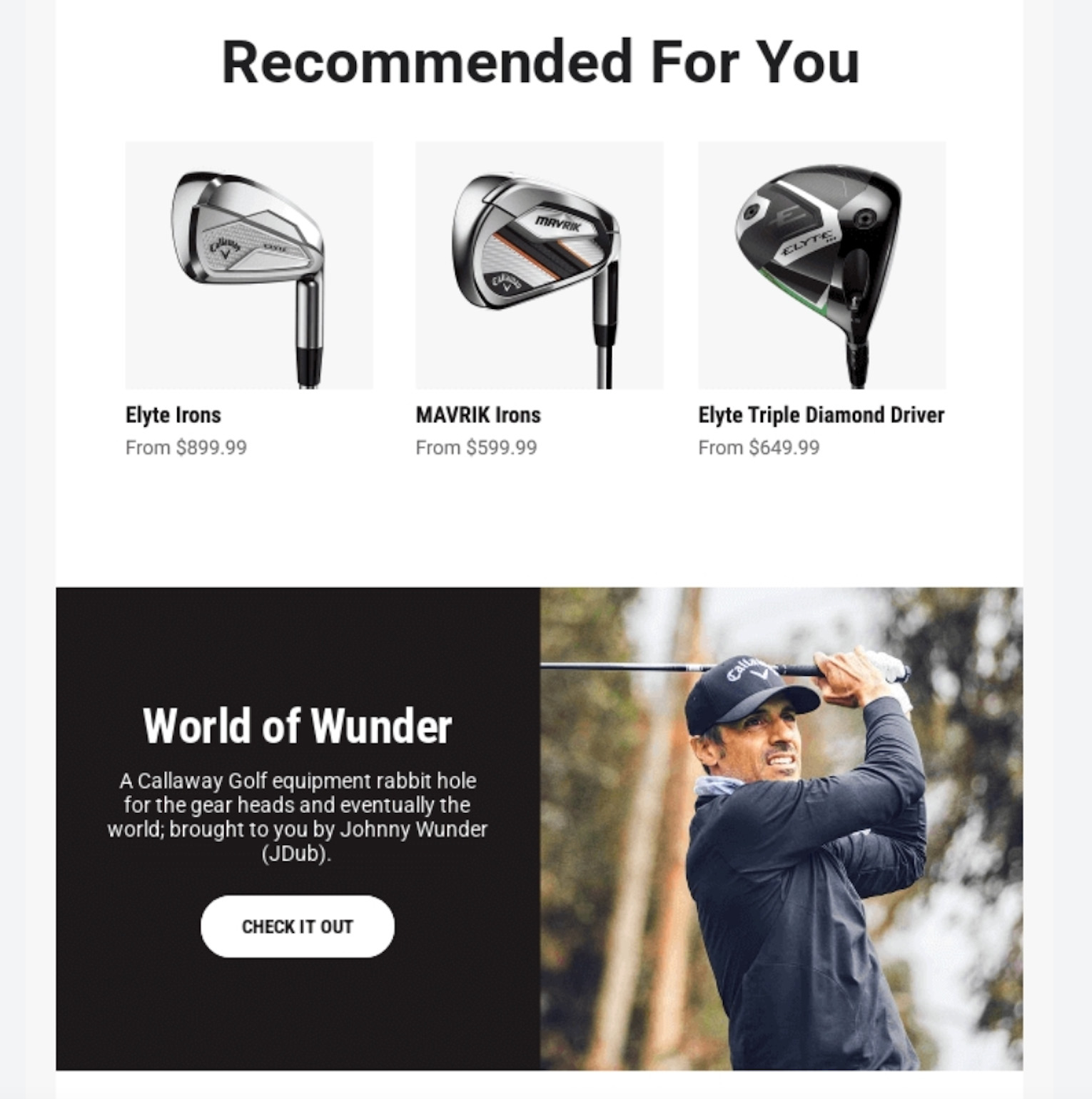
Callaway Golf nails the welcome email, as it immediately delivers what was promised (early access, a discount code and curated content) and tells the brand story in a compelling way.
The brand also uses a bold welcome email headline, product recommendations to encourage engagement and purchases, and a storytelling section to add context. It sells and builds customer relationships in one go.
An effective welcome email sequence follows a clear arc:
- Email 1 confirms the signup and delivers the offer
- Email 2 shares the brand story
- Email 3 adds social proof
- Email 4 drives the next action.
What to steal: Treat your welcome sequence as your highest-priority email investment. Use benefit-led onboarding, paired with a clear next step, so that the first email converts to action immediately. Map the sequence to a narrative arc, personalize everything and keep subject lines strong.
2. Abandoned cart campaigns: Recovering revenue where intent has been shown
 (Source: OneDayOnly)
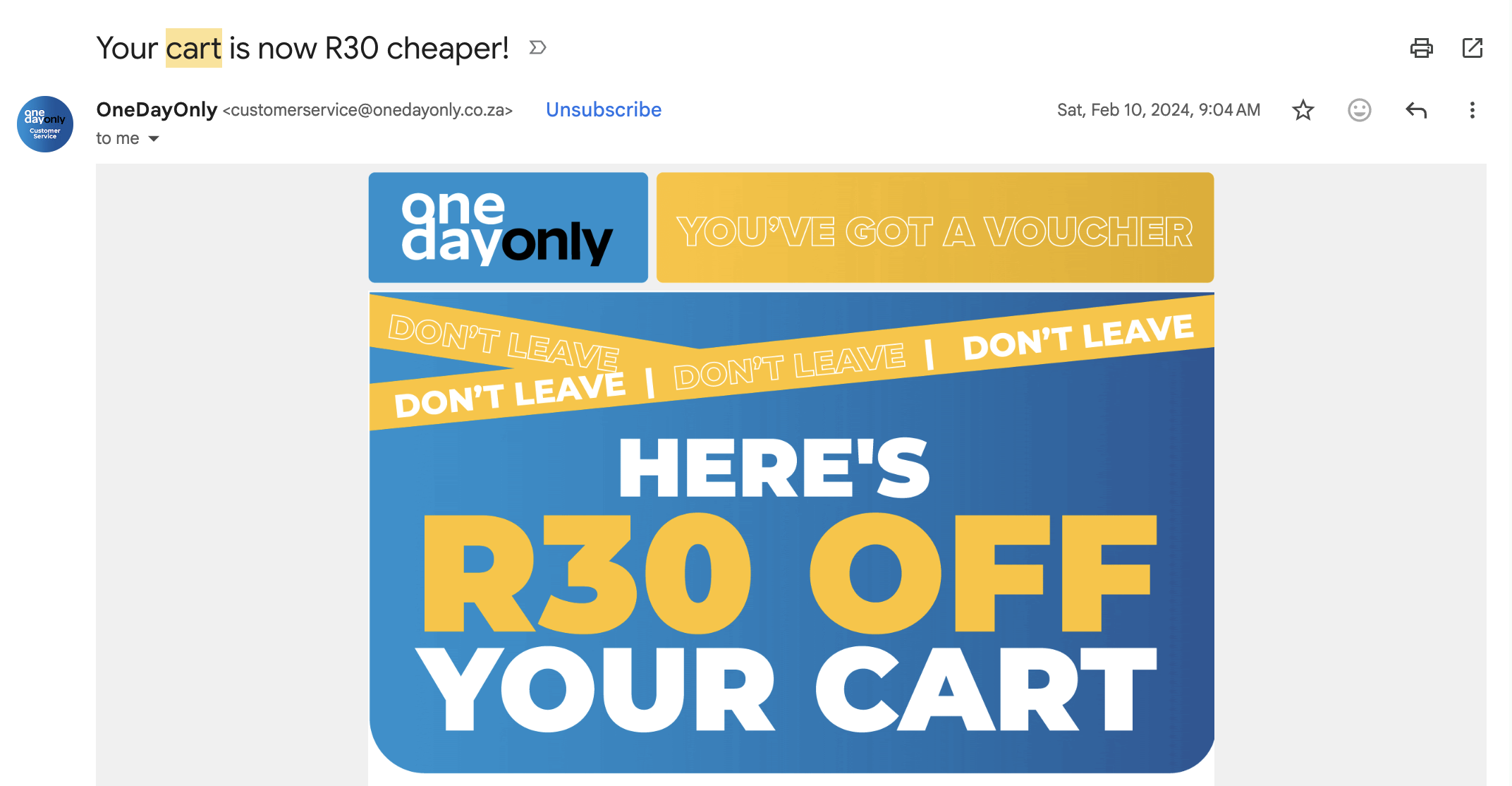
Cart abandonment emails are also high-value, because users have already demonstrated intent to purchase. Across industries, the average cart abandonment rate is around 70%, while abandoned cart emails recover and convert approximately 4.6% of those abandoned carts.
The best ones remind without being pushy, reduce purchase friction and add one piece of contextual value. It works to clearly show the product image, link straight to the cart and eliminate any checkout hurdles. And if you add something the customer didn’t have when they abandoned the cart (e.g., a “free shipping” offer), you add value that could convince them to buy.
This three-email sequence works well:
- Send a reminder within one hour
- Follow up within 24 hours with social proof (e.g., customer testimonials)
- Send another follow-up within 72 hours with an optional incentive
What to steal: Make sure the email links directly to the cart, not the home or product page. Use the product image as the hero visual to reconnect the customer with what they almost bought. Keep the sequence to no more than three emails, and introduce a stronger incentive only in the third if needed.
3. Post-purchase sequences: Turning a transaction into a relationship
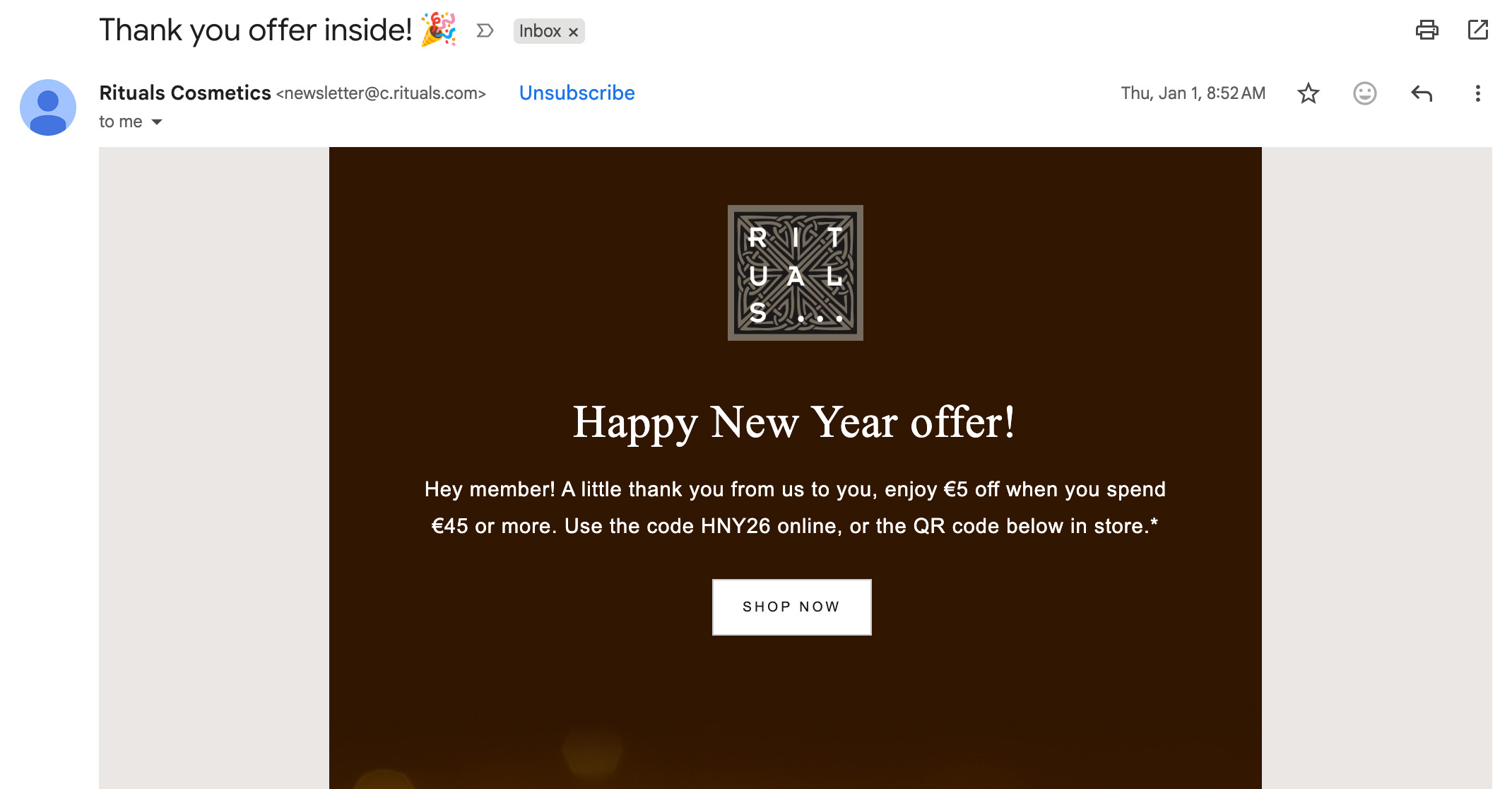
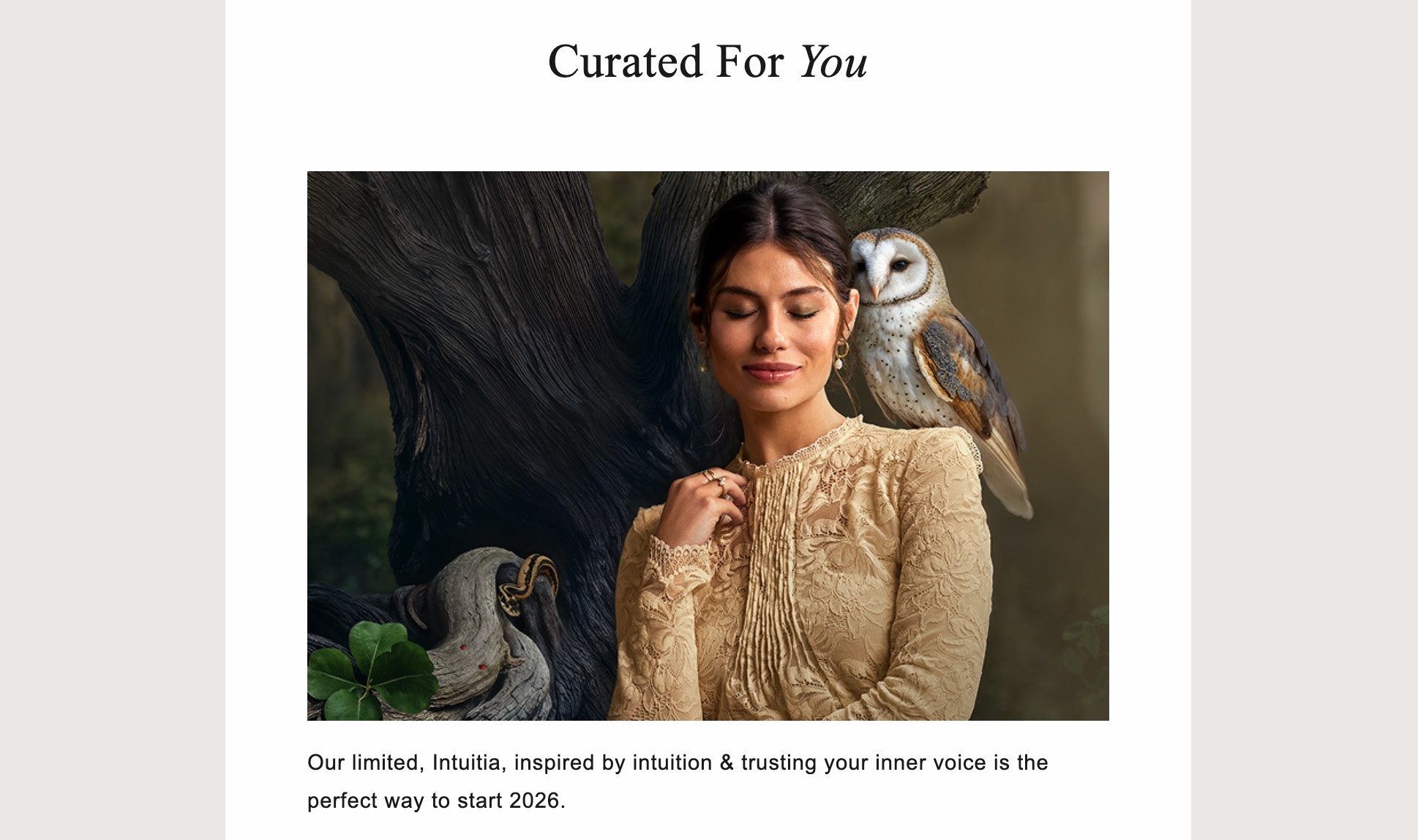
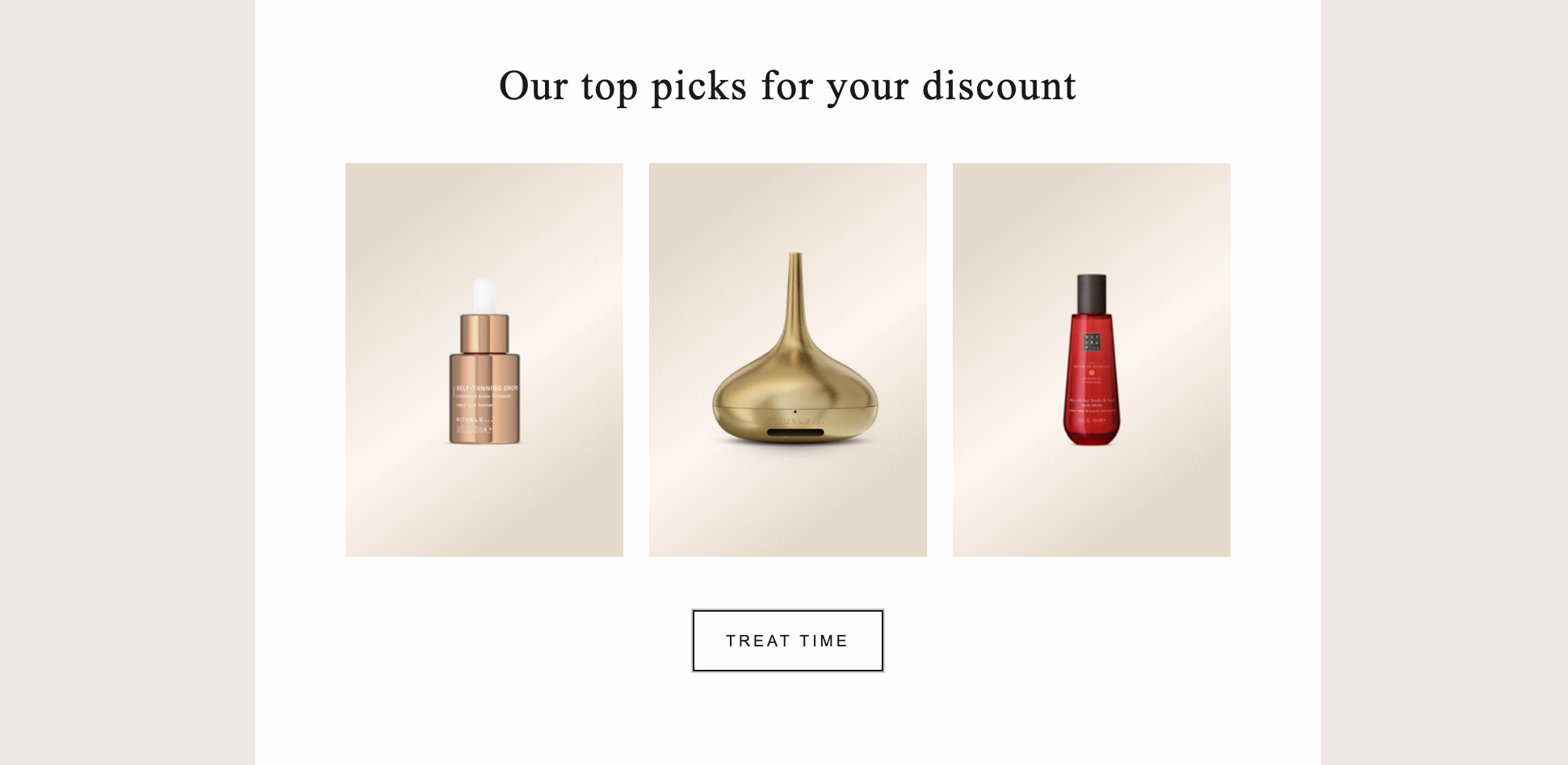 (Source: Rituals)
Post-purchase emails consistently earn among the highest engagement rates. Right after a transaction, existing customers are already thinking about the brand, which makes it a very receptive moment.
Yet many brands underuse this window. They treat post-purchase communication as purely transactional (limited to order confirmations and shipping updates) rather than as an opportunity to build a deeper relationship. Others go quiet altogether, pausing communication until the next seasonal promotion goes out.
The most effective sequences follow four stages:
- Transactional emails (order and shipping confirmations), sent immediately, build trust and reduce post-purchase uncertainty.
- Onboarding emails (for example, with product usage tips) help customers realize value quickly.
- Social proof emails encourage product reviews and UGC once customers have had time to experience the product.
- Retention emails promote repeat purchases by, for example, encouraging replenishment or highlighting loyalty benefits.
Allbirds follows this structure. Their post-purchase sequence starts with clear, on-brand transactional emails, followed by educational content that helps existing customers care for and get the most out of their products.
Only after reinforcing product value and brand trust do they introduce subtle cross-sell and retention messaging. This creates a progression that feels helpful rather than overly promotional.
What to steal: Extend your post-purchase email sequence to include onboarding content, a review or UGC request and retention messages. Also, invest in the design quality of transactional emails as their high open rates make them more valuable than promotional emails.
4. Re-engagement campaigns: Win them back before you lose them for good
Inactive email subscribers drag down your sender reputation score, make your list look bigger than it is and increase email costs. But they’re also an opportunity. With the right win-back strategy, you can bring inactive email subscribers back (much cheaper than finding new customers).
Prevention matters as much as recovery: Lists built from verified addresses, often checked with an email finder before the first send, accumulate fewer dead contacts in the first place.
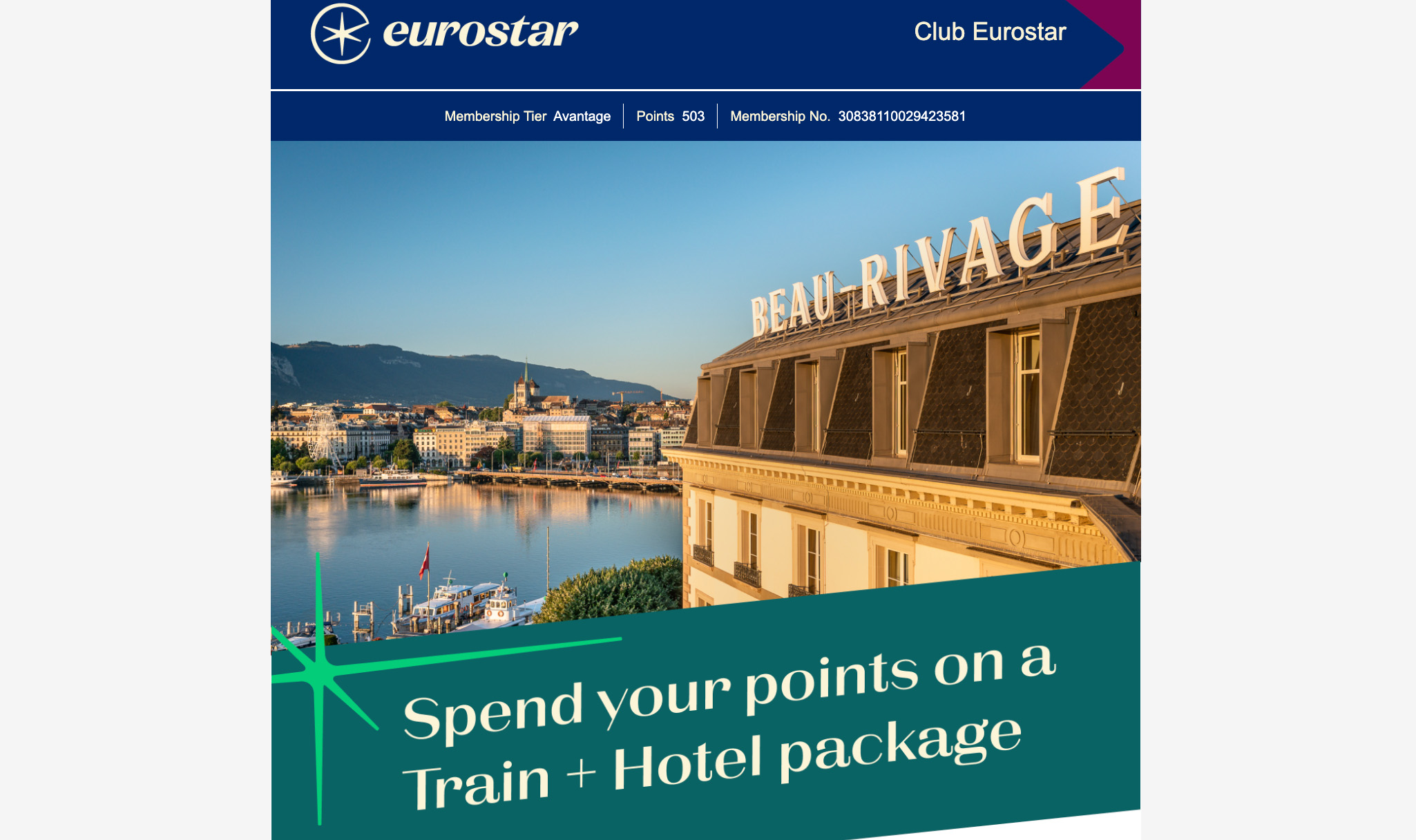 (Source: Eurostar)
Eurostar mastered this approach. The brand uses browse and purchase history to trigger highly relevant reminders to inactive subscribers, such as information on how to use their points or travel deals. This makes re-entry feel timely rather than intrusive.
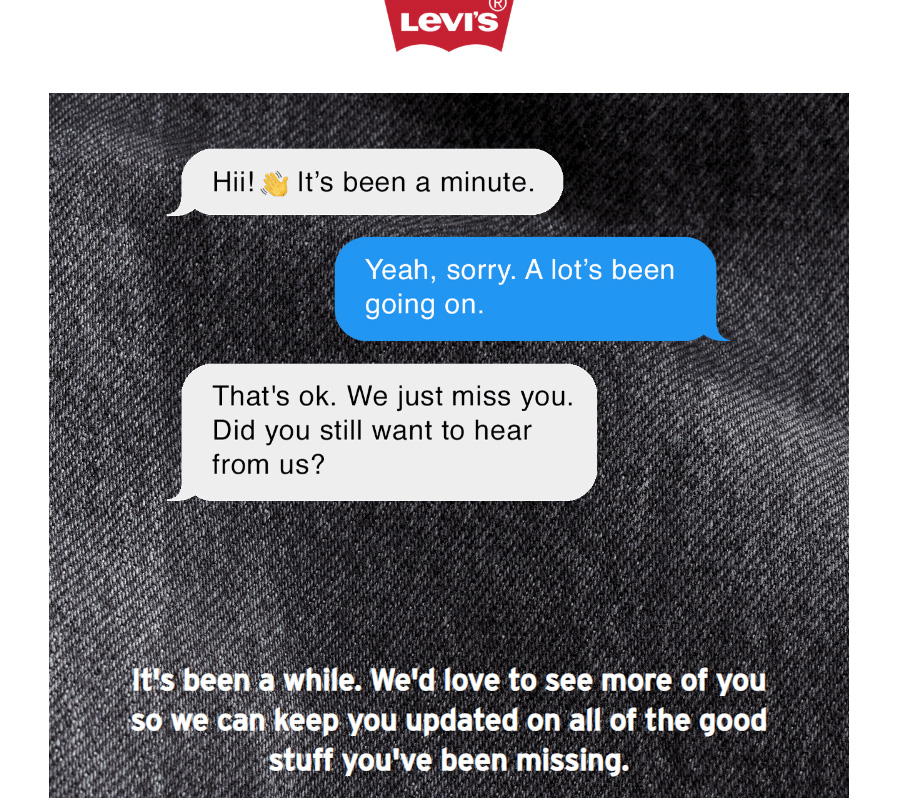
One of Levi’s final “stay or go” emails uses a conversational, friendly tone that mimics a text message from a friend. The simplicity of the design, combined with a clear CTA, invites subscribers back without pressuring them.
 (Source: Email Love)
The most important creative decision in a re-engagement email is the subject line. A single “We’ve missed you” line is tired.
What to steal: Define inactive subscribers (or a lapsed subscriber trigger) based on your typical purchase cycle. Then design your win-back emails as a story that invites them back (not, for example, as a series of discounts). Finally, send a “stay or go” email asking them to confirm whether they really want to opt out.
Many brands underinvest in B2B email newsletter design because emails are seen as content-delivery vehicles rather than brand assets. Those who treat the newsletter as a core brand touchpoint tend to see good results.
Our advice? Newsletters should be a regular, designed, value-first communication that builds authority with your audience over time.
 (Source: Mckinsey)
A strong example is McKinsey Perspectives. Rather than pushing services, McKinsey & Company delivers consistent, high-value analysis and original thinking, with clean editorial design that reinforces authority. For engaged subscribers, the newsletter is a trusted source of insight that builds an emotional connection.
 (Source: TEDEd)
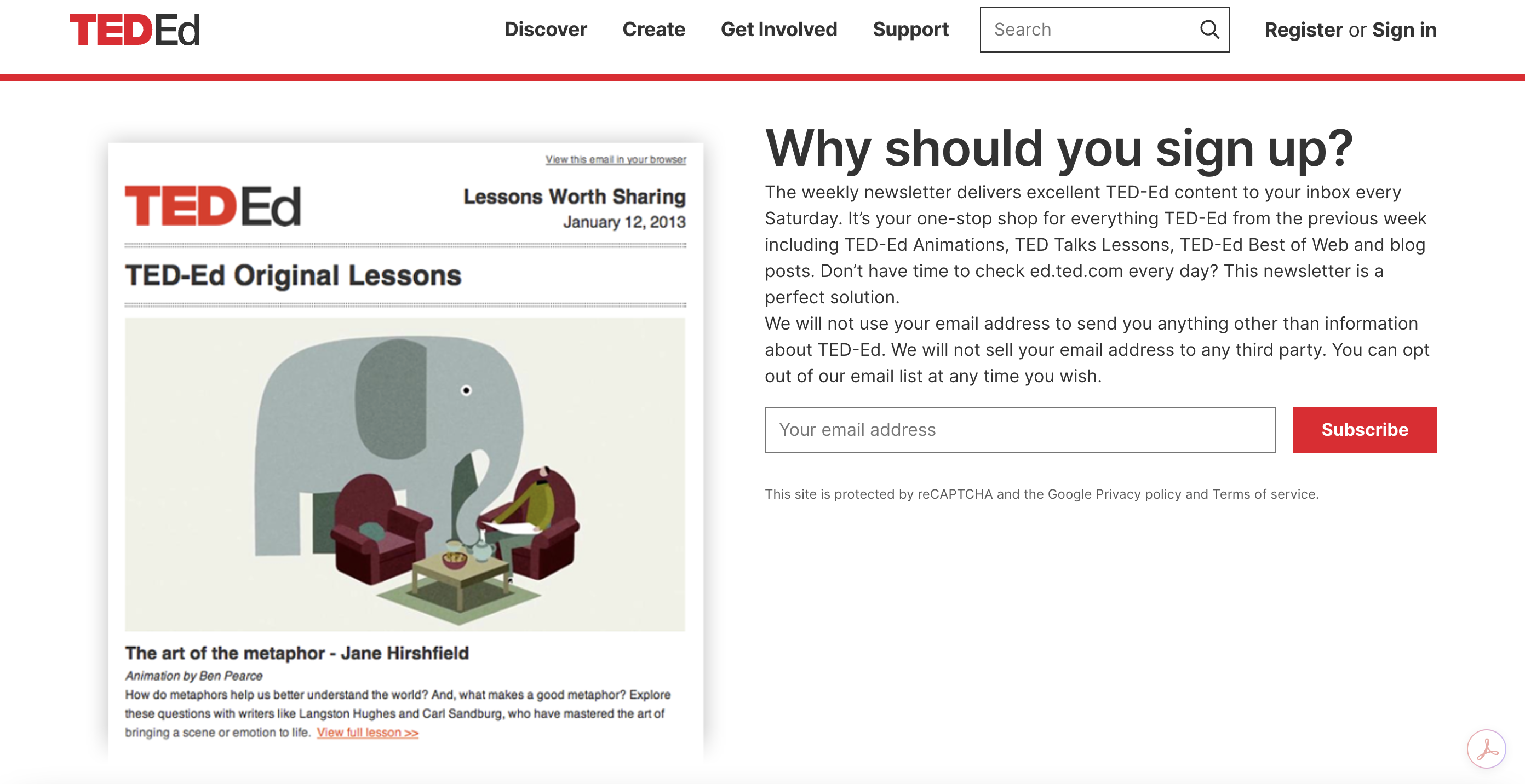
TEDEd takes a different approach to keep its audiences engaged. Its newsletters focus on curating talks, ideas and themes in a structured, easy-to-scan format. With clear content sections, strong visual hierarchy and minimal overt promotion, the emphasis stays on delivering value. This builds brand affinity and long-term engagement.
The common thread across the best B2B email marketing examples is clear visual hierarchy, consistent send cadence and a strong editorial POV. These emails routinely perform well because subscribers treat them as a resource rather than a commercial transaction. For B2B teams, those engagement signals can also help identify when a subscriber is ready for a sales conversation, with appointment setting as one possible next step.
What to steal: Opt for editorial, value-first messages rather than product-focused newsletters. Invest in strong design systems that make each issue feel cohesive and on-brand, regardless of the content mix. Use data about your most engaged subscribers’ activity to personalize messages.
How Superside helps enterprise teams execute email creative at scale
Successful email campaigns all share a quality that can be hard to operationalize in high-pressure enterprise environments: They unmistakably reflect the brand behind them and stay consistent across markets and volumes.
As the world’s leading AI-first creative partner, Superside helps enterprises achieve brand-consistent email design without the overhead of traditional agencies or the operational burden of managing freelancers.
We create modular design systems with reusable components, localization-ready templates and mobile-first layouts to help our customers produce thousands of email assets that remain true to the brand identity.
Brand Brain, the AI intelligence layer within our Superspace collaboration platform, sits at the heart of our operations. It captures your brand identity, creative decisions and past learnings, then applies that context automatically to every new project.
Beyond email production, our flexible subscription model gives you access to a host of creative services, from campaign strategy and copywriting to web design and social media creative. This means your email campaigns become part of a cohesive brand system that tells one clear, compelling brand story.
Book a call to learn how we can support you with AI-powered, human-made and brand-perfect email campaigns and other marketing efforts.
FAQs

Join 70K+ creatives and marketers
Subscribe to The Creative Brief for the latest events,
articles and insights sparking industry-wide interest.

Drive action, not noise.
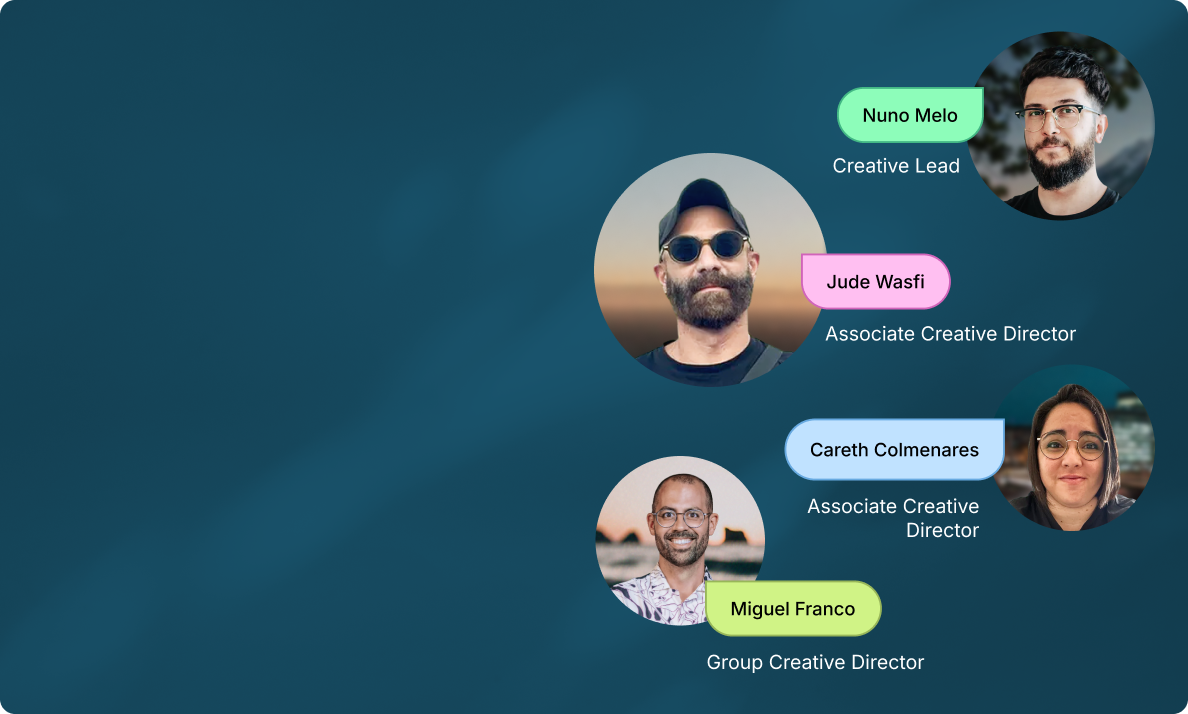
Meet the Superside Email Design Team.
Lifecycle strategy, design systems
and email performance at scale.
“Email design is not how an email looks.
It is how it performs.” - Jude Wasfi
This is the quality you can create with Superside
Discover how Supersiders help global brands
launch high-impact campaigns at scale with top design.
We're your creative team's creative team.