





Digital experiences span every web and product touchpoint where customers interact with your brand. Most enterprises struggle to keep them consistent because of fragmented ownership, slow execution and no shared system for iteration. This guide breaks down a practical framework for fixing that, from dashboard design and information architecture to AI-powered QA and backlog support, and shows how Superside helps brands scale cohesive digital experiences as an AI-first creative partner.
Your brand isn't experienced in a single moment anymore.
It lives across hundreds of micro-moments: the first landing page someone hits from a paid ad, the pricing page they skim on mobile, the onboarding flow in your product, the dashboard they rely on every day.
Modern consumers meet your brand in many places and at different times. Collectively, those touchpoints shape perception. But here's the distinction many teams miss: having a digital ecosystem (all the places your brand shows up online) is not the same as delivering a great digital experience (how it actually feels to move through those touchpoints and whether they help people get what they came for).
The best digital experiences feel effortless. The website matches the product's logic and visual language. The UI feels on-brand without being restrictive. The flows are intuitive across devices. And the experience keeps improving because the team can actually ship.
This guide will help you design digital experiences that are brand-consistent, conversion-focused and built to scale across your web and product ecosystem. You'll see the framework Superside uses as an AI-first creative partner and learn why it works for enterprises that need to move fast without sacrificing quality, with insights from Miguel Franco, Group Creative Director of Web Services at Superside.
What does 'digital experiences for brands' mean?

The term "digital experience for brands" (or "brand digital experience") refers to the total experience someone has with your brand through digital touchpoints. These are the interactions that influence::
- Perception: "Do I trust this brand?"
- Decision: "Is this right for me?"
- Action: "Can I sign up, buy, book or start?"
- Retention: "Is this easy enough to keep using?"
- Advocacy: "Would I recommend this?"
Digital experiences are how a brand shows up across every touchpoint where a customer interacts with them online. It's the continuity between discovering a product on social, exploring features on the website, subscribing to updates and engaging with content over time.

For enterprises, digital experiences typically span two ecosystems:
1. The website experience (the first-impression engine)
Your website isn't just a source of information. It's where consumers, potential employees and other stakeholders form their first impression of your brand.
It should clearly communicate what you do, who it's for and why your product matters. But messaging, design, UX and operational systems must also work together to guide visitors toward specific actions.
The website experience rarely stops at your core domain. You also need to consider:
- Search and SEO (consumers are likely to land via search)
- How AI models discover and cite your content
- Your omnichannel campaign ecosystem (social media, email, paid campaigns and in-store QR codes)
- Resource centers, blogs, newsrooms and product marketing hubs
- Recruitment pages and employee touchpoints
To design these experiences well, you need a deep understanding of your users' behaviors and pain points.
2. The product experience (the daily value engine)
Your product is where customers test whether you deliver on what you promised on your website. This is the experiential side of your brand: how it feels to use your product day after day and how reliably it helps users achieve their goals.
Product experience includes everything from onboarding workflows and feature experiences to platform navigation, dashboard design and relevant user journeys.
Your product experience is how your brand shows up every day. It's the difference between a customer who logs in because they have to and one who logs in because it genuinely makes their work better.
Strong digital experiences nail both. Your website may win customers, but your product experience determines whether they stay and become advocates.
Why standout digital experiences matter more than ever
Today's customers don't compartmentalize your brand into neat platform buckets. They evaluate one experience across channels.
Every interaction adds up to a judgment: does this brand make my life easier or harder? When the experience is frustrating, slow or inaccessible, most don't contact support. They close the tab for good.
A strong digital experience feels seamless, intentional and connected, whether someone is navigating a marketing site, using a product interface or opening an email. At its best, digital experience combines strategic clarity with sensorial moments that make interactions memorable and distinctly tied to the brand.
The business case is simple. Exceptional digital experiences drive measurable outcomes:
- Higher conversion: Clear messaging + smooth UX = fewer drop-offs.
- Higher retention: Smooth onboarding + simple workflows = more habitual use.
- Lower support burden: Fewer "how do I...?" moments = fewer support tickets.
- Stronger brand trust: Consistency across your digital ecosystem = greater credibility and long-term loyalty.
The business case is simple. Exceptional digital experiences drive measurable outcomes:
- Higher conversion: Clear messaging + smooth UX = fewer drop-offs.
- Higher retention: Smooth onboarding + simple workflows = more habitual use.
- Lower support burden: Fewer "how do I...?" moments = fewer support tickets.
- Stronger brand trust: Consistency across your digital ecosystem = greater credibility and long-term loyalty.
The brand case is even stronger. Competitors can copy designs, match pricing and outspend you on ads. But it's much harder to replicate a cohesive digital experience built on a scalable design system and optimized continuously. That's what "built to scale" really means.
Digital experiences create differentiation by turning brand strategy into something customers can feel and interact with. Most companies deliver fragmented experiences. When digital experiences are designed as a unified system, customers recognize the difference. Differentiation doesn't come from individual pages or features. It comes from the coherence, craft and intelligence embedded across every interaction.
The most common reasons digital experiences fail at scale

If you've ever thought, "We keep launching updates, but the overall experience doesn't seem to improve," you're not alone. Here's why digital experiences often go off track as operations scale:
1. Fragmented ownership
Web and product teams tend to operate on different timelines, use different tools and pursue different goals. Without shared ownership and a clear CX strategy, digital experiences start to diverge. Navigation behaves differently across touchpoints, visual styles vary and interaction patterns become inconsistent. This misalignment increases operational costs, slows delivery and ultimately impacts business outcomes.
2. Inconsistent UI and brand expression
Without a well-defined design system, every new page becomes a custom build. This quickly leads to UI inconsistencies and diluted brand expression.
3. Slow execution cycles
Even when teams know what needs improvement, many struggle to ship fast enough. Too many handoffs, unclear sprint structures and constant reinvention slow everything down. By the time updates get published, priorities and market conditions have already shifted.
4. 'Pretty' designs that don't perform
A beautiful interface that doesn't support user intent is just expensive decoration.
On the web, underperforming design is often linked to unclear hierarchies, weak mobile optimization, slow page performance or messaging that doesn't match user intent.
In products, it typically results from confusing onboarding, poor information architecture, misaligned workflows or inaccessible components that block users' progress.
The clearest sign is when a design looks polished but doesn't drive action. Beautiful design without conversion logic is decoration. High-performing design without craft feels cheap. The best work does both: visual hierarchy that guides the eye, messaging that creates urgency, accessibility that removes friction and brand expression that builds trust. Enterprise teams need both, and they need them working together, not competing.
5. Misaligned web and product experiences
One of the fastest ways to erode trust is to let web and product feel like they were built by different companies. A user lands on a marketing page that promises simplicity, then logs into a product that's confusing and visually disconnected. These gaps happen more often than most teams realize.
Trust breaks when web and product feel like they were built by different companies. The fix isn't better handoffs. It's shared systems: design systems, tone frameworks and cross-functional accountability. Enterprises that treat digital experience as one interconnected ecosystem don't lose trust. Those that don't, churn customers without understanding why.
6. No system for continuous improvement
Without regular audits, rigorous QA and structured iteration, digital experiences inevitably degrade. When new launches and pages pile up, teams end up in a cycle of short-term fixes instead of meaningful improvement.
Time for a better approach? If these challenges sound familiar, you probably don't need more design output.
You need better alignment across teams, stronger governance and a repeatable model. In other words, you need a digital experience operating system.
A practical framework for designing digital experiences that scale
In product design, achieving scale doesn't mean designing more screens. It means building the right systems to maintain usability, consistency and speed as you grow.
Superside approaches product design as a set of modular, high-impact building blocks you can mix and match depending on what you're launching, fixing or evolving. Guided by the Atomic Design methodology, we make each component scalable, consistent and easy to use. Here's the framework:
1. Dashboard design: Turn complexity into clarity
Dashboards are often packed with data, diverse user types and complex workflows. "Good enough" design quickly becomes a churn risk. If the layout isn't clear, customers get confused and leave.
What we do: Superside transforms complex information into visual narratives that make it easy for users to understand what's happening, what matters and what to do next.
What you get: Clear hierarchy, scannable layouts, intuitive interactions and UI patterns that support fast, confident decisions. All aligned with your brand identity.
Best for: Analytics products, admin panels, internal tools, finance/ops dashboards and any product where data overload creates friction.
2. Information architecture strategy: Build structure users can navigate
If customers feel lost inside your product, it's usually an information architecture (IA) problem. How you organize content and features determines how easily people find what they need.
What we do: We map and organize the product's structure to guide user journeys and flows, ensuring navigation, labels and pathways make sense across roles, permissions and devices.
What you get: A product structure that reduces cognitive load, makes features easier to find and supports business growth.
Best for: Mature products with design debt, new feature expansions, multi-audience platforms and products with high drop-off due to confusion.
3. Product MVP: Validate fast before you build big
When speed to market matters, don't aim for perfection. Build a Minimum Viable Product (MVP) first and test whether real customers will actually use it.
What we do: We design a basic version of your product idea for fast validation and early user testing. This helps you gather data-driven insights quickly and reduce risk before committing to full development.
What you get: A focused MVP scope, high-fidelity screens and a prototype experience that captures user feedback and helps stakeholders make informed decisions.
Best for: New product launches, new feature concepts, internal innovation teams and "we needed to test this yesterday" moments.
4. User flow prototyping: Make the journey real before coding starts
Flow issues don't show up in isolated screens. They appear when a user tries to complete a task. That's why user flow prototyping is essential.
What we do: We visualize and test complex user journeys through high-fidelity prototypes so teams can spot issues early and iterate before engineering time is wasted.
What you get: Clickable flows, realistic interaction models and a shared prototype that aligns design, product and engineering around how the product actually works.
Best for: Onboarding, checkout, multi-step forms, permissions-based flows and any workflow that touches multiple screens or states.
5. AI-powered QA: Speed up iteration and retain quality
Scaling digital experiences requires fast iteration cycles and strong feedback loops. Being AI-first means embedding intelligence into quality processes, not just using it as an add-on. At Superside, AI powers our QA workflows so teams can ship confidently at speed. Learn more about our AI-first creative approach.
What we do: We use automated, AI-powered flow validation and feedback loops to streamline product testing and iteration. This helps teams catch issues early and deploy updates with confidence.
What you get: A tighter feedback loop for UX consistency, broken flows and missing states, plus repeatable checks that reduce rework.
Best for: Teams that launch frequently, products with many states and edge cases and organizations that need quality control at scale.
6. Platform audit: Find what's costing you and fix it
If your product underperforms, assumptions won't cut it. You need a clear, accurate diagnosis.
What we do: We run UX, UI and accessibility audits to evaluate platform usability and performance, pinpointing friction points, inconsistencies and compliance risks.
What you get: A prioritized set of clear recommendations with a roadmap from quick wins to foundational fixes.
Best for: Products with churn concerns, accessibility requirements, low conversion/activation rates or teams managing legacy UIs.
7. Product backlog support: Keep shipping without breaking the experience
Most product and web teams don't fall behind because they can't design. Bottlenecks happen because they lack the right systems and support.
What we do: We provide design support for sprint backlogs to boost your delivery pipeline. Improvements don't stall and UX consistency stays intact.
What you get: Reliable sprint support, faster throughput through AI-powered workflows and a creative partner who can plug in fast.
Best for: Growing products, understaffed teams, enterprise roadmaps and "we have more work than capacity" realities.
What digital experiences for brands look like in practice

"Digital experience design" is a broad term. It's often mistaken for a redesign or full rebuild. In reality, it can just as easily mean ongoing optimization across channels. Whichever path you're on, as Miguel mentioned, great digital experiences aren't defined by aesthetics alone.
They're defined by how consistently and effectively they help customers move from intent to action. Here's what strong digital experiences typically include when you zoom out and look at the whole system:
1. A connected ecosystem, not isolated touchpoints
A strong digital experience brings web and product together so they feel part of the same narrative. The website's promise matches the product reality. Visual language and interaction patterns are consistent. Hierarchy aligns across surfaces. Customers can start a journey on the web and continue it in-product without friction.
Key outcome: More trust, higher conversion and faster activation.
2. Simple, clarity-first UX
Successful digital experiences prioritize simplicity over cleverness. That means straightforward information hierarchies, predictable interaction patterns, obvious next steps and accessibility built in from the outset.
Clear UX is especially critical for enterprise platforms with complex workflows, content-heavy websites and products where decision-making happens inside dashboards.
Key outcome: Lower drop-off, faster time to value and fewer support tickets.
3. A repeatable system for consistency
Companies struggle at scale when every new page or feature is designed from scratch. High-performing teams rely on design systems, shared UI patterns, component libraries and modular page frameworks to accelerate creative execution.
Building a repeatable system isn't just about speed. Consistency also tells customers: "You're in the right place. This behaves the way you expect. This brand is reliable."
Key outcome: Shorter time to market, less rework and more cohesive brand expression.
4. Evidence-driven improvement
Digital experiences aren't something you launch and walk away from. You need to track engagement, test what works and continually improve. Today's AI-powered tools make this significantly easier. Key practices include:
- UX/UI audits: Review key journeys to spot where customers get stuck or drop off.
- Platform audits: Check for usability issues, accessibility gaps and inconsistent behavior.
- Data-driven iteration: Use analytics to see where customers abandon flows or fail to complete tasks.
- Ongoing user feedback: Run user tests, review session recordings and analyze support insights to surface real-world problems.
Key outcome: Continuous gains in conversion, retention and usability without constant reinvention.
5. Fast validation before heavy build
Teams that scale successfully test ideas with real customers before investing heavily. They use clickable prototypes to validate journeys, define focused MVPs to reduce risk and run short iteration cycles that incorporate stakeholder input. This is especially valuable for new product launches, major feature redesigns and high-stakes funnel changes. Read more about creative experimentation strategies that drive results.
Key outcome: Fewer expensive rebuilds and faster learning cycles.
6. Two experience domains, one standard of quality
Your web and product teams may operate in different sprints, but customers don't experience these two domains separately.
Map the journey, then design the system. You can't scale experiences by designing individual pages or features in isolation. Identify where customers enter, where they convert, where they drop off and where they need reassurance. Then build the infrastructure to deliver consistency at scale: design systems, reusable components, clear governance and cross-functional ownership.
They expect the same quality on both. That means shared standards:
- Shared design systems: One source of truth for interaction patterns and brand expression in a single design system.
- Shared performance expectations: Page speed, accessibility compliance, mobile optimization and UX consistency should be non-negotiable across web and product.
- Shared experience metrics: Conversion and activation rates shouldn't live in separate dashboards. Both teams should track time to value, web-to-product drop-off, feature adoption vs. messaging and support themes tied to UX friction.
- Shared accountability: If the website promises simplicity, the entire experience must deliver on that promise.
Scaling isn't about doing more. It's about designing once and deploying everywhere with intention.
Scale your digital experiences, the Superside way
Your digital experience is your brand experienced in real time. It's critical that both web and product experiences are intuitive, scalable and easy to update. Both should also be fully aligned with your brand identity.
When web and product are treated as a single interconnected system, nothing holds you back. You deliver faster, convert more and build trust that compounds over time.
You also don't have to build this system alone. Superside is the world's leading AI-first creative partner, built to plug into enterprise teams as an extension of your in-house capabilities. Being AI-first means AI isn't just powering individual tools. It's embedded across the entire creative model: from how our teams are trained, to how our platform captures brand knowledge, to how AI-powered workflows speed up delivery and quality control.
With world-class creative talent, AI excellence, proprietary workflows and sharp strategy, we help brands build scalable, cohesive digital experiences that drive real business outcomes. We're your creative team's creative team.
FAQs


Increase your creative capacity
Let your in-house team reach for the stars,
while Superside keeps your day-to-day creative needs
at an industry-leading level. Ready to scale?
Websites built to scale
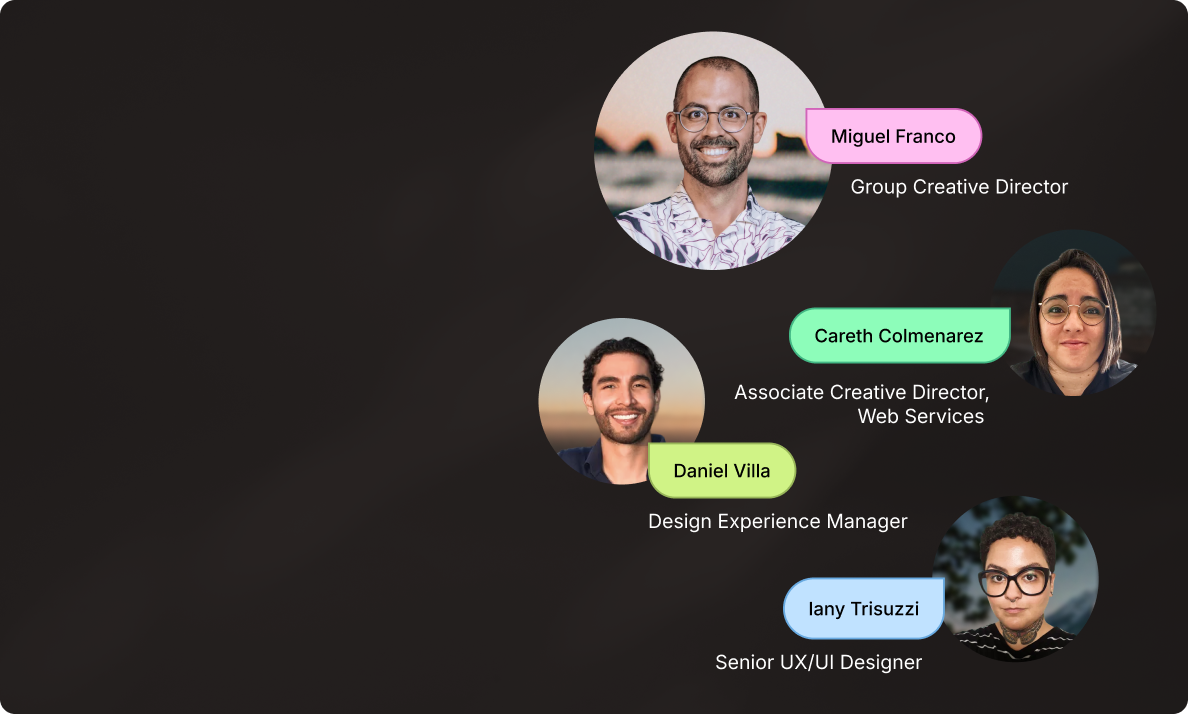
Meet the Superside Web Services Team.
Strategy, design and Webflow development
working as one.
“One great page doesn’t scale
a business. A connected digital
ecosystem does.” - Miguel Franco.
Websites built to scale
Meet the Superside Web Services Team.
Strategy, design and Webflow development
working as one.
“One great page doesn’t scale
a business. A connected digital
ecosystem does.” - Miguel Franco.


