





At Wistia, creativity doesn’t clock in solo. Find out how an open culture, true alignment and fearless collaboration fuel ideas worth pitching—and even printing—for creative-marketing power duo Adam Day and Taylor Corrado.
An SNL-inspired twist on a classic campaign.
An analogue book that’s shipped over 700 copies around the world.
A TikTok series narrated by a psychic raccoon.
Okay, that last one’s made up. But one thing’s for sure, the creative and marketing teams at Wistia don’t just bring the creativity—they crank it to eleven.
That’s why we had to speak with them for Superside’s latest guide, Inside Great Creative Partnerships. Wistia’s Adam Day, Creative Director, and Taylor Corrado, Senior Director of Brand Marketing, were kind enough to oblige and spill their secrets, including:
- Where they get their best ideas
- How to validate creative approaches
- What happens when you say "yes" more
- How to build a safe environment for creativity to thrive
So, let’s dive into how this creative-marketing duo turns trust, alignment and fearless collaboration into campaigns that truly resonate.
Inspiration has no org chart
Both Day and Corrado are firm believers that the best ideas do, in fact, come from all over. The more you open doors to novel sources of inspiration, the more creative and varied your campaign ideas will be. So swing those doors wide open for people across the business, too.
The best ideas come from all over. We get a lot of inspiration from brands outside our industry. And we have a creative inspo channel in Slack where people from all over, not just the marketing team, can share examples of social posts, advertisements, anything related to creative to spark ideas across the team.

Day seconded this sentiment, adding an important qualifier: What does the phrase “best idea” even mean?
Know your goals, tap your wells
The merit of an idea is inherently subjective. So, rather than think about which idea is “best,” Day emphasized the need to focus on which idea is best to achieve the outcome or goal you have in mind. This helps remove some of the subjectivity from the ideation process—though there will always be an element of taste that comes into play. (More on this in a moment.)
The best idea is so subjective. What’s the best idea for the outcome you want? What’s the best idea for the goal?

Day went on to outline three different ways or “wells” where great ideas show up:
- Inspired. Sparked from a conversation, random observation or moment, inspired ideas can be ignited by anything and everything. As Day describes, these types of ideas tend to arrive fully-formed, popping into existence with vision and clarity.
- Data-driven. Prompted by a trend or insight drawn from data, these ideas build on what’s working or capitalize on an opportunity made evident by the story the numbers are telling you.
- Born out of constraints. Whether you have $10 to accomplish a task or three key messages you need to convey, any type of constraint requires creativity to work within, often giving rise to innovative approaches and ideas.
If you understand these three sources and how to tap into them depending on the project at hand, your well of ideas should never run dry.
Validate based on taste, value and emotion
Given a bottomless well of great ideas, determining which ones to pursue may seem daunting. But again, Day has a talent for breaking it down simply. In addition to making sure ideas ladder up to goals, he explained three ways to validate creative approaches:
- Taste. Great taste is hard to define, but plays a key role in creative decision-making. Day and his team use the “smell test” when assessing concepts, based on the taste they’ve acquired by consuming high-quality work throughout their careers. With the proliferation of AI content, Day predicts taste and having great creative curators will become even more important moving forward.
- Value. Is the idea valuable? Is it very clearly contributing something? Whether that’s a tangible asset or intangible benefit, like a moment of levity in an otherwise stressful day, Day suggested asking yourself whether an idea will offer your audience genuine value.
- Emotion. Does the idea elicit an emotional response? Does it make someone cry? Does it make someone laugh? Stopping the scroll is all about tapping into real emotion—that’s when your audience will get drawn in. If there’s no emotional reaction, you’ll likely get no reaction period.
With emotion, comes resonance. Corrado added achieving that resonance is all about deeply understanding your audience—from the problems they face to the humor they enjoy.
Of course, ideas stemming from data might already be validated. Corrado mentioned her team likes to build on high-performing initiatives striving to improve every go around, like Wistia’s ever-popular, annual State of Video report.
A good idea could be something that already performed well, but you’re making it 1.5X better. So, have you done it before and can you make it just that little bit better to resonate more and hit your audience.
Try the pitch test
One last tip when validating ideas: Always be pitching.
If you can pitch it with conviction, chances are it’s a great idea. Day explained how a pitch brings together answers to all the questions you should be investigating when formulating a concept, like whether you considered data points, user behavior, audience preferences and external inspiration.
A pitch brings in the inspiration, the data and any other insights or personal taste you’re bringing to the project. If you can pitch with clarity, if you can argue for an idea, that’s when it’s a good idea.
When Day’s team is presenting a design to a stakeholder, he wants them to be able to explain why all the choices they made were good. So yes, taste may be intangible and design subjective. But as Corrado noted, great taste also means you’re working from a deep understanding of your brand—from aesthetics to values—and that, you can explain in a pitch.
Embrace the unexpected, make ideas your own
Beyond encouraging a good pitch, Day and Corrado are genuinely open to ideas from all sources. So, when a couple designers brought forward the idea of putting together a real, physical book inspired by Hinge’s phonebook campaign, they were all for it.

Some may have balked at the notion—questioned the relevance or the lift. Day said, “Okay, figure out how to do a book, and we’ll do it.” This type of response is part of how he builds a culture where everyone feels safe to share their ideas, which is a topic we’ll dig into next.
The designers went on to investigate book-making on the side, going so far as to visit book printers. And then, sure enough, the right opportunity arose. As part of Wistia’s webinar wizard campaign, Day and Corrado’s teams put together a beautiful 80-page webinar guide book that has now shipped 700+ copies around the world, driving over 1000 downloads and 40,000 page visits.
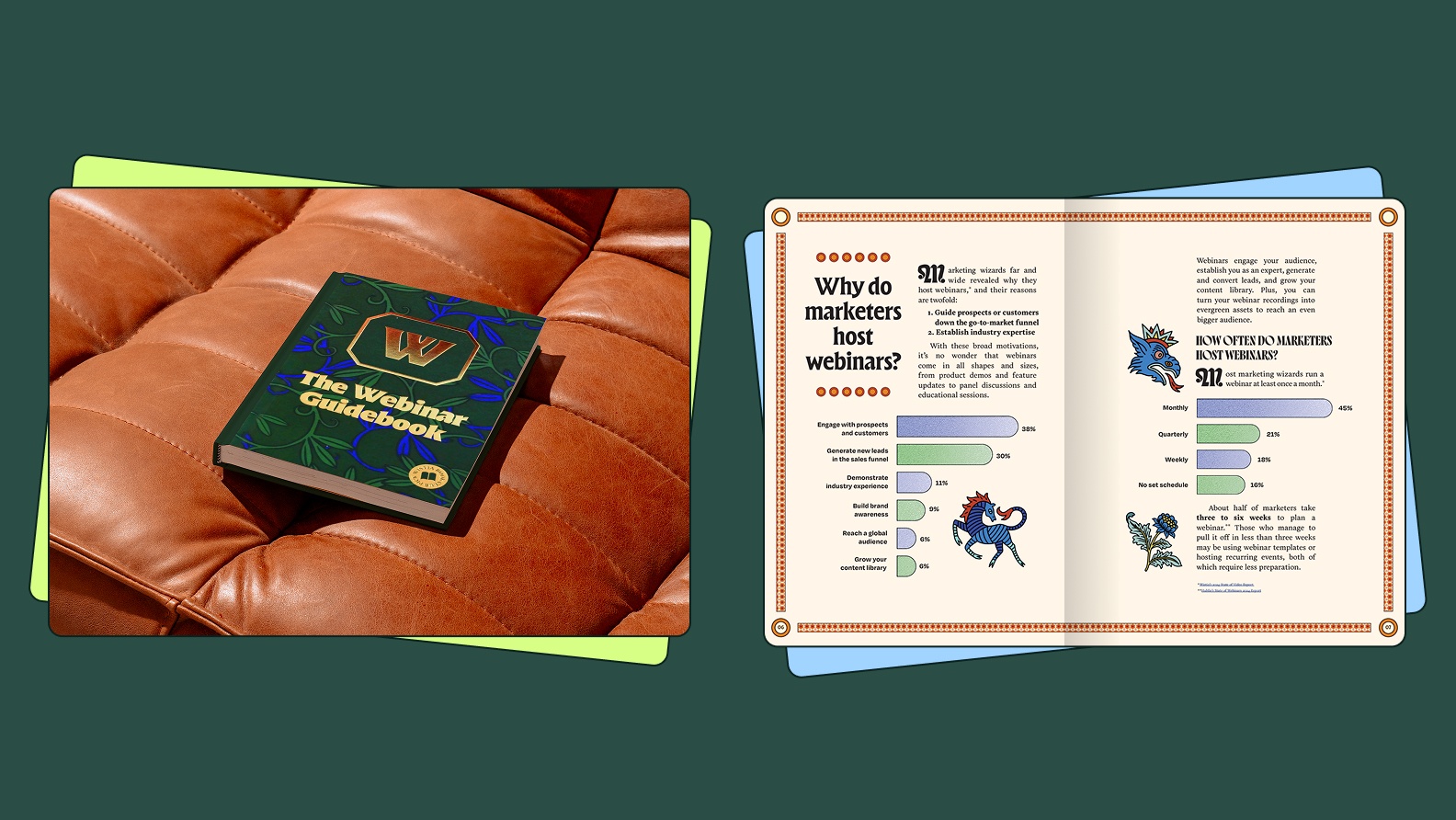
The book was meant to be an inspiration for people running webinars and a way to get out of the digital world for a minute. Similar to the Hinge campaign, which was a way to get off your phone and interact with people in the real world. We built off that idea.
What if it hadn’t worked? Well, Day and Corrado have some thoughts there too…
Build trust and break down fear
Even working from a deep understanding of your brand and audience, Day and Corrado know not every idea will be a smash success. They both shared instances where a creative idea didn’t fully land in practice, but where they learned lessons along the way, including the importance of challenging your own assumptions and letting your team try, experiment and fail forward.
Because as Day said, “Working scared is the death of creativity.”
When he shared this thought, Day was speaking to fostering an environment where creatives aren’t afraid to speak up—a topic he feels quite passionate about. Whatever department you work in, chances are you’ve experienced moments when you were criticized or penalized for sharing a thought or trying something different. Day knows these moments can stick with you, seeding doubt, fear and reluctance to put yourself out there again.
That’s why Day and Corrado do their best to build an environment where their teams feel safe and supported, breaking down fear and swinging open doors to collective ideation. How?
- Lead by example. Jump in first and often with ideas, however out there they may be. Say things like, “This is a really silly idea, but I need to get it out of my head to get to the next idea.” Leading by example extends to being encouraging in every context. Get excited about your team’s ideas and be loud about that excitement. Day added that he tries not to put a rigid process around ideation either. Letting it happen organically and in many different ways, rather than forcing a Miro board or brainstorm every time, allows team members to ideate and share in the ways that work best for them.
- Make it happen. Demonstrate that a good idea can come from anywhere by not only encouraging those in non-creative or non-marketing roles to share, but making their ideas happen when they do. The more people see others not only sharing, but having their ideas actually actioned, the more they’ll feel empowered to contribute their own thoughts, too.
- Give ownership. In the event a team member is scared or timid, convey that they have ownership of a project and work with them to take responsibility. That includes placing your trust in them and giving them the opportunity to experience both wins and failures—and if they do stumble, support them. Knowing their job isn’t on the line if they have a bad idea will help build trust and that feeling of safety that’s so crucial for creativity to thrive.
- Ask! If someone isn’t speaking up in a brainstorm, ask them for their thoughts. As Day reflected, “We’ve all been in meetings where our heads were full of ideas, reactions and opinions, but we didn’t speak up.” Give people an opening to contribute, and if they don’t have anything, no problem. Just asking shows you value everyone’s input. Extend this practice to asking for feedback from peers and colleagues across your organization. The creative and marketing teams at Wistia hold office or virtual office hours where coworkers can drop by, share work in progress and get feedback, which gives people a smaller setting to contribute and build confidence that they can bring thoughts, challenges and out-of-the-box ideas to the table in the future.
- Establish trust. All of these approaches are designed to build trust. Once you’ve established that foundation, you might consider discussing hang ups or fears with your team members directly. As Day noted, negative experiences really do stick with people, and he sees the instinct to hold back in a lot of creatives. In these instances (once trust is established!), having a conversation about fears and working on breaking that down with them may be appropriate.
Day summed it up succinctly, “All of these practices build trust that as a leader you want your team members to grow, which helps them in their careers and also encourages them to contribute their absolute best creative work.”
“Plus one,” said Corrado.
And that’s how this creative and marketing leadership duo build an environment where great ideas can, and do, come from everywhere.
Great work starts with an open door policy
Turns out, standout creative isn’t just about bold ideas—it’s about hearing every voice in the room.
Through real trust, shared ownership and open collaboration, Day and Corrado show that when creative and marketing lead together, great ideas follow. You’ll find more lessons like these in our guide, Inside Great Creative Partnerships, featuring leaders who know behind every “wow” is a “we.”


Inside Great Creative Partnerships
Tap into the minds of 22 top creative and
marketing leaders at brands like Wistia, Booking.com
and Twilio and see how they ship great work, together.
Inside Great Creative Partnerships
Tap into the minds of 22 top creative and
marketing leaders at brands like Wistia, Booking.com
and Twilio and see how they ship great work, together.


