




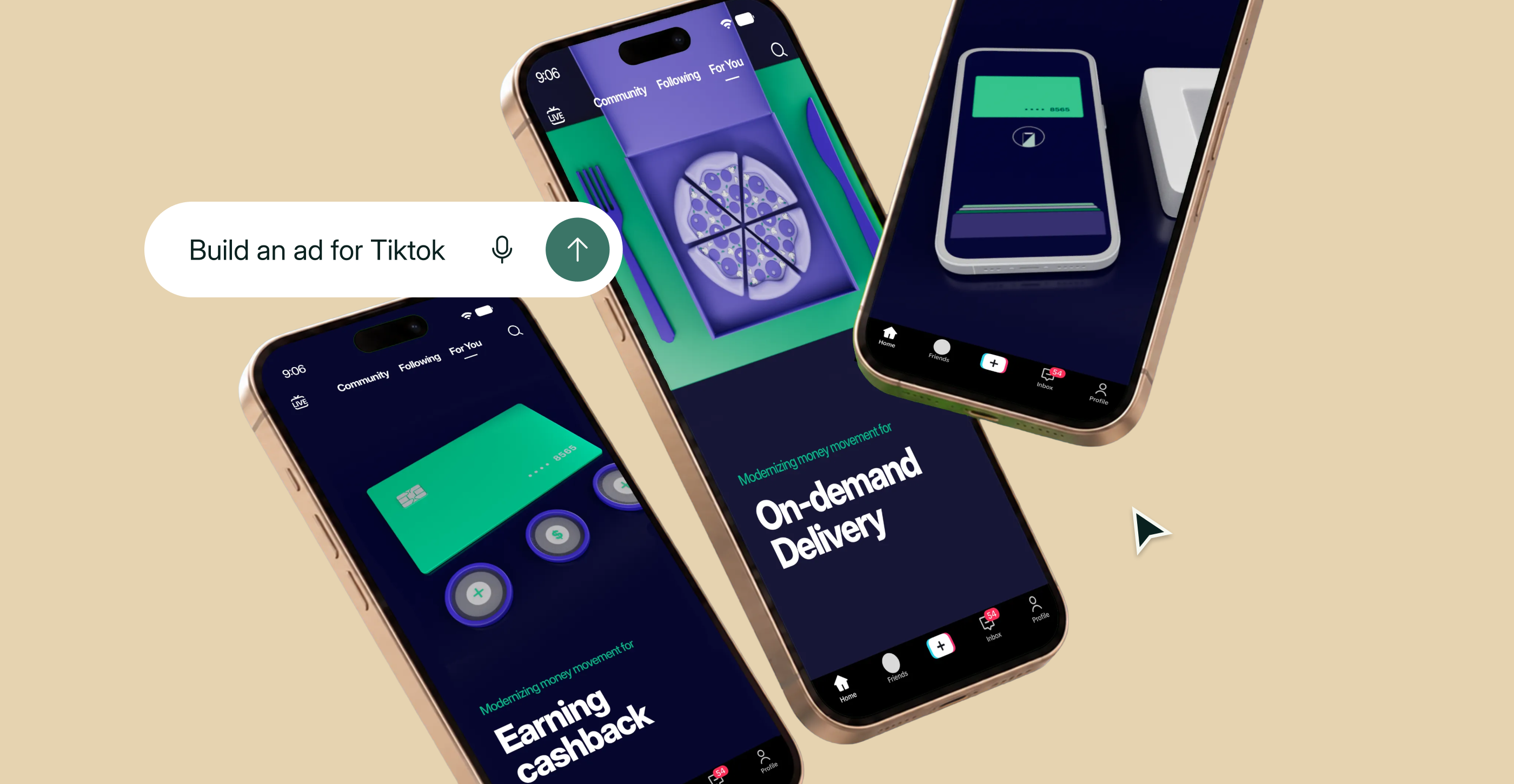
TikTok ad creative works best when it feels native: vertical, sound-on and hook-first. This guide covers current formats and specs, the anatomy of strong ads and 14 great TikTok ad examples. It also explains how to produce, test and refresh creative at scale, using Suzanne Kalan's 5,124% increase in TikTok views to show what's possible.
Most paid social creative can survive a little repurposing. TikTok is less forgiving.
Its "For You" feed is packed with vertical, sound-on videos made by creators who know exactly how to build irresistible hooks and hold attention. Drop in an ad that feels like it was made for LinkedIn or Facebook, and you'll simply be ignored.
That makes TikTok ad creative a discipline in its own right. The strongest ads feel native to the feed yet still clearly connected to the brands behind them.
The challenge for marketers is delivering effective ads consistently. TikTok rewards fresh creative and constant experimentation, which means teams need enough concepts and variations to keep testing.
This guide explains how to make TikTok ad creative that works, from current formats and specs to hooks, sound, safe zones, testing and measurement. We also break down 14 standout examples and show how Superside helped luxury jewelry brand Suzanne Kalan increase TikTok views by 5,124% in three weeks.
Along the way, Guillem Saura, Senior Video Producer at Superside, shares what he sees when teams try to produce TikTok creative at volume.
What counts as TikTok ad creative?
TikTok ad creative is the video or image content used in a paid TikTok campaign and designed specifically for how people watch and interact with content on the platform. The key word is "specifically."
Effective TikTok ads aren't Instagram posts, YouTube videos, LinkedIn ads or traditional commercials resized to fit a vertical screen. They're designed around TikTok conventions: vertical video, sound-on, fast pacing, strong hooks, on-screen text and content that feels at home in the "For You" feed.
Creator and user-generated content (UGC)-style ad creative is particularly effective, because it naturally matches the content surrounding it. At the same time, "native" or "authentic" doesn't have to mean "low-budget" or "lo-fi." As we'll see later, even luxury brands can produce polished TikTok creative that feels completely at home on the platform.
Ultimately, every brand that wants to reach its audience with TikTok marketing should understand how to create advertising that speaks the platform's language. Let's take a closer look.
TikTok ad formats and specs

Before we get into the creative itself, it helps to understand the platform's possibilities and restrictions. TikTok offers several ad formats, each designed for a different type of campaign.
1. In-Feed Ads
Standard In-Feed Ads appear in a user's "For You" feed and compete directly with organic content for attention. They work well for product demos, special offers, direct-response campaigns and regular promotional content.
TikTok recommends vertical 9:16 video at a minimum of 540x960px, with a file size no larger than 500MB. Non-Spark video can run up to 10 minutes, and TikTok's creative guidance recommends at least 720p and putting your hook in the first six seconds. Because these ads sit alongside organic posts, they perform best when they feel native to the feed rather than like traditional commercials.
Spark Ads let you turn organic posts into ads. You can boost content from your own account or, with permission, amplify a creator's post, and the original post stays intact so viewers can interact with it as they normally would. TikTok's In-Feed Ads documentation notes that a maximum of four text lines can be displayed, emojis included.
This native structure makes Spark Ads especially powerful. TikTok reports a 134% higher completion rate and a 157% higher six-second view-through rate than standard In-Feed Ads, based on its own 2022 A/B testing. Spark Ads also carry no video length restrictions.
2. TopView
TopView is a premium placement that puts your video front and center when users open TikTok.
In TikTok's words, the experience "launches with a 3-second video takeover before re-introducing the native in-feed video experience with icons and interaction elements." That makes it a high-impact option for major launches and awareness campaigns.
3. Top Feed
Top Feed is a feed type available for TikTok Reach and Frequency campaigns. It places your video in the first in-feed ad slot, shown after the user's initial organic videos.
This format works well for key branding moments and mass awareness. Because it runs through Reach and Frequency buying, you can reserve inventory in advance and manage how often audiences see the ad, which makes delivery more predictable.
4. Branded Mission
Branded Mission is TikTok's crowdsourced creator-ad format. Instead of commissioning every piece of creative yourself, you launch a brief that invites eligible creators to produce their own videos.
You can then review the submissions and boost the best ones as paid ads in the "For You" feed. Selected creators are compensated.
Other formats: TikTok also offers the TikTok Pulse suite (contextual adjacency to top-performing content), Carousel Ads and Playable Ads, among others. Availability and specs change regularly, so always confirm the latest requirements in TikTok's Business Resource Center.
The anatomy of a high-performing TikTok ad
TikTok describes a simple three-part structure for effective ad creative: hook, body and close. The structure sounds straightforward, but executing it well is hard.
The hook, win attention immediately
Effective hooks create an immediate reason to keep watching. The hook might be a bold statement, a question, an unexpected visual, an attention-grabbing human face, a moment of suspense or a movement that interrupts the rhythm of the feed.
According to TikTok's own Value of View analysis, around 90% of an ad's recall impact is captured within the first six seconds. Your opening isn't simply an introduction. It does most of the work. A slow build or several seconds devoted to your logo won't earn views.
Guillem Saura has watched that pressure reshape the brief itself.
TikTok ads briefs used to be super loose. Basically, here's the product, make it feel native, and editors figured out the rest themselves. Now it spells out how the ad should grab people in the first few seconds, whether that's a question, a bold claim or something that stops the scroll.

Body, bring your audience along
Once you have attention, give viewers a reason to stay. The body of the ad should communicate the idea, demonstrate the product or tell the story the hook promised.
Whenever it makes sense, put the product into the action rather than saving it for a final reveal. TikTok's creative research found that ads showing the product on screen drive a 65% increase in brand affinity and a 25% uplift in recall.
Keep the momentum going. Tight editing, visual movement and a clear narrative all help prevent the viewer from finding a reason to swipe.
Close strong
Finally, make the next step clear. The close can drive viewers to shop, learn more, download or sign up. TikTok Display Cards can add information or reinforce a CTA without interrupting the video itself.
The key is that the CTA feels like a natural conclusion to the creative, not a rushed afterthought.
Sound, captions and the safe zone
TikTok is a sound-on platform, so music, voiceover and audio can make or break your ad. Don't leave this to the last minute. Plan the audio from the start.
At the same time, some viewers will watch without sound. Captions make your message accessible to those users and improve accessibility more broadly, so add them too.
Then there's TikTok's interface. Buttons, captions and other UI elements occupy parts of the screen, so important messaging, faces, products and CTAs need to stay within the safe zone. There's no single fixed percentage, because safe-zone size varies by dimension, caption length and the add-ons you use. TikTok publishes downloadable safe-zone overlay files for exactly this reason. Use them. There's little point perfecting your headline if the interface covers half of it.
UGC-style versus polished
Creator and UGC-style content often performs well on TikTok because it resembles the content people already share. TikTok's own Ipsos-run research found that when brands make TikTok-first ads, 74% of viewers say they catch their attention. That's self-reported attention rather than measured behavior, but the direction is clear.
However, that doesn't mean polished production can't work. The key is that the creative feels native. A professionally produced video can still use TikTok pacing, hooks, creators, trends and sound. Likewise, a deliberately lo-fi video can fail spectacularly if it doesn't resonate.
Asked which of those production models hits its scaling limit first, Guillem doesn't hesitate.
Polished in-house, easily. It's too slow to keep pace. UGC scales better, but it runs out of real creator variety and starts looking templated. Creator partnerships scale best, but only with real relationships already built.
The Suzanne Kalan example later in this guide shows exactly how premium production and TikTok-native creative can coexist.
14 TikTok ad creative examples to study
There's no better way to understand TikTok ad creative than to study brands that have figured out how the platform works.
The examples below take very different approaches, from branded challenges and creator partnerships to mascots, Spark Ads and localization. All of them can inspire your own campaigns.
Set 1: Hashtag challenges that became movements
1. e.l.f. Cosmetics, #EyesLipsFace
If there were a textbook for branded TikTok challenges, e.l.f. Cosmetics would deserve a chapter.
Its #EyesLipsFace campaign combined a custom song with a simple challenge anyone could join: show your eyes, lips and face to the song's words. That low barrier to participation helped turn a piece of branded audio into a genuine TikTok phenomenon.
According to Movers+Shakers, the agency behind the work, the campaign attracted nearly 5 million user-generated videos and 7 billion views.
What to steal: participation needs to be easy. Give audiences a strong creative prompt and enough freedom to make it their own.
2. Chipotle, #GuacDance
Chipotle built #GuacDance around National Avocado Day and invited TikTok users to show off their avocado-themed dance moves.
The challenge generated 250,000 video submissions and 430 million video starts during a six-day run. On National Avocado Day, Chipotle served more than 800,000 sides of guacamole, its biggest guacamole day at the time.
What to steal: connect a simple TikTok-native idea to a real-world event, product or promotion so online participation has somewhere to go.
3. American Eagle, #AEJeansSoundOn
American Eagle built a music-led campaign around its jeans, pairing original sound with creator content and inviting the community to join in.
TikTok's own case study reports 3.1 billion video views, 402 million likes and 1.5 million creations, making it one of the platform's best-documented fashion campaigns.
What to steal: the product doesn't always have to be the story. Sometimes it works better as the prop that enables the story.
Set 2: Creator partnerships done right
4. Crocs x Post Malone
Crocs started working with Post Malone in 2018, launching a pair of limited-edition shoes designed by the star. That campaign was successful enough that the two have partnered multiple times since, on drops that sell out in hours.
Crocs then turned a Post Malone lyric about "thousand dollar Crocs" into a TikTok challenge. #ThousandDollarCrocs invited users to show what their own $1,000 Crocs would look like, and generated 45,000 videos within 36 hours of launch, along with 100,000 new followers in a week.
What to steal: creator reach matters, but creator-brand fit matters more. The best partnerships make sense before the campaign even starts.
5. Dunkin', "The Charli" with Charli D'Amelio
Charli D'Amelio was already known for drinking Dunkin' coffee before the company formalized the relationship. That made "The Charli," a drink named after her usual order, feel more like a natural extension of her existing TikTok persona than a conventional celebrity endorsement.
On launch day, Dunkin' reported a 20% sales boost across cold brew and a 57% increase in daily app downloads. Both figures came from the brand rather than an independent measurement.
What to steal: pay attention to creators who already use or talk about your product. Organic affinity gives paid partnerships a head start.
6. Fenty Beauty, #FentyBeautyHouse
Fenty Beauty went beyond individual influencer partnerships by creating a dedicated TikTok creator house in Los Angeles.
Creators produced tutorials and other content using Fenty products while keeping their own styles and audiences. Instead of forcing every post into a rigid campaign template, Fenty made the brand part of creators' existing content.
Per the brand's own Shorty Awards entry, the #fentybeautyhouse hashtag drew more than 93 million views in three weeks, while the brand's TikTok audience grew 1,180% in a week.
What to steal: creator partnerships work best when creators still sound like themselves.
Set 3: Brand voice and mascot content
7. Duolingo, Duo the Owl
Duolingo turned its green owl mascot into something much bigger than a brand identifier.
On TikTok, Duo became a character with a personality of its own, appearing in trend-driven videos, workplace clips and jokes that often had only the loosest connection to language learning.
The strategy worked fast. Sprout Social reported that Duolingo grew from 100,000 to 1.7 million followers in a couple of months. The account now has more than 16 million.
What to steal: a distinctive brand asset becomes far more useful when it has a recognizable personality and can consistently participate in culture.
8. Ryanair
Ryanair has done something many corporate social teams would find terrifying: making jokes about its own reputation.
The airline regularly turns customer complaints, budget-airline stereotypes and TikTok trends into self-deprecating content, often using its now-famous airplane face filter.
It's an approach that requires a high tolerance for irreverence, but it's helped Ryanair build an audience of 2.9 million followers.
What to steal: self-awareness can be a brand advantage. But only adopt a provocative voice if it genuinely fits your brand.
9. Scrub Daddy
Cleaning sponges aren't obvious social media stars. Scrub Daddy decided not to let that stop it.
The company leans into absurd humor, trending formats and CleanTok creators, turning the product itself into a recognizable TikTok character.
The approach has earned it more than 4.4 million followers and a reputation for taking risks.
What to steal: your product category doesn't have to be inherently entertaining. Your creative approach does.
Set 4: Mixing formats to extend reach and performance
10. Vessi, Spark Ads
Footwear brand Vessi worked with creator Kris Collins, then used Spark Ads to amplify the creator-led content.
Crucially, Vessi didn't force Collins into a conventional branded script. They gave her creative freedom, and the resulting content kept her familiar style while naturally introducing the product.
Benchmarked against Vessi's TikTok ads without creators, the campaign delivered more than 2x higher ROAS, a 38% lower cost per click and a 59% lower cost per purchase.
What to steal: Spark Ads work well when you amplify content that already feels genuinely organic. Don't try to disguise a traditional ad as creator content.
11. NYX Professional Makeup, #TrueIDCard
NYX Professional Makeup's #TrueIDCard campaign in France combined creator-led storytelling with identity, running across Spark Ads and TopView.
The campaign invited participants to create a "True ID" reflecting how they identified, producing powerful videos from creators including Bilal Hassani.
NYX reported a 20% increase in sales, a 28% increase in brand preference and an 11% increase in brand awareness.
What to steal: TikTok formats are tools, not strategies. They become powerful when they amplify an idea the audience actually cares about.
12. Pepsi, brand rebrand rollout
Pepsi used TikTok as part of a brand rollout in Brazil, mixing several placements to make the redesigned brand hard to miss.
The campaign combined TikTok Pulse, Top Feed and In-Feed placements to pair high-impact reach with native feed exposure. The result was a 14.2-point incremental lift in ad recall.
What to steal: you don't have to choose one format for a major campaign. Different placements can play different roles around the same creative idea.
Set 5: Lifestyle and localization
13. Gymshark, #Gymshark66
Gymshark's recurring #Gymshark66 challenge taps directly into something its audience already cares about: building healthier habits.
Participants commit to three daily habits across mind, movement and nutrition for 66 days, the length of time Gymshark cites for a habit to form, and share their progress. That creates a natural stream of fitness-focused UGC.
A steady flow of authentic user-generated content has helped push the brand past 6.6 million followers on TikTok and earned it tens of millions of views.
What to steal: start with the behavior or identity that unites your community rather than asking, "how do we make our product go viral?"
14. Maybelline, #MayBeLi in Vietnam
Maybelline localized its TikTok strategy for Vietnam and tapped into the local popularity of rap music. It created a music video featuring Vietnamese stars, then turned the concept into a participatory challenge that leveraged the #TikTokMadeMeBuyIt trend.
The campaign generated 173 million views in its first five days, more than 75,000 user-generated videos and 30,000 new TikTok followers.
What to steal: adapt the creative idea to the culture. Don't simply translate the text or script.
A Superside case study: How Suzanne Kalan grew TikTok views 5,124%

Suzanne Kalan is a Los Angeles luxury jewelry brand known for colorful, handcrafted designs.
Ahead of Mother's Day, the brand wanted to reach a younger Gen Z audience on TikTok without compromising the premium identity it had spent years building.
That presented an interesting creative tension. Luxury marketing typically demands polish, while TikTok demands immediacy and authenticity. Push too far in either direction and the campaign could feel out of place on TikTok or out of character for Suzanne Kalan.
The brand partnered with Superside to find the middle ground.
Our team identified a real mother-daughter duo who could embody Suzanne Kalan's brand and bring the authenticity TikTok demands. The #DoubleTheLove campaign concept centered on the mother-daughter relationship, including shared style and jewelry that can become both a gift and an heirloom.
Darren Suffolk, who directed the video work, explains how the team arrived at that concept.
We didn't choose to hang the campaign on an existing hashtag. But we did use the idea of a mother and daughter bonding over these high-value items that serve as both a wonderful gift and inherited heirlooms full of family history and memories.

We managed pre-production and a studio shoot in Los Angeles, then produced six teaser videos, three hero videos and nine product-focused videos. That's 18 TikTok-ready assets in total, delivered in under a month with zero revisions and 1.5 weeks ahead of schedule.
The campaign produced a 5,124% increase in TikTok views in three weeks and surpassed half a million organic views across video platforms.
The takeaway: "TikTok-native" doesn't have to mean unpolished. With the right concept, talent and production approach, brands can respect TikTok conventions while remaining unmistakably themselves.
How to build a TikTok creative strategy that scales
One great TikTok campaign is useful. A creative system that helps you produce, test and improve ads at scale is much more valuable.
TikTok rewards experimentation and fresh creative, which means enterprise marketing teams need a repeatable process to generate, test and learn from multiple ideas. Three components make this possible.
1. Produce for volume and testing
Don't put all your budget behind one lovingly crafted hero asset and hope it wins. Give TikTok several meaningfully different creatives to test and optimize across. TikTok itself suggests three to five different creatives per ad group and three to five diversified ad groups per campaign.
That means more than changing a headline. Test a creator-led demo against a problem-solution hook or a testimonial. You'll give TikTok more delivery options and learn more about the creative approaches your audience responds to.
A structured creative testing framework can help your team run these experiments without chaos.
Guillem says the constraint that actually caps output is rarely the editing itself.
Usually it's one or two people trying to QC every cut. They become the ceiling. The fix is a clear brief and a hook rubric, so editors can self-QC and only outliers get escalated.
2. Refresh before creative fatigue sets in
Even strong creative won't perform forever. Monitor performance at the individual-asset level and introduce fresh variations as results start to decline.
That means your production process needs to stay ahead of the media plan. When one set of creative goes live, the next shouldn't still be waiting for a brief. Your team should learn from early performance and start developing the next round of hooks, concepts and variations.
Our article on how to beat creative ad fatigue unpacks this in more detail.
Guillem can see fatigue in a batch of cuts before the performance data confirms it.
Editors start recycling the same three or four hooks, or the same trending audio, because it works. Hooks also get safer and more generic right before performance actually drops.
3. Use AI for velocity, not creative autopilot
TikTok's demand for variations makes it a natural use case for AI.
AI can help your team generate strong hook variations, adapt master concepts into multiple cuts, localize creative, turn static concepts into motion and handle repetitive production tasks much faster.
But speed alone doesn't make good advertising. Human creative direction remains essential. Your creatives should still choose which ideas are worth pursuing, what feels right for the brand and whether the finished work is good enough to publish.
On whether raw volume actually wins, Guillem is skeptical.
Cranking out tons of ads just buries the good ones. You don't get enough time or eyes on any single idea to know if it actually works. A few ads with a genuinely different hook beat 20 versions of basically the same thing.
That's the model behind Superside's AI-first approach: top-tier creatives remain responsible for strategy, craft and quality, while an AI operating layer helps teams increase throughput, generate variations and move faster. Our guide to scaling short-form video with AI explores this workflow in more detail.
How to measure and score your TikTok ad creative

Views and overall campaign performance can tell you whether something worked, but not why. Was it the hook? The format? The creator? The product demo? The CTA?
That's why it's critical to analyze performance at the creative level and feed those insights back into production. Superads can help you do exactly that.
Superads is Superside's AI-powered creative analytics platform, used by more than 10,000 brands and agencies. It brings creative performance data from TikTok, Meta, Google and LinkedIn into one place so marketing and creative teams can understand what drives results. Plans start at $125 per month with a 14-day free trial.
Several features are particularly useful for TikTok:
- Superads Scores benchmark creative against your historical performance, with Hook, Hold, Click, Engagement and Conversion Scores that show where an ad wins or loses attention.
- AI tagging automatically categorizes ads by attributes such as visual format, hook, product and angle, which makes it easier to spot patterns across your creative.
- Competitor tracking lets you follow other brands, see the ads they're running and save useful examples into reports and collections.
The goal is always to turn those insights into the next round of hooks, formats and variations, creating a feedback loop between what performs and what gets made next. That matters especially on TikTok, where the time between "this works" and "we need something new" can be short.
How to make TikTok ads for B2B brands
TikTok is usually associated with consumer brands, but there's no reason B2B marketers should automatically rule it out.
Business decision-makers don't stop being people when they leave LinkedIn. They watch all kinds of videos, follow creators and scroll TikTok like everyone else.
The creative rules remain largely the same: hook quickly, feel native, communicate like a human and give viewers a reason to keep watching. What changes is the subject matter.
B2B TikTok creative might include:
- A founder explaining an industry trend.
- An employee answering a common customer question.
- A quick product demonstration.
- Behind-the-scenes footage.
- A customer pain point explained in 20 seconds.
- Educational content with a strong point of view.
The key question is whether the people you want to reach use TikTok, and whether your brand can create content they'll genuinely want to watch there.
Common TikTok ad creative mistakes to avoid
A lot can go wrong between a good concept and the feed. These are the mistakes to watch for.
- Repurposing without adapting. Dropping a horizontal or square ad into the TikTok feed immediately signals it was made for another platform. Adapt the idea, pacing, framing, sound and format.
- Starting too slowly. Leading with a logo or a long setup burns the seconds in which you need to earn attention. Design hook-first.
- Treating audio as an afterthought. TikTok is a sound-on environment. Music, dialogue, voiceover and sound effects should be part of the concept from the start.
- Ignoring the safe zone. Keep key messages, products, faces and CTAs clear of TikTok's interface elements, using the platform's own overlay files.
- Leaving tired creative running indefinitely. Monitor individual assets and introduce new variations when performance begins to fade.
- Measuring only at the campaign level. If you can't see which creative elements drove the result, you can't make more of what works.
Produce TikTok ad creative at scale with Superside
TikTok demands an awkward combination from creative teams: platform-native ideas, strong craft, enough variations to test properly and a steady supply of fresh assets.
For many enterprise teams, the real challenge is building the creative capacity to keep making these ads. That's exactly where Superside's digital ads and social offering comes in.
As the world's leading AI-first creative partner, we help enterprise teams produce ad creative at the speed paid actually runs. Top-tier creatives lead the work, while an AI operating layer helps teams generate variations, adapt assets and increase throughput without sacrificing quality or brand consistency. Being AI-first means AI isn't just powering individual tools. It's embedded across the entire creative model, from how teams are trained to how brand knowledge compounds over time. That's the thinking behind our human-led, AI-powered approach: great creative still needs great creatives.
Suzanne Kalan shows what that can look like on TikTok. For this customer, we produced 18 platform-native videos in under a month with zero revisions and helped the jewelry brand increase TikTok views by 5,124%.
With Superads, your team can connect production to creative performance, identify the hooks, formats and elements that work, and use those insights to inform what gets made next. The result is a useful loop: create, measure, learn, iterate, then do it again before the feed moves on.
Our AI-first, human-led model is delivered three ways: a dedicated team, a flex team or high-impact projects. You can choose the option that suits you best.
There's independent proof the approach works. A Total Economic Impact study commissioned by Superside and conducted by Forrester Consulting (April 2025) found a 94% ROI over three years for a composite organization, with the subscription paying for itself in six months.
Ready to build a steadier pipeline of TikTok creative? Book a call and let us become your creative team's creative team.
FAQs

Scalable video production
Customize the exact video services you need
and get it all on time, on budget and on brand.
No extra headcount
Scale strategy, motion and production
for video marketing in one place.
Use the world's best without hiring.


Stuck in AI testing mode?
It’s time to move from experiments
to real impact.
Explore AI Reset—a 5-step framework
to embed AI into your creative workflows.
Your creative team's creative team
Choose the world's leading AI-powered creative service
and get high-performing ads, videos, experiences and
more at scale, on your schedule and to your standards.


